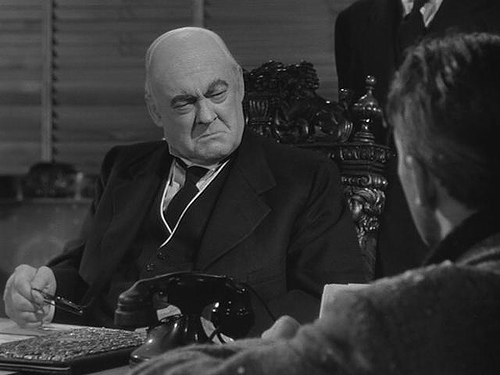
The Potter Factor: is 20% too much?
David Sokol was widely believed to be the anointed successor to billionaire Warren Buffett at the helm of Berkshire Hathaway Inc. until he resigned unexpectedly, following shocking revelations about his personal stock trading. Clever Sokol! He purchased ten million dollars worth of shares in Lubrizol Corp., a chemical company, then persuaded his boss, Buffett, to acquire it. Buffett agreed, the purchase swelled the values of the stock, and Sokol then sold his shares at a hefty profit, about 3 million dollars.
Sokol lost his job over the transaction, which has tarnished Buffett’s reputation, but he got his money. He appears to have found a neat little loophole in the insider trading prohibitions, which make it illegal for an individual to profit from investments made with the assistance of information that is not generally known. If Sokol knew that Buffett was going to purchase Lurizol and bought the stock to profit from it, he could be headed to jail. Because he made the purchase before he and Buffett discussed the deal, however, he’s only heading to the bank. Galling as it is, most authorities agree that he broke no laws.
Sokol has stated that he did “nothing wrong,” which in the minds and mouths of the unethical, means “I didn’t break the law.” This widespread mindset was at the root of the Wall Street collapse, and has always been the reason why the financial and business sectors cannot be trusted to restrain or police themselves. If a tactic or maneuver is legal and looks like it will be profitable, there are too many business executives and investment professionals who will try it even if it is irresponsible, unfair, damaging to others, greedy or dishonest. If it is legal, these individuals believe, then it isn’t wrong. People who think this way are dangerous, and they exist in all professions and fields.
How many high-ranking business executives still think like this, after all the reforms and solemn words about public trust and ethical organizational culture? The Argyle Executive Forum, a private membership organization made up business execs, polled thousands of its members on the question of whether Sokol’s scheme was unethical, and got more than 800 responses. 77.5% said that Sokol was unethical.
Good news? No, terrible news. 12.2% said the purchases were ethical, and 10.3% “weren’t sure.” Over a fifth of our nation’s top executives don’t know what ethics is.
There is no possible way Sokol’s conduct could be called ethical:
- He betrayed Warren Buffett’s trust for personal gain.
- He used knowledge of his influence with Buffett to gain an unfair investment advantage.
- He persuaded Buffett to buy the chemical company on the pretense that he was doing so because it was a good deal for Berkshire Hathaway, when he was really making the recommendation because of his ownership of the stock.
- He breached his duty of disclosure.
- He took action that he knew would harm the reputations of both Buffett and his company once the truth came out.
He was disloyal, irresponsible, dishonest, failed to relay important information that he was obligated to relay and intentionally created and concealed a serious conflict of interest. Yet 22.5% of the executives polled can’t bring themselves to say this is wrong. Forbes heralded the results as if they were encouraging: “an overwhelming majority” of 77.5% condemned the transaction! Forbes is deluded. 77.5% means that a fifth of the companies in America are managed by ethically-inert leaders and managers, who transmit their unethical instincts and values daily to subordinates, contributing to a company-wide unethical culture that will corrupt thousands of future executives, many of whom will carry their ethical rot to new organizations, and help corrupt them as well.
When 22% of a population has a disease, it is called an epidemic. The acceptance of unethical conduct as business as usual is a disease in the corporate and investment worlds, and now we have a clue as to the extent of it. It is an epidemic, and a deadly one, and it will only get worse if the business community regards being 20% unethical as acceptable.
 Ethics Alarms
I think there is a deeper, important lesson about accountability here. Berkshire Hathaway is successful because Warren Buffet runs it and it is his company. When you have a hired ‘manager’ in control of the company, they have no such motivation to look after the long-term best interests of the company or its employees.
I see this in every McDonald’s I go to. The difference between a corporate store and a franchise store is astounding. You can just walk in, look at the employees and the restaurant and know which one you are in. The sad thing is that the McDonald’s corporation has been buying out the most successful franchises on the fallacy that the reason the franchises do better than the corporate stores is that they are in the best locations! As a result, it is harder and harder to find a decent McDonald’s.
You can’t get good management from someone who is only in it for the money. Is it any wonder that Ford is the only US automaker that didn’t need a bailout?
Good points, Michael. Incentive is a key factor in the running of any successful business. Of course, professional ethics are to any reputable one. In a perfect world, one will complement the other. These, however, are highly imperfect times! You can tell who the unethical ones are when times get tight. They’re the ones who’ll seek to “get their’s” by whatever means they can, casting all friends, partners and reputation out the window in a final bid for Easy Street. The trick is spotting them before they can wreck havoc. But, as Michael says, when a person’s life is tied to that business itself- when he’s more than just a hired hand- then the danger lessens considerably.
Do you think Alan Mulally is “in it” for more than the money?