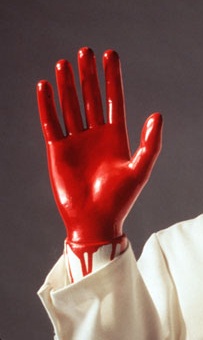
"Now that you've been caught red-handed, there need to be an investigation to determine what color your hand is."
The University of Alberta’s Faculty of Medicine dean, Dr. Philip Baker, delivered a convocation speech to medical students last Friday that included verbatim excerpts from a speech given last year by Harvard professor Atul Gawande to graduates of Stanford University Medical School. Nevertheless, the plagiarizing dean has not been suspended and will remain working “until allegations are investigated in a formal procedure,” University officials announced. “This is somebody’s reputation and we take this very seriously.”
If the University takes it seriously, why hasn’t Baker been fired, or, for that matter, why hasn’t he resigned? He has all but admitted that he stole portions of the speech without attribution…pure, unadulterated plagiarism. He apologized to the students in a letter; he sent another written apology to Gawande. Apologies are appropriate, but the unavoidable fact is that a university professor or administrator cannot engage in the same conduct, an academic cardinal sin, that will get any student expelled.
What exactly is there to investigate? Here is the most quoted duplicate selection from Baker’s speech; you decide: Could this have been an accident? A coincidence?
“Half the words you now routinely use, you did not know existed when you started: words like arterial-blood gas, nasogastric tube, microarray, logistic regression, NDMA receptor, velluvial matrix. OK, I made that last one up. But the velluvial matrix sounds like something you should know about, doesn’t it? And that’s the problem. I will let you in on a little secret. You never stop wondering if there is a velluvial matrix you should know about.”
Baker stole it, and was caught red handed. He’s a disgrace to his school, his profession, and academia, and if he remains in his job, any pretense to integrity the University of Alberta had, has or hopes to have will have evaporated.
Baker, of course, has an obligation to resign. If he does not, however, every second he remains in his post is proof that the University of Alberta regards honesty, diligence and accountability as hollow concepts for teaching, not practice.
 Ethics Alarms
Jack,
I don’t disagree with the main thrust of the article, however, this: “an academic cardinal sin, that will get any student expelled.” is wishful thinking at best. Sad though it may be, any number of Universities (U of H included) have begun backing away from this policy as its seen as too harsh and unforgiving.
Claims of plagiarism used to result in an automatic zero in the class (as it was rightly thought NONE of your work could be trusted) and a hearing to determine whether suspension or expulsion was necessary. Now, however, there have been cases when it results in only a zero on the assignment itself and a note on your permanent record. Like it or not, we no longer hold deans to a very high standard because so much less are expected from the students.
People forget that sometimes zero tolerance works ..
-Neil
Let me echo what Neil says. In 30+ years in academe, I have literally never seen a student expelled for a first offense of cheating or plagiarism. The default position is gravitating away from failing the course toward a zero on the assignment, but there are sometimes pressures from above even to allow the student to re-write the paper or re-take the test with little if any actual penalty. I remember a case a few years ago in which the offending girl’s father begged our department chair (this wasn’t at my current institution) to punish her, and he still let her re-write the paper in question. Moreover, the logistical red tape associated with filing a report ends up punishing the faculty member more than the student.
As you may know, at many universities, there are more than one kind of failing grade. At my school, for example, there’s a QF for students who simply stop going to class. This is used by the financial aid office (and, I presume, federal authorities) to determine eligibility for financial aid: there’s a difference between the student who can’t do math and the one whose “job” is to get a “difference check” from the government. I can’t remember which university it was that began a policy a couple of years ago to create a similar grade for students who fail because of academic dishonesty. I tried to get our university to do something similar: couldn’t even get a hearing in the Faculty Senate.
Clearly, I’m out of touch….and a bit biased by law school, where plagiarism still will get you kicked out if it is clear and egregious. And I haven’t checked on my college lately—again, we were told that cheating would get us expelled. You may recall that Ted Kennedy was expelled from my alma mater for having someone else take a test for him.
You can be forgiven for this one.Alot of the plagiarism codes still look tough, it’s the enforcement that’s not there.
I can remember grading for a Calc class and coming upon two papers that were identical. When I say identical, I mean each number and sign was in exactly the same spot, and the assignments were multiple pages of multiple columns on a page. Also, they were both in purple ink in the same handwriting, and they were turned in next to each other. So stupid.
The teacher’s official policy for submitting another work (and allowing your work to be submitted as someone else’s) was failure. These 2 people were punished with simply a zero on one assignment.