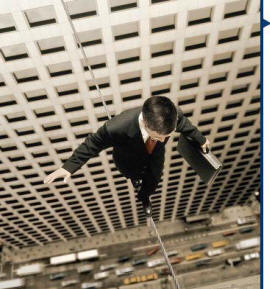
"Anything to make you happy, dear!"
Thalia Rodriguez seems to have decided to push her fiance, William Mancera, to conquer his lifetime fear of heights by going on a carnival bungee ride with her. Predictably, the plan went horribly wrong when the Irving Texas love bird got stuck 50 feet off the ground for three hours because cables got tangled. Dallas firefighters used an aerial ladder truck to help get the couple safely to the ground.
Mancera said afterwards, reasonably, that he is “never riding anything of that sort ever again.” Not so reasonably, he says the ordeal has brought him and his fiancée closer together, and their February wedding is still on.
Good luck with that, William. Using a lover’s affection and trust to cause him to do something that makes him uncomfortable is emotional blackmail, an abuse of power, and a breach of that trust. If she’ll make William do something that terrifies him now, I dread what she’ll coerce him into doing after they are married. “If you love me, you’ll try bungee jumping/sky-diving/cave exploring/smack-smoking/whatever it is that you hate to do or object to most!“, or any of its equivalents, requires a complete dearth of respect for one’s partner’s autonomy. This would have been true of Thalia even if the bungee ride had been a barrel full of fun.
The AP news reports on this story are ambiguous, suggesting without showing that Thalia’s “well-meaning” efforts to help William get over his fear of heights were behind the fiasco. (I am not the only one who has read the story this way.) Several readers have taken umbrage at what they perceive as my unfair presumption that Thalia was the instigator of the situation: maybe, they say, William was the one who wanted to get over his fear of heights and she was just being supportive.
It’s a legitimate point, and if this was indeed what happened, I apologize, Thalia. As someone who detests heights and amusement park rides employing them, however, I find that alternate scenario unlikely. Many people have tried to get me on roller coasters and Ferris Wheels in a “well-meaning” effort to help me conquer a fear that hardly diminishes my enjoyment of life one bit. I, on the other hand, have never suddenly said to a loved one, “Would you help me as I ride on an attraction that I know I will hate in order to conquer the reason I hate it?” I still interpret the scenario as the more common case of someone using affection to “change” a partner “for his own good.” My observation regarding that scenario stands, even if it turns out that Thalia was an innocent, well-meaning bystander, maligned by Ethics Alarms.
If Thalia was the instigator, I’m hoping that this near catastrophe teaches her, and us, a lesson, because if it doesn’t, my advice to William would be to avoid heights….and Thalia…in the future.
 Ethics Alarms
I could see pushing someone too far out of their comfort zone. But he got on the attraction, so how far from his comfort zone could it have been? An honest person would say that we all have a fear of heights and that some people simply manage it better than others.
I think she’d be a dunce if she had to resort to A-Team / Mr. T tactics that involved drugging him and throwing him on a plane against his will.
I hate snakes. If you wanted me to hold a snake, I’d say no. If you threw a snake on me or let it slither onto me, you’d have crossed a line. However, if you made your case and I acquiesced, I would say that is my decision, and you would not be a dunce.
I’m with Tim. I don’t see enough information to blame the fiance.
People pushing their loved ones to overcome their fears isn’t exactly odd behavior. Would you have the same take if the ride had gone smoothly? What if the underlying fear was agoraphobia? Arachnophobia? Ailurophobia? Friggatriskaidekaphobia?
maybe its because I’m terrified of heights myself, and maybe what I see as res ipsa loquitur is not really so obvious. If he’s terrified of heights, and someone he cares about knows it, they shouldn’t suggest something like this. It doesn’t have to be forced on him to be coercion I had an English mastiff with bad ankles (they often have arthritis) and the dear dog wouldn’t run for anyone, unless I threw a ball. My wife pointed out that I shouldn’t take the fact that she chased to ball to mean she enjoyed it or wasn’t in pain—she was doing it because she thought it made me happy.
I stopped throwing the ball..
T-I did say that even if the ride had turned out swimmingly, it was still wrong to suggest that an apparent acrophobic go on it.
I am also afraid of heights, and had a girl friend who made me feel like weenie because I wouldn’t go with her on the roller coaster. I was tempted, even though I knew it would make me sick. I didn’t go. But that may just mean that Robert was a weenie. It;s still blackmail.
Neither the dog example or roller coaster example apply. The dog had a rational desire not to run (pain). You have a rational reason not to ride rollercoasters (sickness).
As for personal experiences, I have gotten over some phobias. In my phobicdays, I hated the thought of facing them, but I did recognize that attempts to get me to face my fears were not emotional blackmail. My friends and family thought they were helping. Turns out, they were.
I might even be willing to say that enabling irrational fears is unethical.
Oh, do! That will be a great argument to have!
I think fear of heights is a very rational fear—see the post about the falling Ranger fan.
Fear of heights is not a rational fear. Fear of accelerating into a hard object under the force of gravity is a rational fear.
http://www.grandcanyonskywalk.com/
Quick hypothesis: I think almost all irrational fears come from some rational danger, pain or something else.
My cleaning lady was ailurophobic for a while after being attacked by a devil cat. (20 lbs of pure evil muscle. This cat eats Dog chewtoys. Eats them!). Did it make sense to then fear my completely pudgy, completely passive 10 lb cat…which she already knew?
Everything is caused by something else. If you go back far enough, I’m sure one of the causes is rational. So what? Should we get into a discussion of free will here?
Free Will or Chaos Theory? Sometimes I think they are the same thing.
Considering that both lead to determinism, I’m cool with that.
I have to say: I’m with Tim and TGT on this one. It is entirely possible that he wanted to conquer his fear, and was open to some way to do so–neither the linked article nor the Ethics Alarms commentary indicate one way or the other.
Thus, the fiance could had simply made this suggestion, and promised to make it easier by being with him the whole time.
–Dwayne
Dwayne—you, Tim and tgt could well be right. I’m on the extreme side when it comes to true autonomy. We can be talked into all sorts of things that go against our essence under the influence of sex and love. I think it is best to err on the side of avoiding undue influence. I acknowledge that my position is rather unforgiving.
I would have appended this to tgt’s comment, but I didn’t want him to have the satisfaction of squeezing a concession out of me….
The sweet smell of concessions. Can the concession by a Chicago hotdog? Maybe a giant smoked turkey leg would be better.
What is part of a person’s “essence?” Fear of heights, clearly. What about homophobia? Political beliefs? Religious beliefs? I doubt you define yourself by the former, but the last couple are pretty standard. Your definition seems to mean that I shouldn’t try to convince my family to support liberal libertarian policies, but it’s perfectly okay for me to work on you and SMP.
I just don’t think your position can be rationally supported. We do have to be careful that we don’t accidental use emotional attachments to manipulate people, but there’s an equal responsibility for our loved ones to call us out if we fail to do so.
Oh, crap, I agree with you here too. But I’m not talking about opinions and biases. Opinions and biases are made to be changed, and cognitive dissonance works whether we . want it to or not—we tend to be drawn toward the opinions of those we like and admire, regardless of the independent merits of the opinion. Manipulating fears, loves, passions and loyalties, however, can cross into disrespect and abuse of power. Persuasion is one thing; coercion is something else.
Since when is fear of heights not a bias?
I understand the noncoercive inputs we irrationally base our ideas on and I generally agreee on the persuasion vs coercion idea, but I’m a little more lenient in practice. Minor coercion to get someone to face their irrational beliefs is alot different than coercion to get someone to behave unethically or against their greater interests.
Further, I’d like you to point out the coercion used by Thalia Rodriguez that qualified her for a “Dunce” award. We only know that she suggested the amusement ride and promised to be there with him. We don’t know that he initially refused and we don’t know how severe his fear of heights is. She may well be a Dunce, but you didn’t prove it with the available information. How about a retraction or a simple admission that she’s not a dunce?
Tim…not quite a retraction or an apology, but I have revised the post to reflect your concerns. I still would bet my head that my interpretation is what happened, but the accounts are all vague, and it is unfair to state the Thalia was clearly guilty of pushing William to bungee jump. But still think that’s what happened.