 (For Memorial Ethics, Part Two, go here.)
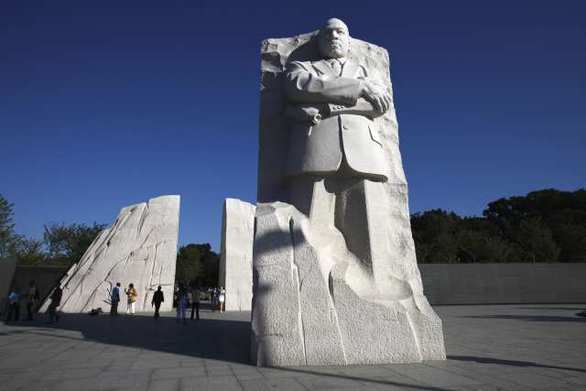
[It is almost forgotten now, but when the design of the new Martin Luther King Jr. Memorial was chosen back in 2007, there was much unhappiness in the black community. A Chinese artist was chosen to design the memorial, and this raised issues both ethical and ironic. Now that the memorial is completed (the planned dedication this week has been postponed due to Hurricane Irene), it seems clear that critics aimed their objections in the wrong direction: the problem wasn’t the designer, but the design, an imposing piece of classic Socialist-Worker art that would look at home in Red Square. But, hey, there’s lots of bad art in Washington, covering an abundance of styles: the large bust of JFK in the Kennedy Center makes it look like President Kennedy was made out of chewing gum. At least some bad Communist statuary is a change of pace.
The debate over the choice of artist was interesting, and is even more so in retrospect. It is worth pondering as the new monument joins the National Mall. Here is my article on the matter, slightly edited from the original published on The Ethics Scoreboard in 2007, followed by a response from the artist selection’s most vocal critic.]
An intense controversy surrounds the choice of a statue’s sculptor, specifically the Chinese artist whose design was selected by the Martin Luther King Jr. National Memorial Project Foundation to become a major monument to the martyred civil rights leader in Washington, D.C.
The Washington Post reports that some critics are outraged that the creator of King’s memorial isn’t an African-American, or at least an American. Others are angry that the artist is a citizen of communist China. A man named Gilbert Young has launched a website to provide a forum for those who want the choice of sculptor to be overturned.
In its defense, the Foundation points out that the commission that selected prominent Chinese artist Lei Yixin was predominantly made up of African-Americans, and that Lei is working closely with painter Jon Onye Lockard and sculptor Ed Hamilton, both of whom are African-American. But Young and his many allies are not mollified. His passionate statement on his website is unequivocal:
“… I’m willing to yell at the top of my lungs my disgust at the decision made by the King Memorial Foundation to choose a Chinese artist to sculpt the image of Martin Luther King Jr., for the first ever national memorial to an African American man. … Among those pretending to be in charge are obviously too many who can not see the travesty of justice in having the “national treasure of China,” Lei Yixin–that’s Communist China–sculpt the center piece of the most important African American monument, in recognition of the most important African American movement in the history of the United States. A movement that never could have taken place in China. I am appalled.
“Is it that…the Memorial Foundation Leadership could not find one African American sculptor good enough to create a likeness of King? That’s crazy…There is not ONE national memorial, not ONE monument to a leader or historical event in China, Russia, France, Italy, India, Germany…that has the name of an African American artist engraved in its base. It’s probably not that they don’t like us or appreciate our abilities. It’s that a commission of such importance is a legacy for a country and its countrymen. Why should the King Monument be any different?
“Here was the opportunity for a national monument to a Black man in Washington D.C., to be created, developed, designed, and executed by the best that African America arts and culture and development has to offer, a testament to all our own achievements as Black people who benefited from Martin Luther King, Jr. and the Civil Rights Movement…Yet once again our worth is kicked to the curb.”
In analyzing ethical quandaries, usually the most useful threshold question is “What is really going on here?” It is tempting to conclude that what’s going on in this instance is veiled racism…and maybe not even veiled. Young’s website’s name, “kingisours” (King is ours”) is certainly strong evidence of this. Martin Luther King’s life’s mission was to end bigotry and discrimination, and to ensure that the culture of America, and not merely the nation’s Constitution, embraced the principle that every individual should be judged on his or her qualities as a human being, not by race, skin color, or ethnicity. King was black, but he certainly doesn’t “belong” to blacks, any more than Gandhi and Mother Theresa belong to whites. National monuments in Washington honor the nation’s heroes, not icons of particular interest groups. If what’s going on here is the assertion that only an African-American artist should sculpt an image of an African-American citizen who made major contributions to his country—that an Asian or foreign-born artist cannot—then the ethics verdict is clear and damning. If this is their argument, then Lei’s critics want to defy King’s principles while supposedly honoring them. If there is any revered national figure for whom the race of a sculptor shouldn’t matter, it is Martin Luther King. In fact, it shouldn’t matter for any national figure.
But wait; let us not be hasty. If one goes to Young’s on-line petition, there is this comment by “B. Fargo,” who writes, “It is ludicrous that Dr King’s monument could be built in a country where slave labor is status quo.” Is it “ludicrous?” It is undoubtedly ironic. Still, the artist is not responsible for human rights violations in his country. Do we really want to enforce a formula by which artists are only permitted to make artistic statements that are consistent with their home country’s policies? That doesn’t make sense at all.
All right, then: what about the argument of others on the website that hiring a foreign artist is “outsourcing” an American job overseas? As Young says in his own statement, other nations haven’t been willing to entrust the immortalization of their heroes to African-Americans, so why is the Foundation giving the honor of immortalizing King to a Chinese artist? This objection relies on even weaker ethical logic than the previous one. This is a work of art we are talking about, not a contract to manufacture Mattel toys. All that matters with a work of art is the art itself, not the nationality of the artist or the politics of his or her homeland. The Foundation was wise to leave the increasingly dubious logic of affirmative action out of the design choice, thereby rejecting an approach that would contradict King’s words and legacy.
Young points to the choices of sculptors for monuments in other nations as if the United States should be influenced by practices abroad. The fact that other nations behave a certain way does not constitute an argument that America or Americans should behave the similarly; this is the illicit rationalization “everybody does it” on a grand scale. Many American values and traditions constitute a rejection of the accepted attitudes and values of other nations. Racial equality, in fact, is one of those American values. Young asks why the King Monument should be any different from the monuments in other nations. The answer is, simply, that America is different.
This country has never been especially concerned about the nationality or race of those who design our monuments. One of the most prominent statues of George Washington stands in the Virginia State Capitol in Richmond and has a replica in downtown Washington D.C. It was created by French sculptor Jean-Antoine Houdon. Another native of France, Frédéric-Auguste Bartholdi, designed the most celebrated American statue of all, the Statue of Liberty. Among the most visited and most effective memorials in Washington is the Viet Nam Memorial, designed by American artist Maya Lin. Not only is she Asian and of Chinese ancestry, her aunt was Lin Huiyin, a famous Red Chinese architect. Is it “ludicrous” that this memorial to slain American soldiers was designed by an artist whose recent ancestors came from the very same nation that made the weapons that killed them?
No. It is just American.
One can sympathize with Young and others who wish the King monument could be crafted by a member of the oppressed group he fought for. King doesn’t “belong” to African-Americans, but he was an African-American, and the connection felt by African-Americans toward him and his achievements is uniquely personal. But it isn’t unusual for racism and bias to be fueled by genuine emotions and personal experience. All the other arguments against Lei designing the memorial have arisen to bolster the basic racist premise that only an African-American should sculpt Dr. King’s statue. The argument is unfair to Lei and unworthy of King.*
____________________________
*Here is the thoughtful reply to my piece, sent to me by Mr. Young:
“It’s always a good practice to know the facts about a matter before attempting to discuss it. That you would boil the King Monument controversy down to the notion that we are racist without knowing the facts is a mistake. There’s more to it than that.
“Allow me to introduce myself. I’m a 66 year old African American artist. My work is considered “socially conscious”. For 50 years I’ve created work that glorifies the beauty and culture of African American people. My work is in movies and on TV. I’m commissioned by organizations nationwide to create commemorative works including the Salute to Greatness Award presented by the King Center here in Atlanta.
“I’m old enough to have witnessed Jim Crow, and I survived it. If you remember history you know African Americans are not native to this country. We’re not immigrants. We didn’t choose to come here. Our ancestors were brought by force. Up until this time our most indelible footprint in history has been that we are descendents of survivors of the horrendous institution known as American Slavery. Our names appear sporadically in history books, and every February our accomplishments are condensed into brief sentences for PR purposes.
“That changed 8 years ago with the announcement that Dr. Martin Luther King, Jr.–an African American–would be immortalized in a national monument in the capitol of the most powerful nation on this planet. In my mind, that meant African American History would be important to the world 365 days a year.
“Through misguidance, ignorance and apathy, it was decided by a few to hand the most incredible honor of sculpting the centerpiece of the monument to an artist famous for his statues of the mass murderer Mao Tse Tung from Chinese granite quarried using slave labor. Workers are not even provided proper masks to keep killing silica dust from their lungs. No granite company in the USA was allowed to bid on this project before it was outsourced to China.
“Your ethics asks, do we punish the artist for what his government does? Take into consideration that Yixin receives a stipend from the government, that he is listed as a “treasure” of the PRC. Do you believe someone who disagrees with the politics of the PRC would receive such favor? Would he be allowed the highest honor of sculpting Mao if he was not “of the body”? Then how could someone who upholds and represents such a government consider sculpting King an honor?
“In case you haven’t read or heard, Yixin did not win a competition. The Los Angeles Times reports him saying that he was napping in the grass when committee members found him. He had been recommended to them by his peers. The members asked if he would sculpt the monument without even seeing his work. Yixin said he did not know how big a project he’d agreed to work on until he saw the plans. ‘This is a great compliment to Chinese artists,’ said Yixin. What you may not know is that Yixin was originally hired as a subcontractor. A black artist, Ed Dwight, created the original models for the monument and Yixin was hired to take the models from 12 clay to 28 foot granite. When Yixin’s model was presented, Dwight wrote a 13 page critique, and the Foundation kicked him to the curb. Their excuse? ‘Artistic differences.’
“Dwight’s explanation? A donation from the People’s Republic of China if their artist was used.
“Remember this: King didn’t die. He was murdered. He was assassinated for leading a protest against injustices toward “Negro” garbage collectors. It’s true his hope was that someday black people would have the same opportunities as everyone else. He wanted us to go to school together, attend the same churches, get the same pay for the same jobs. Yet here is our very first opportunity to display our culture and heritage in the FIRST monument to an African American man (will there be another?)and we’re being told we’re still not good enough. As far as the Foundation is concerned there’s nothing wrong with the monument being ‘Made In China.’ They like to quote passages about colors of skin and brotherhood. There were other quotes from Dr. King: ‘Where Do We Go from Here? First, we must massively assert our dignity and worth. We must stand up amidst a system that still oppresses us and develop an unassailable and majestic sense of value. We must no longer be ashamed of being black.’
“African American people must be allowed to take the lead in this chance to honor our beloved hero. WE care that someone who sculpted memorials to a murderer has been given the honor of sculpting King. We WON’T allow someone who knows nothing about the Civil Rights Movement and nothing about what King stood for to have his named carved into Chinese granite in a monument to an African American & American national hero.
“Ethically, it just ain’t right.”
 Ethics Alarms
The problem isnt that it was “out sourced” but they had hired Ed Dwight and then fired him for this hack. Look at Ed Dwight’s work and compare it to the piece of garbage they erected on the mall. Ed Dwight’s work is beaming with a vitality and life that is missing in the MLK statue on the mall.
And yes Lei Yixin should not have been hired to perform this work because of his country’s use of slave labor. And also when he came here to erect it. It was supposed to be erected by workers hired here but instead they allowed him to bring workers from China to erect it.
The whole thing is so disgusting I want to spit. That one of the greatest Americans this country has ever had now has a horrible memorial in his honor disgusts me.
I dislike the current design too, but I think that’s distinct from hiring the artist.Should we have rejected Kurt Weil’s music during the 40’s because his country was killing Jews?
No becuase he fled Germany in the early 30’s and was denounced by the Nazi goverment and was a victim of the goverment.
Lei Yixin is an employee of the state and enjoys the fruit of the countrys slave labor.
You changed the criteria—you said that Lei Yixin should be disqualified for what his country did. So an artist has to move out of his country for us to accept his art on its own terms? What about Prokofiev? He scored propaganda films for Stalin, but just wanted to be allowed to compose. Did he have to defect for us to respect him as an artist?
Okay, let’s go with that idea.
Leni Riefenstahl was a brilliant documentary film-maker whose works glorified the Nazi Reich. Would she be the appropriate artist to engage to make a documentary about, say, Anne Franke?
Dr. King won the Nobel Peace Prize.
The Chinese government, which pays and praises Lei Yixin for his artistic works, has imprisoned Nobel Peace Prize winner Liu Xiaobo.
Lei Yixin has never denounced that crime, yet he and the Memorial Foundation believe that he is eminently qualified to sculpt the image of Dr. King, who if he were Chinese, would be in jail as well.
A brilliant documentary maker would make a brilliant documentary about Anne Frank. That’s all you need to know. Sure, she’d be an appropriate choice. Is a a lawyer who represents a serial child killer an appropriate attorney trying to seek wrongful death damages for a dead child? Sure. Was Nazi Werner Von Braun an appropriate person to help the US win the war and launch its space program? Yes. Race, political views and past clients should not be factors in choices when the issue is who will get the job done most effectively..
Riefenstahl is a great example.
Sorry I wasnt clear. Lei Yixin should be disqualified becuase he is envolved personally in profiting at the expense of slave labor.
You are also talking about people from the past , not the here and now.
And we are not talking about respecting him as an artists, come on youve admited its bad, but instead should we pay someone for his work when his work utilizes slaves?
Back to Chinese slave labor. And the other question: To whom is Martin Luther King an American hero? Not just black Americans, I am sure. Few (black and white) would disagree that he helped change the course of America, and richly deserves a memorial on the National Mall.
But I did not know that the original design was done in fact by an American (black or white is not my issue), and that some committee decides by fiat to choose a Chinese Communist who turned that original design into a piece of Socialist art is extremely troubling.
It’s not Socialist art. Socialism has no set artistic style, and has little to do with Communism. It’s Stalinist art.
Someone wrote ttat MLK had been encased in carbonite, and now I can’t see the sculpture without laughing. It does look ready to be hung on Jabba’s wall.
It’s ugly – no matter who designed it. Standing in front of it you look up into his nostrils–some inspiration. I see nothing black or American in it–and isn’t that what he was?
Yeah, it pretty much comes off as “Dr. Mao-tin Luther King”.
Can an artist who is commissioned to capture the soul and the spirit of the subject he sculpts truly achieve that objective if he is an uncomplaining and well-paid servant of a regime that despises and persecutes men and women like Dr. King?
Is the artist whose statue of the criminally inhumane monster, Mao Zedong, has won the acclamation of that tyrant’s brutal successors really the right artist to be awarded the honor of sculpting Dr. King’s image?
Will a memorial to Dr. King that is carved by an artist who approves of tyranny and constructed with materials prepared by subjugated and oppressed people be a lasting honor or a permanent insult to his memory?
Harry Johnson, President of the MLK Memorial Project Foundation, has said, “When you go out and see the memorial itself and see Dr. King standing there, a tear may form up in your eye — your heart may flutter a little bit.”
What would Dr. King say? I have no doubt that there would be tears in his eyes and sickness in his heart for the millions of murdered victims of Chinese Communist tyranny and for all those Chinese human rights activists who are rotting away in jails built for them by Lei Yixin’s Communist Party buddies.
Real artists in China, like Ai Weiwei, are in jail or in hiding. Lei Yixin has no such problems. That alone is enough to disqualify him as an artist, but I’m sure he could still be one helluva lawyer.
“Can an artist who is commissioned to capture the soul and the spirit of the subject he sculpts truly achieve that objective if he is an uncomplaining and well-paid servant of a regime that despises and persecutes men and women like Dr. King?”
I don’t see why not. Character and artistic genius are not especially correlated. Elton John was well-paid to perform at Rush Limbaugh’s wedding. Does that mean he can’t write a good song about Princess Diana?
“Is the artist whose statue of the criminally inhumane monster, Mao Zedong, has won the acclamation of that tyrant’s brutal successors really the right artist to be awarded the honor of sculpting Dr. King’s image?”
Why not? Howard Hawks directed “The Thing’ and “Bringing Up Baby.” Why is versatility suspicious?
“Will a memorial to Dr. King that is carved by an artist who approves of tyranny and constructed with materials prepared by subjugated and oppressed people be a lasting honor or a permanent insult to his memory?”
Do you know anything about the man who designed the Lincoln Memorial? I don’t. He could be a cannibal for all I know. Ultimately it is the art not the artist, that matters. Richard Rodgers wrote beautiful love songs, and was a cold-hearted SOB. Does it matter?
“Harry Johnson, President of the MLK Memorial Project Foundation, has said, “When you go out and see the memorial itself and see Dr. King standing there, a tear may form up in your eye — your heart may flutter a little bit.” What would Dr. King say? I have no doubt that there would be tears in his eyes and sickness in his heart for the millions of murdered victims of Chinese Communist tyranny and for all those Chinese human rights activists who are rotting away in jails built for them by Lei Yixin’s Communist Party buddies.”
It doesn’t matter what King would say—the memorial isn’t for him, but for the people who are alive. I’m sure Lincoln would hate his memorial. So what?
“I have a dream that my four little children will one day live in a nation where they will not be judged by the color of their skin but by the content of their character…” this should have been put on his memorial!
And may I respectfully add, “Duh.”