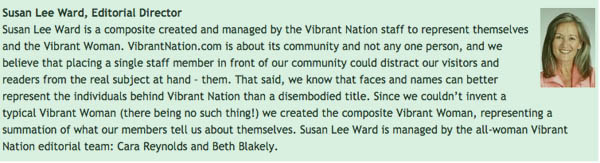
 The above staff bio is featured on VibrantNation.com, a website styled as “the leading online community for Baby Boomer women – the place where they connect and support each other on issues unique to life after 50.” The “composite staff member” known as Susan Lee Ward even has her by-line on some articles.
Your Ethics Quiz Question:
Is featuring an imaginary editor on a website unethical if it is fully disclosed? Or is it just batty?
The problem is one that has come up before: does disclosing something as an untruth cleanse it of its unethical characteristics? After all, there is no Susan Lee Ward, yet she is listed as an editor. That picture can’t possibly be her, because there is no “her.” Anyone who doesn’t read staff bios will in fact be deceived–and how often do you read website staff bios? Heck, people still write me angry e-mails saying that they don’t know who is writing all these ethics essays.
As usual, this comes down to a matter of trust. Are we less likely to trust a website that posts the bio and picture of a staff member who doesn’t exist? Or are we more likely to trust a website that tells us that it has invented an editor? OR are we less likely to trust a website that says it has invented a website for new-agey reasons that don’t really make much sense? When a publication uses fake editors, I wonder who or what they are trying to hide.
My reluctant call on this one: I don’t distrust the site because it has invented an editor. It has made a good faith effort to be transparent.
I distrust the site because inventing an editor for the stated reasons tells me that the real staff is insane.
[Thanks to Health News Review for finding this.]
 Ethics Alarms
Do you also distrust Mark Twain, Lewis Carroll, George Orwell, Dr. Seuss (he even calls himself a doctor!) & George Eliot (she even implies she’s a man!).
1) Yes. For the same reason that I don’t like anonymous web posts and fake screen names. Voltaire and George Elliot I’ll cut some slack. They had issues.
2) They were, however REAL. I really don’t trust Richard Bachmann and Allan Smithy.
How do you feel about abridgments of the work of S. Morgenstern?
A pseudonym is a much different situation than a conglomerate person. While I don’t post under my real name, I still post as me. If they want one account that is handled by a number of people, they should create a clearly representative account…like with the name Editorial Staff and the picture of a horrible headline.
What if people know it is a conglomerate person? The Economist generally publishes without a byline, but they have some columns like Lexington, Bagehot and Schumpeter that everyone knows are written by different people. This makes it possible to have an opinion column without having journalists who are trying to create their own distinct voice such that you can pretty much always guess what they will say before you read the article.
Also, what about books written by more than one author? Is it unethical to not indicate which chapters are written by each other? If not, how is this different than choosing a conglomerate person like Nicolas Bourbaki to be the author?
Also, how is using a conglomerate author different than using a brand name? Emily Post probably doesn’t write about etiquette anymore. Her name is basically a brand name. Similarly, if you buy a car from, say, Chrysler, it probably wasn’t made or designed by Walter Chysler. Should Chysler change its name to Marchionne?
What if people know it is a conglomerate person?
Then it’s fine. Full stop. Giving them a name, title, and photo precludes this, even with the bio.
Also, what about books written by more than one author? Is it unethical to not indicate which chapters are written by each other? If not, how is this different than choosing a conglomerate person like Nicolas Bourbaki to be the author?
Books by multiple authors are fine, so long as they list all the authors. If it’s a collection of individual sections, they should all be noted with the author (or psuedonym), but if the book is intended to be one voiced, just listing all the authors is fine. The key is that the contributors are clear. Listing the Author as Bourbaki is not clear.
Also, how is using a conglomerate author different than using a brand name? Emily Post probably doesn’t write about etiquette anymore. Her name is basically a brand name. Similarly, if you buy a car from, say, Chrysler, it probably wasn’t made or designed by Walter Chysler. Should Chysler change its name to Marchionne?
No confusion: no problem. Has Emily Post slipped into the main stream? If it’s clear that Emily Post means Emily Post Institute, then it’s fine. If it’s not clear, then it’s not. With Chrysler, it’s clear.
This reminds me of the mystery novels written by “Richard Castle”, who is in fact a fictional character–a mystery writer–on a TV show. The books don’t tell you who the real-person author is, and even go so far as to put a picture of actor Nathan Fillion on the back cover.
–Dwayne
P.S. Ethics Quiz: If the fictional character Richard Castle was seen on television promising never to kill an unarmed person, would the University of Wisconsin ban his books?
Unethical. Par for the course in marketting and productizing, but that doesn’t save them.
And it just occurred to me . . . WHOSE PICTURE IS THAT?
If you’re trying to be honest about SLW not being a real person, showing a woman’s picture next to the “bio” doesn’t exactly push the scales in that direction.
–Dwayne
Yes, the photo is the tipping point for me.
I almost snorted tea out my nose! As I read their explanation, I was envisioning some group of 8-10 progressive women who couldn’t choose an editor because it would set up a patriarchal power dynamic or some such reason. Then I saw that it was just TWO women. Is the composite editor a composite of the two of them or is it a fictional editor with stereotypical opinions as the editors see fit? If it was the former, I don’t see why they weren’t co-editors. If it is the latter, I do see a problem with having a fictional and therefore unaccountable editor (don’t blame us for that article, the editor is a composite of people who aren’t the authors). I could see a humor site doing this for comic affect, but this is either silly, disturbing, or cowardly. What happens when someone reprints or links to a made-up opinion of this editor (something outrageous) and the opinion gets attached to the face of whoever-that-woman-is because the linking site doesn’t know about their unique ‘editor’?
Let me take it a step further. It’s silly, disturbing and cowardly, yes – but more than those, it’s chickenshit and bespeaks real problems with market and brand. If these two gals* have so little confidence in their message and their site that they can’t own up to signing their own work, then Vibrant Nation will fail. Simple as that.
*Have my doubts that Cara Reynolds and Beth Blakeley exist themselves. Or, if they do, suspect that they’re guys.
Deception = the thumbnail photo next to the “who is SLW” explanation = unethical. I don’t trust, and won’t trust, anything posted on the website. Call me “absolutist” in this matter. Suffer.
I’m trying, Jack, really trying here, but I just can’t get too excited about this one. I’ve read your post, of course, and followed the comments carefully. Both make some good points. But…well, look: My first encounter with you was finding, more or less accidentally, Ethics Scoreboard. I knew, at that initial encounter, who you were, or who you said you were, because I read the information you posted about yourself and Pro Ethics. I always read those bios and the like, and don’t trust sites that don’t post them. If the site seems at all “off,” or solicits anything involving money from me, or otherwise might lead me down an alley I regard as uninviting, I try to dig a little deeper. All of it public information, mark you, but I do dig a little. It just seems like common sense to me. It’s the internet. Basically, anybody can post just about anything. Google all manner of random topics and you’ll find sites distributing nothing but stone truth sharing cyberspace with sites spouting tripe, or worse. I can’t, and don’t even try, to check up on everything I encounter. But when the consequences of belief pass a certain threshold—a moving target, to be sure—I take just a little extra time to try and verify. I am always surprised when I find people don’t check out online content—which means I’m surprised a lot—but I tend to regard them in the same way I would regard someone who takes a long walk on a short pier. I take no joy in the result, and hope they come out of it sadder but wiser, but figure that they did bring it on themselves. Likewise, I have no brief to offer for deceivers of various stripes, but too often their victims turn out to have been accomplices, in effect if not intent. Anyway, on the website in question, the consequences of believing that Susan Lee Ward is a real person strike me as being not too problematical. Any advice, etc., offered on such a site should be checked out anyway, if one is planning to act on it. Heck, I’ve done just that where I knew beyond the proverbial shadow of doubt that the person it was attributed to was real. Again, just common sense. Or am I missing something?
You’re severely overestimating the population at large.
Look at news sites reporting that kids are now ALL doing based on someone who hasn’t seen it, but has heard of it.
Look at the people switching from Cain to Newt because Cain’s adultery tars him.
Look at the prevalence of chain letters and hoaxes.
Look at the large majority of Americans who deny unguided evolution.
You’re a critical thinker, so you aren’t fooled, but that doesn’t make the behavior unlikely to fool others.
No, sadly, I’m aware of the instances you cited. I have no brief to offer on behalf of deceivers, even those who deceive without intent. I do say that anyone who comes to grief because they bought into a deception after failing to say “Wait a minute…” and do a little checking has put themselves in the role of being an accomplice in their own deception. There is probably a scale involved here: someone who does some checking but finds nothing wrong because the lie was very carefully constructed certainly would be less complicit, it would seem (to me, anyway). Can we agree on that much?
I agree, but that doesn’t make the deception ethical.
You don’t miss much, Karl. If anything, all you missed is the fact that I found the device less unethical than idiotic. I’m certainly not especially excited about it, as this is occurring on a niche website where, as you suggest, the harm is minimal. But using imaginary people on by-lines and posting pictures of imaginary editors is deception, and the argument that”if you are paying attention you won’t be deceived, so it’s not really a lie” is squarely in David Manning territory, no?
I wasn’t saying that it wasn’t a lie. At least, I hope not. I agree that it is deception—OK, a lie. Also, I did not mean to imply that you were excited over this and, if I did, apologize for it. I do agree that the device is idiotic, as well, but it just strikes me as, well, as about the most minimal amount of deception something can have, and still be in lie territory.
If there are two authors, either both or none should be listed. To create a composite staff member, with a photo no less, is misleading. Writing editorials or other opinion pieces should offer honesty to readers about whose opinion it is. A writer of fiction, however, should be afforded more leeway since what they are writing isn’t fact or opinion based in fact, but is instead a creative expression involving fictional characters.
Yes, all online information should be checked for accuracy. It still doesn’t make it right to spout lies and disinformation. This discussion isn’t saying that lies, distortions, and inaccuracies aren’t published on the internet, the point is that it is unethical. The question is “Is it unethical to write fictional editorial opinions under the byline of a fictional editor?”. The fact that you should check your facts is irrelevant.
I agree with Debbie about admitted fiction writers who make clear what they are doing, what they are publishing, etc. deserving “leeway.” I can agree that anonymity and non-attribution are not automatically unethical. I will never agree that VibrantNation.com content-producers deserve anonymity and no accountability to their website’s audience for all content posted there. Especially not by way of some cutesy-obfuscatory “composite” editor.