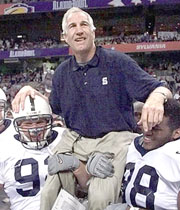
"Well, yes, there was THAT, but what really matters is that he was one hell of an assistant coach!"
The high-profile Sandusky/Paterno/Penn State child molestation scandal has shaken the foundation of the sports world, and in the process, given resolve to past victims of child abuse to identify their molesters. The most recent example is veteran Philadelphia sportswriter Bill Conlin, who abruptly resigned from his job as a columnist for the Philadelphia Daily News when he learned that four adults had come forward to accuse him of molesting them when they were children in the 1970s. This created am immediate crisis for the Baseball Writers Association of America, who had this year bestowed its highest honor on Conlin, the J.G. Spink Award. It never looks good when the person you have declared to represent the best of your profession is revealed as drug-dealer, a serial killer, a foreign agent, or a child molester.
Here’s how the BBWAA dealt with the matter on its website, in this “official statement”:
“Bill Conlin has been a member in good standing of the BBWAA since 1966. The allegations have no bearing on his winning the 2011 J.G. Taylor Spink Award, which was in recognition of his notable career as a baseball writer.”
Nothing in the statement is untrue. Nonetheless, its subtext is that it doesn’t matter whether or not Bill Conlin was a child molester, as long as he was a great baseball writer (he isn’t and wasn’t, but that’s beside the point.) The statement also reflects a warped perspective: four kids, and possibly more, may have been harmed, and the Association’s first thought is, “Gee, we need to make it clear that this isn’t our fault!” First, nobody in their right mind would suggest that, so the impulse is foolish. But the effort to try to partition Conlin’s activities in the sportswriting world from his alleged personal conduct is both pusillanimous and misguided. It is also hypocritical, as the baseball writers vote former players into the Baseball Hall of Fame in Cooperstown, which famously (or infamously, if you are a Barry Bonds of Mark McGwire fan) requires great baseball players to meet a minimum standard of good character for enshrinement. The statement is right in line with the sentiment of the Penn State students who rioted upon learning that Joe Paterno had been fired, saying in essence, “We don’t care that Joe Pa knowingly let a sexual predator loose to menace young boys: he’s a great foot ball coach.
The baseball writers should care that their most recent honoree is accused of molesting young children, and of course they do. The organization wouldn’t have awarded the Spink honor to Conlin after these allegations, would it? If not, then of course the allegations have a bearing on the award.
The effort to separate personal character from professional standing is a mistake, one that damages the culture, and one that is based on denial rather than honesty. Who would you trust more as your banker, lawyer, accountant or Congressman, a child molester, or someone who isn’t a child molester? Whose judgment about anything—politics, law, popular music, baseball—are you more likely to respect, a child molester, or a non-child molester? Respect and trust are essential elements of personal and professional relationships. Every institution in our society should reinforce that fact, not deny it.
Nothing has been proven yet. All the BBWAA had to say was that Bill Conlin, its 2o11 honoree, was recently the object of serious allegations of criminal conduct. The Association is saddened and concerned by this, and wants to express both its sympathy for the alleged victims and its caution that its member and colleague should not be pre-judged before the facts are known.
Because it really does matter if your top member is a child molester.
 Ethics Alarms
“Nothing has been proven yet.” With this in mind i offer the following:
While the BBWAA wishes to draw a line between the activity of writing about baseball and the alleged bad conduct of Mr. Conlin, there is a good chance that Mr. Conlin’s access to the baseball world at a level most do not enjoy will be revealed as a means used to gain access to the victims.
Time will tell.
Bingo!
This is wacker than any plot in the Law & Order franchise.
Question, Jack; is it ethical to call someone a child molester before he has been proven in a court of law to be one? Is innocent until proven guilty no longer an ethical stance? Mr. Conlin may be guilty as h***, but it is exactly this attitude that results in total assumptions of guilt on the word of one person and results in wrongful guilty verdicts in the face of zero evidence. Again, I know nothing about this situation, but it is the same attitude, and my question remains: when it comes to sexual offenses, the rest of the world has abandoned innocent until proven guilty. Have you abandoned it also?
Well, I have several answers. First of all, unless I missed one, I don’t see a single place in the article where I say unequivocally that Conlin is a child molester. I specifically say that nothing is proven. You know, no court has declared that Jerry Sandusky is a child molester either. But he is one: you know it; I know it, Joe Paterno knows it. Non-child molesters don’t get seen by witnesses at least twice molesting kids, and don’t have past victims in double figures suddenly come forward. “Innocent until proven guilty” describes the burden of proof in the American criminal system—it does not over-rule logic and common sense. It is ethical to call O.J. Simpson, John Wilkes Booth and Lee Harvey Oswald murderers, for example. And they were.
The use of alleged as a routine journalistic device is irritating but important, because journalists are stating facts, not conclusions (supposedly). This comes in handy in cases like the Duke lacrosse fiasco, where the rest of the media is up for a public lynching. But we can conclude, fairly, that Herman Cain, for example, has a womanizing problem. Based on my experience, he’s also probably a sexual harasser, but he had the right to know who his accusers were and what he was being accused of.
All that said, I think it is extremely unlikely that Bill Conlin didn’t do something to those kids, because four people don’t suddenly decide, “Hey, let’s pick out this completely innocent man and accuse him of something we’ll never be able to prove!” Conlon’s conduct, suddenly retiring as soon as he learned that the accusations were going to be written about, also bolsters my belief. The BBWAA treated the allegations as meaningful, meaning that from that organization’s standpoint, it was dealing with the situation where a prominent figure connected with the organization has done something wrong. If not, why make any statement at all?
I wrote:
“The baseball writers should care that their most recent honoree is accused of molesting young children, and of course they do. The organization wouldn’t have awarded the Spink honor to Conlin after these allegations, would it? If not, then of course the allegations have a bearing on the award.
The effort to separate personal character from professional standing is a mistake, one that damages the culture, and one that is based on denial rather than honesty. Who would you trust more as your banker, lawyer, accountant or Congressman, a child molester, or someone who isn’t a child molester? Whose judgment about anything—politics, law, popular music, baseball—are you more likely to respect, a child molester, or a non-child molester? Respect and trust are essential elements of personal and professional relationships. Every institution in our society should reinforce that fact, not deny it.
Nothing has been proven yet….”
Nobody can read that and come away with the idea that Conlin has been proven to be a child molester. So I really don’t know what the basis of your complaint is.
Bakersfield, California
One monstrous aberration does not a standard make. This was an example of unethical and incompetent psychiatric practice. I looked for any evidence that anything like that was involved in Conlin’s case, and have found nothing.
That abberation makes me think twice of such accusations.
I didn’t even know they had an association, let alone one that gives annual awards. Perhaps it could more accurately be called the SPECUA (Society for the Preservation and Encouragement of Cliche Usage in America).
(With apologies to SPEBSQSA.)