Comment of the Day: “The Idiot, the Ex, and the Consequences”

I’ve been remiss in posting “comments of the day” of late; it is not a reflection on comment quality, which has been excellent, but rather on my own distractions. Here is a new one at last, from new commenter Kathryn. It appeals to me because it nails the subtext of the original post, and like most Comments of the Day, takes the original topic to the next stage of analysis. I hope we hear more from her. Here is Kathryn’s Comment of the Day on the post, “The Idiot, the Ex, and the Consequences.”

“I am waiting, perhaps overly optimistically, for culture to catch up with information availability and develop new ways of handling privacy outside of responding to information when it is made public, regardless of the source or context for that information. Everyone says/does something particularly unwise/unwell/without grace during their life. Technology is getting to the point that these moments, rather than being forgotten or a story told among friends, are fairly permanently in the public record. (The Internet is public, whatever Facebook settings attempt to convince you.) Continue reading

The Idiot, the Ex, and the Consequences

Denise Helms, who will probably not look like this the next time you see her if she knows what’s good for her.

My position would usually be this: for an employer to use a privacy setting Facebook post as justification for firing an employee is unfair. That applies to vacation photos of an elementary school teacher holding a beer and looking bleery-eyed at a pub, a Sunday school teacher doing a strip tease at a bachelor party, and political posts of a radical, vulgar or offensive nature. Two factors can change the equation, though. Action may be justified if the posting reasonably calls into question the trustworthiness of the employee in his or her job duties, or if the posting becomes public, subjecting the employer to embarrassment or undermining the employee’s ability to do her job, as in the naked teacher cases.

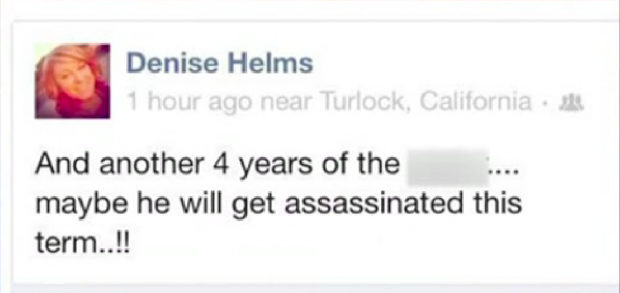
Denise Helms, the idiot referenced in the title above, posted this on her Facebook page, intended only for her closest, presumably most racist or most idiotic friends:

Continue reading

Be Careful What You Wish For Dept.: “Occupy” May Finally Have a Plan, and Sure Enough, It’s Ethically Bats

Oh, yes,THIS is bound to work out well…

The core of my objection to Occupy Wall Street and its progeny was and is that it never had the discipline, cohesion or communications skills to make it clear what the “movement” really wanted to accomplish, other than generally blaming all the world’s ills on the wealthy and successful. This was the reason for its failure, though Occupy fans like to say that it “succeeded” by starting a national dialogue about corporate executive salaries and the growing disparity in income levels between the richest and the poorest Americans—as if that dialogue hadn’t been ongoing long  before the first sign went up in Zuccotti Park.

Now there are signs that the Occupy bitter-enders are hard at work launching a real, substantive effort with a specific goal, albeit and insane one: to bring down the financial system with a “debt strike.” ( In These Times headlined its story about this “You Are Not A Loan.” Pretty clever!) The idea is to refuse to pay back the interest or principal on outstanding debt, and to insist that all loans and interest  be forgiven, since the debt system is inherently corrupt and rigged to transfer wealth from the poor to the rich.

We shouldn’t have to expend a lot of argument on why this is unethical. People, companies and nations in serious debt reach that point because they spend more money than they have. They borrow money promising to repay, agreeing to pay an additional fee, interest, for the privilege of using money that doesn’t belong to them. The vast majority of debt is not amassed by desperate debtors who have to deal with the equivalent of Loan Shark Larry and risk broken legs or death unless they pay unconscionable fees. Most debt comes from wanting something before you can pay for it. While laws are in place to minimize predatory lending and to provide a safety net (in the form of bankruptcy) so people and companies don’t end up destitute and in debtor’s prison, essentially the system, like society itself, exists on trust, the cornerstone of all ethics.  Lenders give their money to trustworthy loan-seekers, and charge higher interest rates to those who they deem less trustworthy. That is fair. Continue reading

Ten More Hollywood Ethics Cures For A Post-Election Hangover (Part 2)

Here are the final five ethics movies, making 25 on the Ethics Alarms list so far. Except for the last, they are a sober batch. I think I now understand why they are at the back end of my list of 25; this group is darker than the first 15 and more tinged with defeat than hope. Their ethics lessons, however, remain inspiring, or if not quite that, thought-provoking:

6. The Insider (1999)

Another true story, one that explores the murky area of whistleblowing and whistleblowers as well as the conflict between the business of journalism and the profession of journalism.

Ethical issues highlighted: confidentiality, whistleblowing, law vs. ethics, sacrifice, courage, media ethics, integrity, honesty, trustworthiness, betrayal

Favorite quote: “You’re in a state of conflict. Here’s how it lays out. If you have vital insider stuff that the American people for their welfare need to know and you feel compelled to disclose it and this violates the agreement – that’s one thing. On the other hand, if you want to honor the agreement, it’s simple. Say nothing. Do nothing. The only guy who can figure this out is you, and that’s you all by yourself.” Lowell Bergman (Al Pacino) Continue reading

Ten More Hollywood Ethics Cures For A Post-Election Hangover (Part I)

A year ago, the combination of the erupting Penn State scandal (and Penn State’s students’ scandalous reaction to it) and our dysfunctional government led me to list my “15 Hollywood Cures…,” my favorite movies dealing with ethics themes that I reflexively turn to when the world’s ethics alarms look frozen and broken. I had to leave some of the best ethics films off that list (Part I is here; Part II is here), and this seems like a good time to remedy that injustice. Here are ten more excellent films to prime our ethics alarms with minimal preaching and maximum entertainment value, bringing the Ethics Alarms movie list to 25. It will get larger, I’m sure:

1. The Magnificent  Seven (196o)

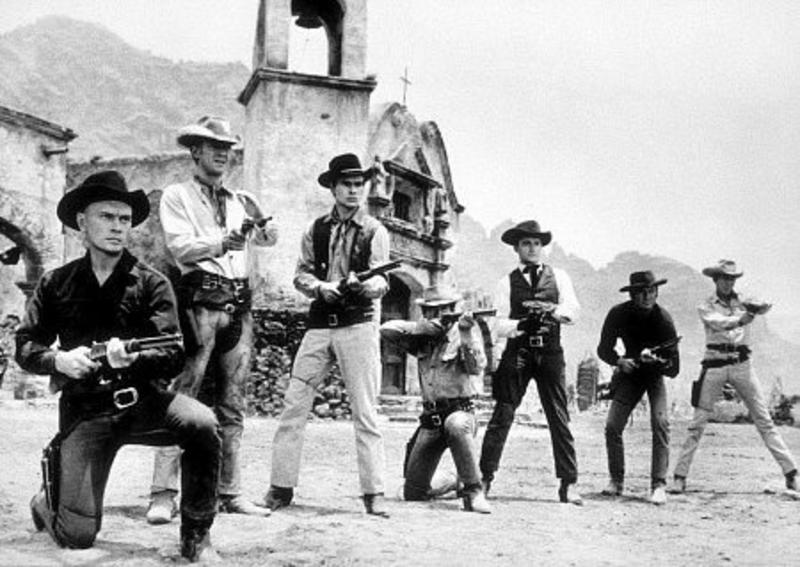
Ethics Bob Stone’s favorite ethics movie, and he has a good case. A group of seven hired gunslingers help an impoverished Mexican town fight off looting bandits, each of the seven for a different reason, facing their own ethical dilemmas and contradictions.

Ethical issues highlightedaltruism, bullying, charity, courage, integrity, teamwork and the importance of prioritizing values.

Favorite quote:

Harry (Brad Dexter): “There comes a time to turn mother’s picture to the wall and get out. The village will be no worse off than it was before we came.”

Chris (Yul Brenner): “You forget one thing — we took a contract.”

Vin (Steve McQueen): “It’s not the kind any court would enforce.”

Chris: “That’s just the kind you’ve got to keep.” Continue reading

Are Employers Ethically Obligated Not To Take Advantage of Women’s Negotiation Choices?


Yet another career for Shatner—coaching female job-seekers.

A recent study of 2500 job seekers indicated that men are far more likely to negotiate salary and benefits in job situations where it has no been stated that the salary is negotiable.

I am not surprised. Running non-profit organizations with limited resources, I always ended up with primarily female staffs because women would accept a lower offer than men with similar qualifications. This meant that the women got the jobs for salaries their male competition turned down. This, in turn, may have effected their salaries for a long time to come, in subsequent jobs. Is this bias?

Clearly not. The negotiations between an employer and potential employee are ethical and the conditions are known. A skilled negotiator (I am personally incompetent at negotiating my own fee; in ProEthics, my partner handles all of that) will get a better deal; a poor or reluctant negotiator will get terms more advantageous to the employer. It is not bias if the most aggressive and effective negotiators happen to be men.  Continue reading

Ethics Train Wreck Watch: The Petraeus-Broadwell Affair

There is too much information awaiting disclosure to do a thorough ethical analysis at this point, but it is already clear beyond question that the David Petraeus-Paula Broadwell scandal is an ethics train wreck, with many more individuals and perhaps institutions involved than the direct participants. Today’s news reports that the adulterous affair prompting the much-respected CIA Director’s sudden resignation was triggered by Broadwell’s  threatening e-mails to another women she suspected of vying for the General’s affections clinches train wreck status. This thing is still rolling.

Other features of the wreck-in-progress: Continue reading

Ethical Quote of the Month: Gen. David Petraeus

“Yesterday afternoon, I went to the White House and asked the President to be allowed, for personal reasons, to resign from my position as D/CIA. After being married for over 37 years, I showed extremely poor judgment by engaging in an extramarital affair. Such behavior is unacceptable, both as a husband and as the leader of an organization such as ours. This afternoon, the President graciously accepted my resignation.”

—-Gen. David H. Petraeus, Director of the Central Intelligence Agency, in a public statement announcing his resignation from that position.

How quaint.

Democrats and Republicans must have felt that they had stumbled into the Way-Back Machine and delivered into England circa. 1904. A high government official resigning over adultery, sex,…”personal misconduct?” How bizarre! Naturally, Sen. Diane Feinstein, who heads the Senate Intelligence Committee,  announced that she would have supported Petraeus if he had chosen to stay. “I wish President Obama had not accepted this resignation, but I understand and respect the decision,” she said in a statement, and described Petraeus’s resignation as an “enormous loss for our nation’s intelligence community and for our country.”

The right way to leave after an affair, apparently, is to try to cover it up, submit to extortion, corrupt others in the process, and only quit when the hideout is surrounded, the hounds are clawing at the door and someone is yelling at you through a bullhorn—you know, like former GOP Sen. John Ensign, who waited two years to resign while his colleagues, like Feinstein, looked the other way. Nobody gets it in Washington—“it” being the ironclad principle that leadership must set the highest example, not the lowest level it can get away with, or the whole system rots below. Nobody, apparently, except the man who just resigned. Continue reading

CREW vs. Issa: Biased Accuser, Guilty Accused

Unethical for Rep. Issa to make it, and unethical that CREW didn’t

The Center for Responsibility and Ethics in Washington does almost half a great job in its stated role as a government ethics watchdog. The supposedly non-partisan group is obviously partisan, since it goes after unethical Republican officials with frequency and relish while targeting unethical Democrats with infrequency and reluctance. CREW’s complaints, however, are almost always well-supported and legitimate. Why almost half a great job? CREW can’t be as effective in its efforts to expose unethical Republican conduct as it needs to be because its obvious bias makes the organization’s motives and judgment less trustworthy and more vulnerable to attack.

We have a perfect example in the news. “The Hill” reports that CREW….

“…has asked the Office of Congressional Ethics to investigate whether Rep. Darrell Issa (R-Calif.) violated rules by producing a video that attacks President Obama. Continue reading

Porn and the NFL: In Search of A Biased Referee

With condoms, what, 2.5 X’s?

55% of California voters decided yesterday to make porn stars wear condoms on the job—good for their health, bad for the health of the state’s booming XXX film industry. It is a reasonable guess that injecting condoms into the proceedings will put California’s porn products at a significant competitive disadvantage, and also a reasonable guess that the voters who enacted the measure couldn’t care less. So legal enterprises may go bust, their employees may lose their careers, and consumers may lose a form of entertainment they crave because of the policy priorities of those who hold all three in low regard, and who are unlikely to apply any kind of balancing standard. It’s safer for all concerned to require condoms, that’s all. Porn companies, porn careers, porn lovers—who cares about what they want? Continue reading