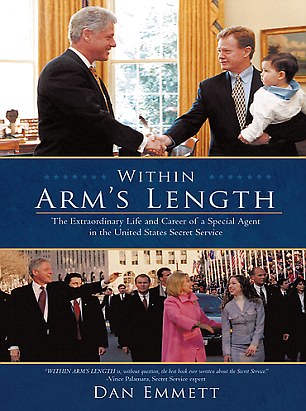
 A despicable former Secret Service agent named Dan Emmett has self-published “Within Arm’s Length,” a tell-all book about his work protecting the Clintons. I’m not going to repeat any of his stories, and nobody should read his book either. This kind of thing is another fever on the way to the complete death of trust and professionalism.
Emmett’s job was to guard the First Family, and as part of his job he saw them all in private and unguarded moments. The Clintons had to trust that his sole objective was to ensure their safety, not to gather juicy material for a book, and they should not have had to worry about whether every stray remark or imagined slight would later find its way to the internet. “Within Arm’s Length” is nothing less than betrayal, and in my view, it falls just short of treason, and perhaps not short at all. Undermining the relationship between the Secret Service and the President of the United States, which this book does, threatens the safety of future Presidents. For agents to do their jobs, they must be trusted to the extent that nothing is withheld from them out of fear that they will disclose it. Emmett proves that such unquestionable trust is unwarranted, and in this sad era where betrayal is rewarded or shrugged off as predictable, probably impossible.
Almost as disturbing as Emmett’s conduct was the blasé response to it by the Secret Service itself. “We do stress to all our employees the importance of not sharing anecdotes about the personal, private moments of the protectees,” said Secret Service spokesman Ed Donovan. “It causes concern because we don’t want to erode the trust that we have with our protectees.” “Causes concern”? They “stress” the “importance” of not abusing the trust of the First Family? Unless this is just Secret Service PR speak for “our agents pledge not to do this, and penalties are appropriately severe. You may not be seeing Mr. Emmett around in the future. Take the cannoli”, I’d say the Service needs to “stress” a bit more effectively.
The reason this is happening now, when we didn’t get Secret Service tell-all books about Teddy Roosevelt having late night snacks of raw buffalo brains, Calvin Coolidge dressing up as Catherine the Great and JFK taking on the entire female cast of “Beach Blanket Bingo” with the help of a vat of Wesson Oil, is that violations of professional standards are rewarded now by an ethically bankrupt media and an irresponsible public. Once upon a time, money-grubbing creeps like Emmett would be shunned and publicly pilloried. Today they are guaranteed of at least a few national TV interviews, and—who knows?—maybe a paid appearance on a cable reality show, like “My Sneaky Fake Protector.”
The media’s unethical attitude is neatly encapsulated by the reaction of The Atlantic’s Ray Gunstini: “…we’d suggest anyone who is important enough to be given Secret Service protection is resigned to the fact that someone, someday is going to write an unflattering book about them.” So the fact that unflattering books are inevitable makes the fact that one comes from someone they trusted with the intimate details of their private lives in the belief that their only interest was protecting them more palatable? This is the level of ethical thinking that flourishes in journalism. “Everybody does it” and “You can’t stop it” passes for justification.
The ethical principle is pretty easy; most first graders understand it. When you promise someone that their secrets are safe with you, it’s wrong to sell them later. When you represent an agency that builds its effectiveness on trust, violating that principle is an institutional betrayal as great as the personal one. When that agency’s job is to protect the leader of the United States…well, there’s a name for that kind of betrayal.
 Ethics Alarms
Jack, just asking, not challenging: do you consider the book, “Dereliction of Duty,” by retired Air Force Lieutenant Colonel Robert B. Patterson, Jr. (circa 2003) a similarly unethical tell-all?
Patterson was a military aide in the Clinton White House who carried the nuclear “football” – the little suitcase with all the launch codes.
I read the book once, years ago. I probably let it feed my confirmation bias more than I should have let it. But then, it WAS a book about Bill Clinton.
Yes, I thought I wrote about it at the time, but maybe not: I can’t find the post.
Suppose the President, or someone else, in the context of “protected” privacy, gave reason to believe that he was going to order the execution of a political enemy? That he was going to have an executive of his own staff “take care of him” for me? In any other context, INCLUDING that of attorney-client privilege, one is REQUIRED to disclose this. Why is it different, especially nearly 20 years after the President has left office? Is the President above the law? (Unless he is “President” Obama, that is?) Lesser matters (and to be honest, I haven’t read this book) then become more or less fair game for revelation, depending on how heinous they are. I do not subscribe to the belief that the private life of a public person is OFF LIMITS, because private life gives evidence of CHARACTER. And character in private life gives evidence of TRUSTWORTHINESS in public life. Just because the previous few dozen Presidents, with some exceptions, have “gotten away” with such dissolute behavior in private life, doesn’t mean that we ought to condone them, a conclusion with which I hope you will agree (having stated that “Everybody does it” is no defense).
I think it’s very reasonable, to use your example as a jumping-in point, to say that a Secret Service agent is sworn to uphold the Constitution of the United States first, and to protect the privacy of his or her charge second. Clear indications of law-breaking should be reported through proper channels and investigated.
If an agent hypothetically reports that he witnessed the President burying a dead body in the Rose Garden, and nothing is ever done about it, THEN he/she has good reason to go to the press in the role of a whistle-blower.
At no point is a tell-all book appropriate.
–Dwayne
I understand what you are saying, and I think there is a fine line between describing events of merely prurient interest, and those which lend themselves to shedding light on such character defects that affect one’s credibility and trustworthiness as a leader, or the potential that he or she could be subject to blackmail. The hidden message here, however, is that somehow no one expects moral leadership in politics anymore. What happened to the concept that one should not do in private what one would be ashamed to admit in public? Is this so archaic a concept that it has no place in the modern world, along with the aphorism that “Every man has his price, except the honest man, and he is a fool, for his price is free”? It’s unfortunate that a dry treatise limited to matters of clear moral deficits of the kind I am discussing, free of sensationalism, but placed in a fact-finding format, wouldn’t sell. Therefore, it’s not clear to me how ELSE we are to discover these very damning character traits I am talking about.
A secondary problem with this is that the book (any book) is published and read after-the-fact. If Emmett’s book hypothetically contained a detailed account of how Clinton attempted to have Rush Limbaugh murdered, the new information doesn’t really do anyone any good in terms of deciding whether or not he’s a good leader. He can’t be impeached NOW.
A book like this doesn’t help anyone assess the character traits of any leader, because if that leader really is bad for the country, “the damage is already done” as they say.
–Dwayne
Better to publish such things anonymously, as “leaks” DURING the Presidency? As in Wiki-leaks? Probably wouldn’t happen when it needs to because the culprit would be found and soon be “leaking” blood (or extradited from a foreign country to serve time in a US jail, until media attention dissipates and he can be “disappeared”). In any case, without the direct infusion of millions to one’s personal bottom line, perhaps it would only happen if you are dealing with that rare individual who just wants to “out” the President on reprehensible details that he or she believes are in the public interest to know. Even when that does happen, as with all the dirt that Obama had on him prior to elections, it is likely to be squelched and ignored by the mainstream media if they happen to favor his politics or his personna. Books like the one discussed turn out only to trivialize the whole issue of Presidential character, since what would have appeared reprehensible, and potentially impeachable behavior DURING Presidency, just becomes more “Oh, that’s just what politicians do” tell-all pulp 20 years later. I still believe that a President should be a moral leader, and that there should be nothing significant they do in private that they should be ashamed about if made public. Now returning to slumber…… Rip Van Winkle.
This is a “Seven Days in May” issue. There is nothing inconsistent in saying that professionals and trusted associates have an absolute obligation to keep confidences, even damaging ones, of those who trust them because of a professional relationship or other relationship of trust, and holding that there are extreme exceptions. A president who is going to commit treason or undermine the Constitution should be stopped, and if a trusted associate is the one to stop him, so be it. But it has to be seen as an exception and a breach of trust that is over-ridden ethically by other, greater considerations, for the greater good.
General character flaws, poor conduct and embarrassing acts don’t and must not qualify for the exception, particular when the motivation, as in Emmett’s case, is personal profit.
Emmett is now an author but lost his honor in the process. Too bad.
What, indeed, ARE the Secret Service regulations concerning these things? Having once held a Top Secret clearance, I’m still liable to prosecution for speaking of certain things I was involved with… though long since retired. Obviously, an agent in this position must not only have such a clearance, but have an oath on record for his specific assignment.
I was a census enumerator. If I told anyone anything that I learned from the people I visited, I go to jail.
I’m working hard on forgetting, and let me tell you, airplane glue was cheaper back in the day.
I was an Army M.P. I used a little beer to delete my data banks!