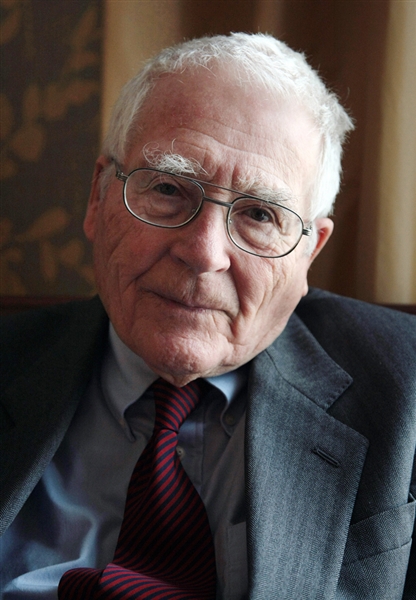
James Lovelock
“The problem is we don’t know what the climate is doing. We thought we knew 20 years ago. That led to some alarmist books – mine included – because it looked clear-cut, but it hasn’t happened. The climate is doing its usual tricks. There’s nothing much really happening yet. We were supposed to be halfway toward a frying world now. The world has not warmed up very much since the millennium. Twelve years is a reasonable time… it (the temperature) has stayed almost constant, whereas it should have been rising — carbon dioxide is rising, no question about that.”
With that admirable statement of candor and humility, renowned earth scientist James Lovelock did what everyone in the climate change debate should be doing, and should have been doing all along. He admitted the uncertainty of climate science, the fallibility of models and projections, and the fact that the extent, speed, predictability and causes of climate change are still far from certain. If other scientists involved in this critical issue had Lovelock’s integrity, perhaps ignorant pundits, journalists and politicians would not feel so justified in calling skeptics about climate change the equivalent of Holocaust deniers.
Lovelock’s comments came in an interview with serial Holocaust denier-comparers MSNBC, which is especially satisfying. He is a legendary environmentalist with impeccable credentials, listed in 2007 by Time magazine as one of 13 “Heroes of the Environment.” He is best known for his “Gaia Theory,” which holds that the Earth’s physical and biological processes are inextricably bound to form a self-regulating system.
Lovelock, who still strongly believes that carbon dioxide levels raise the earth’s temperature, said that as “an independent and a loner,” he was able to say “All right, I made a mistake.” University or government scientists, he suggested, might fear that an admission of a mistake would lead to the loss of funding.
If other scientists involved in climate science were honest and straightforward about the limitations of their projections and research, they would not have forfeited so much of their credibility, appearing to be political and ideological advocates hyping the certainty of their
projections to bolster public policies and environmental measures they personally support. If they appeared to be interested in getting at the truth rather than promoting agendas, those who attack global warming studies as “hoaxes” would have no basis to do so. The conventional wisdom is that climate scientists can’t admit the real limitations of their projections because the public won’t be sufficiently alarmed. That approach has been a disaster, because it is based on deceit and misrepresentation. The public doesn’t trust such scientists.
They can trust Lovelock, who believes that carbon levels are rising and that they warm the Earth. Now he believes that other factors might be offsetting that, which is what climate change skeptics—not “deniers” have been saying all along. I strongly suspect that many, if not all of his colleagues agree—the difference is that he has the integrity and honesty to say so in public. Let’s hope he shows them the way.
And yes, he thinks that Al Gore misrepresented the issue.
Now someone explain to the Nobel Prize committee why misrepresentations, fear-mongering, and passing off theories as fact don’t advance the cause of peace, or anything else worth while. Only cynicism and distrust.
 Ethics Alarms
The following from your blogpost strikes me as quite a stretch:
“The conventional wisdom is that climate scientists can’t admit the real limitations of their projections… The public doesn’t trust such scientists.
They can trust Lovelock…I strongly suspect that many, if not all of his colleagues agree…”
Whose conventional wisdom? That’s a surprise to me. I found his claim of billions dead by end of century to be ludicrous – but I would have guessed a lot of climate scientists are also far less alarmist.
Honestly, who are you to assert that “the public can trust Lovelock?” Do you have any more credentials than I do (which is to say, any more than pretty much zip)?
The fact that you “strongly suspect” that “many, if not all” his colleagues agree with him strikes me as way over the line for you to say.
If a climate scientist suddenly started spouting off about what he strongly suspect about ethics, would you consider him an instant expert in that area?
I am skeptical of the ground you’re staking out on this one, sir.
I trust people who admit when they are wrong, and are honest about the limitations of their expertise. I said that I suspect most of Lovelock’s colleagues agree that the projections are not the dead-lock cinches that have been characterized as. I can trust people who are wrong; I don’t trust people who cover-up when they’re wrong. I know zip about climate science, except a layman’s knowledge. I know something about large systems and their unpredictability.
At what point did I say I was an expert on climate science? I am an expert on trust. Lovelock demonstrated his integrity and fairness, a quality that has been notably absent from both sides of the global warming debate. It doesn’t mean he’s right; it does mean that I’ll take his statements as sincere and worthy of consideration.
Jack,
You undercut your own argument.
You say you trust people who admit when they’re wrong and who are honest about the limitations of their expertise. And then you claim you’re an expert on trust.
Jack, I am an expert on trust. My support for that claim is 3 books and 15 years’ work solely on that subject. And yours?
Are you being honest about the limitations of your expertise? If I Google “Jack Marshall ethics” I get loads of entries; “Jack Marshall trust”? Nothing.
By contrast, try googling me: “Charles H Green ethics” and you get very little. But “Charles H. Green trust?” I’m all over it.
You just called yourself an expert on trust. You say, “I trust people who admit when they are wrong, and are honest about the limitations of their expertise.”
Yes?
The fact that you are a more published (at least on paper—there are about 5 books worth of ethics essays between The Ethics Scoreboard and Ethics Alarms–and I have one book on Amazon myself), recognized, googlable and perhaps even more trustworthy expert on trust (in a business context) —I’ve read two of your books, by the way—“The Trusted Advisor” is right in front of me now…doesn’t mean I’m not an expert as well. My specialty is professional ethics, and legal ethics in particular: trust is at the core of both. You’re in business ethics: good for you. You’ve been a consultant since 1976: there was no ethics profession to speak of until the Federal Sentencing Commission Guidelines in ’91, and no legal ethics profession of substance until the same decade. My expertise, in my field, is substantial; I have been accepted as an expert in court; I consult and I teach. I am consulted as an expert by the media. Since 1994, I’ve created, researched and taught over 200 distinct seminars of 2-4 hours, all with trust as a foundation, to business, legal, education and government professionals, many of whom took them for certification purposes. I have testimonials from nearly a thousand professional stating the value of my presentations. I am regularly engaged by over 35 professional associations and many law firms.
The fact that I haven’t branded my self as a “trust expert,” as you have, is irrelevant, especially to the issue at hand. I also have never felt the need to go on other professionals’ websites and attempt to belittle their qualifications while using their site as a billboard for my own business on the pretense of commenting on a post…a particularly obnoxious and deceitful variety of high-toned spam.
I like your books, Charles. Based on this exchange, however, I question your judgment, and you appear to be a pompous jerk.
I don’t trust jerks. But if I see evidence that I am wrong in my assessment, I will admit it. Just like Lovelock.
Jack,
On reflection, I agree that my second comment had enough bad elements in it to warrant making me look like a pompous jerk.
I apologize.
Charlie Green
(and thanks for the nice words about the book)
Charles: And I retract the jerk verdict. I often sound like a jerk, as do we all all. You showed yourself to be a man of integrity and character for your willingness to apologize. Thank-you. I hope you weigh in on other topics. Trust is vital: an expert’s input here is always welcome.
I think there are a lot of people in the science community that realize the infant state of climate science. Although the basis of global warming is sound, the extent is very complicated to predict and determine. Although it is doubtful that anyone thinks that dumping vast amounts of carbon dioxide into the atmosphere is a good or wise thing to do, the urgency of the response needed to stop it is still in doubt. It sounds like Mr. Lovelock got caught up in the hype around the most irresponsible and extreme of the climate ‘scientists’ and now he has realized a healthy dose of skepticism is needed. I applaud him for being a big enough man to admit that. The problem seems to be that the whole global warming debate seems to be run by a small cabal of climate ‘scientists’ with very little outside review or input. They have their own journals that they then claim are ‘peer reviewed’ and you get a self-perpetuating cycle. Everyone needs a little more skepticism after discrepancies such as the IPCC claiming that the Himalayas will be ice-free by 2035 and NASA reports that the Himalayan glaciers are actually still ADDING ice.
I think I will start a vast website for myself on being ‘wisest of the wise and advisor to all world leaders’, so web searches will associate me appropriately. My current title of “Minister of Soft Pretzels” seems so inadequate.
Why is global warming the only scientific issue where persons are compared to Holocaust deniers merely for being skeptical?
I do not recall critics of general relativity being compared to Holocaust deniers.
…not to mention that the Law of Conservation of Mass had more universal scientific “consensus” than any climate science will ever have, yet one smart man named Einstein disagreed.
He was the one who was proven right.
–Dwayne
So those who disagreed with Einstein must have been the equivalent of Holocaust deniers.
Or does that principle apply only to global warming?
Are we talking about the ethics of a human being taking responsibility for miscalculating a prediction? Or our ethical responsibility to take care of the planet? Or are we talking about how much we need to take care of the planet now that we believe the predictions were miscalculated? Shouldn’t we always be taking care of our planet regardless of what any scientist says (ethically speaking)?
Well, sure. We also have to take care of the people currently living on the planet, and the nations on the planet, and their welfare and the welfare of their citizens. Ethics is balancing, and it involves long and short term calculations. It requires hard choices, competing interests (ethical dilemmas) and ethical values (ethics conflicts). Looking at just one part of any equation isn’t ethical. What does “taking care” mean? Should we have left the US plains and forests? Should Dc have been left a swamp?
Single focus issue groups are, essentially, incapable of ethics. They refuse to balance, and see everything as absolutes. We are talking about honesty and candor, and letting people who have to make hard choices have the best information to do so, not filtered, politically calculated, hyped propaganda.
Such questions have no place in science.
Probably kismet that I was away for this one. I am biting my tongue so hard it is bleeding. My dad would be so proud 🙂