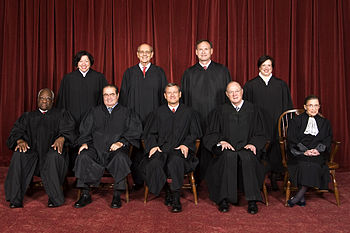
If you dislike these people,but haven’t read their actual opinions, don’t know their names and are basing your opinion on what other people say, I don’t care what you think, and neither should anyone else.
I suppose there may be could be some uses for the recent New York Times-CBS poll measuring public attitudes about the Supreme Court. It could be used to launch, for example, a discussion about how little the public understands about the Court and how it operates. It might prompt a discussion about the recklessness of the two parties, which regularly attack the integrity of the Court every time it arrives at a decision that one of them doesn’t like. It might even prompt a refresher course on what went on during the 2000 Florida vote recount, and why that case required the Supreme Court to play a unique role that had nothing to do with helping George Bush “steal the election.” All of these would require an unformed and responsible newsmedia. however, so what the poll is prompting instead misleading debates among talking heads about what the Court needs to do differently.
The Supreme Court needs to do nothing at all differently. The poll revealed that the popularity of SCOTUS was in decline, with only 44% in approval, though still fewer in disapproval. A large majority believes that personal beliefs, not legal analysis, guides the justices in their decisions. Today on “This Week with George Stephanopoulos,” George was knitting his brow, saying how bad this was, and asking his (ridiculously extreme) guests, including Ann Coulter and Van Jones, what the justices should do about it. Pennsylvania’s governor Ed Rendell helpfully suggested that the Court needed fewer 5-4 decisions. Does Rendall think this is a baseball game? A 5-4 decision means that the case is a difficult one with good arguments on both sides. Just because the average nincompoop doesn’t read beyond the headline and bases the decision on the “score” doesn’t mean that’s a valid way to judge the Court, its decisions, its reasoning in the decisions, or anything else.
Is Rendell suggesting that the Court fake the vote in a close decision, and change it to look like it was an easy call? That by being less honest,the Supreme Court will be respected more? That’s something a politician would do, not a judge. Interestingly, Rendell’s introduction to his silly remark was citing Chief Justice Earl Warren, who, it is said, worked hard to make Brown v. Board of Education, outlawing segregation in the schools, a unanimous 9-0 decision. Warren was a politician: he had been Governor of California. He had never been a judge before being appointed Chief Justice.
The vote in SCOTUS decisions is significant, because it lets policy makers and the public know that an issue was either a close call constitutionally or that a decision was not likely to be overturned in the foreseeable future. Rendell, in essence, was suggesting that the Supreme Court cover its tracks, misleading legal analysts for PR benefit. Gee, Ed, what a good idea!
On what basis has the public decided that the Court makes its decisions based on “personal opinions” rather than “legal analysis” (assuming the public has a clue what legal analysis is, which it does not)? How many of those polled read the majority and minority opinions in key SCOTUS opinions? How many are capable of understanding them, and concluding, “Huh…here, Justice Breyer was clearly influenced by his upbringing, the President who appointed him, and his fondness for licorice rather than the precedent he cites!” .1%? Less? How many can even name all the members of the Court?
If the public has decided that the Court is basing its decisions on politics and bias rather than the law and good faith legal analysis, it is because that is what they have been told over and over again by pundits and politicians who also don’t have the training or intellect to understand the typical Supreme Court opinion, but do have training in spinning, bloviating and deception.
Let’s look at a typical, controversial Supreme Court decision, 2005’s Kelo v. City of New London.* In that case, the Supreme Court upheld New London, Connecticut’s taking of a woman’s property by the power of eminent domain, in order to hand it over to land developers. It was a 5-4 decision. The Fifth Amendment of the Constitution only allows private property to be requisitioned this way for a legitimate “public use,” like building a road or public park. The majority, then complied of the so-called liberal branch of the Court, upheld the taking, stating that legal precedent gave wide berth to interpretations of what constituted a public use, and the the Court wouldn’t second guess local governments. The majority also acknowledged that the taking of a perfectly good piece of property and the home on it to convert it into a private development that would raise more tax revenue was a horrible use of eminent domain, and that Congress should pass legislation prohibiting such schemes. The minority, conservative justices, including Justice Scalia and Justice Thomas, argued that the majority was ignoring the rights of individuals in order to side with the “disproportionate influence and power in the political process, including large corporations and development firms.” These are the same justices, you will note, who are regularly accused of favoring those with “disproportionate influence and power in the political process, including large corporations.
How many of those responding to the Times-CBS poll read the Kelo decision, or know who voted for the majority opinion? It was an awful result, as even members of the majority acknowledged, but it was made on the basis of the law, not the “personal beliefs” of the justices. Then again, the President of the United States didn’t insult the Supreme Court over the result while misrepresenting it, as President Obama did to the current Court regarding the Citizens United case. And the media didn’t accuse liberal majority of holding a bias favoring corporations to the disadvantage of citizens, though that was the result of the opinion, because that doesn’t fit their biases. If one examines all the Supreme Court opinions and those of the individual justices, it becomes clear that the justices have clear judicial philosophies that affect how they approach particular issues, but that they are remarkably good at keeping personal biases out of the equation, and their opinions, whether one agrees with them or not, are well-reasoned and well-supported, sometimes quite eloquently.
This was not always the case. The comparatively popular Warren Court, the epitome of judicial activism, had members who were as predictable as Big Ben, and who obviously decided how they wanted a case to come out and then hustled to cobble together a legal argument that would support that result. The prime offenders were Justice William O. Douglas and Justice Thurgood Marshall, both liberal icons, both social architects masquerading as judges. Yet while various advocacy groups and local politicians accused the Court of being political, the respectable public officials did not. No President made public statements like those made by Obama about the upcoming individual mandate opinion, impugning both the integrity of the Court’s decision-making process and its power to strike down a measure passed by Congress.
There are three conclusions to be reached regarding the poll, and the apparent falling regard for the Supreme Court:
- The public opinion of the Supreme Court is uninformed and based primarily on ignorance. Basing conduct or policy on uninformed and ignorant opinions is irresponsible, though politicians do it all the time. This is why the Supreme Court is accountable to nobody but the Constitution, the law, and the justices’ own consciences.
- The erosion in popular respect and support for the Court is a concern, but it is not the Court itself that needs behavior modification. It is our elected politicians, who have unconscionably misrepresented the Court’s decisions for political gain beginning in 2000.
- The public’s acceptance of the Supreme Court as a fair and objective arbiter of the law is critical to the stability of the United States, and vital to the Founders’ concept of checks and balances. The Court doesn’t need to change. It needs to keep doing what it has always done, and maintain its professionalism and integrity. Elected officials and the media, however, need to stop dishonestly and irresponsibly undermining trust in the Court for partisan purposes.
They are playing with fire.
____________________________________________________
Spark: This Week With George Stephanopoulis (ABC) 6/10
Source: New York Times
Graphic: Wikipedia
 Ethics Alarms
I simply could not agree with you more. Unfortunately we have let the liberal social do-gooders take over our educational system and we don’t even teach ‘civics’ any more. Very few people in the United States have any understanding at all of our government and the way it was intended to operate.
Blaming this on “liberal social do-gooders” seems to only compound the problem by framing the issue as nothing more than partisan politics. In fact, Mr. Smith could not DISAGREE with Mr. Marshall, for much of Mr. Marshall’s basic conceit in this column is that we should NOT evaluate the Supreme Court through a political prism. Yet that is precisely what Mr. Smith has done here.
That’s no “conceit,” that’s true. Viewing the Supreme Court through a political prism, especially without bothering to read the opinions or understand what they are based on, is lazy, misleading, and manipulative.
Right — and MBS’s concluding that the problem you identify is a result of “let[ting] the liberal social do-gooders take over our educational system,” without bother with any research or evidence of this hypothesis is equally “lazy, misleading, and manipulative,” and only leads us further from any solution to this problem.
I don’t disagree, Noah. This isn’t a partisan issue, really; it’s bi-partisan ignorance and cynicism, and dangerous.
I have a funny association with the Supremes. My next door neighbor growing up was Harvard Prof. Bob McCloskey, who was the first to study SCOTUS from a government, rather than purely legal, perspective. He got me reading opinions while I was still in high school. Black, the liberal, and Harlan, the conservative, were my contemporary favorites. In college, and of course law school, I developed a real passion for reading the opinions, which were always intellectual battles to the death. Then I got to meet some Justices—Rehnquist, Tom Clarke, Ginsberg, and Scalia, who had a beer with me and some friends when we entertained at a bar meeting.I also once did a satirical review at the Court’s annual dinner, and ribbed the Justices pretty hard. We were a little wary—all of us were lawyers—but Chief Justice Berger and the rest were great.
This is, and has always been, a dedicated group of extraordinary, dedicated and talented professionals. The public had it right 20 years ago, The Court should have a 100% approval rating, whatever they decide.
Also, a factual correction:
Mr. Marshall wrote: “the media didn’t accuse the mostly Democrat-appointed majority of favoring corporations to the disadvantage of citizens. . . .”
In fact, only two of the nine Justices on the Kelo Court (both of whom were in the majority) were “Democrat-appointed.” The five-member Kelo majority was Justice Stevens (Ford-appointee), Justice Kennedy (Reagan), Souter (GHW Bush), Ginsburg (Clinton) and Breyer (Clinton). So, the “mostly Republican-appointed majority.”
Yeah, thanks, I’ll fix it, but you are obscuring the point, which is unchanged. Stevens, Souter, Ginsburg and Breyer were the liberal wing, taking a position that benefited corporate interests, and nobody accused them of being biased in favor of big business. When the conservative justices ruled for Citizens United, however, it was called political.
No intention to obscure any point — just pointing out the factual error. I completely agree with the points you are making.
I have very high respect for SCOTUS. I don’t always “like” their rulings, but I believe their job is the most difficult and untelligible in all of our government. I can’t comprehend the amount of information that they must go through to satisfy the constitution. I am sure they would want to judge according to their own philosophies. That would be easy. Then any Joe could be appointed. Thanks Jack! Good Post!