“It is very common for the teachers of the year, the championship coaches and the vanguards of education to be perpetrators…They will put on this mask of an exemplary teacher to look the same as a true exemplary teacher.”
—Terri Miller, president of the national organization Stop Educator Sexual Abuse, Misconduct and Exploitation.
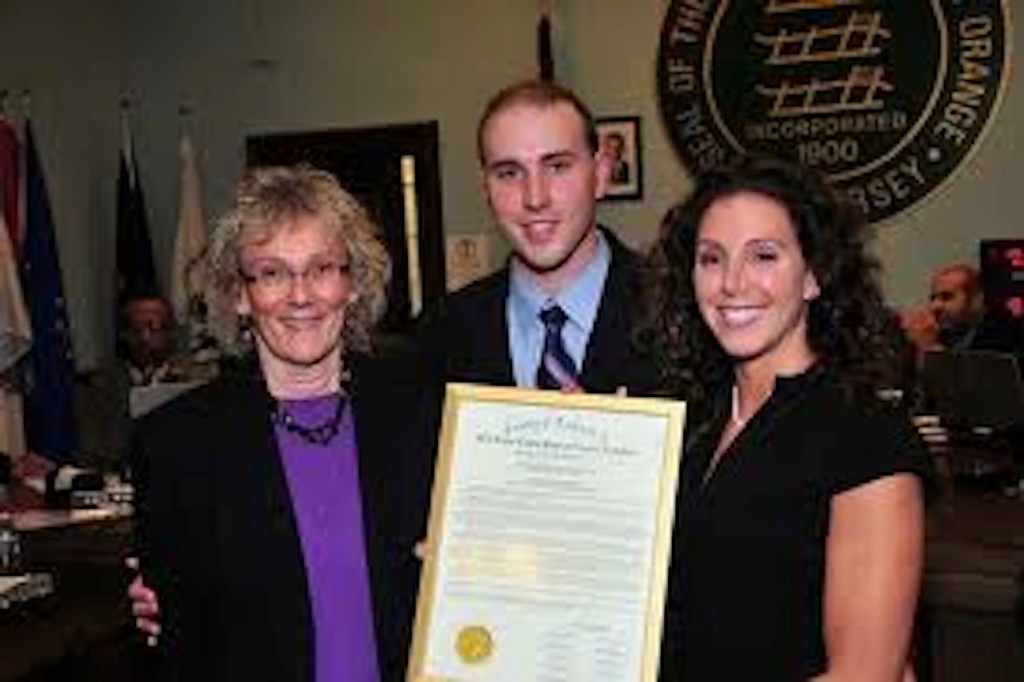
Erica Depalo (right): Teacher of the Year, vanguard, child-molester
Miller’s quote was prompted by the recent arrest of West Orange High School English teacher Erica DePalo, 33, who is accused of having a sexual relationship with a 15-year-old male student she taught in her honor’s English class. Prosecutors charged DePalo with first-degree aggravated sexual assault, second-degree sexual assault and endangering the welfare of a child. DePalo, who teaches Honors English to ninth and tenth-graders and is also the school’s junior varsity tennis coach, was honored as Essex County’s top teacher for 2011-2012 as part of the state Department of Education’s “New Jersey Teacher of the Year” program. Accepting her award, she said, “I am merely a representative of all the hardworking dedicated teachers, especially those with whom I work at West Orange High School … teachers who are committed to their students, who consistently advocate for their students, and who exceedingly go above and beyond their everyday duties and job descriptions.”
Yes, I’d say having sex with 15-year-old student qualifies as going above and beyond their everyday duties and job descriptions. Or perhaps below and beyond.
Miller’s observation, if true or even close to true, raises more disturbing questions than it answers. If the best teachers are the ones most likely to be molesting their students, what is the proper response? Look for worse teachers, who don’t give a damn? Should we be inherently distrustful of the leaders, the popular and the stand-outs in the teaching profession? What kind of profession expects widespread misconduct from its “vanguards”? If parents can’t trust the vanguards, who can they trust? The slackers? The mediocrities?
Is there any profession in America more adrift ethically than that of educators?
_______________________________________
Facts: NorthJersey.com
Graphic: Jersey Tomato Press
 Ethics Alarms
Yes–journalists.
Close call.
Yes. Republicans and the Tea Party
What is this I don’t even….those aren’t professions.
Are you saying you believe Terri Miller?
I don’t know. This is her field, not mine—she has some credibility. It’s a disturbing quote whether its true or not. I suspect it is often true.
If we improve significantly the respect, income and benefits of teachers, we might considerably improve the chances of hiring quality teachers.
Respect before performance? Interesting concept. The sex from the kids is free. Why do you think paying predators more will stop them?
I still think politicians are the bottom of the barrel.
I’m quite skeptical of politicians these days. And journalists, too – not as a whole profession, but many need to review their code of ethics: http://www.spj.org/ethicscode.asp
Lately, finding the truth in reporting has been quite a challenge for me.
I’d say a teacher that spends all their time with students is not necessarily an exemplary teacher.
What is the criteria for the designation Teacher of the Year?
I’d say a teacher who has sexual intercourse with a student is per se not an exemplary teacher. But attentiveness is certainly a virtue, if education rather than carnal knowledge is the objective.
Terri Miller may have a point. A great many of the news stories about predatory teachers have mentioned that the accused were widely regarded by both their superiors and their peers as being not merely good, but great, teachers. Makes sense, too. If someone is a teacher who resides somewhere on the esteem scale between indifferent and bad, it might not be such a tough sell to suggest that they were engaging in inappropriate—-or downright illegal—activities with students. What would the reaction be if the same allegations were made of an exemplary teacher? It has been stated by many who have studied such things that those who molest minors often regard themselves as their victim’s best advocate, or even friend. Not surprising, then, if such a teacher is also willing to go the extra mile even (or especially) when doing the things teachers are supposed to do. But—man!—that really is a disturbing line of reasoning. Which doesn’t make it a faulty line of reasoning, more’s the pity.
The same or similar qualities used to measure exemplary teachers turn out to be the ones predictors have.
How are we supposed to know the difference until they show themselves to be one or the other?
Same goes for politicians and psychopaths. It’s the nature of the beast.
Hmmmm. I seem to have asked the same question the whole thing started with. Clearly I have no answer, or much to add to the discussion. I’ll stop now.
In many cases the “Educator of the Year” is a popularity contest and has nothing to do with excellent teaching in the classroom. Sociopaths can be great actors and as a result are very well liked. I have no doubt that Ted Bundy would have been a very popular teacher also.
By the way, Jayson Blair and Jack Kelley were very popular guys also. Editors allowed things to slide and gave these guys the benefit of doubt because they seemed too nice to “cheat”. In the end, both men showed traits of sociopathic behavior and there were always questions about what was really going on but those questions were just not asked. I think this is very true in education also.
It’s true in every field. It is especially problematic when children are the targets and victims.
Many of the same qualities that make for a superior teacher—affability, attentiveness, persuasive ability, personal attention, facility at reading non-verbal indicators—also make for a successful abuser. Add to that Karl’s point about an (otherwise) excellent teacher’s credibility, and you’ve got a mess. Substitute “priest” or “little league coach” or “youth choir director” into the previous sentences and nothing changes. People think they can tell what a sexual predator looks like, just as they believe they can determine the trustworthiness of a political candidate based on campaign rhetoric. We can’t. We’ve got to go on the basis of what we think we know. Sometimes, tragically, we’re wrong.
Not just sometimes, but too often,
The same qualities that make people leaders—charm, cleverness, forcefulness, persuasiveness—are also the calling cards of sociopaths. It has ever been thus.
We should note that we can be wrong in both directions. For instance, one of my high school teachers was accused for improper contact and conduct by a couple students… until they couldn’t keep their stories straight and claimed things happened at impossible times, followed by one of them admitting the two of them had fabricated the stories.
I think some of the problem is how stacked the deck is against the accused once something becomes a legal matter. Because of that, I think people are less willing to report questionable conduct for fear of ruining an innocent person.
Assuming for a moment that the best teachers are statistically more like to engage in sexual misconduct with their students, the appropriate response to this ‘trend’ (for lack of a better word) would be to continue to support those teachers that excel in their jobs as teachers. Until some method to detect predatory sexual deviance is invented we cannot assume the worst of someone simply because they have suspect traits – if indeed good teaching skills can be called suspect.
The only reasonable preventative measures I can see, are the kind we already rely on. Solid ethical training of those in positions of authority and parents willing to be involved in the lives of their children.
Though, personally, I doubt these instances of ethical failure by some are indicative of the whole.
What ethical training do educational professionals get? There isn’t even a Code of Conduct that is generally accepted. I agree with you, in essence, but faith in training, in this field, just isn’t warranted.
If there isn’t some kind of mandated instruction against sexual misconduct with students, Id be very (unhappily) surprised.
But mainly, without evidence that these incidences are more than a statistical super minority, the kind any profession may suffer, I would say faith in our teachers ability to not molest students has, so far, been well placed.
From the linked article:
In North Jersey, more than two dozen teachers, coaches and educators have been arrested for improper relationships with students in the past three years. This week, Park Ridge High School saw the arrest of John D. Rankin. an assistant track and bowling coach, on charges of sexual assault and endangering the welfare of a minor. Accused of having a relationship with a former student that started in 2009, when she was 16, Rankin was the second employee of that school to be accused this year. A popular math teacher at Park Ridge High was arrested in January, also for allegedly having a sexual relationship with a teenage student.
Rankin’s arrest prompted Bergen County Prosecutor John Molinelli to comment this week that there has been “an alarming increase in the number of reported instances” of educators sexually abusing students.
Prosecutors and victims advocates can only speculate that the recent cluster has been triggered by more young victims gaining the courage to come forward by hearing and reading about others who have done so.
I think regarding these as aberrations and a “super-minority” understates the seriousness of the problem.
In 2010-2011 there we over 100,000 full time teachers in NJ (courtesy of http://www.nj.gov/education/data/fact.htm). Even taking the past three years combined that’s a percentage of approx. 0.00022101279111% a number so small it is better expressed in scientific notation. It gets even smaller if you look at it in a year by year basis, and smaller still when you consider that 24 arrests is not the same as 24 convicted guilty men.
No one is understating the seriousness of the ethical breach when teachers have relationships with students. But lets not damn a system and a profession that has achieved a rate better than 99.9997789872089% molestation-free teachers.
I think you have to multiply that percentage by about 3. That’s still only about .0007, if your figure wee correct—they aren’t, because the number of two dozen referred to North Jersey only, whatever that means, and not the state as a whole. The reason for the factor of three is that we’re talking about sexual relationships, which knocks out grades 1-8 at least. I agree with your general point, but your calculations need to include all of NJ, and only grades 9-12. Let me know what you come up with.
You’re off by 2 decimal places: 24/100,000 ~ .00022. which, is .022%
And, as I pointed out, that’s wrong too. The more accurate figure would be .06 or .07 IF the 24 number was for all of New Jersey, but its not. If those numbers were representative of South, West, East and Central NJ too, then we’d have to multiply the .07 by 5, giving us .35. in short, we don’t have the data.
I should have added a line of: “And then all of Jack’s criticisms and modifications apply.”
It almost shocks me how bad people are with decimals and units, and then I remember Verizon Math: http://verizonmath.blogspot.com/.
Good catch on the decimal points, I copy pasted from my calc and kept writing. But using what recent data we have:
108,591 – base number of teachers in NJ
51.1896201205338% – percent of NJ population in North Jersey (1) used in an equivalent capacity to estimate the teaching population
31.111510899223% – percent of teachers who are high school teachers (2), all other things being equal
This gives us approximately, 17,533 high school teachers in North Jersey after being rounded to the nearest whole.
Finally, we divide the 24 arrests equally into their three constituent years, which leaves us with eight arrests per year.
This leaves us with a final percentage of 0.045628243882% ethical failures.
Or a final percentage of 99.954371756118% good teachers, or rather teachers who don’t sleep with their students.
1. North Jersey as defined by “The Record”, the paper owned and operated by the same news group that owns and operates NorthJersey.com and the percent population from 2010 census.
http://en.wikipedia.org/wiki/North_Jersey
http://www.northjersey.com/aboutus/tagline.html
http://www.usatoday.com/news/nation/census/profile/NJ
http://www.google.com/publicdata/explore?ds=kf7tgg1uo9ude_&met_y=population&idim=county:34041&dl=en&hl=en&q=population+of+warren+county+nj
2. Determined from the Bureau of Labor Statistics, for lack a NJ specific source
http://www.bls.gov/ooh/Education-Training-and-Library/Kindergarten-and-elementary-school-teachers.htm
http://www.bls.gov/ooh/education-training-and-library/middle-school-teachers.htm
http://www.bls.gov/ooh/education-training-and-library/high-school-teachers.htm
Where are the stats for all of Jersey? You are comparing apples to oranges—and the full slate of teachers, as I said, are not the universe. Plus it is almost certain that the reported abuses are not all the abuses by any means. This makes this a classic false use of statistics, putting decimal points on dubious estimates, incomplete figures and mixed contexts. Next you’ll be saying that women are only paid 70 cents on the dollar…
Where are the stats for all of Jersey? You are comparing apples to oranges—and the full slate of teachers, as I said, are not the universe.
There is no apples to oranges comparison here. The arrestees and total pool were limited to the same sample. That the sample is just Northern Jersey doesn’t harm the effectiveness of the math.
The comment on reported abuse vs actual abuse is good (thought it’s more properly arrests vs actual abuse).
This makes this a classic false use of statistics, putting decimal points on dubious estimates, incomplete figures and mixed contexts.
The exactness is fine. The only thing actually wrong is what the percentages represent.
He’s using the total NJ teacher populations against the arrests in one section of New Jersey. Right? That’s how I read it.
Total teacher population was scaled down based on the percentage of the total NJ population in North NJ (As you requested. That’s the 51.xxxx% number.
The teacher percentage is an estimate based on the population percentage, so it shouldn’t have all those signficant digits, but it’s likely not signficantly far from 51%. Same goes for the calculation of how many of the teachers are high school teachers.
Somewhere in the neighborhood of .05% of North NJ high school teachers are arrested each recent year for the given reasons. We’re looking at half the size of NJ, and the data wasn’t cherry picked, so I don’t think bias comes into play.
There could be issues with differing ideas of what qualifies as North NJ that mess up the results, along with diversion programs and the like, but assuming the data is good, the calculation is generally good. Just the meaning and specificity of the information is off.
Or a final percentage of 99.954371756118% good teachers, or rather teachers who don’t sleep with their students.
No, that’s not what you ended up with. You switched units from arrested teachers per year to molester teachers.
Units matter.
“The only thing actually wrong is what the percentages represent.”
“No, that’s not what you ended up with. You switched units from arrested teachers per year to molester teachers.”
“Just the meaning and specificity of the information is off.”
I dont see where you can conclude that, except maybe in the wording following the final percentages?
To be clear:
Approximately 0.045628243882% of North Jersey high-school level teachers are arrested for sexual relationships with their students.
The remaining 99.954371756118% of North Jersey high-school level teachers, if they are arrested at all, are not arrested for this kind of misconduct.
—–
This is, for our purposes, on a yearly basis and consists of numbers published between 2010 and 2012.
The significant digits were ‘not reduced’ for any specific reason and are not meant to imply an unreasonable level of precision. They were copy pasted from my calc program after accounting for the two decimal places.
What constitutes North Jersey may vary by personal opinion but since “NorthJersey.com is powered by the award-winning people and publications of North Jersey Media Group (NJMG), the area’s largest news-gathering organization. [and] NJMG is best known for their flagship daily newspaper, The Record .” its reasonable to assume that if The Record specifically defines the counties constituting North Jersey that definition may also be used for NorthJersey.com. That is where the wikipedia link comes in, it should be citation 3.
Also note that there are many possible variations and qualifications in the data inputs but lacking any more specific data than was available, I feel its a reasonably accurate result.
Just because you copied a number from your calc program doesn’t make it correct. Your use of the number to 12 digits was improper specificity. It’s wrong.
I also stand by my comment that you switched units. Remember this? “Or a final percentage of 99.954371756118% good teachers, or rather teachers who don’t sleep with their students.”
That’s a false conclusion.
“Your use of the number to 12 digits was improper specificity.”
While correct, its a relatively unimportant technicality. Leaving 12 significant digits does not harm the effectiveness of the math, it is only harmful to the result if it implies a level of extreme precision you cannot guarantee – which I don’t. See the qualification “The significant digits… are not meant to imply an unreasonable level of precision.”
“I also stand by my comment that you switched units. Remember this? “Or a final percentage of 99.954371756118% good teachers, or rather teachers who don’t sleep with their students.”
That’s a false conclusion.”
I feel its unfair to suggest that the designated teachers are sleeping with their students without evidence, but… you are not technically wrong – hence the clarification:
The remaining 99.954371756118% of North Jersey high-school level teachers, if they are arrested at all, are not arrested for this kind of misconduct.
1. Using the digits inherently does mean the number is precise to that amount of digits. That you don’t understand this doesn’t make it less true. I pointed out the error. Since it was, apparantly, unintentional, it would have been appropriate to note it was a mistake and correct yourself, not argue with well defined conventions and meanings.
2. Coming up with a reason to only include arrestees does not change the fact that you switched units. That you complained that I called it out and that you didn’t didn’t understand why I did so was enough reason for me to reiterate my positions and show exactly where this occurred.
3. Your conclusion, again, is still wrong, and still wrong for a unit reason I already pointed out. Can you find it?
—
If anyone wants to know why people don’t trust statistics, this post is a good reason why. Statistics and Math are themselves fine, but people misrepresent them all the time, often unintentionally. I trust my ruler, but I don’t trust a blind person to read it for me.
“Using the digits inherently does mean the number is precise to that amount of digits.”
I never said they did, I recognize this concept. Thats the logical reasoning behind including the qualifier “The significant digits… are not meant to imply an unreasonable level of precision.” Your still arguing a technicality with no real bearing on the resultant figure or the theory behind the resultant figure. If you feel 12 significant digits changes the meaning of the data some how, feel free to explain your position and we’ll adjust as needed.
“Coming up with a reason to only include arrestees does not change the fact that you switched units.”
Noted and corrected.
“Your conclusion, again, is still wrong, and still wrong for a unit reason I already pointed out. Can you find it?”
Dont be coy, if you see an error identify and explain it. I have no problem adjusting a position for valid criticisms.
Finally, adjusting the finer points of the data and conclusions for an ever more accurate representation is something to be expected when producing statistics. Though if the overall purpose for producing the statistics and the general conclusions that can be derived from them has changed little I don’t see how it can be called a misrepresentation in anything but the pettiest sense.
“Using the digits inherently does mean the number is precise to that amount of digits.”
I never said they did, I recognize this concept. Thats the logical reasoning behind including the qualifier “The significant digits… are not meant to imply an unreasonable level of precision.” Your still arguing a technicality with no real bearing on the resultant figure or the theory behind the resultant figure. If you feel 12 significant digits changes the meaning of the data some how, feel free to explain your position and we’ll adjust as needed.
First, the qualifier came later. You presented the number without qualifier at first. Second, you continued to use the digits after you were corrected. It’s pretty clear you don’t understand what signficant digits are. They absolutely do change the meaning of the data, as they suggest a false confidence.
“Your conclusion, again, is still wrong, and still wrong for a unit reason I already pointed out. Can you find it?”
Dont be coy, if you see an error identify and explain it. I have no problem adjusting a position for valid criticism
I wasn’t trying to be coy, but I’d already pointed out the problem. You switched between teachers arrested per year year to teachers arrested. You just can’t do that. with some data on length of teaching span and recent turnover you could estimate the number of teachers based on the teachers per year, but they aren’t the same number.
Finally, adjusting the finer points of the data and conclusions for an ever more accurate representation is something to be expected when producing statistics. Though if the overall purpose for producing the statistics and the general conclusions that can be derived from them has changed little I don’t see how it can be called a misrepresentation in anything but the pettiest sense.
Point out false confidence is not petty. Pointing out that the calculations don’t lead to the conclusion is not petty. This isn’t fine points on the data and conclusions, this is massive non sequitur errors. If 30 people out of 2000 attended a give play, I can’t say “only 30 people like this play” or “99.5% of the population hate plays.”
I think the investment banking community is currently based on fraud and manipulating the markets for their own good and the country’s detriment. But education has sold our future for unproven educational fads and jobs for the barely educated.
As for Miller, If you think about what constitutes a ‘good’ teacher these days, she is probably right. To attract an convince students to have sex with them, the teacher needs to be popular and spend a lot of one-on-one time with the students. This in itself is considered good teaching. A teacher with high standards who requires a lot of homework, gives few A’s and always has high scores on their AP exams is likely to get fired.
In my area, it is usually the coaches that I hear about having sex with the students. In some of the districts in my area, it is endemic, widely known, and not punished. A prominent coach was fired at our high school and many people wondered if one of the girls’ parents has complained about the fact that he was sleeping with the students. It wasn’t. Although his activities were well-known, he was fired because his win percentage was down and he lost some prime recruits this summer to rival schools. The crazy part is that most of the parents don’t care. A few years ago, one of the local college coaches had to marry the player he had impregnated. They then had a big banquet in his honor when he was named Outstanding Coach by the conference! I joked to one of our administrators if his award was for his on or off the field activities and was sternly told not to mention such things.
My graduating class just recently had its 30th reunion. Two teachers showed up that were now married to former students. Almost everyone one of the teachers that people described as their favorite teacher were also described by other former students as sexual predators.
I think that a couple of things can be done to reduce this happening.
No teacher shall be alone with any student at any time either on or off school property.
All tutoring must be done on school property in a designated area under the supervision of electronic monitoring.
All teacher / student communication must be done through a school supervised email service. At no time will a teacher / student communicate through instant messaging or cell phone.
Surveys of each class each, year shall be used to evaluate teachers and to ask specifically about student teacher interaction.
Any teacher dismissed by a school district for sexual misconduct whether convicted in a court of law or not shall be put on a national database that shall be reviewed by all school systems before hiring a teacher.
Think of the children!!! We can’t trust adults! We need more lists of people not convicted of anything! Rare bad cases should create general rules for everyone!
I would generally agree with you, you had me at that horrible expression “Think of The children”. But if not things like I suggest, what do you suggest?
I dont think they are as rare as you think. God knows they were common when I was in school.
Limit nonschool 1 on 1 time. A teacher should not be hanging out in a kids room and vice versa. Banning 1 on 1 in school is unworkable.
Tutoring is just like all other tutoring. Public locations are best, but the school or government shouldn’t set rules for when teacher’s can give paid tutoring…. unless paid tutoring by teachers is banned. Any official tutoring related to the teacher should be at at school following standard rules.
I’d limit most teacher student technological communication to email, and the parents should be allowed to be included on any non-blast communication if they desire, but no zero tolerance policy. An automated 7am txt of “don’t forget your homework” isn’t the work of the devil.
Safe space initiatives are generally common, and surveys asking about interaction would likely be either too general to get information on problems or would turn into push polling.
What would actually be best would be throwing out stranger danger for sane discussions of appropriate and inappropriate contact, and that inappropriate contact should be reported, whether it came from a stranger or someone trusted. I’d compare it to burglary, our best defense is a home alarm, not trying to figure out who can cannot enter the neighborhood.
All good points, especially the stranger danger comment and teaching kids what is appropriate and what isn’t.
Sociopaths are sociopaths. We do the best we can.
+1 perfectly succinct quote
I don’t think the education establishment is doing the best it can by a longshot.
How can you “put on this mask of an exemplary teacher to look like a true examplary teacher?”
Like, there is a way to pretend to be an exemplary teacher if you really aren’t? And it fools everyone?
I just assumed that “exemplary teacher” would be based on performance markers of some sort.
I think what she should have said was, “It’s really easy for a molester to be named an exemplary teacher.”