Tough one! Are you ready?
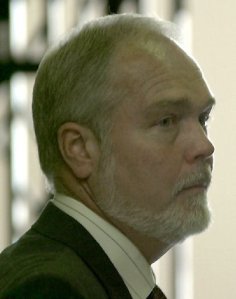
Convicted killer and lawyer too?
Richard Buchli, a Missouri lawyer who was convicted of beating his law partner to death, was getting a new trial after it was revealed that the prosecution had illegally withheld exculpatory evidence from the defense. There was some strong evidence supporting his conviction, such as the fact that the partner’s blood was splattered on Buchli’s clothes in a manner consistent with a beating death. (Buchli argued that he got bloody trying to revive his partner.) The court, however, frustrated with the prosecution continuing to drag out discovery and failing to deliver all the evidence to Buchli’s legal team, threw out the conviction completely and barred all the evidence in the case, effectively making Buchli, who had been in prison since 2002, a free man.
Now Buchli, who was disbarred in 2005 (killing your law partner is considered unethical), wants his law license back. Your Ethics Alarms Ethics Quiz Question:
Should he get it?
I think he will get it back. Though the bar’s disciplinary committee isn’t bound by the court’s ruling when it considers Buchli’s character, I’d be shocked if it didn’t restore his license. That’s not the question. Should a lawyer who is still legitimately under suspicion of murder—and a particularly brutal murder at that—be deemed fit for the practice of law? Remember, he was convicted, and never found “not guilty.” His case was thrown out because of conduct by the prosecution, not weaknesses in the case against him. Yet his conviction, in the eyes of the law, is invalid, and thus he spent ten years in jail based on a proceeding that violated his constitutional rights. Now he wants to rebuild his life, beginning with recovering his profession. We can’t blame him for that.
And yet…is a lawyer whose culpability for a murder was never fully determined still worthy of trust? The legal profession’s disciplinary process is supposed to protect the public, and when there is sufficient evidence that a lawyer lacks the character traits essential to serving the public with honesty, integrity, discretion and honor, it has to deny that lawyer the privilege of practicing law. I would not be pleased to find out, after retaining an attorney, that he was released from a murder conviction without a judicial determination that he was, in fact, innocent on the facts. And I sure as hell wouldn’t dare dispute his fee. Should the Missouri Bar subject Buchli’s clients to this kind of doubt?
As I began by saying, this is a tough one. In the end, however, I cannot get past this: Buchli has not been convicted, legally, of any crime, and one’s right to earn a living at one’s chosen profession should not be removed on the basis of suspicion alone. Nor should the Missouri Bar Disciplinary Committee members become Buchli’s jury on the murder charge. That isn’t their job.
No half measures make sense either, such as suspension. If Buchli is a murderer, he should not practice law, ever. If he isn’t, then he shouldn’t be punished at all. Suspending him for murder is ridiculous—“Don’t ever kill anybody again, now!” This is an all or nothing situation.
The only fair and ethical outcome is to give Buchli his law license back…and hope that he didn’t beat his partner to death.
____________________________________
Pointer: ABA Journal
Facts and Graphic: Kansas City Star
Ethics Alarms attempts to give proper attribution and credit to all sources of facts, analysis and other assistance that go into its blog posts. If you are aware of one I missed, or believe your own work was used in any way without proper attribution, please contact me, Jack Marshall, at jamproethics@verizon.net.
 Ethics Alarms
In your analyis, you make the same mistake that so many do. A “Not guilty” verdict is not the same thing as finding some one innocent. “Not guilty” means no more and no less than the prosecution couldn’t its case beyond a reasonable doubt.
Since the prosecution failed to deliver exculpatory evidence (and we don’t know what that evidence was), the merits of the prosecution’s case in this instance becomes questionable.
Having said that, I can empathize with your feelings of unease. But that is an emotional response, and, as you have pointed out many times, the emotional response is not always the ethical one. [Witness the media and political response by the gun control advocates to the Sandy Hook shootings.]
Excuse me, but I did not make that mistake, and I never do. I said that he was not found to be “not guilty,” meaning that his guilt, in the eyes of the law, was never established, and in the eyes of the law, though I didn’t say this, he is indeed innocent, though his innocence was never established either. In many cases, true or likely innocence IS established in trial. Just watch “My Cousin Vinny.” A VERDICT of Not Guilty only signifies that guilt beyond a reasonable doubt wasn’t proven. I didn’t suggest otherwise. What I wrote was not a mistake, it was 100% accurate. That he wasn’t found “not guilty” doesn’t mean we have to regard him as innocent, and I never said that we should. In fact, my subsequent commentary suggests nothing of the kind.
Your last paragraph–-“Having said that, I can empathize with your feelings of unease. But that is an emotional response, and, as you have pointed out many times, the emotional response is not always the ethical one. [Witness the media and political response by the gun control advocates to the Sandy Hook shootings” is baloney. My unease about a lawyer found with the blood of his partner all over him and his partner dead, with no other suspect or killer having surfaced in 10 years isn’t “emotional,” it’s rational.
And the reference to the Sandy Hook shooting is a complete non-sequitur.
Just because someone has not surfaced in 10 years, do not make him culpable. On the contrary, this suggests more commonly that once the “police” have who they want, the blinders go up, and no further inspection is done — everything is thrown in (no matter how minor or off the wall) in order to prove they are right — and hopefully they are.
I for one, do not judge people’s guilt or innocence based on what is published in the news as they often put more weight in what is drama rather than what is truth. Truth to me is everything leaving out nothing. The news tends to subtract all the “boring” parts which just so happens to be part of the whole story — and like the pressure on a conviction, every detail (no matter how minor) should matter.
Without review of all the evidence – properly obtained (as you know this clause is there due to corruption, but is difficult to prove when something was improperly obtained sometimes), and discussion with witnesses, and the accused, I can not say one way or the other whether or not this man should even be alive, let alone practicing any profession.
The question is this: Did he do it ?
If Yes : Then he should not be walking the streets.
If No : Then yes, he should be “allowed” to practice, and further, he should be well compensated for the suffering he endured. Innocence in prison is no joke.
Which ducks the question. As of now, the answer is neither yes nor no, but “who knows?” and “We’ll probably never know.”
That is very true. My answer would be conditional upon obtaining all the facts, rather than following the public exploitation and possibly deliberate attrition of stripping the man of his life, and career. I do not believe that we will ever know what really happened, and thus never really be able to conclude definitively whether this man is to suffer further punishment or not.
In that case, I would propose that the ethical solution would be to allow him to practice where at worst case, he would realize how close he came to failure, and be able to better defend those under similar premise. I believe that in any case this experience could make him a better lawyer having seen both sides of the fence.
He killed another lawyer? Should that even be a crime?
Interesting, if predictable, point.
Of course its predictable. Its such an obvious shot.
By the way, how does one claim movie rights on this court room drama?
Restoration of his liscense is fair since he wasn’t convicted through Due Process.
The Free Market will certainly give him a relatively fair hearing as well.
How many lawyers will want to go into partnership with him now? Their free market decisions are not bound to the court decision. He will still get clients, but will he land some of the clients he would otherwise have hoped for now?