If it accomplished nothing else, the Supreme Court’s Hobby Lobby decision is doing a dandy job of flushing out the bigots. First it was the feminists blaming the decision on the all-male majority…because, as we all know, only women can balance ethical and legal conflicts fairly and intelligently, and they are incapable of bias. This line of attack is gender bigotry, acceptable because, well, just because. Then Harry Reid, leader of the Senate majority, condemned the five justices whose analysis prevailed as white males, adding racial bias to the mix. Also stupidity, of course, since last I looked, Justice Thomas was still black. Then again, to hear Harry and his friends tell it, being a conservative and not folding up like a deck chair any time women or a minority group complains means that you must be white, meaning that you must be bigoted against women. That’s just what whites are like. And males. Says white male Harry Reid.
It’s a strange, strange world we live in, no doubt about that.
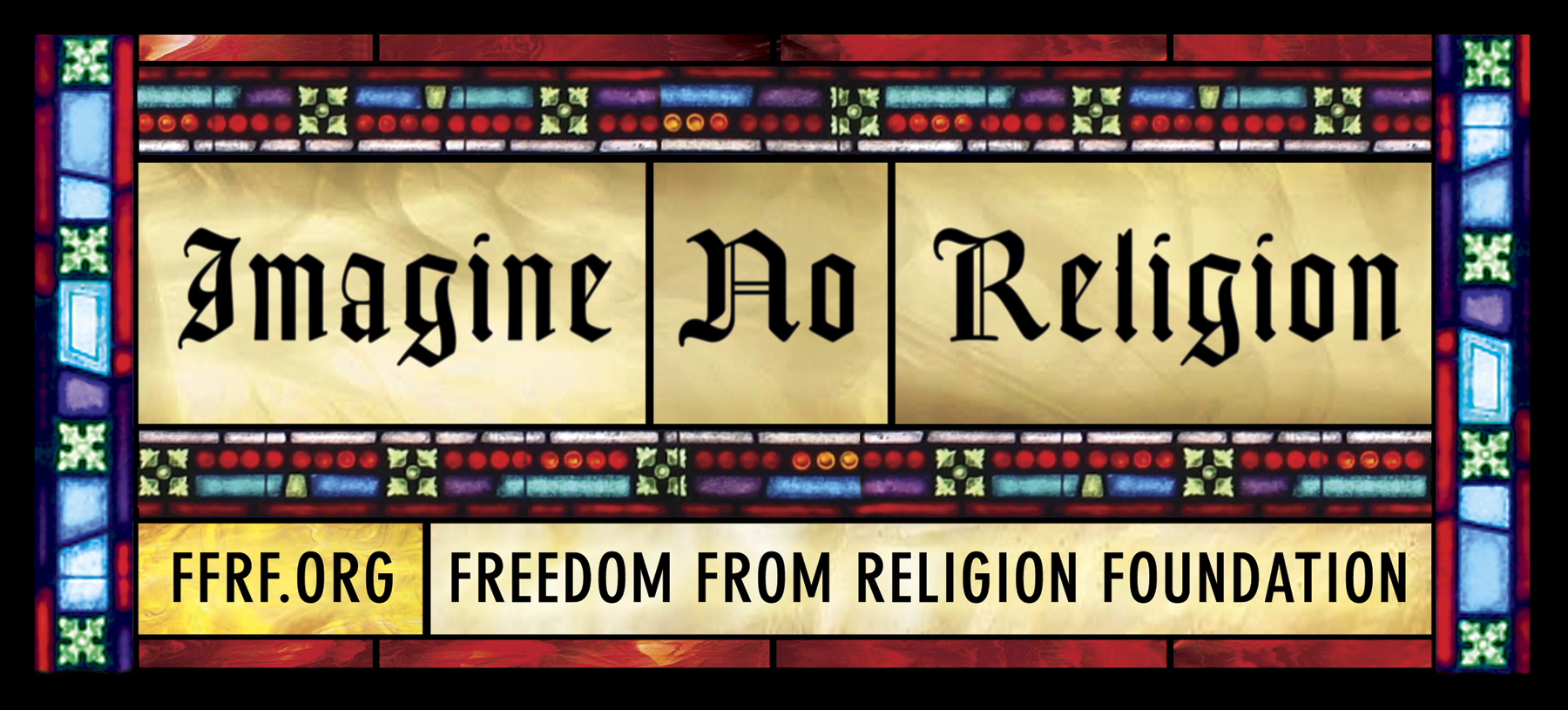
Now comes the Freedom From Religion Foundation with an ad published in the New York Times blaming the decision on the fact that the five justices in the majority were male and Roman Catholic. Anti-Catholic bigotry! I confess, I didn’t know what religion the justices were, because I don’t care. Do you? John Kerry is a Roman Catholic; so is Joe Biden. It never occurred to me to attribute their various decisions and policy determinations to their religion, or to presume that anyone’s religion is fair game for criticism. Ah, but this is blood politics as defined by today’s culture. The right people can use bigotry against deserving targets….you know. Conservatives.
Imagine if a critic or elected official had attacked the minority in Hobby Lobby as a bunch of Jews (three out of four are), or an example of typical female obsession with birth control over reason (three out of four dissenting justices are women). Would this be acceptable? Not to me, it wouldn’t. That kind of rhetoric presumes that members certain groups cannot be trusted to engage in logical and dispassionate reasoning, or to overcome narrow personal biases. Human beings, and professionals, deserve more respect. Well, unless they are the bad guys, that is. You can tell who the bad guys are: they are the ones who it is acceptable to be bigoted against. Try to keep up, will you?
Commenting on the ad, Seth Lipsky reminds us that the most emphatic statement in the Constitution is the line, “No religious Test shall ever be required as a Qualification to any Office or public Trust under the United States.” The natural extension of this principle is, as David Bernstein writes in the Volokh Conspiracy, that “attacking a fully secular Supreme Court opinion on the grounds that its authors happen to be Catholic should be well-out-of-bounds,” which is to say that it is unfair, disrespectful, and wrong.
Bernstein’s simple remedy: “So stop it.” It would help if those whose opinions, voices and views lazily and divisively resort to bigotry of the gender, racial, gender or religious variety would “stop it” as well.
It is unethical and wrong.
______________________
Sources: Washington Post(Volokh), New York Sun
 Ethics Alarms
The FFRF are religion-haters, plain and simple, who scour the nation looking to make trouble over non-sectarian invocations at meetings and crosses on war memorials. They should be treated the same as those who hate based on color or any other characteristic.
First, a disclaimer…I am a conservative. I am also a rationalist, which means in some terminology, I am an atheist. I do NOT claim to be an atheist, but, functionally, that’s the way it works out. And yet, I am also SUPER tolerant of other peoples religious beliefs…as silly as I find some of them. Still, they have a right to a belief system. And I will NEVER say that they don’t have that right. That does not give me the right to buy ad time that denigrates their belief system (even for the creationists, whom I find irrational in the extreme) nor does it give me the right to criticize their political beliefs because they are Christian. In actual fact, unless SCOPTUS’s decisions are clearly and obviously slanted toward Christian beliefs (this one was not), there is no room to criticize.
Their attack ad begins with a false premise- that there is a civil liberty to someone else being forced to offer you something.
Sadly common. Search any complaint about the Hobby Lobby case, and I can almost guarantee you will find someone who thinks that neglecting to cover something the employee might want is an imposition on that employee. Not acting for is the same as acting against in their eyes. This add in particular used the word impose, but even in the worst case, where one of the exempted forms of birth control is the best form for an employee and costs a lot, there is no imposition involved in declining to pay for it for them.
Then employers must be violating their employees’ Second Amendment rights, according to their logic.
Hobby Lobby wasn’t “declining to pay for” birth control. The payment wasn’t an issue in the case. Hobby Lobby pays for insurance as part of its compensation package to employees. Nothing about the payment aspect has changed as a result of the Supreme Court decision. The birth control coverage didn’t make the plan more expensive. At issue was how employees would be able to use the compensation that they earned.
Congress passed a law regulating employer-provided insurance. Hobby Lobby argued that its female employees should not get the same insurance coverage that other Americans are guaranteed because they work for a corporation whose owners believe women should not use birth control.
“The birth control coverage didn’t make the plan more expensive” Cite? Additional covered items always increases the cost of insurance. Hobby-Lobby was NOT just throwing a lump sum at the insurance company and letting employees choose what services were or were not covered, they negotiated a contract with the insurance company. Requiring that compensation to include something morally abominable to them was an imposition on them. Not providing it doesn’t impose anything on the employee.
“Hobby Lobby argued that its female employees should not get the same insurance coverage that other Americans are guaranteed because they work for a corporation whose owners believe women should not use birth control.” This is simply a lie. Unless you are a moron, you KNOW it’s a lie.
No, what was at issue was what sort of compensation employers were allowed to offer in the first instance.
No, it did not. The contraceptive mandate was an executive regulation.
Funny, the record below showed that Hobby Lobby wanted to deny the contraceptives in question to both women and men. No sex discrimination there.
How does Freedom From Religion Foundation explain Harry Reid?
They don’t. Frankly I think they should be renamed the HORF – the Hatred Of Religion Foundation.
Pingback: Wordpress Blogs - Wordpress Blogs .NET
Three out of nine SCOTUS justices are Jews? Well that tears it! There are more Jews on SCOTUS that representationally valid. No more Jews!
It never occurred to me to attribute their various decisions and policy determinations to their religion, or to presume that anyone’s religion is fair game for criticism.
Why on earth would their religion not be fair game for criticism? The Roman Catholic Church is a membership organization. Thus the five justices–all five of them–are members of an organization with a long list of political policy positions. It’s an organization whose leaders actively criticize public officials who deviate from the official policy positions of the church.
If members of the Supreme Court were found to be members of an underground cult that encourages poodle-sacrifice, and subsequently five of those members decided in favor of poodle-sacrificers in a major decision, the combination of those two facts would be 100% relevant to public discussion, and completely within bounds of reasonable criticism.
Well, justices on the Supreme Court are members of a religious organization that opposes birth control, and they just rendered a decision in favor of those who oppose birth control. That’s a relevant topic for discussion. The Catholic church has actively chosen to be involved in political matters. That makes it, and its members, fair game for political discussion.
Now, it is possible, in the course of this acceptable discussion, for the justices (or their supporters) to argue that private religious views were completely irrelevant to their public actions here. But it is ludicrous to suggest that we must always assume that to be the case.
A justice’s religion and personal beliefs are irrelevant to the process of deciding a case, which is based on law. If we are going to allow Thurgood Marshall to rule on civil rights cases and not view his race as a conflict of interest, then we must not treat gender or religion any differently. If a Catholic justice can’t rule objectively on any case involving an issue the Church has a position on, then that justice has a conflict. By not recusing, the justice has stated, as a matter of truth and good faith, that he can be objective. End of issue. I accord the three female justices the same presumption.
It always amazes me, when the Justices make a ruling that completely goes against their religion, in favor of the law (Roe v Wade is perhaps the most famous example) the left doesn’t fuss, it makes sense, they don’t comment on how it’s a miracle the angry white club overcame their religion to be social justice heroes, they just care their side ‘won’. But if the same institution sends back a decision like this, their history just goes out the window, they need to be judged as the white, male, cis people they are. (Whether they’re white, male, or cis is irrelevant, perhaps).
I think Obama made this situation worse when he appointed Sotomayor, who was, I think, a Hispanic woman first, and a justice second, in Obama’s eyes. Was she the most qualified for the job? God I hope not. But her profile had enough boxes checked (Roman Catholic was one of them, by the way).
Perhaps it’s projection…. Perhaps the left is so concerned with the backgrounds of their Justices, with law being secondary, that they just can’t imagine that a justice might actually look at the law first.
A justice’s religion and personal beliefs are irrelevant to the process of deciding a case, which is based on law.
That is the way that things ought to be. If one believes that this ideal situation has not occurred or is not occurring, then it should be viewed as perfectly reasonable to point it out and discuss it, don’t you think?
By not recusing, the justice has stated, as a matter of truth and good faith, that he can be objective.
What you appear to be saying is that, first, we must always accept at face value the intrinsic message that a justice is unbiased and, second, that a justice couldn’t possibly be unaware of a bias that influences his or her ability to make a fair decision. On what basis do you make these two claims?
If we are going to allow Thurgood Marshall to rule on civil rights cases and not view his race as a conflict of interest, then we must not treat gender or religion any differently.
I think that we should not allow Thurgood Marshall to rule on cases, on account of his death. (I’m kidding! We totally should.)
But race. religion, and gender are not analogous when it comes to evaluating whether decision-making was partisan or biased. For all intents and purposes, everyone has a race. Everyone has a sex. Not everyone has a religion, and a person’s religion can change based only on their thoughts and opinions. As such, no matter what one’s views of race and gender might be, an adult person’s religion should always be viewed as a choice.
Does that adult person have the right to make that choice? Absolutely. The right to be a member of a religion, and to hold religious beliefs, is, for want of a better word, sacred. But the actual beliefs of that religion can be, in theory, utterly abominable. Criticizing such beliefs is perfectly within the bounds of acceptable discourse.
Do you disagree? I’m not asking if you agree with my overall point about the original post. I’m curious if you agree with my specific claim that criticizing religious beliefs is within the bounds of acceptable discourse.
Criticize the beliefs themselves? Sure. That’s not what someone is doing when they presume that religious beliefs governed a SCOTUS decision. Then they are engaging in bigotry: we can’t trust judges who have X (coloring, religious backgrounds, chromosomes). The critics who are using the religious backgrounds of the justices to attack the decision are doing the latter. The fact that someone is a Roman Catholic doesn’t even mean they necessarily like that religion.
I disagree with this, though: “But race. religion, and gender are not analogous when it comes to evaluating whether decision-making was partisan or biased. For all intents and purposes, everyone has a race. Everyone has a sex. Not everyone has a religion, and a person’s religion can change based only on their thoughts and opinions.” We now know that racial identification and gender identification has many degrees and variations, just like religions. You are either male, or something else. Similarly, you are either a practicing Roman Catholic, are you are not. I don’t think your distinction is significant as far as presuming conflicts are concerned.
That’s not what someone is doing when they presume that religious beliefs governed a SCOTUS decision. Then they are engaging in bigotry: we can’t trust judges who have X (coloring, religious backgrounds, chromosomes).
I’ve already said that I don’t accept your logic that religious affiliation is analogous to race and sex. You assert it again here.
Not all religions and religious organizations are the same. The Roman Catholic Church, however, is an hierarchical membership organization with a list of specific policy positions that it (at least nominally) requires its members to adhere to. Furthermore, it is an organization which touts–officially–that its policy positions are more important than legislated laws.
IF a member of the Supreme Court is a willing member of an organization which has an official policy that its precepts on public policy are more important than the laws of man, then that person’s choice to belong to such an organization is a relevant subject of discussion.
It is possible that some members of said organization do not adhere to its every policy position, but that does not negate the fact that their decision to belong to it is worthy of public analysis.
If a member of the Supreme Court were also a member of the religious organization known as the Ku Klux Klan, that would be a reasonable topic for discussion and criticism–even though they have a civil right to belong to that organization.
When a member of the Supreme Court is a member of the religious organization known as the Roman Catholic Church, that fact is just as reasonable to discuss and criticize as membership in the KKK would be. The substance of the criticism might differ, but the appropriateness of criticizing would be exactly equal.
The fact that someone is a Roman Catholic doesn’t even mean they necessarily like that religion.
I’m not sure what you mean by this. Are you saying that a person can be a Roman Catholic even though they think that Roman Catholicism is not the right religion for them?