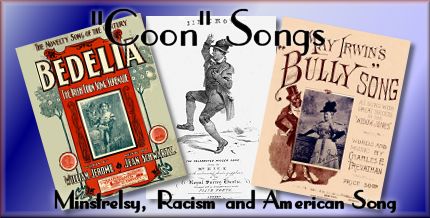
The Looney Tunes post was the latest in along line of those that I never anticipated provoking the rich discussions that they have, and this fascinating post by SamePenn really took off into an unexpected direction—ragtime and racist songs—that is still relevant to the post. Just read, enjoy, ponder and learn; I did.
Here is SamePenn’s Comment of the Day, and there’s a second COTD coming, on the post, Ethics Quiz: The Looney Tunes Cartoon Disclaimer:
I am a longtime entrenched, incurable fanatic for ragtime. The original hey-day for the music was the 1880’s to about 1920, so I wasn’t at all surprised to discover that along, with the thousands of compositions I had to chose from, a great deal – many hundreds, another thousand? – of pieces were lost. What did surprise me, however, was that most of those pages were “lost” deliberately, starting even before today’s powerful revival began in the 1950s and “went viral,” (when computers were still science fiction to the general public, and viruses were still organic), when The Sting was released in 1973 with the catchy classic rags of Scott Joplin for a soundtrack.
It was a pop step-child of ragtime called “Coon Songs” — how’s that for “offensive?” — that both began and ended in the middle of the original ragtime era, that made it all the way from (practically) everybody’s home piano to success on Broadway in dozens of all-Black productions. There was no other name for them, then or now: the word “coon” was usually in the title. The Coon Songs WERE racist (in spite of having black composers and artists), the pictures and lyrics WERE offensive, and they were not (obviously) the deathless melodies that arose out of much of ragtime itself … but they held a population in this country and in many parts of Western Europe in thrall for at least 15 years.
Before reproduction there was notation. In order to sell the notation to practically every household that had a piano, there was an illustrated cover on each piece of sheet music. And lyrics running between the upper and lower staffs. And, worst of all, titles. Coon songs were composed by black and white alike, performed by black as well as black-faced actors.
They didn’t all perish out of sudden shame. There were fig leaves to wear. Some were republished with new titles on the cover (and aliases for the composers), some with the lyrics altered, others with the parent tunes disguised in “versions” such as Mister Johnson or just shorn of lyric altogether and presented as instrumentals, like Shave ’em Dry … People are more familiar with some pre-rag — pre-copyright! — folk & country songs (and children’s music): the 180-year-old Old Zip Coon that transitioned multiple times into Turkey in the Straw, word alterations in Li’l Liza Jane and Old Dan Tucker, Dixieland and Bluegrass standbys, that made these syncopated tunes into perennial survivors acceptable to Decent Folk. But the pop songs of Then (the randier rap of Now) were shut down around the time we went marching off to the War To End All Wars. Ragtime already had a reputation for being fast, literally and otherwise, so there was nothing to do but leave the Coon tunes behind and pretend thereafter, that it was pretty much instrumental.
The sheet music is still around, though (mysteriously, paper, you know, can last longer than metal) an integral albeit unintegrated part of American social history as well as being the “original” original all-American music. It is traded and played and even framed to be hung on private walls by people who love the music and who know their history, who are neither necessarily racist nor politically correct, who cross all class and. most recently, age lines. But they know better than to display it except where other fans and collectors collide. You can Google “Coon Songs” on YouTube and get dubious information and, as usual, the most extreme (i.e., offensive) examples to be found. If you’re curious beyond the ugly examples online — we fanatics take our syncopation very seriously — check out the seminar (no test/no grade) of a ragtime historian, enthusiast, composer and Denver radio host, Jack Rummel. It starts off with a disclaimer that does indeed include the word “offensive” and which his audience took to be a joke. While you’re watching (it’s audio and slide show plus full transcript below) think about whether it’s ethical or not to be watching something soooo unethical that its own creators destroyed it.
http://www.westcoastragtime.com/seminars/2012_seminars/jack-rummel/skeleton-in-ragtime’s-closet_legacy.htm
 Ethics Alarms
Correction: the link I gave for the seminar is not working. This one is: http://www.westcoastragtime.com/seminars.htm
Song writers and publishers (and performers) do what they do to make money. As do “rap moguls.” They’re not social justice warriors.
We elevate people like Russell Simmons or Sting at our peril.
Well since “social justice warrior” is originally a derisive term for a person posing as an activist for selfish (often monetary) reasons…maybe they are social justice warriors.
Other Bill, you take my breath away.
Of course, you could have meant to be commenting on The Looney Tunes post where your sweeping generalizations might have at least some relevance . . . .