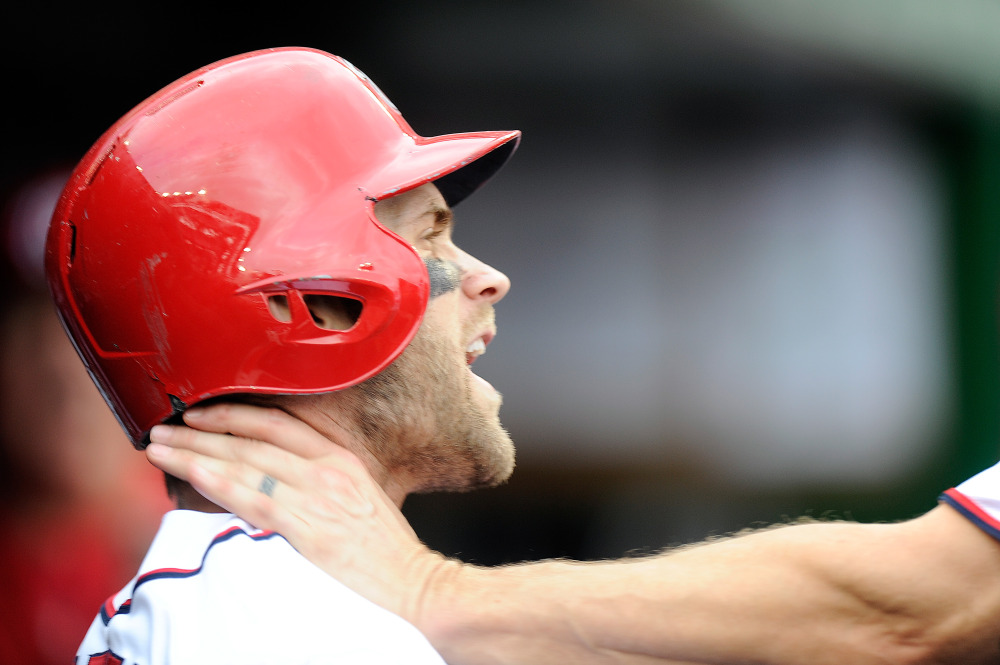
An Unethical Photo And Caption, And The Ethics Fog Of A Baseball Fight

WASHINGTON, DC - SEPTEMBER 27: Bryce Harper #34 of the Washington Nationals is grabbed by Jonathan Papelbon #58 in the eighth inning against the Philadelphia Phillies at Nationals Park on September 27, 2015 in Washington, DC. (Photo by Greg Fiume/Getty Images) ORG XMIT: 538595765 ORIG FILE ID: 490330798

According to USA Today and many other reputable news sources, Washington Nationals pitcher Jonathan Papelbon “choked” team mate Bryce Harper in a dugout altercation in full view of fans and TV cameras during yesterday’s loss to the Phillidelphia Phillies. The photo above, freezing the moment in which Papelbon’s hand touched Harper’s neck, was presented full page width in the Nats’ home town paper, the Washington Post.

Now here’s the video:

http://www.youtube.com/watch?v=t1HjwToIdSU

Papelbon’s hand was on Harper’s throat for less than a second, as opposed to the impression given by the still, in which you can almost hear Harper gagging ACK! GAH! LLLLGGGGHHH!  The USA Today headline “Bryce Harper was choked by Jonathan Papelbon in Nationals’ dugout fight” is pure sensationalism and an intentional misrepresentation. I’m not even certain Papelbon was trying to choke Harper, but if he was, he failed immediately because Harper backed away.

This incident transcends its context for ethical interest, because it demonstrates how much context and biases influence public and media assessments of right and wrong.

First, some context: Continue reading

Weekend Comment of the Day #2: “The VW Scandal: Huge Consequences, Simple Ethics Lessons, Ominous Implications”

GermanFlagVWThe second Comment of the Day, from prolific commenter Michael R, explores how the Volkswagen plot may have been nourished by industry-crushing over-regulation.

Here is his Comment of the Day on the post, “The VW Scandal: Huge Consequences, Simple Ethics Lessons, Ominous Implications”:

This scandal is worse that you present it. When you look at it, our government encourages such conduct. When you look at what happened, it sure looks like our wonderful Democrats hate the United States and the companies and working Americans. In 1998, the government went after US diesel manufacturers for a less-devious defeat device (it seems that it worked only when the engine was under strain and the emission controls worked at least some of the time during normal operation). They were fined and had to pay for environmental remediation to the tune of $1 billion. The software was not as essential to the running of the engines as VW’s, as the companies were able to make the engines compliant with a software fix.

Continue reading

Weekend Comment of the Day #1: “The VW Scandal: Huge Consequences, Simple Ethics Lessons, Ominous Implications”

VW handWeekend comments at Ethics Alarms are typically down about 20% on weekends, but they often make up in quality what they lack in quantity. There were several comments that materially enhanced the posts that inspired them, and I’m going to begin the week’s ethics safari by featuring a few as Comments of the Day.

The first is from Charlie Green on the VW scandal. This is his wheelhouse, and I was hoping he’d weigh in.

This is his Comment of the Day on the post, “The VW Scandal: Huge Consequences, Simple Ethics Lessons, Ominous Implications”

(I’ll have a brief note at the end.)

A similar point was made about the evident contradictions in ENRON’s mission statements. Just as this is an ethics issue, so is it a trust issue, and one I’ve been writing about as well.

The only thing I’d add is to caution against the simplification that these are conscious evil-doers. The truth is always messier.

I’m sure very few employees at VW felt a fully conscious awareness of wrong doing on their parts. That doesn’t mitigate the importance of full on prosecution of leaders, but it does mean we need to recognize the nature of human frailty and group-think, as well as the huge impacts of environment.

Demonization doesn’t work here past a few top people —like [resigned CEO]Winterkorn, who has no excuse for not having known. But this is also a particularly strong case for the proposition that environments pollute moral behavior – it’s not just bad apples.

The best case I’ve seen for this argument is here:
http://www.nytimes.com/2015/09/25/business/international/problems-at-volkswagen-start-in-the-boardroom.html?_r=0

And a great case for moral outrage not just at individuals but at our overall institutions is today, from the great Henry Mintzberg, here:
http://www.theglobeandmail.com/report-on-business/rob-commentary/volkswagen-corruption-crisis-isnt-a-scandal-its-a-syndrome/article26479332/comments/

To paint this as just a few evil blackhats gone wild is to miss the true nature of evil – it’s endemic in the culture, and that’s much scarier.

I’m back, just to note that Charles’ message is the one that had become the career cause of social scientist Phillip Zimbardo, whose work I have referenced several times.

Boehner, Leadership And The Consequentialism Exception

At the end of John Beohner’s press conference responding to his sudden resignation, there was this exchange:

QUESTION: Can you talk about what you think your legacy is as you’re leaving? What are your most important accomplishments, and what are you going to do on November 1st? Are you moving to Florida?

BOEHNER: I was never in the legacy business. You all heard me say it, I’m a regular guy with a big job. And I never thought I’d be in Congress much less I’d ever be speaker. But people know me as being fair, being honest, being straightforward and trying to do the right thing every day on behalf of the country. I don’t need any more on that.

I will frequently inveigh here against the fallacy of consequentialism, the mistake of believing that whether conduct is ethical or not can be judged by its results. This leads inexorably to an “ends justifies the means” orientation and a misunderstanding of ethics. The ethical nature of an act can only be weighed according to how it was arrived at, its intent, and whether the conduct itself meets the tests of one or more ethical systems. Then moral luck takes over: an ethical decision can have catastrophic consequences and still be ethical, and the most unethical conduct can have wonderful results.

In life, however, and especially in some fields, ethics isn’t enough, and we all know it, or should. This is why consequentialism can’t be snuffed out of our thinking. There are fields of endeavor in which results are the primary standard by which we can—and should— judge whether someone was competent in the role he or she took on for themselves when others could have done the job better. In these fields being ethical isn’t enough, and often is grossly inadequate.  If one is a leader, for example, it cannot be right to lead those behind you to disaster, indeed to fail. In a field that is defined by the successful completion of a task that affects others, failure and ethics are incompatible. A failed leader is a bad leader. The objective in leadership is not just to “do the right thing,” but to succeed at ethical objectives in the right way. Continue reading

The VW Scandal: Huge Consequences, Simple Ethics Lessons, Ominous Implications

VOLKWAGEN

In case you were too distracted by the Pope, you probably noticed that Volkswagen has been caught red-handed in a massive scandal involving cheating on the emissions testing of 11 million diesel-powered cars sold in recent years. The costs to the company may be as much as eighteen billion dollars in the US alone. This is by far the biggest of the many automotive scandals—the fiery Pinto, GM’s deadly ignition switches, Toyota’s self-accelerating cars or Ford-Firestone’s exploding tires—in scope, if not in public policy impact.

Diesel is more popular in Europe than in America, in large part because of environmental testing standards. Gasoline engines emit more carbon dioxide, diesel engines, which are more efficient fuel-wise, emit far more nitrogen oxides (NOx) than gasoline engines. Since the introduction of the US Clean Air Act of 1970, NOx emissions are subjected to more stringent controls than CO₂ emissions here, while across the pond, CO₂ is more tightly controlled than NOx. Thus diesel automobiles make up one third of the passenger vehicle fleet in Europe, but are a relative rarity in the U.S. The sales of diesel cars has been on the rise in recent years, however. Now we know why.

Volkswagen, which manufactures many of the beasts, devised and installed a code functioning as a “defeat device” to sense when one of its diesel vehicles was being tested for nitrogen oxide emissions. test. Once a test was detected, the software would reduce torque and NOx emissions, while under normal conditions, that is, when the vehicle was not being tested for emissions, the car would be guided by a separate program that would increase acceleration, torque, and fuel economy.

Clever! Also unethical and, obviously, illegal. Continue reading

Audience Ethics And Ethics Dunce Kelvin Moon Loh

"I hear child screaming in audience, so audience cannot hear King. Is a puzzlement! But brave..."

“I hear child screaming in audience, so audience cannot hear King. Is a puzzlement! But brave…”

I don’t want to be harsh, because Mr. Loh is obviously a sensitive and compassionate young man who means well. However, he is also receiving plaudits on Facebook and in the media for taking a position that is not ethical, and is in fact just more political correctness guilt-mongering and double standard-peddling. It is also likely to provoke disrespectful and arrogant parents to believe that they have a right to impose their problems on unsuspecting theater audiences.

At  Broadway’s Vivian Beaumont Theater, a screaming child disrupted a matinee performance of “The King and I.”  Some members of the audience agitated for the child to be removed, and the woman with the child indeed left.

One of the understudies in the production, Kelvin Moon Loh, defended the woman who brought the child to the performance in a post on his Facebook page, in which he assumed the kid was autistic and used the incident to argue for compassion and “inclusiveness” in the theater, and compassion.  Loh actually praised the woman as “brave.” Brave she may be; she also was selfish, irresponsible, disrespectful and absolutely wrong.

This is not an issue of tolerance. This is not an issue of compassion. The ethical issue is whether one person has a right, and can be right, to ruin a theatrical performance for the rest of the audience, or to unreasonably risk doing so. It’s an easy call: noNever. It is no more “brave” to take a child who cannot behave properly to a Broadway show (or any show) than it is to take a cranky infant to a movie. This is not like the airplane situation, where the mother has no choice, and the child’s noise doesn’t interfere with the flight’s main purpose, which is to get to the destination. The mother doesn’t have to see “The King and I,” nor does she have to bring her child to potentially disrupt it. Doing so is inconsiderate; defending her conduct, as Loh does, stands for a kind of etiquette affirmative action, in which being the mother of an autistic child relieves one of any obligation to care about anyone else. Continue reading

An Eight-Year-Old New Jersey Girl Is Waiting For Her Invitation To The White House…

Left: Potentially harmful to the academic environment. Right: A positive influence on students' behavior.

Left: Potentially harmful to the academic environment. Right: A positive influence on students’ behavior.

Proposition: Any educational system that can produce a headline like this…

Girl suspended from school for wearing wrong shade of green

…needs help desperately.

Or to be torn down and reconceived completely. I am tending toward the latter.

The headline is in fact correct. Winslow Township Elementary School No. 4 sent an eight-year old girl home  for wearing a Kelly green polo shirt, which was deemed to be in violation of the Camden County (New Jersey) school’s dress code, decreeing that shirts and blouses may only be white, navy blue, or dark green.  This is important, for as the  Winslow Township School’s code on dress and grooming points out “school attire can influence a pupil’s behavior and potentially impact the academic environment.”

This kind of mindless autocratic abuse of children causes them to become cynical, angry, submissive, fearful, distrustful of adults, or contemptuous of authority, none of which are good. The President of the United States, since he appears to be in the business of addressing local school wrongs, could perform a service by humiliating these cruel, dim-bulb administrators and their many equivalents by inviting this victimized young lady to the White House. But then she’s not a Muslim, or dark skinned, or a kid who pretended to invent something when he didn’t, so forget it.

I’m sorry I mentioned it.

________________________

Pointer: Fark

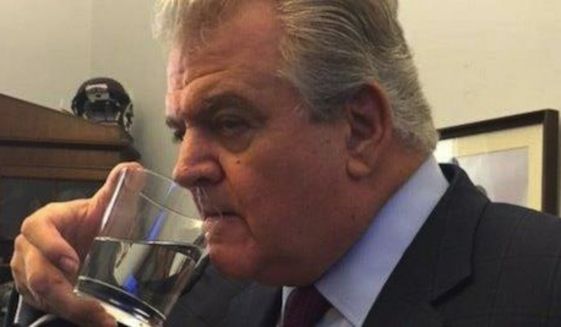
Incompetent Elected Official Of The Week: Rep. Bob Brady (D-Pa.)

bob_brady_pope

From the Washington Times:

“As Congress members rushed to touch Pope Francis after Thursday’s historic address on the House floor, Rep. Bob Brady reportedly made a beeline for the podium to swipe the Holy Father’s discarded water glass.

The Pennsylvania congressman immediately took a sip out of the glass and brought it back to his office, ABC News reported

“The congressman is a Catholic and has immense respect for the Holy Father,” Rep. Brady’s Chief of Staff Stan White told ABC.

His office confirmed that Mr. Brady drank from the water and shared it with members of his staff and his wife, Debra Brady…The congressman kept the remainder of the water and plans to sprinkle it on his grandchildren, Mr. White said.”

Actually, I don’t know what to call this conduct.  Creepy? Superstitious? Embarrassing? Unsanitary? Silly? Bizarre? Funny? Deranged?

Incompetent will just have to suffice.

Does every glass the Pope drinks from become like the Holy Grail? I’d be careful, if I were were the Congressman…

Brady’s antics make the entire government look foolish. There’s religious belief, and there is irrational conduct. One doesn’t have to lead to the other, but such a display should cause serious voters to pause and wonder whether a man who acts like this belongs in a high office, or even a not so high office.

What an idiot.

UPDATE: After I posted this about an hour ago and had to run an errand, I began wondering whether Brady’s reverence for the Pope, which seems to extend to a belief that his lips are magic, also extends to accepting Catholic doctrine and what the Pope advocates, at least when these don’t conform to the Democratic Party’s platform. Here are Brady’s votes on abortion. A summary: Brady has voted for the most extreme pro-abortion positions. Reconcile that, if you will, with his water glass stunt.

I cannot comprehend Catholics who embrace this kind of hypocrisy and cognitive dissonance, nor can I respect any voter who would observe Brady and say, “Now there’s a man of integrity, wisdom and judgment!”

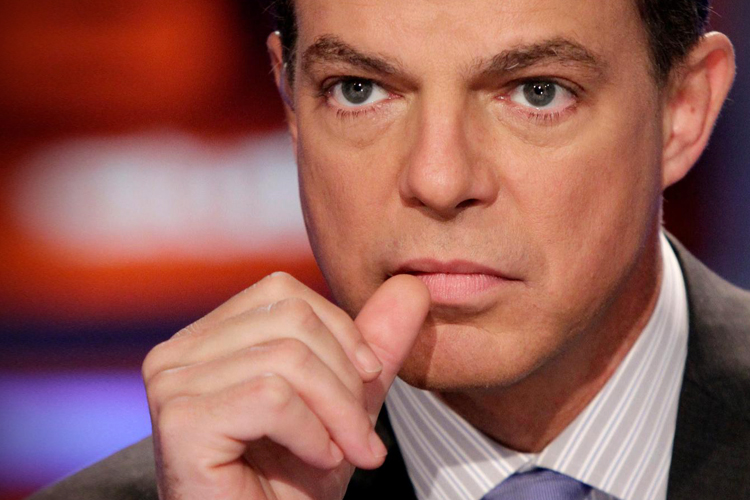
Ethics Quote Of The Week: Fox News Anchor Shepard Smith

Looks thoughtful, sounds thoughtful, isn't thinking...

Looks thoughtful, sounds thoughtful, isn’t thinking…

“I don’t know…I think we are in a weird place in the world when the following things are considered political. Five things, I’m going to tick them off. These are the five things that were on his and our president’s agenda. Caring for the marginalized and the poor — that’s now political. Advancing economic opportunity for all. Political? Serving as good stewards of the environment. Protecting religious minorities and promoting religious freedom globally. Welcoming [and] integrating immigrants and refugees globally. And that’s political?”

—-Fox News anchor Shep Smith last week, responding to critics of the Pope’s visit to the U.S. and his message, as it was being celebrated by Democrats, Catholics, intellectually dishonest progressives, and, apparently, naive news anchors.

The short answer to Smith’s question is, “Of course it’s political. All of those issues are political.” I would also add, “How can you report political news and not understand that they are political?”

Now I’m going to tick them off:

….”Caring for the marginalized and the poor” requires time, money and personnel, as well as planning and efficiency. All of those in turn require re-allocating resources away from other needs and activities, including important ones that allow people to avoid poverty and marginalization. A society that makes cariung for the non-productive members of society its first priority becomes non-productive itself. So where does “caring for the marginalized and the poor” fit on the priority list? What is the definition of  “the marginalized and the poor”? The Pope doesn’t have to define them, but to seriously create policy that accomplishes the goal of “caring for” them—which also requires a definition—is a political task.
Continue reading

If Anyone Starts Paying Attention To What Bernie Sanders Is Saying, He’s In Trouble

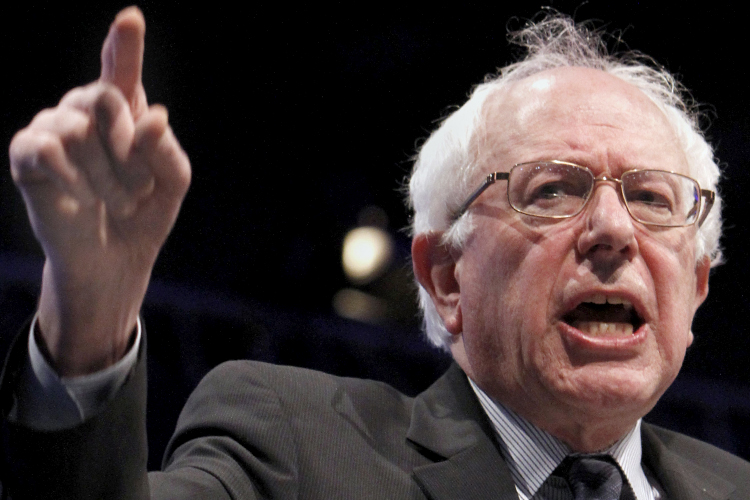
U.S. Sen. Bernie Sanders, I-VT, gestures as he speaks at the Californi Democrats State Convention in Sacramento, Calif., Saturday, April 30, 2011. Sanders called on Democrats to work together to stop what he calls the GOP's attack on the middle class.(AP Photo/Rich Pedroncelli)

So far, Bernie Sanders’ major function in the Democratic presidential nomination race is as a gauge of how badly Hillary Clinton is doing. The same function could be served by a wooden spoon or an Elmo doll, but Bernie will do: as Hillary’s machinations and lies about them sloooowly convince even Democrats that she should not be allowed near any office that includes a button labeled “Power,” he rises in the polls. So far, this had not required anyone actually thinking about Sanders himself, but the contents of a recent speech to a throng in Portland, Oregon should be cause for alarm. Sanders managed to announce his willingness to rig the Separation of Powers and eliminate judicial independence as well as his contempt for judicial ethics and his ignorance of how the Supreme Court works, all at once. All of this indicates that Sanders really isn’t qualified to be a U.S. Senator, much less President.

In his speech, to the sounds of cheers, Bernie shouted, “My nominees to the U.S. Supreme Court will in fact, have a litmus test and that test will be that they will have to tell the American people that their first order of business on the Supreme Court will be to overturn Citizens United.” Those cheers are interesting. My guess would be that not a single member of the audience, and quite possibly not even Bernie himself, has read the decision. Most people who turn red in the face and twitch when one mentions Citizens United do so because they think that it stands for the proposition that “corporations are people.”

It actually stands for the rather reasonable principle that the First Amendment protects the rights of people who band together for common purposes, and who wish to use such organizations to express their opinions regarding elections. The decision forbade the government from restricting independent political expenditures by a nonprofit corporation, and by extension to for-profit corporations, labor unions and other associations. Among other things, the law that was struck down in the case allowed the Federal Government to ban books and films based on content. Continue reading