KABOOM! Did A School Really Try To Brainwash A Second Grader? [UPDATED]

kaboom-red

The comments to a perfectly sane article about the value of teaching logic and critical thinking in elementary school are fascinating, terrifying, aggravating and all too typical in some ways. For example, it takes just 25 comments or so before some of the participants start calling each other names based on their assumed political views. The entire thread is enlightening reading, but the most provocative part is the discussion sparked by this comment:

If you teach your kids logic they’ll have conflicts with their teachers lol. I know because all of mine have had issues and it should not be this way. My youngest corrected a teacher in the 2nd grade because she was teaching something wrong. My daughter ended up going to ISS(in school suspension). I was called and they said while your daughter was correct, she cannot correct a teacher. They had put my daughter in ISS and wrote on the whiteboard 4=eight and as soon as my daughter agreed with that statement she could go back to class. She was in ISS all day. I was proud of my daughter and disgusted with everyone that would treat a 2nd grade little girl the way they treated her. Was glad that she wasn’t in that school very long.

This is also the source of the KABOOM!, as you can see. North Korean brain-washing methods have apparently penetrated some parts of the American teaching establishment. My head exploded in protest, but I can’t say I’m surprised.

Some random observations, and then I’ll leave the reactions to you: Continue reading

Thanksgiving Ethics From The “Fear Of Being Shot Causes Broken Ethics Alarms” Files

Bridgeport, Connecticut police stopped cars on the day before Thanksgiving, and surprised the motorists by handing them turkeys rather than tickets.

Awww!

Too bad it’s per se unethical conduct, an abuse of power and position, and a dangerous precedent. This is unpleasant déjà vu, for I’ve written this post before, more than once, and as many times in this year than the previous seven years combined. It’s pretty obvious why. Police, who were being shot and ambushed all over the country last week, are desperate to endear themselves to citizens and validate their role as a beneficent force in the community, which needs no validation.

“It’s a way of giving back, reaching out to the community and making sure everyone has a meal for thanksgiving,” says Bridgeport Police Capt. Roderick Porter, not getting it at all. I wonder what would have happened if one of those turkey stops was a fleeing felon. Would objections have been raised if the white cops only stopped black motorists, to say “We like you! We really like you! Here’s a turkey!”

Here comes the déjà vu again: As I wrote about the ice cream caper, which was pretty much the same thing: Continue reading

More Noose Ethics: In Virginia, Affirmation That The Constitution Permits One To Be Racist And Talk Like A Racist, But Not To Do THIS

nooseThe Virginia Court of Appeals took on the case of a man convicted of violating a state law prohibiting displaying a noose with the intent to intimidate, in violation of Va. Code § 18.2-423.2. Actually, Jack Turner did a bit more than that. The noose was hanging from a tree on his property and was on the neck of a dummy appearing to portray a black man. However, the law only prohibits a citizen from displaying a noose in a public place, and this was, his lawyers argued, Constitution-protected speech on private property. Turner was appealing his sentence of five years in prison (all but six months were suspended).

No doubt about it, this was “hate speech”; Turner admitted it.  After his African American neighbor reported the display to police, who questioned him about his intent, Turner initially said that the hanging black dummy was “a scarecrow.” When it was pointed out that he had no garden, Turner elaborated by explaining that he was a racist, and “did not like niggers.”

At the trial, one of Turner’s African American neighbors testified that after seeing the hanging dummy he was especially upset when he saw the dummy because nine African-Americans had been killed in the Charleston South Carolina church shooting earlier in the same day. The neighbor’s wife testified that she now feared for her family’s safety.  After the incident, the parents no longer allowed their sons to walk past Turner’s house, because, they said, they didn’t know what else a man who hanged such a warning was capable of doing. For his part after he was forced to remove the hanging black effigy, Turner continuously hung a Confederate flag in a window  facing his neighbor’s home. Great neighbor.

Hate speech, however, is still protected speech. As the Supreme Court confirmed last session, to be legally prohibited hate speech must constitute a “true threat,” meaning that a speaker means to communicate “a serious expression of an intent to commit an act of unlawful violence to a particular individual or group of individuals,” even where the speaker does not “intend to carry out the threat.” Prohibitions of true threats protect individuals from “fear of violence and from the disruption that fear engenders.”

The Court of Appeals didn’t have to exert itself to find that when a man hangs a noose with a black figure dangling from it within view of his African-American neighbors’ house, it indeed constitutes a “true threat.” The Court found the display, after reviewing the history of lynchings in Virginia and the powerful symbolism carried by Turner’s noose, comparable to a burning cross, Continue reading

Trump, Master Of Rationalizations, Scores A Perfect #4 AND A Perfect #5!

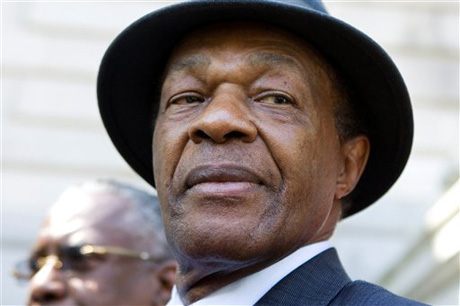
Former District of Columbia Mayor Marion Barry attends a news conference on the steps of Washington's city hall Monday, July 6, 2009. At the news conference Barry's attorney Frederick Cooke said Barry vehemently denies the allegation by Donna Watts-Brighthaupt, and that he's confident the stalking charge will be dropped. Barry, 73, stood behind Cooke but said nothing. (AP Photo/Manuel Balce Ceneta)

Somewhere, Marion Berry is smiling…

This is juuuust the beginning…

I have noted before that our President Elect never expresses any ethical awareness, and uses rationalizations exclusively to explain and justify his conduct. This is typical of say, 12-year-olds, but is less common among professionals in responsible positions.

Trump just authored a classic example, following the expression of concerns about his conflicts of interest, which are massive, unavoidable, and which should have been addressed seriously long ago, like in a Presidential debate, and at length. Unfortunately, Hillary Clinton and various journalists felt it would be more helpful to their cause to spend time talking about what Trump had said about an over-weight Miss Universe and in a private conversation with Billy Bush. How did that work out for you, guys?

Now various lawyers and ethics experts are saying that Trump “must” sell off his business holdings because his company’s myriad business entanglements will cast many White House decisions under a cloud. The President Elect has a neat answer for them, to wit:

“The law’s totally on my side, meaning, the president can’t have a conflict of interest.”

— Donald Trump, interview with the New York Times, Nov. 22, 2016

Bravo! This is a perfect expression of Ethics Alarms Rationalizations #4, and #5

4. Marion Barry’s Misdirection, or “If it isn’t illegal, it’s ethical.”

The late D.C. Mayor and lovable rogue Marion Barry earned himself a place in the Ethics Distortion Hall of Fame with his defense of his giving his blatantly unqualified girlfriend a high-paying job with the DC government. Barry declared that since there was no law against using the public payroll as his own private gift service, there was nothing unethical about it. Once the law was passed (because of him), he then agreed that what he did would be wrong the next time he did it.

Ethics is far broader than law, which is a system of behavior enforced by the state with penalties for violations. Ethics is good conduct as determined by the values and customs of society. Professions promulgate codes of ethics precisely because the law cannot proscribe all inappropriate or harmful behavior. Much that is unethical is not illegal. Lying. Betrayal. Nepotism. Many other kinds of behavior as well, but that is just the factual error in the this rationalization.

The greater problem with it is that it omits the concept of ethics at all.  Ethical conduct is self-motivated, based on the individual’s values and the internalized desire to do the right thing. Barry’s construct assumes that people only behave ethically if there is a tangible, state-enforced penalty for not doing so, and that not incurring a penalty (that is, not breaking the law) is, by definition, ethical.

Nonsense, of course. It is wrong to intentionally muddle the ethical consciousness of the public, and Barry’s statement simply reinforces a misunderstanding of right and wrong.

Continue reading

Note To Conservatives On The “Hamilton” Cast’s Harassment Of Mike Pence: I’ve Got This. You’re Not Helping.

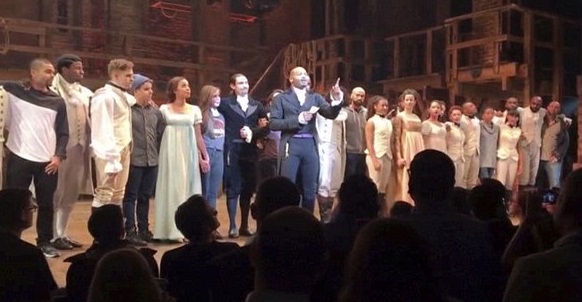
grandstand-hamilton

The problem is that, as you might guess, Trump-supporting Republican and conservatives are as ethically clueless as the Democrats attacking them.

Now there is a backlash against the “Hamilton” actors who singled out an audience member (who happened to be the Vice-President Elect) for specific abuse last week, because, the theory goes, elected officials who a cast doesn’t like shouldn’t be able to attend live theater without entailing the risk of being harassed. Ethics Alarms has been very clear about why this is wrong in every way, and all rebuttals have boiled down to “But we don’t like Mike Pence or Donald Trump, so we should be able to suspend ethics!”

Keep telling yourselves that.

Now it has been discovered that some of the “Hamilton” grandstanders probably didn’t vote in the election, and the actor whose mouth was used to issue the lecture to Pence had himself authored some Trump-like misogynist  rhetoric in a tweet or two. This is supposed to prove hypocrisy, and undermine the legitimacy of the cast’s ambush.

It doesn’t do this, because the cast’s stunt had no legitimacy at all, votes or not, hypocrisy or not.

Is the whole Trump term going to be like this? I fear so, since the incoming President literally is bewildered by all concepts ethical, and his defenders appear to be similarly disabled.

Look: if it is per se unethical and wrong for a theatrical production to turn on audience members without consent or warning to humiliate, threaten or accost them, the qualifications of the cast members engaging in this harassment can’t make the unethical act more or less so. Continue reading

Well, These Episodes WOULD Have Helped Elect Donald Trump, If He Hadn’t Been Elected Already…

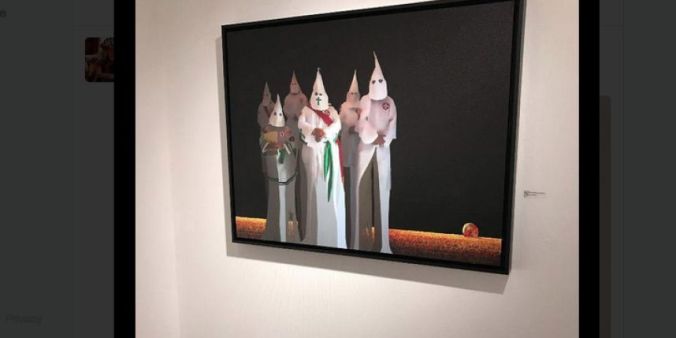
kkk-art

I can’t bring myself to be thankful for the election of a President who has horrified and revolted me for the better part of a decade, but I am thankful that some troubling trends and attitudes in our society and culture have received the metaphorical slap in the face that Trump’s victory delivered. The Ethics Alarms tag “This will help elect Donald Trump” is about to be retired, but when mourning progressives ask you today, while passing the gravy, “Why? Why?”, you should direct them to this link, and this post.  If they don’t help, they are are beyond helping.

Three awful stories surfaced after the election, two of them yesterday, that illustrate the kinds of social dysfunction that have been nurtured in the Obama years, and if a Trump administration can erase them and their ilk, returning some sanity to the national landscape, no one will be able to say the Trump experiment was a total bust…

1. First, and most unforgivable, we have this recent quote from Bernie Sanders’ former spokeswoman, Symone Sanders (no relation). Appearing on CNN yesterday and talking about the future of the shell-shocked Democratic Party, she said in part…

“In my opinion we don’t need white people leading the Democratic party right now.”

On April 6, 1987, Dodger executive Al Campanis appeared on  the ABC News show “Nightline,” and infamously said that black people couldn’t be major league baseball managers. The statement caused an uproar, and Campanis, whom nobody who knew him regarded as a racist, lost his job and career. Symone Sanders’ comment, which like that of Campanis equates the ability to do a job with race, is no less offensive than what Campanis said, but similar sentiments are broadcast frequently from black public figures without widespread obfection or consequence. ( Sanders also said sarcastically this month, after the election, when shown a video of a mob beating up a Trump supporter, “Oh my goodness, poor white people!”)

Acceptable anti-white racism and a bigotry double standard both defy American values, including basic decency, respect and fairness, but there are seldom consequences for shameless bigots like Sanders, except the cumulative one of having the people she and others denigrate for their color and ancestry sticking the human thumb named Donald Trump in their eyes.

It is no more racially biased for white Americans to take offense at the broad negative stereotyping endorsed by Sanders than for black Americans to oppose white supremacists…or clueless passive bigots like Al Campanis. Their anger at being told their skin disqualifies them for any job is justified, and the fact that news media talking heads nod respectfully at racist bile like the comments of Symone Sanders is further justification. (  Ted Koppel’s reaction to Campanis’s jaw-dropping statement 30 years ago can be fairly summarized as, “Wait…what? ) Not happily voting for a political party that embraces individuals who want to marginalize you because of race or gender isn’t bigotry, as the current Bitter Hillary Fan narrative now styles it. It is common sense.

Promoting racial division and bias is unhealthy and un-American no matter what direction it comes from. Until everyone can be certain that the Democratic Party is on board with that concept, and until proud and arrogant racists like Symone Sanders are shown the same level of tolerance Al Campanis received—that is, none—distrust of  progressives and the news media will grow, and should. Continue reading

From The “Rules Are Rules” Files: China’s “No Arms, No Loans” Policy

Don't be afraid of Wu, you banks! He's completely armless!.

Don’t be afraid of Wu, you banks! He’s completely armless!.

Just when you are tempted to think the United States leads humanity in outrageous bureaucratic rigidity and the refusal to make sensible exceptions when common sense and decency demand it, a story like this one comes across the wires to restore one’s faith that cruelty and stupidity are universal.* That’s something to be thankful for…isn’t it?

Maybe not.

Wu Jianping, a 25-year-old teacher from Zhengzhou in the Henan province of China, told the news media there that banks have denied his application for a mortgage loan because he had inadequate identification.  Banks in China require fingerprints for loans, and Wu has no fingers. In fact, he has no arms, having lost both of them when he was electrocuted in an accident at the age of five.

Jianping says he typically writes his signature by holding a pen in his mouth, but banks rejected his loan applications on the grounds that his written signature can be easily imitated, presumably by anyone holding a pen in his mouth, and they don’t accept toeprints.

“Fingerprinting is a common practice because signatures can be imitated, but there is no way to copy a fingerprint,” one bank employee was quoted as saying. Ah. And just how does someone impersonate a loan applicant with no arms? How many 25 year-old teachers without arms are there in China, anyway? Are people always coming up to Wu Jianping in the streets of Beijing, where he works, and telling him, “I’m sorry! I mistook you for someone else” ?

The banks are receiving widespread criticism online and in social media, with many writing that demanding fingerprints from an armless man is unreasonable. Gee, ya think? Let’s have a panel discussion about it. Now some of the banks are apparently relenting. That’s generous of them.

I bet George Bailey would have given Wu a loan…

[Ethics Alarms will now open up the thread to all the terrible jokes anyone wants to submit, as my Thanksgiving gift to the readership. I might as well, since I know you will make them anyway. I reserve the one in the caption, one of my all-time favorites, and also “Well, they can’t accuse him of asking for a hand-out!”, because I wanted to write it first, and it’s my blog, so there. But there are a lot more. A lot.]

*One of the very first posts on Ethics Alarms highlighted a similar episode in an American bank. [Thanks to Tex for reminding me!]

_______________________

Pointer: Fark


At Least They’re Keeping An Open Mind…

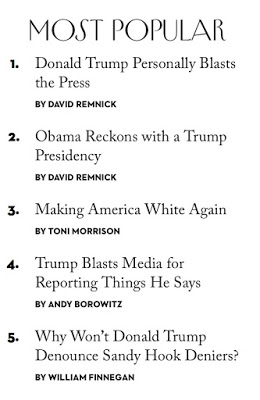
new-yorker-best

Ann Althouse, who flagged this, wrote, “Oh, New Yorker!”

She’s right: what a relentlessly negative and divisive way to welcome a new President. The New Yorker is supposed to be the flagship publication for sophisticates and intellectuals. The better term for the audience appears to be “bitter snots.”  The flagship is playing to the mob, Althouse suggests. Is that all the media has become? Clickbait purveyors and the reinforcement of pre-existing biases, fears and prejudices?

I’ve been around a long time. I have never seen those on the losing side of any election behave so nastily, defiantly and unfairly. It reflects poorly on the nation, its politics, and its journalism, but it really reflects badly on Democrats and liberals. I’m embarrassed for them.

Ann tags this “Trump derangement syndrome.” That is too kind.

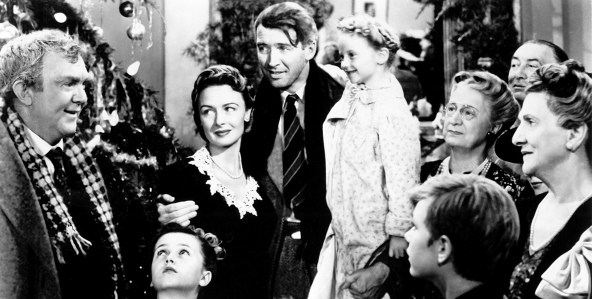
The Complete “It’s A Wonderful Life” Ethics Guide [UPDATED AGAIN! ]

 Once again, Ethics Alarms re-posts its ethics guide to Frank Capra’s 1946 masterpiece “It’s A Wonderful Life,”one of the great ethics movies of all time. It was written in 2011, and revised regularly since, including for this year’s version. I suspect we need it more in 2016 than usual.

It is fashionable now, and was even when the film was released, to mock its sentiment and optimism. On one crucial point Capra was correct, however, and it is worth watching the film regularly to recall it. Everyone’s life does touch many others, and everyone has played a part in the chaotic ordering of random occurrences for good. Think about the children who have been born because you somehow were involved in the chain of events that linked their parents. And if you can’t think of something in your life that has a positive impact on someone–although there has to have been one, and probably many—then do something now. It doesn’t take much; sometimes a smile and a kind word is enough. Remembering the lessons of “It’s a Wonderful Life” really can make life more wonderful, and not just for you.

Here we go:

1. “If It’s About Ethics, God Must Be Involved”

The movie begins in heaven, represented by twinkling stars. There is no way around this, as divine intervention is at the core of the fantasy. Heaven and angels were big in Hollywood in the Forties. Nevertheless, the framing of the tale advances the anti-ethical idea, central to many religions, that good behavior on earth will be rewarded in the hereafter, bolstering the theory that without God and eternal rewards, doing good is pointless.

We are introduced to George Bailey, who, we are told, is in trouble and has prayed for help. He’s going to get it, too, or at least the heavenly authorities will make the effort. They are assigning an Angel 2nd Class, Clarence Oddbody, to the job. He is, we learn later, something of a second rate angel as well as a 2nd Class one, so it is interesting that whether or not George is in fact saved will be entrusted to less than Heaven’s best. Some lack of commitment, there—then again, George says he’s “not a praying man.” This will teach him—sub-par service!

2. Extra Credit for Moral Luck

George’s first ethical act is saving his brother, Harry, from drowning, an early exhibition of courage, caring and sacrifice. The sacrifice part is that the childhood episode costs George the hearing in one ear. He doesn’t really deserve extra credit for this, as it was not a conscious trade of his hearing for Harry’s young life, but he gets it anyway, just as soldiers who are wounded in battle receive more admiration and accolades than those who are not. Yet this is only moral luck. A wounded hero is no more heroic than a unwounded one, and may be less competent as well as less lucky.

3.  The Confusing Drug Store Incident

George Bailey’s next ethical act is when he saves the life of another child by not delivering a bottle of pills that had been inadvertently poisoned by his boss, the druggist, Mr. Gower. This is nothing to get too excited over, really—if George had knowingly delivered poisoned pills, he would have been more guilty than the druggist, who was only careless. What do we call someone who intentionally delivers poison that he knows will be mistaken for medication? A murderer, that’s what.  We’re supposed to admire George for not committing murder.

Mr. Gower, at worst, would be guilty of negligent homicide. George saves him from that fate when he saves the child, but if he really wanted to show exemplary ethics, he should have reported the incident to authorities. Mr. Gower is not a trustworthy pharmacist—he was also the beneficiary of moral luck. He poisoned a child’s pills through inattentiveness. If his customers knew that, would they keep getting their drugs from him? Should they? A professional whose errors are potentially deadly must not dare the fates by working when his or her faculties are impaired by illness, sleeplessness or, in Gower’s case, grief and alcohol.

4. The Uncle Billy Problem

As George grows up, we see that he is loyal and respectful to his father. That’s admirable. What is not admirable is that George’s father, who has fiduciary duties as the head of a Building and Loan, has placed his brother Billy in a position of responsibility. As we soon learn, Billy is a souse, a fool and an incompetent. This is a breach of fiscal and business ethics by the elder Bailey, and one that George engages in as well, to his eventual sorrow. Continue reading

Let’s Hear No More About Facebook “Values”

china-facebook-1024x576

The New York Times reports that Facebook has developed software that will enable partner Chinese companies to monitor popular stories and topics that Facebook users share across the social network. Facebook’s partner would have power to decide whether those posts should show up in users’ feeds and suppress posts from  in specific geographic areas. The censorship and information-suppressing software  was created to help Facebook get into China, a lucrative market where the social network has been blocked. CEO Mark Zuckerberg is, sources say, full supportive of this effort by Facebook to make the subjugation of Chinese liberty easier.

One of Facebook’s core mission statements is “Make the world more open and connected.” Like so many mission statements, it is public relations deception. If Facebook was devoted to this mission, it would not even consider breaching its intent, letter and spirit by spending time and money to develop censorship software.

Facebook’s real mission is making a fortune by expanding into new markets. Let us not debase the topic of this blog by defaulting to Rationalization # 25. The Coercion Myth: “I have no choice!”

Facebook has a choice, the ethical one. That choice is to tell China it has a choice: either accept Facebook without censorship, of do without it. Google and Twitter, neither exactly paragons of virtue, have been blocked there for refusing to yield to the government’s  censorship requirements. Boy, when a company isn’t even as ethical as Twitter..wow.

This is the company we are going to trust to decide what is “real news.”  Ridiculous.

Prominent Democratic Party supporter Zuckerberg, like the party itself, is insufficiently allergic to the methods and objectives of totalitarianism.