From The Double Standard Files: I Just Watched Ellen Degeneris Sexually Harass Jake Gyllenhaal On TV…Why Is That OK?

jake-gyllenhaal-ellen

That was a rhetorical question. It isn’t okay. It’s sexual harassment. It’s a double standard. And it’s wrong.

I must admit, I’m kind of ticked off about it.

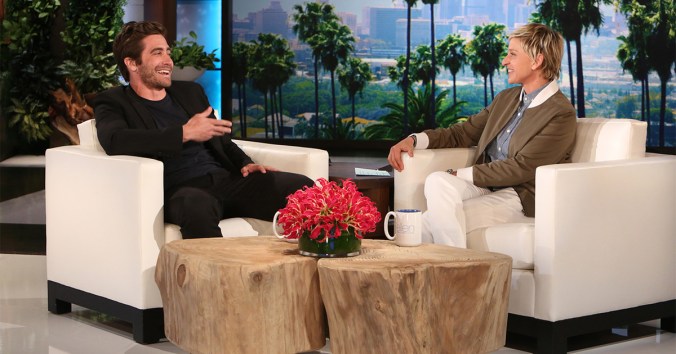
Jake Gyllenhaal is a marvelous and attractive young actor, currently starring on Broadway in the revival of Sondheim’s “Sunday in the Park With George.” He’s also a favorite guest of Ellen Degeneris, America’s favorite openly gay TV talk show host. I don’t usually watch “Ellen,” but I was in a dentist’s chair getting SIX cavities filled (Remember Dudley Moore in “10”? Like that.) and that was on the telly while I was suffering.

Ellen spent easily five minutes nagging Jake to take off his shirt. Well, it’s possible it was less: time seems to pass slowly when you are watching a famous and beloved Hillary Clinton supporter engage in unethical sexual conduct that is far, far more substantive than anything Billy Bush did when he was caught on tape with Donald Trump, and there are drills, rubber devices, cotton and random finger in your mouth.

Try it some time. You’ll see. Continue reading

Halloween Ethics Meets Campus Ethics Meets The First Amendment, And Stupidly, Too

costume-lunching

I didn’t want to write about this, as I am having to defend too many jerks of late,but multiple readers have flagged it, and besides, there hasn’t been a good Halloween costume controversy this year. This one isn’t good, but it will have to do.

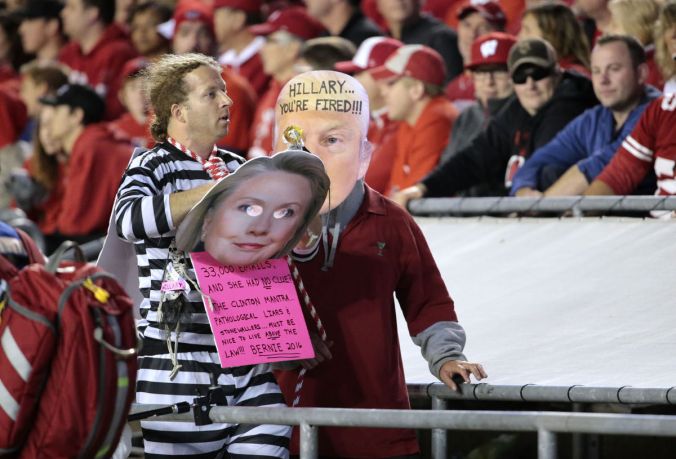
During the University of Wisconsin football home game against Nebraska, one fan in faux prison garb wore a mask of Democratic presidential nominee Hillary Clinton over his face, and a mask of Obama on the back of his head, as another person wearing a mask of Republican nominee Donald Trump held the end of a noose that was looped around the Hillary/Obama individual’s neck.

Key points:

1. It was Halloween weekend. Costumes were not out of place.

2. It was a two person costume, and an incoherent one that would support multiple interpretations. Was it an attack on Trump, accusing him of being racist or wanting to harm Hillary? Was it an endorsement of Trump, arguing that Hillary should be punished? Was it intended to evoke lynching imagery? Was it saying that Hillary was the equivalent of Obama? A sign worn by Hillary/Obama, which nobody who wasn’t close up could read, concluded, “Bernie 2016.”

3. This was unequivocally political speech, whatever it was supposed to mean.

4. The University has some discretion to forbid expression and conduct at a sporting event that risk creating violence or that are objectively uncivil .

5. Anyone who uses lynching imagery in public, in any connection to a back public figure, or any African American at all, is an asshole at best. This is a public event intended to be entertaining and a family-friendly activity. Using it for political theater is obnoxious. The civil place for this costume, if anywhere, was in front of the stadium, on the sidewalk. Continue reading

Unethical Quote Of The Week: White House Spokesman Josh Earnest

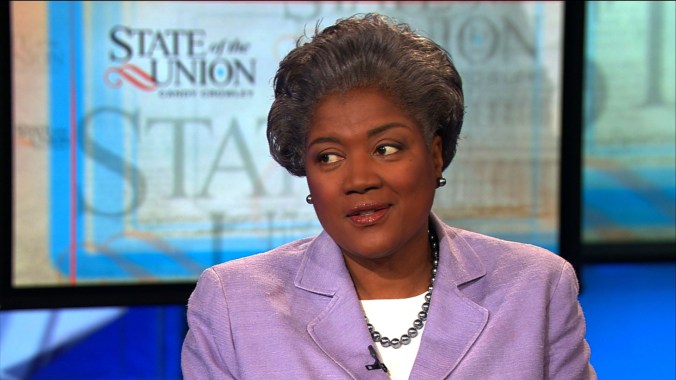
Donna Brazile on State of the Union with Candy Crowley

“Those of us who have known Donna a long time, know that she is a person of integrity and she is a person of high character.”

—-White House spokesman Josh Earnest, responding to a press briefing question about whether DNC chair Donna Brazile, revealed to have unethically used her CNN connection to acquire questions to be posed to Hillary Clinton in a town meeting and a televised debate, and to have passed them along to the candidate, who then pretended to answer them spontaneously.

Thus we now know what the President, his spokesman and Democrats officially regard as “integrity” and “high character.”

Cheating. Continue reading

Latest Ethics Notes On The Hillary Clinton E-Mail Scandal Ethics Train Wreck, Part I

train-wreck-air

[The first example of an Ethics Train Wreck or ETW (Ethics Alarms Definition: Ethics train wrecks are chains of unethical conduct created by a central unethical action. As the event becomes more complex and involves more participants, it becomes increasingly difficult to sort out right from wrong, and all parties who become involved with the episode in any way are at risk of engaging in unethical conduct themselves, intentionally or inadvertently.) that spawned a second ETW, or sub-train wreck to a train wreck, was the Trayvon Martin-George Zimmerman ETW, which has launched  several (Ferguson, Freddie Gray). I am now forced to designate the Hillary Clinton E-Mail Scandal, previously just a prominent car, perhaps even the engine, on the Hillary Clinton Presidential Candidacy Ethics Train Wreck, as an ETA itself. Since the revelation of the letter FBI director Comey sent to Congress explaining that the investigation into possible Clinton criminal wrongdoing regarding her reckless handling of official State Department communications was no longer to be considered “completed,” passengers have been leaping onto this rampaging juggernaut like there was free Halloween candy on board. I have no choice. In what I fear will be just the first of many, this post will sort out the latest developments.]

1. The word that best expresses the reaction of the Clinton campaign, its media allies and Hillary’s supporters is fury. The emotion in this context resembles the moment in every action film when the super-villain or evil mastermind who was sure that victory was his suddenly discovers that through an amazing confluence of factors, he’s going to lose after all. This comparison is not flattering to Hillary, her minions and her corrupted, but it is apt. They really believe that they deserve to get away with years of unethical and incompetent conduct and more than a year of lying about it, and go into election day with it all a distant memory, sure to be spun as just another conservative “nothingburger” …until the next time.

If there is anything worse than unethical practitioners of politics, it is smug and arrogant ones. To some extent I resent being led so forcefully to schadenfreude, but still, this crew so deserves its present pain!  They also deserve to have voters go into their booths November 8 still uncertain of just how dishonest and corrupt Hillary Clinton is, wondering if, as with Richard Nixon in 1972 (Hillary is this generation’s Nixon, except that he was more skilled, and she has the gender card to play), there are more ugly shoes to drop.

I have written this before and recently, but it bears repeating: Hillary Clinton has nobody to blame for this crisis but herself. She could have played by the rules; she could have turned everything over to State immediately, including the mysterious 30,000 “personal” emails; she could have admitted misconduct and ignorance; she could have been honest to journalists and the public. If she had done these things, the entire episode would have been negated before 2015 was out. Being angry at James Comey makes as much sense as Trump being angry at his various sexual assault accusers, and it is just as much an indication of base character.

2. The news media’s taking the cue from the Clinton campaign and reporting this as a James Comey/ FBI story is yet more proof of news media bias and its efforts to assist Clinton. Comey was cheered by Democrats (and accused of conspiring to clear Hillary by Republicans) for not recommending an indictment of Clinton when the investigation was first closed. We have since learned that his decision was very unpopular among his subordinates. The argument that the same man is now showing political bias against Clinton makes no sense.

Here is the most unethical headline yet in the “Let’s smear Comey for Hillary” division. The New York Times. this morning, on the front page, proclaims: “James Comey Role Recalls Hoover’s F.B.I., Fairly or Not.”

Who’s “recalling”? Nobody who remembers Hoover’s FBI and isn’t trying to impugn Comey unfairly would make this comparison. This is a cognitive dissonance attack, despicably seeking to link Comey to the infamously racist, extorting, power-abusing founder of the FBI. Continue reading

As We Watch The Hillary Corrupted News Media Today Facilitate Her Campaign’s Furious And Desperate Attack On James Comey, Let Us Not Forget What The Real Threat To The Election’s Integrity Is…[UPDATED]

pointing-up

…and that would be the dangerous alliance between the party controlling in the White House and the organizations and individuals trusted by the public to fairly and objectively inform it sufficiently to make a responsible choice.

I’ll be covering the astounding wave of disinformation, distortions and unethical conduct by those who should know better in the ongoing effort to crucify James Comey in a bit. Meanwhile, another Wikileaks hack provides some more perspective on the perils to democracy posed by the Democratic Party’s and the Clinton organization’s belief that cheating is an acceptable way to obtain and keep power.

As Ethics Alarms pointed out, DNC Chair Donna Brazile melted into sputtering protests, denials and gibberish when confronted with the clear evidence, via a Wikileaks hacked e-mail, that she unethically used her position at CNN to pass along a question to Hillary Clinton in advance of a CNN town meeting, so Clinton could prepare an answer in advance (and pretend that she had no prior knowledge of the question. This kind of lie, and it is a lie, never makes it onto the lists when Hillary enablers claim that Trump lies more than she does.) She would never do that!, Donna postured.

Another e-mail, from the same source, shows that this too was a lie.

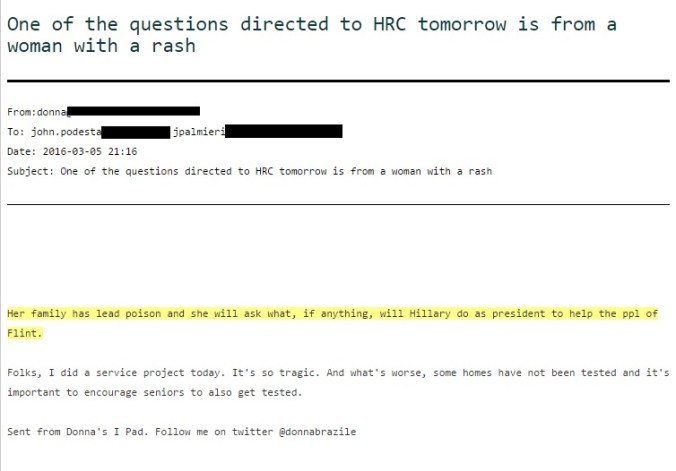
In the latest revelation, Brazile, still working for CNN and bound by journalism ethics, told Hillary what question was on the way, and identified the questioner:

donna-b-tweet

“Rigging,” anyone? Continue reading

From The Ethics Alarms Mail Bag: A Reader Asks, “Is The Verizon Wireless “Can You Hear Me Now?” Guy Unethical For Going Over To Sprint?

Question: Is the former Verizon Wireless spokes-character  whose tag line was “Can you hear me now?” unethical to star in commercials for Verizon competitor Sprint?

Answer: No, because that character, “the Test Man,” wasn’t real.

The real actor who played him, Paul Marcarelli, was playing a character and reading a script. He was acting the role of someone who told the audience how good the Verizon Wireless network was. He didn’t have to believe what he said was true. His loyalty extended no farther than his contractual obligations. The actor wasn’t ethically obligated to use Verizon Wireless, like it, understand it or believe in it, any more than Dos Equis’s “most interesting man in the world” has to really be interesting. Once the first ad series was dropped, he was a free agent.

Verizon could have included some kind of non-compete provision in the contract, forbidding Marcarelli from doing ads for a competitor, at least for a while.  It definitely could have prevented him from playing the same character as he played in the Verizon commercials, because that character is owned by Verizon. However,  Marcarelli uses his real name, Paul, in those Sprint ads, so he can argue that he’s not playing the Verizon character, but himself, and he owns the rights to “Paul Marcarelli.”

However, I do think the Sprint ads are unethical, and so obviously dishonest that they reflect poorly on Sprint. Continue reading

Ethics Hero: The Daily Commercial’s Editorial Board

dailt-comm

The Daily Commercial, a local paper serving Leesburg, Florida, issued a striking editorial apology for its biased coverage of the Presidential race.

In an open letter titled “The media, the election and bias,” the editors apologized to its readers and observed that the paper “hasn’t done enough to mitigate the anti-Trump wave in the pages of this paper….You deserve a more balanced approach to the coverage of elections and other weighty issues.”

The editorial says in part… Continue reading

Social Media Ethics: Speaking Of “Rigged” Elections….

social-media

Can someone give me a benign explanation for this?

From Zero Hedge:

“Does anyone else find it odd that ‘FBI Emails’ does not appear to be a hot topic, trending, big deal on any social media?”

Facebook… “Trending”…


Continue reading

James Comey’s Ethical Conflict

twopaths2

We now know that James Comey’s decision to inform Congress that the Clinton e-mail investigation had been re-opened (If I hear one more Clinton spinner  tells me that no case is ever “closed,” even one that is “completed,” I am going to run naked through the Safeway, screaming dirty limericks in pig latin. Be warned.) was “against Justice Department policy,” specifically the policy of “not acting in such a way as could influence an upcoming election.” Comey understood he was violating these guidelines, sources tell us,but felt he was obligated to do so because he had promised members of Congress he would inform them of any further developments related to Clinton’s email server misuse. Thus he sent a letter to F.B.I. employees after alerting Congress of the (possible) new evidence that necessitated re-opening the investigation. In the letter,  Comey acknowledged that his actions were unprecedented, but explained that…

I feel an obligation to do so given that I testified repeatedly in recent months that our investigation was completed. I also think it would be misleading to the American people were we not to supplement the record. At the same time, however, given that we don’t know the significance of this newly discovered collection of emails, I don’t want to create a misleading impression. In trying to strike that balance, in a brief letter and in the middle of an election season, there is significant risk of being misunderstood, but I wanted you to hear directly from me about it.

According to the Washington Post,  Comey was also concerned that the discovery of the emails would be leaked to the media after he briefed a team of investigators about them, causing the  F.B.I. to be accused of a coverup to benefit Clinton.

Some ethics conclusions:

1. Comey’s actions are consistent with an understanding of the Ethics Incompleteness Principle, which is often discussed on Ethics Alarms:

The human language is not sufficiently precise to define a rule that will work in every instance. There are always anomalies on the periphery of every normative system, no matter how sound or well articulated. If one responds to an anomaly by trying to amend the rule or system to accommodate it, the integrity of the rule or system is disturbed, and perhaps ruined. Yet if one stubbornly applies the rule or system without amendment to the anomaly anyway, one may reach an absurd conclusion or an unjust result. The Ethics Incompleteness Principle suggests that when a system or rule doesn’t seem to work well when applied to an unexpected or unusual situation, the wise response is to abandon the system or rule—in that one anomalous case only— and use  basic ethics principles and analysis to find the best solution. Then return to the system and rules as they were, without altering them to make the treatment of the anomalous situation “consistent.”

Assuming that the “policy” is a sensible and ethical one to begin with (though it isn’t), this was an anomalous case. The FBI, and Comey personally, were rightly under intense criticism for their handling of the investigation. Among other puzzling decisions, Clinton’s aides were given immunity for no apparent reason; Clinton’s interview was neither videoed nor under oath; and Cheryl Mills, who was directly involved in the private server fiasco, was allowed to serve as Clinton’s lawyer when she was questioned. The policy was designed to protect the Justice Department and its component from suspicions of bias and partisan complicity, and the inept handling of the investigation  had already created those suspicions. When such a policy appears likely to have the opposite effect that it was established for, the rational and ethical approach is to make an exception, which is what Comey did.

2. This was courageous. Continue reading

“Black Mirror” Ethics

black-mirror

I finally am getting around to examining “Black Mirror,” the British anthology series that explores, sometimes in a science fiction context, ethics issues involving technology. It is a critical hit, and has just had its  third season posted on Netflix.

Technology ethics is a dynamic and crucial topic. I sure hope the series is better than the  first episode, “National Anthem.”

If you are going to do a series about ethics, knowing something about ethics is mandatory. This episode is so absurd and its resolution so idiotic that it’s barely worth analyzing, No spoiler alert necessary, because I’m only going to reveal what would be in any preview synopsis. The Royal Family’s princess is kidnapped by terrorists—I think that’s a fair description—and they release a video on YouTube in which the terrified young woman announces that she will be executed unless the Prime Minister has live sex with a pig, on all TV networks.

The rest of the episode’s 60 minutes involves the PM’s “ethical dilemma” as social media weighs in and his staff and family apply various kinds of pressure. I wouldn’t waste an Ethics Quiz on this alleged “dilemma.” Continue reading