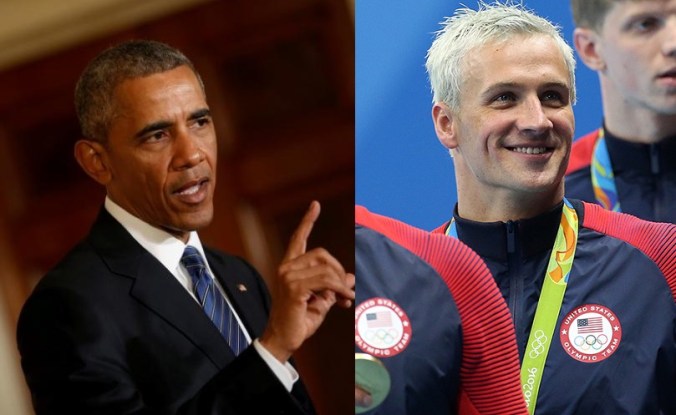
The story that Ryan Lochte told four days ago was frightening and detailed, the Olympic gold medalist recalling a late-night robbery and a pistol pressed against his head. On Thursday, Brazilian authorities presented evidence they say contradicts that account and could turn what at first had been a deeply embarrassing incident for the Summer Games’ host country into a different kind of international incident.
The head of Rio de Janeiro’s civil police, Fernando Veloso, said the version of the events told by Lochte and three U.S. swimming teammates was fabricated. The athletes, he said, damaged a gas station bathroom early Sunday morning and were involved in a confrontation with armed security before paying about $50 to resolve the matter.
“We can confirm that there was no robbery as they described, and they were not victims as they presented themselves,” Veloso told a packed news conference, alleging the athletes had given “a fantastical version of events.”
The State Department conceded for the first time on Thursday that it delayed making a $400 million payment to Iran for several hours in January “to retain maximum leverage” and ensure that three American prisoners were released the same day.
For months the Obama administration had maintained that the payment was part of a settlement over an old dispute and did not amount to a “ransom” for the release of the Americans. Instead, administration officials said, it was the first installment of the $1.7 billion that the United States intends to pay Iran to reimburse it for military equipment it bought before the Iranian revolution that the United States never delivered.
But at a briefing on Thursday, John Kirby, the State Department spokesman, said the United States “took advantage of the leverage” it felt it had that weekend in mid-January to obtain the release of the hostages and “to make sure they got out safely and efficiently.”
There is little doubt as to which of the two lies the U.S. public is being informed about most thoroughly today: It’s #1. After all, Ryan Lochte is a reality TV star, and a celebrity, and an athlete, and this is the Olympics! Up close and personal! Bread! Circuses!
The second story? Meh.What’s the big deal? So the Obama Administration paid ransom for hostages, endangering U.S. citizens all over the world, and repeatedly lied to the press and the public about it over the past two week, issuing unequivocal denials that the 400 million dollar payment and the hostage release were related in any way. So what?
On CNN this morning, the stupid, stupid, stupid story about how a group of boorish Olympic athletes (‘USA! USA!”) peed on the walls of a Rio bathroom and made up a robbery —at gun point!—story to cover up their vandalism was the subject of a full panel discussion. If the Obama version of Iran-Contra was covered at all, it wasn’t in the hour I saw.
Google News search, “Ryan Lochte”…nearly 10 million results.
Google News search, “Iran ransom”…about 220,000 results.
No wonder the public is significantly unaware of what an incompetent, dishonest, manipulative administration we have endured for eight years. The news media intentionally buries the facts to support administration narratives and propaganda. The story of how the Obama State Department handed over40% of a billion dollars to Iran as a reward for capturing and holding, illegally, U.S. citizens is a bona fide foreign policy scandal, one which if it occurred in a Republican Administration would have every editorial page screaming. The news media, however, is now fully engaged in slanting its coverage to ensure that Hillary Clinton defeats Donald Trump, the prime directive. More than ever, the utter failure of the current Democratic administration must be obscured.
Thank goodness the GOP lacks a candidate with the focus and degree of articulateness of the average closed head injury victim. Besides, he’d pay the ransom too. It’s just another deal, after all.
“We do not pay ransom. We didn’t here, and we won’t in the future.” That was Barack Obama’s official statement on the matter, when he was asked about the $400,000,000 a couple of weeks ago. It belongs in the same category as “I am not a crook,” “I did not have sex with that woman,” and, oh yeah, “If you like your health care plan, you can keep your health care plan.” This is why Democrats literally (that’s literally literally, not Sean Hannity’s version of literally, recently displayed in his statement that “The news media literally kiss Hillary Clinton’s and Obama’s asses every day!”) don’t care that their current heiress-apparent is, as William Safire famously said almost two decades ago, ” a congenital liar.” The current Democrat in the White House lies repeatedly, routinely, shamelessly and with no consequences whatsoever. Who cares? We love the Big Brother, currently vacationing while Louisiana swims for its life.
Fortunately the most reliable of the so-called conservative media, the Wall Street Journal, continued to pursue the embarrassing story that the other news organizations regarded as an annoying distraction while they were concentrating on destroying Donald Trump. Finally, Obama had to admit that yes, the US paid ransom for hostages…to Iran, an importer of terror that is dedicated to turning Israel into a parking lot.
All right, all right, but how about that Ryan Lochte?
We knew Ryan Lochte was an idiot during the last Olympics. The second, the very second, I read that Lochte and his buddies claimed to be robbed while the local police denied it, I guessed this outcome. To once again borrow from George S. Kaufman: 0n Mount Wilson there is a telescope that can magnify the most distant stars to twenty-four times the magnification of any previous telescope. This remarkable instrument was unsurpassed in the world of astronomy until the development and construction of the Mount Palomar telescope. The Mount Palomar telescope is an even more remarkable instrument of magnification. Owing to advances and improvements in optical technology, it is capable of magnifying the stars to four times the magnification and resolution of the Mount Wilson telescope.If you could somehow put the Mount Wilson telescope inside the Mount Palomar telescope, you still wouldn’t be able to see my interest in anything Ryan Lochte has done or will do for the rest of his life, because he is a blasted idiot, and so is anyone who wastes a minute of their limited time on earth caring about him.
What the President of the United States does, however, the precedents he sets, the lies he tells and the conduct he models as a leader matter.
UPDATE: This just in…
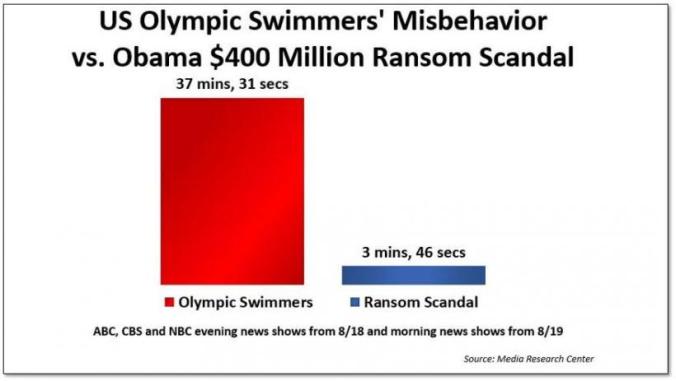
____________________
Sources: New York Times, Google, Los Angeles Times, Washington Times
 Ethics Alarms
It’s a pretty safe bet that we find that Lochte & President Obama, et al, are ALL delinquent on their mandatory ethics CE just like HRC & aides, am I right?
I’m not sure that there are any ethics requirements for swimmers, other than not juicing and not having secret gills.
Ethical considerations are something with which everyone should be aware, yet are so often ignored; i.e. whizzing in the pool…?
Lochte has forfeited an easy 7 + figures in endorsements.
Well, being stupid has its consequences. Anyone who would pay that idiot to represent their product is also stupid, even before this.
“Well, being stupid has its consequences. Anyone who would pay that idiot to represent their product is also stupid, even before this.”
Interesting.
Would this also apply to a client picking a lawyer to represent them?
You do know that you are using two definitions of “represent”…
Different deffinitions Isn’t that what punning is all about?
Hypothetical fun time:
“and not having secret gills.”
Would there be an ethical obligation to disclose such? Aren’t many athletic advantages often due to having inherited exactly the right body type for a particular competition (read as, the right “genetics”)?
Would there be an obligation to disclose a *naturally* inherited advantage?
What if a swimmer had naturally occurring larger and more dominate webbing between the fingers and toes? Would they be obligated to disclose such?
I think there’s a rule about genetic webbing of feet….**off to do research**
One could argue that the answer lies in part with cognitive dissonance. If I (1) am upset by this and (2) I am powerless over it so (3) I don’t want to know about it and (4) refuse to care about it. That would be a neat explanation.
On the other hand, I do think this is just one more example of the power of the press. They tell us what’s important, and what to care about, if we’re stupid enough to listen. So, we have a panel discussion about a minor incident relating to Olympic athletes and bury the ransom-for-hostages story as a footnote. It really doesn’t matter who they are protecting and why: they do it, all the time.
Just be grateful for the internet and other sources of news: the major news media outlets are all about — and sometimes, it seems, only about — “managing” their readers/viewers. it’s pretty scary, though nothing new.
This just in from our reporter on the scene (the fly on the wall in the producers editing room)…
News Item #1: Ryan Lochte lies about robbery.
Top news story! This will sell!! People really like Lochte, let’s try him in the court of public opinion and destroy his life. This’ll be fun and profitable, sell a lot of newspapers, and get lots of cyber hits. This will be a great story and we can use it as a deflection for he next couple of weeks.
News Item #2: Paying Randsom To Iran For Hostages
No point in talking about this; afterall, “what difference – at this point, what difference does it make?” It won’t sell to anyone on the political left so why even try.
Agreed. The media have spent way too much time on Lochte. By God, they should be asking why US Olympic Fencer Ibtihaj Muhammad was denied her Constitutional and international right to bear the US flag in the opening ceremony in favor of some has-been swimmer named Michael Phelps. Her contribution to international fencing clearly outweighs anything Phelps could ever think of doing.
CNN had a panel discussion about whether Trump’s campaign manager Paul Manafort’s received illegal payments from Ukraine’s former pro-Russian ruling party in 2014. The New York times investigated the payment. The other news media did the same. Yet, where have the media been on Doug Band, an executive at the Clinton Foundation, tried to put billionaire donor Gilbert Chagoury — a convicted money launderer — in touch with the U.S. ambassador to Lebanon because of the donor’s interests there? Fox News and the WSJ have investigated but there has been radio silence from the others.
The mainstream media spent a huge amount of time on Trump’s call to Second Amendmenters to ‘take care’ of the Clinton. Where is the inquiry into the Clinton Foundation? Nothing.
jvb
“Finally, Obama had to admit that yes, the US paid ransom for hostages.”
I saw no such admission–citation please?
There’s a difference between leveraging a pre-existing legally owed $400M debt and the extraction of a quid pro quo distinct sum of $400M.
If your statement really were true, that would be big news indeed. But I wouldn’t hold my breath waiting to hear Obama actually say what you untruthfully claim he said.
This is where I am confused about the issue.
Was the $1.7 billion admittedly owed? (My understanding was that, at some point, we agreed to pay that money.)
Was there an agreement to release the hostages? (I did not think there was.)
Taking my above understandings as true (and I don’t know if they are and I really don’t trust either side to clarify that without spin), if the U.S. stalled on an admitted obligation to obtain an additional benefit that it was not owed, I would not see that as paying a ransom. If they owed the money without a hostage release and they threatened to default if they were not given more (the hostages), I do not see how the payment is a “ransom.”
Of course, that puts the definition of “ransom” at issue.
In any case, does anyone have a clear explanation of the facts and timeline, because the talking heads are quite unhelpful? They have jumped to their conclusions, making an explanation of the facts irrelevant.
-Jut
Side note: this reminds me a bit of your Bridge of Spies analysis, where Tom Hanks character leverages the release of a second “spy” when he is only supposed to focus on one.
It is a bit like that.
There is no way to make the US pay anything it doesn’t want to pay, and everything is subject to negotiation, rightly or not. The US delayed handing over the money until the hostages were definitely going to be released. That turned the situation into quid pro quo. If it was quid pro quo, or even it was a bluff, then it’s ransom..whether the money was owed anyway doesn’t matter.
I think Jut’s comments are correct. Think of it this way.
Scenario A: Iran takes hostages, demands ransom.
US conjures up $400 million.
Hostages are released.
Result: Bad bad consequences for future hostages and evil regimes.
Scenario B: Iran takes hostages, demands ransom.
US says, “Oh gee, you know that $1.4 Billion sitting in our accounts payable records that we owe you? Suddenly can’t seem to find it in our records anymore. Shame if something happened to your account with us…”
Hostages are released.
Result: Evil regimes think twice about messing with someone who uses $billions in force multiplier.
See how that works?
Quid pro quo is quid pro quo. That’s spinning, Charles. Iran describes the payment as ransom. They should know.
If you have to cite Iran as proof in an ethical debate, Then Houston we have a problem…
No, Charles’ interpretation is brilliant. Iran are the ones paying a ransom. We were holding their MONEY for ransom in exchange for a payment of U.S. Citizens. It all makes sense now.
Iran describes it as a ransom.
Jack: THAT is spin. That is why I am skeptical of all analysis. It all looks like bias (including YOUR analysis), simply because I do not believe j gave the facts to make an objective judgment.
-Jut
You mean Iran is spinning? I’m certainly not. Why wouldn’t Iran regard it as ransom? They seek that money for decades. Finally they have American hostages, and the settlement is agreed to while the first installment is handed over the same day as the hostages are returned. It takes spin NOT to call it ransom.
And the money is sent secretly, so it won’t look like ransom to anyone else. Jeez. Why is anyone arguing about this?
I do not know why others are arguing about this. I am skeptical because, as a lawyer, I need to know the facts, so I know how to spin things one way or the other.
Of course, the Iranians will try to spin this as a ransom, because that boosts their stature. That is good for right-wingers too, because it proves Obama’s incompetence.
Jack, the bottom line is this: if you can’t state the facts ( not just you, but anyone), but you have an opinion, you are plagued by bias.
-Jut
Bias in favor of what or whom? My bias is against lying and deception. What facts do you think you lack? 1) The money transfer was secret and withheld from the American public. If it was just a settlement payment, why the secrecy? 2) The White House and State department originally said the payment had nothing to do with hostages. The wall Street Journal kept investigating, and yesterday the new story was that the money was used as “leverage”—a euphemism. When money is used as “leverage” to get back hostages, its a quid pro quo: Ransom.
The fact that the Iranians crow about it being ransom is why the US policy is to not pay ransom for hostages—or anything that can be plausibly called ransom by states that are prone to try taking hostages. What the US calls it, using spin, semantics and technicalities doesn’t matter.
My post was about the lie. Tell me why calling a lie a lie is bias.
Remember, again, this was going to be the most transparent administration in history. Everything up front. No quid pro quo! Just money handed over as “leverage.”
I don’t know what facts, as a lawyer, you’re lacking. As a lawyer, I have enough facts to determine what’s going on. And yes, the well-established trends of this incompetent administration are facts as well.
I think it would fall more under blackmail than random *grin*
I agree, the headline should be Obama extorts Iran to regain hostages.
Exactly.
A withholding of funds from Reagan, Bush I, Clinton, Bush II, and most of Obama suddenly paid juxtaposed to the release of hostages does not an extortion make…
Don’t join charles’ Brigade of Bad-Hill-To-Die-On specialists…
Obama is responsible for his departments and their statements. The State Department made the omission. Are you really quibbling about the use of “Obama” to represent his administration, or “The White House” I know that the man often pretends or worse, genuinely, claims that he doesn’t know what’s going on in his own administration, but seriously? That’s your complaint?
“US admits”… says the Huffington Post. You’re arguing that the US can admit, but that Obama’s denial is still “operative”, as a similarly candid and honest administration used to say?
Come on. Come ON.
Show me ANYONE in the Administration who admitted to paying “ransom.” I haven’t seen it.
We held the leverage here, not Iran–they got caught bringing a knife to a gun fight, and all we had to do was point to the gun.
hostages aren’t leverage?
No we were holding their money hostage and Iran was so desperate to get it that they paid us in captives. Obama is a negotiating genius holding all the cards. That’s really Charles’ perspective.
Oh I have been aware of Charles’ incredibly upside down world view since I first read one of his posts here.
“Obama is a negotiating genius holding all the cards.”
Ah yes, a genius Negotiator, he!
Quite possibly the greatest example of his legendary cunning was when he put the screws to Chinese President Xi Jinping during their 2014 Climate Summit.
President Obama deftly got him to ‘agree’ to ‘curtail’ China’s carbon output so that emissions would peak ‘around 2030.’
The shrewd brilliance of it all? According to they themselves, China was scheduled to have their emissions peak in 2030 regardless.
We’re not worthy.
If all we had to do was point a gun, we’d have all the hostages back. For free.
Don’t try to sound tough when you don’t know how.
“We held the leverage here, not Iran–they got caught bringing a knife to a gun fight, and all we had to do was point to the gun.”
No.
This is a case of America getting caught bringing an Obama Administration to a Foreign Diplomacy fight.
New questions
Was the USA holding the dollars owed as hostage and demanding a ransom of human hostages from the Iranians?
In other words; was the USA holding up the release of dollars to cover a debt owed the Iranians as a method of extorting the release of the hostages?
Pretty much yes. But Diplomats don’t use words like “blackmail” and “ransom” , at least, not until the deal is complete.
The two stories you compare here have both been racialized in the coverage. Any story about an Obama lie is treated as a threat to the legacy of the first black president and is, by definition, a racial story in the eye’s of the media. So the lie is downplayed
The Lochte story is being treated as a “white privilege” story by the same media. Rich white guy commits a crime with no consequences. Now that’s news.
I may use this as a classic example of “spin.”
1. Give us X or we won’t give you Z
2. We owe you Z, but won’t give it to you unless you give us X
3. We’ll give you Z for X.
1. We traded Z for X.
2. They weren’t going to give us Z unless we have them X.
3. We gave them X, and so they gave us Z.
Any combination of these is a quid pro quo. In any situation where X is hostages and Z is money, hostages have been ransomed. Any other description is just spin, and dishonest.
I’m with you on this situation, but not when you over-simplify in these terms. In doing this, we can argue that every transaction is a ransom transaction and it loses meaning. The grocery store won’t give you groceries until you pay the ransom. Commerce is ransom at its core.
Ransom by its nature is an illicit transaction, and is based on extortion in one direction.
The groceries are a bad example: you have no claim to the groceries unless you pay. With hostages, the US, not Iran, “owns” the hostages. Whatever Iran “demands” to return them is the quid pro quo. If the US has the power not to pay a settlement it agreed to (“The hostages, or the deal is off!”) then paying is fairly called ransom. The hostages should be returned with nothing in exchange. (Prisoners for hostages is ransom.)
And if the mandate, as it must be, is to make sure that there is no confusion, and that no ransom means “nothing that could conceivably by any interpretation be called “ransom”—that is NO quid pro quo, no matter how Iran, me or anyone else cuts it—then you can’t say “we didn’t pay ransom and never pay ransom” and then shift to its “Not TECHNICALLY ethics.”
This is exactly like the appearance of impropriety. Exactly. Being technical isn’t good enough. The payment was tied to the return, and it doesn’t matter who does it.
You say extortion in one direction. In this case, which direction? Because, if you want to spin this, you can spin this either way. Either they extorts us for payment, or we extorted them for hostages.
-Jut
As a nation, we’ve refused to give the money through Reagan, Bush 1, Clinton, Bush 2, and most of Obama. 3+ decades. We weren’t going to pay that back. Ever.
Oh wait. Except on a day that by pure luck we happened to have hostages returned to us.
There isn’t a way to spin this like we “extorted” them. It was a ransom. It’s not that hard to see. Only the most blindly partisan hacks, idiotically muddle headed true believers, or maliciously deceptive individuals are spinning this in any other way. Don’t join their ranks.
The day we had hostages returned to us by pure luck? You mean when Reagan just happened to get all those hostages from Iran back just around the time that he got inaugurated.
Are you joining their ranks? Then shut up! And don’t accuse me of anything similar. I have no sympathy for Obama, but I can’t say the ransom spin is fair. I do not believe either side is giving me a fair appraisal of the facts before giving me their spin. But, just because I despise Obama does not mean this is ransom.
That is how you combat bias. Skepticism help fight bias.
-Jut
Another irrelevant reason to feed your Obama frenzy.
Sent from Yahoo Mail on Android
Specific to this situation, if Iran is calling it “ransom”, does that mean the $400M did not pay down the $1.7B debt in their eyes? So, if you asked Iran, they’d say we still owe $1.7B from pre-revolution?
If the balance sheets aren’t updated then it’s strictly ransom. Now – if the balance sheets were updated (with agreement by Iran) then this is the best spin I can give this situation: The $400M is not the ransom. The ransom paid was non-tangible in the form of a favorable decision and action on the issue that remained dormant for decades.
Tim, I’ve made plea deals. I’ve made all sorts of deals. “Specific to this situation, if Iran is calling it “ransom”, does that mean the $400M did not pay down the $1.7B debt in their eyes?” My brother has something that was owned by my father that is precious to me, and my father said he wanted me to have it. My brother has it, knows this, and won’t give it to me unless I agree to pay 50% of a disputed debt I have refused to pay forever, and for all he or you know, would have continued to withhold. If I pay that disputed 50% as the only way there is to get that object of my father’s, is that not, for all intents and purposes, ransom?
Does the definition….1.
a sum of money or other payment demanded or paid for the release of a prisoner.
synonyms: payoff, payment, sum, price
also say, “and nothing else, or its not ransom”? I don’t see that. Quid pro quo, in the eyes of the hostage takers. That’s what you want to avoid. That’s what we got.
In your scenario – you state the answer. Your brother is holding for ransom “your something precious”. What does he want from you in return? An agreement to pay 50% of a disputed debt. The ransom is the agreement in this scenario. Theoretically, if he trusted you to pay, once he had your agreement he would release the item and you could pay the debt at agreed intervals.
Are you saying that according to the definition that only MONEY can be ransom? Ransom can’t be a favorable act or decision?
Don’t get me wrong – in this IRAN situation, it’s cut and dried RANSOM. If they think it was ransom, then that is what it is.
No, giving anything that you wouldn’t have given anyway is ransom. Now I’ve completely forgotten what we were debating. The main thing is, Iran (and presumably other potential hostage takers) thought we were paying ransom.
I am a bit rushed, so I checked for 30 seconds to see who had written a coherent and researched explanation for why, if the international rogue holding the hostages thinks its getting ransom, then it is. From Jonah Goldberg in the Chicago Tribune:
(the emphasis is mine)
One of my all-time favorite lines is from Henry David Thoreau: “Some circumstantial evidence is very strong, as when you find a trout in the milk.”
It came to mind recently when the White House and State Department insisted the charge that the U.S. paid a ransom to get back American hostages was purely circumstantial. Sometimes, a $400 million pay-off in laundered money, delivered in the dead of night in an unmarked cargo plane, isn’t what it looks like.
“Implementation Day” was Jan. 16, 2016, for the nuclear deal between the United States and Iran, in which the state sponsor of terror received sanctions relief possibly worth as much as $150 billion — which would be roughly equivalent to 40 percent of its GDP — in exchange for some guarantees against developing nuclear weapons for awhile. (The merits, and even the nature, of the Iran nuclear deal are hotly disputed, but that’s a topic for another time.)
That same day, the Obama administration announced a prisoner swap between the U.S. and Iran, in which we traded seven Iranian criminals and removed another 14 from an Interpol “most wanted” list. In exchange, they returned four innocent Americans, illegally held by the Iranian regime. Back then, Secretary of State John Kerry boasted about what a masterful diplomatic breakthrough it was. Those Americans were freed thanks to “the relationships forged and the diplomatic channels unlocked over the course of the nuclear talks,” Kerry preened.
Yes, well maybe. But few things really cement a solid working relationship like $400 million in cash. Kerry failed to mention that part in his press conferences or congressional testimony. In fact, the Obama administration kept the whole thing a secret.
The White House concedes that it all looks very bad. But it insists this was in no way a ransom payment; the trout got in the milk for perfectly normal reasons. You see, the Iranians were suing for funds deposited with the Pentagon in 1979 for a weapons purchase that was later blocked when the ayatollahs deposed the shah. The $400 million wasn’t a ransom; it was simply the first installment of a $1.7 billion settlement of that dispute. “We would not, we have not, we will not pay ransom to secure the release of U.S. citizens,” top White House flack Josh Earnest insisted. That the money was delivered to coincide with the release of our hostages is little more than a funny coincidence.And shame on you for thinking otherwise, Earnest seemed to be saying. The $400 million drop-off was actually a great success for smart diplomacy, because it saved taxpayers “potentially billions” more if the arbitration over the matter hadn’t gone our way.
Still, one wonders why, if it was such a laudable and innocent money-saving maneuver, they kept it all secret from the American people.
Here’s one possible reason from The Wall Street Journal expose: “U.S. officials also acknowledge that Iranian negotiators on the prisoner exchange said they wanted the cash to show they had gained something tangible.”
Catch that? The Obama administration did not think the huge pallet of Swiss francs, euros and other currencies dropped off in the dead of night was a ransom payment — they just wanted the Iranians to think it was.
And they bought it! “Taking this much money back was in return for the release of the American spies,” Gen. Mohammad-Reza Naghdi, a Revolutionary Guard commander, boasted on Iranian state media.
Sometimes you just have to marvel at the way smart people can talk themselves into stupidity. The whole point of not paying ransoms to terrorists isn’t to save money. The reason we don’t pay kidnappers is that we understand that it will only encourage more kidnapping. So letting the Iranians think the $400 million was a ransom payment is doubly asinine, because it fooled exactly the wrong people, the wrong way. Who cares if the Obama administration “knew” it wasn’t a ransom? What mattered was to make it clear to the Iranians that it wasn’t a ransom, not give them every reason to believe it was.
Now, because of this pas-de-deux of asininity, not only have we given the Iranians untraceable walking-around money to give to its terrorist proxies, we’ve also given them every incentive to kidnap more Americans — which is exactly what they’ve been doing. But at least the folks at the State Department can sleep soundly knowing that they didn’t really pay a ransom — it just looks that way..
***************************************
Exactly. What, in law, we call “a distinction without a difference.”
Jack,
“The Mount Palomar telescope is an even more remarkable instrument of magnification. Owing to advances and improvements in optical technology, it is capable of magnifying the stars to four times the magnification and resolution of the Mount Wilson telescope.”
Is that the same telescope you use when looking down on the rest of us?
Snap! Actually, from the opposite end…
Sometimes you just have to marvel at the way smart people can talk themselves into stupidity.
Australia and A Certain Country That Shall Remain Nameless have a good, friendly relationship. Even when we’re shooting at each other.
Recently, some of our naval personnel committed a “navigation error”, and were quite reasonably detained by ACCTSRN.
Quite coincidentally, the Danegeld, sorry, Foreign Aid payment from Australia to ACCTSRN for that month became unaccountably delayed. You know how these things are.
In a gesture of goodwill and amity, ACCTSRN released the RAN personnel, saying they quite understood how such “navigational errors” could happen.
As a return gesture of goodwill and amity, the delayed payment was expedited.
That’s how Diplomacy works, Jack.
Sure. Unfortunately, outlaw nations, like Iran, use the natural values of diplomacy to profit harm and terrorize. You made argument for negotiations with terrorist. Did you intend to? Certain kind of international outlaw conduct require removal of tools of diplomacy that are available and appropriate in other situations. Paying a penalty to a respectable nation as an apology for a breach resulting in those responsible being detained? Diplomacy. Paying ransom to an international outlaw? Incompetence and cowardice.
“Paying ransom to an international outlaw? Incompetence and cowardice.”
Zoe’s whole point was that this was diplomacy not ransom. Your mere assertion to the contrary assumes the very definition she’s questioning.
Sophistry, Charles. When money is exchanged to free hostages, that’s a ransom. So exchenging substantive benefits of any kind. Again, if this was open and above board “diplomacy,” why the secrecy? Why the cover up? Why the lying? Why the “admission” now? Why was a correction necessary? Are you arguing that “leverage” isn’t a euphemism? (It would fit for a bribe too).
If the President and State Department didn’t think the payment would look like ransom, and didn’t know that the Iranians would regard it as ransom, why the lack of transparency?
“If the President and State Department didn’t think the payment would look like ransom, and didn’t know that the Iranians would regard it as ransom, why the lack of transparency?”
It’s a very valid question, but with a clear answer too. I think the answer is basically that most diplomacy is best conducted in private, not in public. Things can be said privately that are not acknowledged – that can even be on the face of it contradictory – to things said in public.
Hence I sincerely doubt that we “didn’t know the Iranians would regard it as ransom.” I suspect that the Iranians perfectly well know, as do we, that it wasn’t ransom – but it was politically expedient for them, for internal political reasons, to claim otherwise in public. And we understood that too.
Diplomacy, as is most politics, is loaded with “wink wink nod nod” moments. This is also why politicians are so frequently embarrassed when supposedly private conversations end up in public. We knew the Iranians were going to tell their hard-liners that they’d stood down the Great Satan, just as Obama told our hard-liners that we’d won fabulous concessions. Neither side mistakes what the other side says publicly for “truth,” and what is said between the two parties in private probably bears little relation to what either side said in public. And that’s understood by both sides – privately. That’s the nature of diplomacy.
This doesn’t mean private conversations are the “true” conversations; when Romney made the 47% comment he was talking to a specific audience. All such conversations have to be understood contextually.
What this whole thread has pointed out is the difficulty of precisely defining “ransom.” Seems to me it can’t be understood outside of the power dynamics and the public/private context.
What you see as ransom I see as the more powerful party (us) exerting leverage to ensure an agreed-upon outcome stays agreed-upon – a not-so-subtle reminder of just who is the world power and who isn’t.
It’s a very valid question, but with a clear answer too. I think the answer is basically that most diplomacy is best conducted in private, not in public.
Charles. Please.
1. The US knew or should have known that the Iranians would soon crow about it. It was unlikely to be kept secret for long.
2. The diplomacy was over.
The money was Iran’s in the first place. From an Iranian view, yes, this was extortion.
But Equity must have clean hands. Iran’s were as dirty as they come.
Whoa! Whiplash! You do know that ANYONE requiring ransom, by definition, has dirty hands, right?
Which lie is worse? I don’t think that is a reasonable question. The lies were made for different reasons and had vastly different impacts. The swimmers lie is simple to understand. I won’t bother. The Obama lie is (I hate this word) nuanced and by definition of nuanced, complex. As I see it here are two reasons it was made.
One was for the American public in this heated political season. Had this not been a presidential election year I think the Obama administration would have been forthcoming about the reasons the cash was paid and how our ransom policy is complex and not set in stone. This understanding demands a lot of the general (non-too bright or highly partisan) public. But while the right wing would make all kinds of ransom for hostages accusations, this would last a news cycle or two and not end up as a Trump talking point.
The other reason has to do with the way such diplomacy works, and has more to do with Iranian politics than American politics. This has been described in other comments. Again, in a non-presidential race year we could have and hopefully would have been open with explaining this once the hostages were out of Iranian air space.
I think the administration timed the telling of the truth with absolute deliberation about the political effect here. I think the were naive (and dare I said stupid) thinking it would just go away and just waiting to see if they could wish upon a lucky charm and make this disappear from political discourse. They should have known how the Republicans would frame this, girded their loins, and tell the unvarnished truth.
I would hate to be a presidential advisor tasked with balancing ethics with real life, life and death, practical decisions. I ask Jack to put himself in the place of being on such a team as the ethicist going head to head with the CIA strategists. What would Jack say?????
On a lesser scale, but certainly life or death, perhaps Jack could describe how he would handle being the ethicist member of a drone decision team. I doubt we have an ethicist in on decisions about how many civilian casualties are worth accepting for what likelihood a terrorist will be killed in a drone strike. I think having an ethicist on each team would be great, but it would be quite a job to be a credible and persuasive voice for ethics and morality.
But remember, the question wasn’t which was worse, but which was more newsworthy. (There is no question in my mind that lying to the American public and undermining long term trust is “worse,” however.) Obviously, the administration lie is more newsworthy. Ethically, lie is appropriate: it was intentional, and it was designed to deceive. The complexity and nuance of the situation don’t mitigate its dishonest aspects: the intial response to press inquiries about the payment of 400 million being related to the release of the hostages was a flat denial. Then it was admitted that the denial was a deliberate lie. Call it deceit if you like—deceit is still lying.
Perusing the blog, one will find many references to the Ethics Incompleteness Principle, which holds that there will be exceptions to all ethics rules and principles, but that they must be treated case by case as anomalies, and problems to be solved. The ticking world destroying bomb scenario doesn’t make torture ethical. It jsut means that one has to be prepared to breach even absolute ethical principles when that single anomaly arrives. However, if one’s approach is to say every situation is an anomaly, then there is no right or wrong.
There is excellent ethical justification for the rule that one cannot reward terrorists or pay for the release of hostages, ever. The Obama administration asserted this, then secretly paid for the release of terrorists, and initially denied, on the record, that the payment was in any way connected to the hostage release. Both constitute dishonesty and a breach of trust. The details may be complex, but that part is simple.
Sorry I didn’t scroll to the top to catch your actual question…
newsworthy obviously the Obama one.
I wish the rulers of the Citizen Therapist’s Facebook page (which only members can post on) would understand the Ethics Incompleteness Principle and see how I apply it to making an exception to the so-called Goldwater rule for therapists (it’s UNETHICAL to diagnosis public figures) who choose to CAREFULLY make a public diagnosis of Trump. Anyway, like you I spend much time tapping away into cyperspace and like it when people comment…. today on daily Kos I wrote two pieces:
http://www.dailykos.com/story/2016/08/20/1562141/-The-real-reason-Manafort-was-fired
only 8 comments but I put a poll on and 153 people took it:
HOW LONG DO YOU THINK KELLYANNE CONWAY WILL LAST?
A month or less 23% –Between one and two months 25%
She’ll last until the election — 25%—Until she has enough dirt on Trump to write a best seller either/and get her own TV show —14% —Until tomorrow
2 votes This is a stupid question
and
http://www.dailykos.com/stories/2016/8/20/1562157/-Morning-or-evening-Joy-Reid-skewers-Trump-s-surrogates-but-why-do-they-keep-going-on-her-show
with 29 comments
I should have referenced the EIP to your article immediately, since that was obviously what you were arguing, and what I thought of the second I read it. The trick is distinguishing a genuine anomaly from a convenient rationalization, “ethics is a luxury we can’t afford right now…”
As for paying ransom for international hostages, I think refusing to do this was never an ethical consideration. I think it was always a practical one in that it would encourage others to take hostages.
Interesting that there’s never (that I know of) been a move to make paying ransom to kidnappers by individuals.
“Interesting that there’s never (that I know of) been a move to make paying ransom to kidnappers by individuals [unacceptable].
That was the messing part, right?
And I think the answer is that individuals are accountable, catchable and punishable, and that there are effective deterrents without having to refuse ransom. They work, too: domestic kidnappings for ransom are incredibly rare.
However, I like the solution of Mel Gibson’s character in “Ransom”, who uses the ransom demand to put a bounty on the heads of the kidnappers. (And there’s an earlier version with Glenn Ford in the role!)
I really meant to say illegal… that was the “messing” part…
Good thought though that kidnapping is illegal and the perpetrators are often (if not usually) caught, and against Federal and State laws
http://legal-dictionary.thefreedictionary.com/Kidnapping
As for Mel Gibson…. we could discuss why some of us no longer will watch his movies even if they are really good…. or Woody Allen movies, or for that matter Tom Cruise movies….
Let’s see: John Travolta, Frank Sinatra, Roman Polanski, Michael Richards…it’s a long list. Generally I can separate an artist from the art, but it’s emotional, and hard to control. Woody’s best are some of my favorite comedies, but I have trouble watching them, just like as much as I love the Naked Gun films, OJ makes me twitch. Gibson is such a fine actor, as is Cruise…if I can, I put it out of my mind and enjoy the art. Sometimes, I just can’t do it.
Cruise, not because of the Scientolgy thing as much as because he’s an idiot (there are lessor actors who I was surprised to see are scientologists); I will watch a Woody Allen movie but he isn’t particularly a favorite, Micahel Richards was just one of the cast of Seinfeld and I enjoyed the show but actually like Larry David better. And then there are actors who I know are just superior assholes from personal information from friends who live in Sun Valley and know them… one Oscar winner in particular who everyone seems to think is just wonderful whose name will not be mentioned here ….
I’m a longtime student of physical comedy, and Richards really was in lofty company, a rare true clown in the tradition of the great slapstick artists of silent film. His meltdown on stage was really inexplicable, but so ugly that it’s impossible to put it out of my mind, as hard as I try, when watching his old Seinfeld episodes.
“As for paying ransom for international hostages, I think refusing to do this was never an ethical consideration. I think it was always a practical one in that it would encourage others to take hostages.”
I think this is one of those situations where the practical considerations (not encouraging other hostage takers) are actually an outgrowth of the nation’s ethical obligations.
An ethical nation owes its citizens certain duties, after all. Chief among these has always been (and remains) the duty of protecting its citizens from the predations of other polities. Such protections may be imperfect (as evidenced by the fact that there are ever hostage takers at all), but a nation which pays ransoms for its citizens does encourage other citizens to be attacked and abducted for additional ransoms. In doing so, the nation is actively undermining its own responsibility of protecting other (current and future citizens). If we can say that a nation has any obligations to fulfill its portion of the social contract that begins with protecting its citizens, then undermining the most basic clause of that contract is as profound an ethical failing as can possibly be made. A nation which commits such failings regularly is forfeiting one of the core reasons for its existence, and risks freeing its citizens of any ethical obligation to obey its laws, or support or maintain it.
Interesting and relevant:
“Ryan Lochte, Donald Trump and the steep decline of American democracy
Inspiring lessons of this year’s Olympics? Same as the Trump campaign: Smash stuff, lie and issue a fake apology” from Salon
http://www.salon.com/2016/08/20/ryan-lochte-donald-trump-and-the-steep-decline-of-american-democracy/
One of the more embarrassing aspects of the Olympics is the quadrennial effort by journalists to mine cultural meaning from an amorphous and heterogeneous spectacle that, by its very nature, can be used to make any point or support any argument. To paraphrase a wonderful poem by the neglected British humorist Edward Lear, the Olympics contain all the morals that ever there were, and set an example as well. Want to argue that the Olympics are a jingoistic war-substitute? A litmus test for feminist progress? An overproduced schmaltz-fest? A hidden tale of backroom injections and falsified test results? Come on in, the water’s fine.
and
At this point it has become a truism to describe Trump as a candidate molded by reality TV, but that doesn’t make it untrue. Lochte has also played himself on television, with considerably less success. Beyond that, both men are fundamentally creatures of the digital age, shaped by an Internet culture of pixel-thin celebrity, instantaneous “hot takes” and moronic or hateful behavior with virtually no consequences.
and
Trump also apologized for something this week during a speech in North Carolina, which felt weird to everyone watching and can only have been deeply uncomfortable for his supporters. The entire point of Donald Trump (to the extent there is one) is a guy with no filter of civility or decency or “political correctness,” who will say whatever damn thing comes into his head and shrug it off afterwards. His repeated charge that Barack Obama was the founder of ISIS was first presented as factual, then as sarcastic and finally as “sarcastic, but not that sarcastic,” a rare instance of idiocy colliding with Solomonic ingenuity.
and
For Donald Trump or Ryan Lochte to believe in something, or to express genuine regret, would require some conception of the world outside their enormous egos, and also some conception of a moral code that ought not to be transgressed. Their instrumental and cynical understanding of politics and celebrity and sport and everything else — the worldview behind the fake apology that never addresses the misdeed, or seeks to remedy the harm — is certainly not new, and not yet ubiquitous. How far has it spread, and how much damage has it done?
Getting back to our tarnished gold medalist swimmer, here’s a good question. How does one “over-eggagerate” a false story?
NBC has released the first excerpt of Matt Lauer’s exclusive interview with Olympic swimmer Ryan Lochte, who is under fire for apparently fabricating a story about he and his teammates getting robbed at gunpoint in Rio. “I over-exaggerated that story,” Lochte admitted, one day after he posted an apology online. The man who confronted the athletes with a gun was a security guard demanding they pay for damage they caused to a gas station bathroom, a fact that was reportedly explained to them, in English, at the time. As Lauer put it, Lochte’s original story was about the “mean streets of Rio” whereas his new version is “much more about a negotiated settlement to cover up some dumb behavior.” In response, Lochte said that was why he was now “taking full responsibility for it” and blamed his own “immature behavior.”
http://www.thedailybeast.com/cheats/2016/08/20/ryan-lochte-to-matt-lauer-i-over-exaggerated-rio-robbery-story.html?via=desktop&source=copyurl
Will we ever have so-called journalists help educate the less astute public about how to analyze these excuses masking as explanations pretending to be apologies?
“How does one ‘over-eggagerate’ a false story?”
There are those amongst us that remain unburdened by the constraints of truth and ethical accuracy.
When you get caught up in a Four Pinocchio/Pants-on-Fire worthy whopper, you merely claim you “misspoke,” were “inartful,” or you “short-circuited” the truth.
They can do that without any meaningful repercussions because a far larger portion of those amongst us won’t call them on it.
I have to admit that I am baffled over this whole story.
The administration used leverage and diplomacy to get something they wanted. It only would be ransom if we didn’t owe the debt. Everyone acknowledges that we owed the debt. End of story. I’ve been in dozens of settlement discussions between corporations where the exact tactic was used. It would have been irresponsible for the US to pay this money without trying to add every cherry on top of the sundae that it could.
As for publicity, I don’t care if it was kept secret or not. Not every government action is open to the public, especially when it comes to discussions with foreign countries.
I’m more interested in the fact that we stole $400 M from Iran over 30 years ago. That’s egregious.
“Everyone acknowledges that we owed the debt.”
Simply not true. The US refused to acknowledge or pay the debt for decades, and could have refused indefinitely on any grounds it chose. Settlements aren’t acknowledgements that an amount is owed, they are negotiated quid pro quo agreements. If part of the quid pro quo is hostages, it’s ransom.
I have been following this story closely Jack, and even conservative pundits are saying that the debt was owed. The reason that the debt was paid now is that it hasn’t been until recently that we were even talking with Iran.
Plus, $400 million? Even if we were in the business of paying ransom demands, that is a high sum.
I’m not doubting that a debt was owed, but rather whether the US felt any obligation to pay it. If they did, then what took so long? And why did they tie it to the hostages? you can’t have it it both ways.
The big detail that really affects all of this analysis is how long we refused to pay the debt. Reagan, Bush 1, Clinton, Bush 2, and most of Obama.
It’s the detail that if someone consistently ignores in this discussion they are probably spinning pro-Obama. If the someone consistently includes it in their analysis, they are probably not spinning at all.
“The big detail that really affects all of this analysis is how long we refused to pay the debt.”
I don’t see that as relevant at all.
The REAL “big detail” was the decision of the US Iran Claims Tribunal at the Hague, which was made on January 17, 2016. The issue of the debt had been in front of that court under deliberation for a long time before that decision was reached.
Before it was reached, there’s no way in the world the US would have or should have paid the debt – it was an issue in front of an international tribunal. After that date, there’s no way in the world the US would have or should have NOT paid it, unless we want to join China in flagrantly flouting international agencies of justice to which we have previously signed up.
Writing in LawFare the day after the decision, John Bellinger said:
“The State Department announced yesterday that the United States and Iran had agreed to settle one of the largest remaining claims outstanding at the Iran-US Claims Tribunal in the Hague and that in doing so, the United States had agreed to pay Iran roughly $1.7 billion, consisting of $400 million of Iranian money placed in a Trust Fund to buy U.S. military equipment in the 1970s, plus roughly $1.3 billion in partial payment of interest. We do not have all the details, but this strikes me as a prudent legal/financial settlement and consistent with an approach I have urged for many years, although the timing of yesterday’s announcement makes it appear that it was ransom paid for yesterday’s release of five Americans.”
Bellinger goes on to say, “Over the past three decades, the tribunal has issued more than 600 awards and settled more than 4,700 claims. The tribunal has awarded more than $2.5 billion to U.S. claimants and $1 billion to Iranian claimants.”
As further context, “The Tribunal [whose first meeting was held in 1981] has ordered payments by Iran to US nationals totaling over USD 2.5 billion. As of 2014, almost all private claims had been resolved, while several intergovernmental claims were still before the Tribunal.” [source Wikipedia]
There should be no doubt about the international legitimacy of the debt that was owed, just as there should be no doubt about the 2.5X larger judgments made over the years against Iran in favor of the US. That being the case, the only question was one of timing. You can read into it what you want, but I find it not surprising at all that in international relations, you find agreements reaching settlement in clumps, rather than in hundreds of separate entirely independent threads.
Situation #1 X owes z money, and pays it, no conditions. Z owes X its citizens, which it has purloined and no right to keep, and returns them. No conditions. No extortion. No ransom
Situation #2. Z owes X citizens. It won’t return them unless X pays money that is not currently owed. That’s extortion.
Situation #3. Z owes X its citizens. It won’t return them unless X pays money that is it owes to Z, but refuses to pay. It’s still extortion.
Situation #4 Z owes X citizens. It won’t return them unless X pays money that it owes to Z, and X won’t pay the money it owes unless it receives its citizens. It’s still extortion by Z, and is still ransom by X.
Whether the money is owed is as irrelevant as whether X was willing to pay the money absent the extortion. As soon as it becomes a quid pro quo, it’s extortion and ransom paid to satisfy that. Whether the ransom is just money, or “that money you know you really owe us anyway,” is not a distinction.