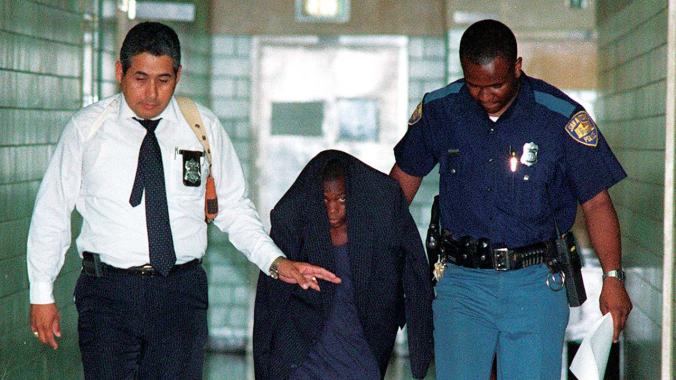
Texas Monthly this month has a troubling profile of Edwin Debrow, who is 37 years old, has been behind bars since he was 12, and may have to stay there until he is 52. On September 21, 1991, Debrow shot a San Antonio school teacher named Curtis Edwards in the back of the head. Edwards’ body was found sprawled across the front seat of a taxi that he drove part-time at night. Edwin, police determined, had shot Edwards during an attempted robbery. Above is the photo of the 12-year-old in custody.
Texas law, you will not be surprised to learn, allows very harsh punishment for juvenile offenders.Other states will sometimes try 12-year-olds as adults. Last year’s documentary “Beware the Slenderman” tells the strange story of Anissa Weier and Morgan Geyser, two 12-year-old Wisconsin girls who attempted to stab another 12-year old girl to death in 2014. Under Wisconsin law, Weier and Geyser will be tried as adults for attempted first-degree intentional homicide, and if convicted, they could be sentenced to up to 65 years in state prison.
Your Ethics Alarms Ethics Quiz of the Day is this:
Is it ethical for society to punish children with such long prison sentences, no matter how serious the crime?
Debow asks, in the Texas Monthly story, “Why can’t people understand I’m not that twelve-year-old boy anymore? Why can’t I be given a second chance?” It’s a fair question but not an easy one. From the article:
Some people who know Edwin believe he was never given much of a first chance. From the day he was born, in 1979, his life was marked by poverty and neglect, by drugs and fights, by knifings and gunfire. He and his six brothers and sisters were raised by their mother, Seletha, in shabby apartments and one-bedroom rent houses on San Antonio’s impoverished East Side. … Everyone slept on mattresses on the floor. When Seletha couldn’t cover her bills with her monthly $220 welfare check, the family would go for days without electricity and water. They ran a hose from a neighbor’s house to take showers. At least once they had to move into a homeless shelter…
Edwin became disruptive in school, got into fights, and snarled at teachers who tried to discipline him. …But he always came to school dirty and hungry. One teacher, Jacqueline Valentine, told her colleagues that she wished Edwin could come live with her. He had such potential, she said. She was worried that if nothing was done, he would turn out to be just another lost kid.It happened sooner than anyone could have imagined. When Edwin was ten years old, he joined the Altadena Blocc Crips. He wore the Crips blue bandanna, flashed gang signs, and spoke gang slang. He began “pumping yay” (selling bags of crack) on a street corner called Jolly Time, which got its name because it was frequented by drug dealers. The other Crips called Edwin “the Baby Gangsta,” and he loved it. “I felt protected,” he said. “And when you’re a little kid running the streets, protection means a lot.”
He stole cars and went joyriding. Even though he hadn’t reached puberty, he gave hookers free dope in return for oral sex. He routinely packed guns. He committed small-time robberies, and he shot at a drug customer who ran off without paying. He went along with some other Crips on a drive-by, opening fire on a house where rival gang members lived. One evening, when he was walking down a sidewalk with some Crips, one of them shot a passerby in the face. Edwin and his pals then calmly strolled over to a Jack in the Box to eat hamburgers. “It was like I had no conscience,” he said. “I didn’t value human life. At that time, I thought it was better for some people to be dead.”
…Prosecutors decided that Edwin provided the perfect opportunity to send a clear message to San Antonio residents about bringing juvenile criminals to justice. When the trial began, in February 1992, prosecutors warned the jury not to be fooled by Edwin’s age and boyish face. Yes, said Gammon Guinn, one of the prosecutors, Edwin was a child. But, Guinn continued, he was “a child that kills.” Guinn said that Edwin had strutted around “like a rooster” at the hospital, bragging about what he had done. Guinn then asked the jury, “Should we cut off society’s nose to spite our face and send him back out there? Do we let him do it again?”
That’s always the argument, isn’t it? The other side of the argument is this: Are you kidding me? The boy was 12 years old! Do you remember what you were like at twelve? Granted, he’s a damaged kid, but he’s still just a child. He couldn’t possibly have understood the full implications of his actions. A 12-year-old cannot justly be held to adult standards, and because of his age, a long prison sentence is harsher than it would be for an adult.
If this isn’t cruel and unusual punishment, what is?
In his plea for mercy in the “thrill murder” trial of teenagers of Nathan Leopold and Richard Loeb in 1925, Clarence Darrow began by reminding the judge that England once hanged children as young as seven years of age. Then he said,
“Your Honor, if in this court a boy of eighteen and a boy of nineteen should be hanged on a plea of guilty, in violation of every precedent of the past, in violation of the policy of the law to take care of the young, in violation of all the progress that has been made and of the humanity that has been shown in the care of the young; in violation of the law that places boys in reformatories instead of prisons, if Your Honor in violation of all that and in the face of all the past should stand here in Chicago alone to hang a boy on a plea of guilty, then we are turning our’ faces backward, toward the barbarism which once possessed the world. If Your Honor can hang a boy at eighteen, some other judge can hang him at seventeen, or sixteen, or fourteen. Someday, if there is any such thing as progress in the world, if there is any spirit of humanity that is working in the hearts of men, someday men would look back upon this as a barbarous age which deliberately set itself in the way of progress, humanity, and sympathy, and committed an unforgivable act.”
Leopold and Loeb, 18 and 19 respectively, were hardly children. Darrow, the iconic progressive, didn’t believe that it was just to punish most criminals at all, and he would have pointed to the life of Edwin Debow as prime evidence supporting his belief. He would have certainly been as horrified to find out that 90 years after his famous closing argument that saved the lives of his young clients who killed a boy just for the fun of it, American jurisdictions are still sending children to prison for 50 years or more. It’s better than hanging seven year-olds, but not much. Darrow closed by saying in part,
“If I should succeed in saving these boys’ lives and do nothing for the progress of the law, I should feel sad, indeed. If I can succeed, my greatest reward and my greatest hope will be that I have done something for the tens of thousands of other boys, or the countless unfortunates who must tread the same road in blind childhood that these poor boys have trod, that I have done something to help human understanding, to temper justice with mercy, to overcome hate with love.”
I think Darrow would feel that the sentence given to Edwin Debow and the ones facing Weier and Geyser prove that he failed in his objective.
My answer to the quiz: For such sentences to be inflicted on children is cruel, barbaric, and wrong.
___________________________
Pointer: Fred
 Ethics Alarms
See? See? A non-Trump, non-Democratic meltdown, non-news media freak-out ethics post!
Hahahaha. Indeed.
But let’s see how quickly we can make the discussion about Trump or the Left…
What a great summary, and what a distressing story. I have to think that sentencing procedures and guidelines will start to catch up with current research into adolescent brain development. One of the things we do know about child development is that the prefrontal cortex, which modulates impulse control, is still assembling itself well into our twenties. (This will come to no surprise to anyone reminiscing about what they did in college.) I suppose the other thing to note is that when you’re talking about adolescents, year-increments are almost exponentially different in terms of growth. In other words, a 13 year-old will see far more progress in comparison with a 12 year-old than an 18 year-old will in comparison with a 19 year-old. I can’t imagine killing someone at age 12. I also can’t imagine being held accountable for something I did at age 12 using the same standards I would expect to be applied to me now. This kid deserved to be imprisoned. But not for his entire adult life.
Even knowing what he did, that photo is heartbreaking. My own son, who is smart, compassionate and good, could easily be in prison now for vehicular homicide, if a stupid episode in his teens had gone differently. Pure moral luck.
The law treats vehicular homicides differently than murders committed in the course of a robbery.
This is a tough one, Jack. When I was a kid, we were told in Catholic school that the “age of reason” was seven. At which point you were capable of sinning. By fourteen, we could drive a car with a licensed driver over eighteen in the car. By eighteen we could be killed in Vietnam. In eighth grade, a classmate shot himself in the head playing Russian roulette. He died on his physician father’s operating table in the ER. I’m guessing we were twelve around that time. At that age would we have known felony robbery murder would have serious consequences? I suspect so. Do older gang members have members under eighteen do things knowing they’ll be tried as juveniles? I don’t know. I guess I’m just saying twelve can be pretty old. Does this guy deserve a second chance? I don’t know.
I’ll take the opposite stance O.B. Im sure we all spend some time around kids at some time or another, but as a teacher, I see a wide gamut of 7 year olds, and the wide variety of maturity levels in them. Using a blanket age of reason, as your school did, seems incredibly misguided, at best. As this relates to this boy, and knowing right from wrong at age 12, yep, most well-adjusted kids know that homicide is wrong at age 12, even with an underdeveloped Prefrontal Cortex. But, this boy was clearly not well adjusted. He was raised on the street to believe that the normal rules of society did not apply. At the risk of channelling my inner liberal (shudder), that’s 100% not on him, even though I agree that some level of serious consequence must fail on his tiny shoulders. A good follow up ethics question would be: Should his mother face jail time for her failure to provide adequate supervision/parenting? At least it would have saved the other 5 children in that household.
There are many things that make me viscerally angry:reasoning based solely on misinformation and emotions, but light on facts; people who virtue signal; people who fail to even attempt to look at the other side of an argument; when the Redskins play poorly; the list goes on. But at the top of that list, heads and shoulders above the rest, is abhorrent parenting, such as the parenting this boy received. My eyes are welling up right now with anger, knowing that he never had a chance, and he was sentenced to this life, at birth, thanks to the f***** up, selfish, self-centered, decision making of his mother* to continue to birthing children that she knew she could not take care of. I HATE negligent parenting. I have spent my life taking care of other people’s children, and may never have my own, and that there are people out there that treat parenthood so irresponsibly, so cavalierly, makes me want to smack them upside the head with a shovel, and I am NOT a violent person. It saddens me that fathers, who don’t want to be fathers (and even non-biological fathers, who don’t renounce their parenthood rights within a certain period of time), are saddled with child support payments under the theory of “it’s in the child’s best interest”, but children like Edwin cannot be taken and placed with people like the teacher who saw the potential in him, because staying with his “mother” is somehow in his best interest? I know I’m comparing apples and oranges here, but it still burns me up just the same.
*-Yeah, I also recognize that everything I said about Edwin in the first paragraph could also apply to his mom, as well. But it also burns me up that sex is such an end-all-be-all in our world, that the idea that someone- oh I don’t know- NOT have sex, to ensure that they don’t have children they cannot afford is never even considered. Damn, I hate this world sometimes.
“There are many things that make me viscerally angry… when the Redskins play poorly…”
You must have had it rough the past decade! 🙂
‘Aint that the truth! Though, 25 years is more accurate….
CB, the seven year-old thing was Catholic dogma. I just mentioned it as being the milieu in which I came of age. I guess we all assumed since that’s was we had been told, that was the rule that applied. It’s the earliest age I’ve ever heard for declaring people responsible for their acts. Just a point of interest, really.
Your points about negligent parenting are, of course, beyond dispute. But what can be done about it? We’ve had this discussion before. Sparty says, not too much tongue in cheek, people should be required to finish a certain amount of formal education and have a certain income and net worth before they can get a permit to have kids. I’m sure that would help but I doubt we’d want to go there. We’re spending lots of tax dollars dealing with the fruits of bad parenting, but I doubt we can deal with the problem at its conceptual, so to speak, source.
We simply need to make it easier for parents to lose custody of their children. I expressied this idea in another post.
https://ethicsalarms.com/2016/05/21/unethical-government-euphemism-of-the-month-justice-involved-individuals/comment-page-1/#comment-391781
I wonder if we have enough troops to make it happen.
Reflecting on my youth,14 is my cut-off for clemency. I think below 14, if you serve 20 years and people agree that you are generally reformed and have completed some education programs to give yourself a fighting chance outside of the system, I think you can get a second chance. Other factors have to be a good support system. If you keep him in there too long, everyone he knows will be dead. No one will personally care about his success and recidivism. If there are good support structures there now, he needs to be given a chance to re-engage.
I am no child psychologist, nor am I a lawyer. I’m just a mom. Do 12 year olds know right from wrong? Yes, they do. The problem lies, I imagine, in understanding the severity of what they do. For Edwin, and the background from which he came, stealing gum, stealing a car, robbing, shooting… These, in his mind, may have all been equivalents.
Jack, I thought you answered this when you wrote about James St. James. https://ethicsalarms.com/2013/08/18/ethics-hero-millikin-university/ Does something different apply here?
Yes. Two material differences. 1) 15 isn’t 12, and 2) He was legally insane, meaning that he was not culpable under the law.
So I am working on my dissertation which has to do with how children develop moral reason, moral emotion, and moral concern. I came across an interesting article that talks about how beliefs shape our thinking process. While a lack of belief will develop more of a critical thinker, an encouraged belief will give a person more of a moral concern. I write this because we are often the product of our environment. Based on this story, the boy was given the skills to develop neither.
According to Kohlberg’s Theory of Moral development, we understand right and wrong based on consequences (at its basic level). A boy, most likely craving attention based on the story, was rewarded constantly for bad behavior. It is easy for us to Monday morning quarterback because we are neither in the situation, understand what it is like to be in the situation, nor what it would take to change that boy’s world view.
Here is where I am torn. To get him out of the environment would take a drastic change. Given the path he was on, it is unlikely that he would have made changes had they gone easy on him.
However, I agree with your general assessment.
Thanks for sharing, and I, for1, would love to read you dissertation when it’s completed.
I mentioned above that I wish that the teacher had actually been able to take Edwin from this family, but I wonder if she alerted CPS with her suspicions. I don’t know the requirements and reach of CPS in Texas 25 years ago, and Im guessing mandated reporting did not exist back then, but, gosh, if there was ever a case for a child (and his siblings) to be removed from a household, this is it.
The question posed is; “Is it ethical for society to punish children with such long prison sentences, no matter how serious the crime?”
“Why can’t people understand I’m not that twelve-year-old boy anymore?”
There are lots and lots of prisoners that can say something almost exactly the same.
When intentional violence is chosen and the death of a victim of said violence is the result no rationalizations should be accepted, the answer is yes it is ethical. If that makes me a heartless ass then I’m okay with that, at least I’m not the heartless ass that chose violent criminal activity that resulted in someone’s death.
The “fix” for what is perceived to be “cruel, barbaric, and wrong” is to address this in the parole system, not the legal system.
Many states have eliminated parole in the “truth in sentencing” reforms that caught on in the 1990’s.
I live in one such such state. Sentences are served as ordered by the judge, with gubernatorial commutation or pardon as the only exception. Many times the sentence includes probation too, giving incentive to behave post release.
Brock Turner would have gotten and served 8-1/3 years here.
Zoltar, yes, Edwin chose violence, but if his concepts of right and wrong were as screwed up (entirely from outside influences) as his were, with such an underdeveloped Prefrontal Cortex unable to readjust his poisoned worldview to accepted societal norms, is that really the same as a grown-ass adult who chooses to harm others?
Chris Bentley said, “Zoltar, yes, Edwin chose violence, but if his concepts of right and wrong were as screwed up (entirely from outside influences) as his were, with such an underdeveloped Prefrontal Cortex unable to readjust his poisoned worldview to accepted societal norms, is that really the same as a grown-ass adult who chooses to harm others?”
These intentionally violent criminal youth know good and well that they are minors and that the system favors leniency towards minors and they intentionally take advantage of that system to get less punishment than an adult making the exact same choices for the exact same immoral reasons. Criminal youth are gaming the system, they are making ADULT choices to commit violent criminal behavior knowing that they can game the system when they get caught; these manipulative youth know exactly what they are doing.
Now when there are a few cases where these youth have been, or are soon to be, treated like adult criminals in court, there’s is an outcry of enabling whining. Give me a break.
I won’t ever be part of enabling.
On one hand you have the argument that he is a murderer, a routine and unrepentant criminal and a danger to society. On the other hand, he’s (was) twelve!
I believe drawing a hard line on either argument is an error. The US Justice System is based on analyzing case by case, and this should be no different. In this specific case, with the information I have, I believe the punishment has been too severe and would support granting clemency. Still, this goes against the assumption that the system did it right and jury and judge considered all circumstances. I don’t know what they know, so I can’t be confident that my judgment is better than theirs.
As to whether a 12-year old can be responsible: Maturity is not an on/off attribute. As a society we created a couple of Schelling points (around 18 and 21) but there are no guarantees that we may have a perfectly capable 16 year old, or absolutely childish at 22. The actual distribution probably looks like a bell curve, and the probability of finding a mature kid at 12 sounds quite far fetched to me. Also we have to find a thoroughly evil person (and this is also probabilistically distributed), so I find it hard to think that we have found the outlier on both distributions in a single person.
I suppose part of the answer comes from is prison for punishment, or rehabilitation. If rehab, then there should be a point where they’re truly changed to where they are not a danger to society anymore. If it’s punishment for a crime, does it matter how old they are, as the crime committed is the same whether they were 12, 22, 42, 62….
But if it is cruel and unusual punishment, than what should be the punishment? At 12 are they allowed carte blanche to be criminals at will? (Obviously not) Is there a limited punishment? And when does it change? Do they know by 14? By 16? I think for most crimes, it’s tough to put away a child for a long time. There should be some way of rehabbing and trying to get them back into some society at some point.
Murder is the tough one for me, as there is no second chance for the victim. They have irrevocably ended the life of someone, who has no chance of a future, as well as any family/friends whose life no longer includes that person. I think the tough part for me is, and maybe I’m a cold-hearted bastard, but if he killed MY child, I don’t think there is too harsh a punishment in my eyes, no matter how old he was at the time.
The “my child” factor is just a conflict of interest and unavoidable bias. That’s why we don’t put the family members of victims on juries.
Why not let them decide the sentencing, though?
That’s true, and why I say it makes me sound like a cold-hearted bastard. And why direct victims of a crime, and of those similar, should not be allowed on a jury. It also goes to the fact that, there is a victim here. We can feel bad for the child murderer, because he was a child at the time of committing it. But he murdered someone. That person is someone’s child, maybe someone’s parent, brother, sister, best friend. They committed a crime that ruined not only that persons life, but others as well. They don’t get to escape that, just because they were a child at the time. It’s why I said murder is the one that is tough for me.
In a slight sense, could the “my child” factor also cloud judgements in other aspects of this. You, yourself, said your child could have been in prison for vehicular homicide if things went differently for him (and I’m thankful it DID). Can that effect the viewpoint of someone who could picture their child in prison, and thus make that view more favorable in less punishment for those who do acts that could send them there? Not saying this does in you, as you’re generally logical in your thoughts on subjects, but certainly could for some people.
We either believe that age 18 is the age of adulthood, or we don’;t. Having these exceptions makes justice elusive. There should be certainty in the law, particularly the criminal law.
As mature as I might have been, I think it was in my mid-20’s before I really had a good sense of the world. They say that your brain is not fully mature until then and for me, that seems accurate. You see a lot of 20-somethings (mostly guys) do a lot of stupid and reckless things. Yet, we never seem to argue that really stupid 20-somethings should be tried as juveniles. If we want to have a juvenile justice system for children, children should be tried in it, regardless of the nature of the offense.
And, I think of George Stinney, executed at 14 and I think, guilty or not, it is cruel to treat children like they are adults.
-Jut
I there’s a lot to be said for your point, JG. Maybe giving prosecutors the option to try juveniles as adults is the problem. Draw a line (at eighteen or wherever) and stick to it is probably the best way to go. I’m 65 and not sure I’m “mature” yet. I doubt that would get me anywhere with a prosecutor, but I will keep it in mind if the occasion presents itself.
I think this man would have been diagnosed as a Conduct Disorder when he was 12. It’s too bad that he had such a hard life when he was a kid. However, in the article in Texas Monthly he seems unrepentant and blames his long time in prison on one mistake. This is the way a sociopaths think. He also hasn’t exactly behaved as a model prisoner and done much productive for himself or others. I think that he still poses a significant danger to society.
The answer is …. SCIENCE! It has been shown that a human brain does not stop developing until the early 20s. This boy, regardless of the seriousness of the crime, cannot be held accountable. Lock him up of course — but lock him up in a child detention center and try to give him all the resources he needs. When he is an adult and if he commits a crime again, then punish him as an adult.
So the age of majority should be 23, 24 or 25? No voting until that age? Juvenile hall for the age group most prone to violent crime? No one in the military until that age? No Democratic Party voters below that age? No cigarettes? No alcohol? Driver’s licenses? Binding contracts? All because of science that we could all get our own expert to disagree about?
Experts really aren’t in disagreement over this. But to answer your question in a roundabout fashion, I do find it odd that boys are old enough to die for our country at 18, but not old enough to buy a beer. We already acknowledge that age is important in some areas. In any event, we don’t need to reach the question of whether someone is an adult at 23, when the example at issue is a 12 year-old boy. We need to set the bar at some point — personally, I think it should be 18.
Let me ask you a question. This 12 year-old obviously was on the worst path possible, and it is unlikely that intervention at this stage would change that. But he’s still a minor. What if he were raped by his teacher or by a 19 year-old girl in his neighborhood? Would you call it rape, or would you argue that he had the ability to consent since this kid was obviously not your usual 12 year-old?
why?
What if the public decides to hold him accountable anyway?
How is science going to stop them?
Spartan said, “This boy, regardless of the seriousness of the crime, cannot be held accountable.”
“People have a duty not to commit assault” or other violent criminal acts including murder. Does that sound a little familiar Spartan? Tell me Spartan, how do these two opinions shared by you conflict with each other? You really don’t have to answer that, just think about it. 😉
Spartan,
I think you’re lacking a little perspective on this, allow me to help with that. What if a rather large 12 or 13 year old boy with a history of violence stalked your daughter, viciously attacked her, violently raped her, and murdered her when he was done with her, would you still be saying that this boy cannot be held accountable? Remember Spartan you said “regardless of the seriousness of the crime”. Gain some perspective before writing such inclusive blanket statements; seriously.
I have oodles of perspective and a law degree to boot.
If something horrible like that happened to my daughter, I would feel tremendous grief and rage. Quite frankly, I would probably want that child murderer dead — hopefully, I would start to see reason with time. I would also know, however, that it is the government who brings a criminal action on behalf of the PEOPLE, not my daughter.
I am not advocating for 12 year-old murderers to be released on to the streets, they have to go to juvenile detention centers. Have you been to one? They aren’t pleasant places and resemble prisons in every sense of the word, the only difference is the age of the inmates. And, it’s possible that a 12-year old wouldn’t be released at 18 anyway. Everyone has duties, but how you are punished for violations of those duties is dependent, in part, on your age at the time that the violation happened.
Spartan,
I’m confused by a couple of things.
Above you said that, “this boy, regardless of the seriousness of the crime, cannot be held accountable” and then immediately followed that up with, “lock him up of course…”; isn’t locking him up essentially holding him accountable? Where is that dividing line where you cannot hold them accountable and you lock them up? Maybe your understanding of accountability and mine are different.
Also using the logic you based your “cannot be held accountable” opinion on, that logic being “It has been shown that a human brain does not stop developing until the early 20s.”, then we shouldn’t be holding anyone accountable for their criminal actions, or any other actions for that matter, until there is proof that the individuals brain has stopped developing or we could just pick some early 20’s age, how about 21.
Furthermore…
If this under-developed brain relationship to accountability is used to minimize the “punishment” for violent criminal activity that results in the death of the victim then that must also mean that they would fully expect that that individual would have made a completely different choice when the brain was fully developed regardless of the circumstances surrounding the choice. I think the basis of that line of thinking is an assumption and if that assumption is even remotely true; why are prisons full of criminals with fully developed brains that have made choices to commit violent criminal activity. Maybe that kind of assumption with criminally violent youth that have murdered someone is false, maybe the fact that this youth made this kind of choice is a tell that they are likely to have made the same kinds of choices even after their brain is fully developed. There is millions of millions of youth with underdeveloped brains that do not make these kinds of violent criminal choices.
I’m sorry Spartan but when a person makes an active choice to take a life threatening weapon to a planned intentional criminal act knowing full well that that weapon has the potential of ending the life of the victim and the end results of that criminal activity is the death of the victim, I have absolutely no sympathy for the violent criminal regardless of age. That criminal should be evaluated for their competency to stand trial and eventually they should suffer as an adult does for the adult choices they made that ended the life of a victim. I do have one limitation, the death penalty should not be available for any violent criminal that was not at the legal age of 18 when the criminal act took place.
There is no such thing as a child making an “adult choice.”
Chris said, “There is no such thing as a child making an “adult choice.” “
That is a matter of opinion. We’ll just have to disagree on that point.
Yes, but you’re letting your opinion get in the way of facts. Chris is right — as is Jack; there’s no need to repeat what he has already written.
Spartan said, “Yes, but you’re letting your opinion get in the way of facts.”
I disagree, in fact I think others are likely letting opinions and emotions get in the way of facts.
The flaw is in thinking that “it” is still a child when that “child” is choosing to plan a crime ahead of time, choosing to take a gun to the crime, choosing to rob a taxi cab driver, and choosing to shoot the driver dead; when you put all those things together, the child is making the same choices that are made by adult criminals and by virtue of those choices this “child” is no longer a child but thinking, choosing and acting exactly like an adult criminal. The choices are the same and the end results might be or might not be the same depending on the circumstances when the crime is put into motion.
In this particular case the legal system agrees with me.
This is the perfect time to post this…
“When I was a child, I spoke like a child, I thought like a child, I reasoned like a child. When I became a man [adult, mature, whatever you choose to call it] , I gave up childish ways.”
Z, I have mixed feelings, and that is all they are, about this. Yes, the kid was 12, but he had a gun. Spartan asked what if somebody was trying to rape him and postulated a 19 year old woman. HE HAD A GUN. That 19 year old woman likely would have had the top of her head blown off. Just like the taxi driver/moonlighting teacher got the back of his head shot off. Is he remorseful? I don’t know. Frankly, I doubt it, even though he said he was in the Texas Monthly interview…or at least Texas Monthly SAID he expressed remorse. Lucky may have had the right idea…let’s revisit this case on a regular basis. Frankly, I don’t know.
I think you missed the point of my hypothetical. Could this 12 year old “consent” to sex with an older woman? Would you argue that a minor always is incapable of consent (that is the law) or that this 12 year old is different and that the 19 year old woman shouldn’t go to prison?
I am an educator and understand the basics about brain development, morality, ethics, abnormal psychology and such topics. When “dealing out”
punishment we must remember how the minds of children are so easily influenced by others. If it is perceived that 12 or any arbitrary age is too young to be held accountable for your bad deeds than why not give it a try, see how it feels to injure or kill another? Then gang mentality can become a factor as well. I don’t know the correct answer to this dilemma but I know how I would feel if one of my relatives was murdered by a young person for no reason. We also have to look to rehabilitate the young offenders rather than exposing them to others that will teach them more vile thoughts and acts of violence. I don’t think there can be one answer. It has to be dealt with on a case by case basis using the best child psychiatrists and neuropsychiatrists available to try to predict the potential of rehabilitation, of teaching how to make good moral decisions, determining if there is an underlying brain malfunction predisposing young criminals to these behaviors. It’s a hard decision but I don’t want to be the one responsible for perpetuating the cycle of violence that seems to be on the rise among today’s youth.
Are people kidding?
He shot a person he was trying to rob in the back of the head. Sorry, that’s a capital murder in just about any other circumstance. There’s a place for mercy, but this isn’t it. Maybe, just maybe, if spreading this story keeps one kid from joining the Crips or Bloods, or some other gang, then we redeem something from this tragedy.
As for Geyser and Weier, this was a stabbing planned for months. Their obvious mental health issues aside, this is also a very adult crime. One of them is refusing to take medication for her prescribed disorder.
Tell me, what about the cruelty done to the families of Curtis Edwards and P.L.? What about the barbarism suffered by Mr. Edwards and P.L., Jack?
A friend was telling me of accounts like this but seemingly even more unjust/severe described in a book “Just Mercy”.
Does civility carry with it the risk of suffering first and bearing that as a necessary personal cost rather than inflicting suffering first as an eventual absolute self protectionism?
At what point is it ethical for society to protect itself from monsters like this kid? At what point is someone such ‘damaged goods’ that we should stop trying?
I don’t know. 12 is pretty young to be caged for so long. On the other hand, 12 is pretty young to commit the serious crimes this kid did. He was a monster (even if not of his making, something I will not concede as he chose his crimes) Others in the same circumstances did not choose to act this way.
This kid was made an example of, because one needed to be made, to that age group (“Yes, you too can go to jail”) who were being used to commit crimes on the assumption they would get away with anything. It worked. Does not make it right, just right for the community at that time.
I believe that society must protect itself from individual members who threaten ‘life, liberty, and property.’ Most especially ‘life’ as that is the ultimate prize in this world. That makes cases like this hard, yet balancing this child’s rights (given the crimes) against my rights (the right to not be a victim), and, by extension, his victims’ (multiple many times over) rights means we jail him, if not execute him.
It is not a rabid dog’s fault that it attacks and attempts to kill people. You still kill the dog for the good of society.
I am open to comment and debate.
Rabid dogs have actual diseases, and are incurable. Speaking of dogs, though: it has been shown that “vicious” pitbulls trained as killers by abusive owners can be completely rehabilitated with care, skill, retraining and love. I cannot believe that the same can’t be done with an abused, badly socialized child. I’ve read people who call pitbulls monsters; it’s an ignorant position. Unless they are sick or permanently damaged, they are just abused and confused animals, and like any other dog placed in their situations would be.
Boys Town was founded on Father Flanagan’s belief that “there is no such thing as a bad boy.” I think he is largely right: there are bad men, but when they are boys, there is hope. I’m no bleeding heart, and I think Darrow’s no free will view of existence was far too dark. I think he was right in cases like this. The boy was failed by society and his parents, and was set on this path against his will. Throwing him away, locking him away, for most of his life is unjust and simplistic. He deserves as much of a chance as an abused pitbull.
How does this position mesh with your capital punishment position?
Pure Darrow as far as kids go. I would never execute a twelve year old either, and the US doesn’t.
Leopold and Loeb, however, I would have pulled the switch myself for.
Other than saving the cost of their meals for the rest of their lives, and possibly frightening people into not committing murders (even though the death penalty evidently did not deter those two from their crimes) what actual good would that do for society? Why is it more ethical than a life sentence?
But what of all the thousands of children who have exactly the same circumstances and never engage in a lifestyle of criminal behavior? If society and parents determine the outcome, setting them on this path against their will, we would have this same result every time. We do not.
Personal responsibility for actions. He knew what he did was wrong, and did not care, even bragging about it.
There was choice involved here, too.
Look, Jack: my heart bleeds for the child whose life was wasted this way. But it bleeds more for the victims of his crimes, including the ones he never committed because we prevented him
The victims are not the clients of the justice system, society is. Society should protect its children, not throw them to the wolves and shrug. We don’t make 12-year-olds accept the same responsibility for their actions as adults. If you can draw the line at 12, you might as well draw the line at 7.
I’ll restate what I stated above. The Justice Sysytem deals with these situations on a case by case basis. On the surface (and I really only know about this case what you wrote) the punishment looks cruel and unreasonable, but on the other hand the judge and jury – with what I assume is better information than I have – decided that throwing the book at him was best for society.
I’m conflicted and lean towards saying this outcome is unjust, but I refuse to accept the categorical assertion that a 12 year old us innocent just because of his age.
Nobody said he was innocent, did they?
Agree with everything you wrote here Jack.
Seconded.
Well, except “the pulling the switch part,” but that’s not the topic of this post anyway.
Well, it’s a line from 12 Angry Men…
Come on, give a charitable reading to my words: “I refuse to accept that a 12 year old deserves a less harsh punishment just because of his age.”
I believe this guy was made an example of and might be worth granting clemency, but I defaulting to lesser punishments gives the wrong incentives (gangs will make all their hitmen 12 year olds for example).
Here’s whole lotta copy and paste, b/c I am not smart enough to come up with this on my own:
—-
Jordan Graffman (cognitive neuro scientist) explains “the prefrontal cortex denotes social behavior and knowledge; the ability to… reflect on your own behavior.”
Daniel Weinberger (Director of the Clinical Brain DisordersLaboratory, National Institute of Health) continues: “It allows us to act on the basis of reason….It can preclude an overwhelming tendency for action. … It also allows us to consciously control our tendency to have impulsive behavior…Without a prefrontal cortex, it would be impossible to have societies based on moral and legal codes.”
—–
Addressing youth violence, Weinberger explains:
I doubt that most school shooters intended to kill, in the adult sense of permanently ending a life and paying the consequences for the rest of their lives. Such intention would require a mature prefrontal cortex, which could anticipate the future and rationally appreciate cause and effect. … The [juvenile] brain does not have the biological machinery to inhibit impulses in the service of long-term planning.
—–
Deborah Yurgelun-Todd of the Harvard Medical School concluded:
“Adult brains use the frontal lobe to rationalize or apply brakes to emotional responses. Adolescent brains are just beginning to develop that ability.”
—-
It is incredibly important to remember here, that those of us saying pump the brakes on treating 12 years olds like adults, aren’t scapegoating the kid, or intending to enable similar behavior in future kids, or saying that he should go unpunished. But he, and every other 12 year old, literally have brains that have a significantly underdeveloped capacity to:
a) reflect of the consequence of their behavior;
b) act on reason, rather than impose and/or emotion;
c) foresee the longterm consequences of their actions
…relative to an adult brain, with a fully developed prefrontal cortex. He should have been punished. But the punishment needs to fit the perpetrator, in these circumstances, as well as fitting the crime.
Click to access Minors%20are%20not%20as%20blameworthy%20as%20adults.pdf
The jury was presented with the evidence.
they made the decision.
Typically, a Judge decides whether or not a child is to be tried as adult. This is decided in motions hearings before it ever goes to trial.
With 12 year old violent felons, what are the rehabilitation rates? Do we, as a society, have the means and ability to rehabilitate most of them? This is a critical question related to the appropriate punishment.
I’m going to throw another monkey into the barrel. I know next to nothing about this case, which I will fix in the next day or two. What I do know about is the TEXAS MONTHLY…the managing editor is a raging liberal, considerably further left than anyone posting here, and is not above (in fact, he is rather in favor of) slanting a purported ‘news’ story or outright faking his data. Remember, it’s published in Austin, Travis County, the home of the University Of Texas at Austin…not exactly a conservative think-tank.
dd’s on the case.
Unless he photoshopped that picture, I don’t see what he could have faked that made a difference.
Regardless of the age of the perpetrator, I do not think it is cruel and unusual – or even punishment, for that matter – to isolate a person who has committed a murder like Edwin did from the rest of the members of society who are presumed innocent of a similar crime. Edwin’s isolation is simply a necessary condition for the justice that both he and his surrounding society deserve.
In what environment should the perpetrator be isolated? How long should such isolation last? How should the isolated person be treated on a path to ending the isolation? Should the kind, or characteristics of, the isolation environment depend at least in part on the age of the perpetrator?
Those are fair questions for consideration on a case-by-case basis.
I don’t have answers.
I believe it is reasonable for a society, its public, and its justice system to regard a person who has murdered, like Edwin did at age 12, with a presumption of being at a higher risk for committing more violent crimes in the future. Therefore, Edwin’s re-introduction to society should be a process of gradualism in terms of degree of isolation, degree of personal freedom, and time budgeted for opportunities to demonstrate trustworthiness, accountability, non-violence, and productivity comparable to previously rehabilitated perpetrators of similar crimes. His status options should not be oversimplified into “jailed or paroled,” “controlled or uncontrolled,” “monitored or unmonitored.” Edwin should complete a years-long, gradual re-establishment of himself as a member of society who has overcome all further need for isolation and what I will call an obligation to submit to “continuous, diligent vetting.” In my opinion, once you murder someone, no matter what your age when you did it and what your actual sentence, you owe society a life-long debt of reparations.
If Edwin should happen to murder again, I hope that with a conviction, the death penalty would be on the table as one possible sentence.