[I was up until 3 AM watching a Red Sox game in Seattle that went 13 innings and five hours—they lost– and this doesn’t feel like morning, it feels like Hell. I’m dictating this to my dog, and hoping it warms ME up…]
1. The American Psychoanalytic Association told its 3,500 members that they should not feel bound by the so-called “Goldwater Rule,” which the rival American Psychiatric Association announced in 1964, prohibiting its members from diagnosing political figures from afar without the benefit of actually examining them. It’s an ethics rule, an obvious one, and shouldn’t be controversial. As I have documented here, however, professionals of all kinds have allowed anti-Trump bias, panic and fervor to dissolve their ethical standards. The groups afflicted include college presidents, teachers, scientists, lawyers, judges, historians, legal ethicists, journalists and artists. Nobody should be shocked that psychiatrists are eager to do the same. As with the other professionals, all they will accomplish is an erosion of public respect and trust. I thought Ann Althouse’s response to the announcement was spot on:
Let them speak, and then the rest of us will speak about whether they are professionals deserving of deference or human beings like the rest of us who can’t keep our political preferences from skewing whatever it is we might think about some pressing issue of the day.
Go ahead, expose yourselves. Let us see all narcissism, impulsivity, poor attention span, paranoia, and other traits that impair your ability to lead.
2. I’m not devoting a solo post to the ridiculous Trump Boy Scout speech controversy, because despite all the efforts of the news media to maintain otherwise, it was not a scandal, was not a big deal, was not an enduring scar on the Boy Scouts of America, and is mostly significant as demonstrating how distorted the perception of those who are verging on being physically allergic to the President has become. Some points that have arisen in the thread about the speech are important to note, however. Continue reading →
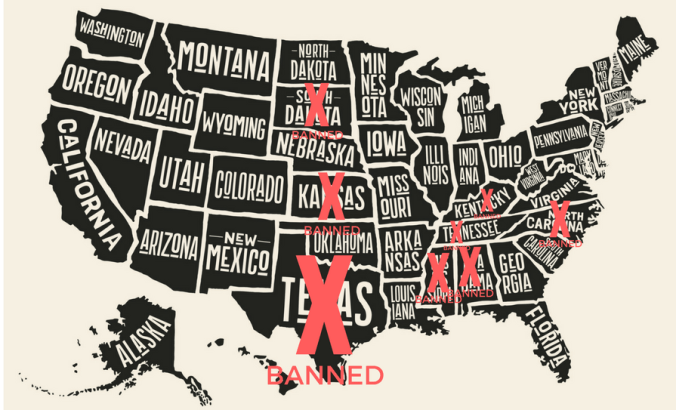
Recently various states have decided to punish their fellow members of the United States of America for daring to adopt laws of which they do not approve. The method: bans on government employees traveling to those states on business and the state dime, with the hope that the state’s lead will discourage private travel as well.Why are they doing this? Oh, many reasons, I suppose, all of them insufficient to justify the conduct, which is unethical.
Some of the state legislators who pass these bans, and the governors who sign them, want to place economic sanctions on the other states, even if the effects are limited. After all, they can’t stop the citizens of the states from traveling, only government employees. But pressure is pressure, and the limited measures are an attempt to meddle in the democracy of those other bad states. Another reason is virtue-signalling, as a state seeks to show that it supports a group that is politically strong in that region against another state’s policies that displease it. A third reason is the related motive of grandstanding. Finally, a state might use a travel ban to strike back at another state that is banning state travel there. An eye for an eye, a voucher for a voucher.
Yes, this will end well.
I wish I didn’t have to say this, because I know everyone thinks I pick on liberals, progressives and Democrats, but it’s the Democratic majority states that are using this weapon, especially…well, can you guess? Oh, come on, guess. Yes, the major offender is California. Others are New York, Minnesota, and Washington state.
“Our country has made great strides in dismantling prejudicial laws that have deprived too many of our fellow Americans of their precious rights,” says the public statement of California’s Attorney General Xavier Becerra of California, who has been instrumental in getting the Golden State to limit trips to Alabama, Kansas, Kentucky, Mississippi, North Carolina, South Dakota, Tennessee and Texas. You know, those conservative bad places, where people with sub-normal IQ’s cling to their guns and Bibles. His quote is a classic of arrogant, doctrinaire, narrow-minded, elitist self-righteousness. Continue reading →
One head explosion after another splattered my office with gore as I read the New York Times sad, sad, <sniff> piece about poor, abused, illegal immigrants who drive without licenses. It began:
“Heading to church one evening in late March, a farmworker and her sister were stopped for speeding in the village of Geneseo, N.Y. They were driving with their five children in the back of the minivan. Two were not in car seats, as required. The police officer, trying to cite the driver for the infractions, discovered she had no driver’s license, so he called Border Patrol to review her Guatemalan passport. Both sisters were undocumented immigrants. They were detained and are facing deportation.”
Good.
The Times, however, currently engaged in a full-on “Let’s make illegal immigrants as sympathetic as possible” campaign—how can we be so mean to people who were just trying to go to church?—makes it clear that such an event is just more cruelty and lack of compassion emanating from the Trump Presidency.
“Under a Trump administration that has taken an aggressive stance on illegal immigration, the moving car has become an easy target. A broken headlight, a seatbelt not worn, a child not in a car seat may be minor traffic violations, but for unauthorized immigrants, they can have life-altering consequences.”
KABOOM! #1. How shameless will the Times’s misrepresentations regarding this issue get? These people are not being deported for “minor traffic violations.” They are being deported because they ahve absolutely no business being in the country at all. The Yorkshire Ripper was caught because of a police stop for a minor traffic violation. By the Times reasoning, this, and not the 13 women he murdered, is why he was sentenced to life in prison.
These drivers are also not “undocumented.” Undocumented is what I was when I was stopped for speeding with an expired license. I was, however, still a citizen. “Undocumented” is a Times and illegal immigration lobby cover-word for what illegal immigrants really are: illegal immigrants.
The term deceitfully suggests that the “undocumented” individual was just missing some papers—t could happen to anybody! No, you are not just “missing papers” that you never had the right to have.
KABOOM! #2:
“As many as 12 states, along with the District of Columbia and Puerto Rico, offer driver’s licenses for unauthorized immigrants, up from three in 2010. New York, which has the third-largest immigrant population in the country, is not one of them.”
Three was unconscionable. Twelve is a scandal and a dangerous attack on sovereignty and the Rule of Law.
KABOOM! #3 and #4:
Supporters of efforts to allow those who are undocumented to get driver’s licenses say that public safety would improve because they would be required to pass road tests and obtain insurance. But critics said that licenses represented a privilege that unauthorized immigrants should not hold, because they should not be here in the first place.
The first sentence is a logical disconnect: Let’s make what these people do legal, because they’ll break the law if we don’t. Yes, and the fact that they’ll break the law if they can’t do something legally is why they are here illegally and why they cannot be trusted as citizens. To its credit, the Times at least quotes a Republican lawmaker who is not deceived, though the paper suggests that she has a comprehension problem:
Senator Kathleen A. Marchione, a Republican representing the Upper Hudson Valley…does not understand the argument for giving licenses to those who are undocumented.“Driving without a license should not give you a right to have a driver’s license when you are already breaking the law in two instances,” she said in an interview. “That’s like saying if a kid is drinking at 16 years old, we might as well let him.”
That is exactly what it is like. She “doesn’t understand” the argument because it doesn’t make sense and never has. The Times won’t accept this, as the second sentence in the quote above makes clear. This isn’t merely what “critics” say. It is a fact. There is no “other side” to facts, and the Times is misleading its readers to suggest that this is just a contrarian position.
KABBOOM #5 and #6 came after reading this quote:
Anne Doebler, a private immigration lawyer in Buffalo, said that undocumented immigrants want to follow traffic laws, and that civil law and immigration law should be kept distinct. “Why do we want to use our vehicle and traffic laws to enforce an immigration policy when it’s detrimental to public safety?” she asked. “I don’t want someone to hit me who doesn’t have insurance…I don’t care what their immigration status is.”
“Undocumented” as a cover-word for “illegal” no longer makes my head explode, it just makes me angry. But Doebler’s spin is outrageous. Oh, the illegal immigrants want to obey laws that make it easier for them to live here illegally, do they? Well, isn’t that wonderful! Why don’t they want to obey the immigration laws? Heck, why don’t we just stop enforcing all laws, since avoiding law enforcement often makes criminals and law breakers breach other rules, laws, and ethical obligations?
The Times cites statistics showing that hit and run accidents by illegal immigrants declines significantly when they are allowed to have licenses and insurance. Hey! I just thought of an even better way to reduce hit and run accidents by illegal residents! Can you guess what that would be?
Would Doebler care what the immigration status of someone who, say, ran down her child was, if that individual had been allowed to stay in the country after a previous traffic infraction? Would she really think, “Illegal, legal, what’s the difference?” I think not. I think she would say, “the driver who killed my kid should not have been on the streets at all,” because that would be obvious and true.
“California and New York will become the first states to allow illegal immigrants to practice law and be sworn in as lawyers. In so doing, they will grant the privilege of upholding the law and defending the U.S. Constitution to people who have intentionally violated the rules, and who have no right whatsoever to be here.”
This is a fair and objective description. I detest conservative radio talk show host Micheal Savage, who wrote a right wing attack tome called “Liberalism is a Mental Disorder” just as I detest that title, and the approach to civil discourse and political disagreements that goes with it. (Ann Coulter preaches the same message, but is funnier when she does it.) However, when I read about things like this, I feel a magnetic pull to the position. In 2013, Governor Brown signed into law a provision allowing illegal immigrants to be awarded licenses to practice law in the state California. At the same time as he vetoed nother bill passed by his reliably wacko legislature that would have allowed those who would not obey the nation’s immigration laws to be eligible to serve on juries, and thus pass judgment on the alleged crimes of U.S. citizens. Ponder that contrast for a minute, and see if your head explodes. Brown had a convoluted explanation for the seeming contradiction, but what he was doing was obvious: he was pandering to illegals and their supporters. Serving on juries is an obligation of citizenship that citizens find onerous: telling illegals that they didn’t have to meet this obligation while still harvesting citizenship benefits was a welcome decision.
“I am not surprised by this turn of events, just made nauseous by it. I almost closed comments for this post. If I really have to explain to someone why those who have never taken affirmative steps to become citizens in this country should not be allowed to practice its laws after years of being in defiance of its laws, I’m not sure its worth the effort.”
I find myself annoyed at the groundswell of good wishes for John McCain after his diagnosis of glioblastoma…McCain is a war criminal and, more to the point. someone who as a politician has championed horrifying actions and been lousy on state commitment to public health…But ultimately what troubles me is the urge to send such well wishes to an utter stranger as it reinforces the notion that some lives are more important than others. There are lots of people with glioblastoma and who have died from it (including my mother twenty years ago)….
—San Diego State University Political Science Professor Jonathan Graubart on Facebook, prompting some calls for him to be fired, and others on campus to second his opinion.
Is this an Ethics Quote or an Unethical Quote? I could call it an Ethics Quote because it raises many ethical issues, and mere statements of opinions, even stupid and vicious ones, are not usually unethical in themselves. This quote strongly suggests that the speaker is unethical in than one respect; it is also, at very least, irresponsible in its context, which is that he is a teacher, and represents the institution.
Jonathan Turley flagged this episode, as he reliably does any time a professor comes under fire for controversial speech. As always, he supports his fellow academic:
“Graubart’s comments are hurtful and hateful. It is a reflection of the incivility that has taken hold of our social and political dialogue. It is always sad to see a fellow academic rush to the bottom of our national discourse. However, we have free speech and academic freedom to protect unpopular, not popular, speech. Popular speech does not need protection. Graubart is expressing his deep political and social viewpoint on social media. He should be able to do that just as his critics have a right to denounce his views.”
San Diego State University is a government institution, and thus subject to the First Amendment, in addition to the principles of academic freedom. However, even a state institution has a right to protect itself from harm. This isn’t just political speech; it is bona fideasshole speech, signaling that the speaker is not a trustworthy teacher, and that any school that would have someone this intolerant, doctrinaire, vile and contemptuous of kindness and compassion educating, aka indoctrinating students isn’t trustworthy either. Universities, public or not, should be able to insist on a minimal level of professionalism from faculty in their public behavior and pronouncements so the institution isn’t permanently discredited, embarrassed, and harmed.
My old friend Mark drops in to comment just a few times a year, but always delivers his trademark optimism, fairness, and perception. When he talks, I learned early on in our relationship, attention should be paid.. His was one of several excellent comments on the horrific episode in Cocoa Beach, where five teens stood by watching a handicapped man drown, and seemed to enjoy the sight mightily as they recorded his death on their cell phones. In response to another commenter’s query, “Are “kids” that are so disconnected that they’d do something of that magnitude rehabilitatable?”, Mark leaped k took the discussion to a related topic that I had found myself thinking about a lot while I was trapped in a lobby and two airports yesterday with nothing to do but wait and silently curse. What are electronic devices and social media obsession doing to our social skills and ability to relate to the world? At what point to we start sounding the ethics alarms…or the societal survival alarms? [ I’m going to include the last part of Mark’s earlier comment on the story, because it is a helpful introduction to the rest.]
…The natural human reaction to observe has been enhanced by our ability to record, and it now seems to be the first response in almost every situation – the more harrowing the better. I’m sure there is some personal thrill involved in being able to post the result, garnering comments and ego-gratifying oohs and aahs.
The situation in Florida is only the most horrible of them, right up there with the guy who posted pictures of himself with the corpse of his step-father, whom he had just murdered. Like everything else, this is a tiny part of a much bigger picture of who we are becoming as a culture. The 21st century ability to remain safely behind a screen while still feeling a full participant in life (Internet commenting a prime example) frees us of the necessary empathy (or simply humanity) to come from behind that screen to behave in ways that might be heroic or even civil. I have little difficulty seeing that behavior manifesting in children raised viewing life through a cell phone.
The much larger question – at least for me – remains “Am I my brother’s keeper?” It’s a nagging question, versions of which swirl in and around almost all the major political issues of our day and, now, into our personal dealings with one another. It is always there, but we come up with more and novel ways to avoid actually answering or acting on it. Clearly, it never occurred to these boys. Cain didn’t want to answer the question. And, I suspect, neither do we.
***
I carry two cell phones, absolute wonders of technology, which remain in my briefcase most of the time although I’ll take one of them with me to a picture-taking occasion. My friends grit their teeth at receiving responses to texts that are weeks old. My relationship with my cellphone(s) was cemented when I had the opportunity to whale watch off of Maui. I realized that I was so concerned about my precious iThing getting wet or falling into the water that I wasn’t watching the whales. I put the phone away and decided that watching the real world with both eyes was more interesting and that’s what I try to do. I hope sincerely that that attitude would ensure that I offer whatever aid I can in a dire situation rather than wondering what it will look like on Facebook later on. Continue reading →
I have written on this topic before, but this is the famous incident’s anniversary, and I have come to believe that the lesson learned from the pine tar incident is increasingly the wrong one, and the consequences of this extend well beyond baseball.
On July 24, 1983, the Kansas City Royals were battling the New York Yankees at Yankee Stadium. With two outs and a runner on first in the top of the ninth inning, Royals third baseman George Brett hit a two-run home run off Yankee closer Goose Gossage to give his team a 5-4 lead. Yankee manager Billy Martin, however, had been waiting like a spider for this moment.
Long ago, he had noticed that perennial batting champ Brett used a bat that had pine tar (used to allow a batter to grip the bat better) on the handle beyond what the rules allowed. MLB Rule 1.10(c) stated: “The bat handle, for not more than 18 inches from the end, may be covered or treated with any material or substance to improve the grip. Any such material or substance, which extends past the 18-inch limitation, shall cause the bat to be removed from the game.” At the time, such a hit was defined in the rules as an illegally batted ball, and the penalty for hitting “an illegally batted ball” was that the batter was to be declared out, under the explicit terms of the then-existing provisions of Rule 6.06.
That made Brett’s bat illegal, and any hit made using the bat an out. But Billy Martin didn’t want the bat to cause just any out. He had waited for a hit that would make the difference between victory or defeat for his team, and finally, at long last, this was it. Martin came out of the dugout carrying a rule book, and arguing that the home run shouldn’t count. After examining the rules and the bat, home-plate umpire Tim McLelland ruled that Brett used indeed used excessive pine tar and called him out, overturning the home run and ending the game.
Brett’s resulting charge from the dugout (above) is video for the ages. Continue reading →
…and gee, it’s good to be back home! You have no idea how good it is.
1. ARRRGH! I returned to Ethics Alarms with 6 pending comments, and I want to apologize profusely for the back-up, especially to poor Paul Schlecht, whose avatar inexplicably makes WordPress hold every single one of his comments in moderation until I rescue it. Only one post got up yesterday, and that was a close call: I was in resort/airport/travel Hell yesterday in Daytona Beach, then Charlotte, pretty much from the moment I got my wake-up call at 6 AM to when my plane finally arrived at D.C.’s Reagan National Airport at just short of 1 am. today.
At least my law firm retreat seminar on legal ethics and technology was lively, but now I am way behind on posts, and also not exactly at the top of my game. Again, my apologies to all. And I’ve got to get a new laptop without a jumping cursor and that doesn’t crash my browser every 20 minutes or so.
2. I mentioned last week that the New York Times Sunday Review section is a weekly exercise in anti-President Trump porn. I couldn’t find a Sunday Times yesterday, so as a test, I’m going to open the copy my wife saved for me and look at the section now.
Let’s see…well the above the fold story is a feature about “why women aren’t CEOs.” The anti-Trump shot doesn’t come until the last paragraph, where the author, Susan Chira, couldn’t help herself from quoting Hillary Clinton as she blamed misogyny for her defeat. The Deplorables, you know. The second story on the front page is a mocking piece by a British historian, about a new Trump Doctrine, but with the term in scare quotes. How dare the President stand up for Western Civilization, we are asked to consider? This author, Stephen Wertheim, claims that the Trump administration’s problems with Iran, North Korea and China are based in racism and religious bias. (Obama’s problems with the same nations were, presumably, based on a sincere concern for peace.) The essay is also fairly anti-American, but concludes with the insult that the problem with the President isn’t so much what he does as who he is.
This is essentially the argument of “the resistance.” You know. Bigotry.
Let’s see—that piece took up all of page two, so we move on to page three. Two op-eds are there, one again mocking the ex-press secretary Sean Spicer, which the Times editorial board had already done, and the other, by Frank Bruni, attacking Jared Kushner. It closes with this, in part:
His counsel to Trump has been flawed, to say the least. He reportedly lobbied for the firing of James Comey, which didn’t turn out so well….I hear that he feels persecuted. Wronged. In that regard, too, he’s like his father-in-law, though Trump wears his self-pity, fury and ruthlessness right out front, for the whole world to see.
This is the company line. Actually, firing Comey turned out spectacularly well: the President was able to get rid of a highly placed leaker who had proven himself incompetent and untrustworthy. Bruni and the Times feel it was a mistake because the completely legal, appropriate, indeed overdue dismissal brought down the ire of the news media determined to get rid of the President. Message: When will you learn that we call the shots, you fool?
In fact, the President and his entire family have been persecuted by the Times from the very beginning, in obvious contrast to the news media’s disgusting fawning over the Clintons and Obamas, and even their chilly respect for the Bushes.
On to page four! Oh! Here’s a cartoon of the President as Donald Duck, and an op-ed by a New York City mother about how embarrassing it is to have a toddler who–The Horror!—likes the President of the United States! Beneath that screed, with a picture of Don, Jr., is an op-ed attacking another member of the President’s family in a piece about “men who never grow up.” The Trump boys are lumped in with Billy Bush, Ryan Lochte (the moronic Olympic swimmer), the fortunate college rapist Brock Turner, and the police officers who shot Tamir Rice! Funny, the nation’s most prominent perpetual adolescent, who embarrassed the whole nation by using the White House as his passion pit, is never mentioned.
The non-Trump stories then take over for a few pages, and we’re finally at the editorial page. Two of the three editorials attack the President’s policies as the embodiment of evil: one condemns the very concept of the Election Integrity Commission— did you know that trying to find out how much actual voter fraud there is constitutes voter suppression?—and the other uses the President’s border wall plan as a prop to level general insults. The rest of that page is devoted to a special selection of Letters to the Editor critical of…Donald Trump! Every one, all ten. You’re right, NYT, the paper doesn’t reflect this opinion thoroughly enough. On the facing page, two of the three op-eds consist of more Trump bashing. Maureen Dowd is one, but to be fair, all she does is level snark at everyone. The other is a second attack on Jared Kushner, because one per section is not enough.
The total: Nine Trump-hate pieces, plus ten anti-Trump letters, and not a single supportive word, balanced analysis, or defense. And the Sunday Review section is like this every week.
3. I can’t believe I’m writing this. The Discovery Channel’s always idiotic and often misleading “Shark Week” told audiences that Olympic Gold Medal swimmer Michael Phelps would be racing a Great White Shark in the ocean. Admittedly, most potential viewers should be smart enough to figure out that there had to be a catch (no pun intended) despite the misleading title “Phelps vs. Shark: Great Gold vs Great White.” They should be, but we know they aren’t, based on the other stupid shows they fall for on the network, and also because there have been three “Sharknado” movies with a fourth on the way. That Discovery Channel title is a lie: Phelps never was in the water with a shark; he never saw a shark; he never raced a shark. He “raced’ a computer-generated shark that was put into the film after Phelps was safe and dry. Some of Phelps’ gullible fans are annoyed.
They should be. On the other hand, they are morons. The entire exercise should have taken about 6 seconds, the amount of time it takes to say “White sharks swim faster than humans, even Olympic champions. Bye.” Continue reading →
1. Not a single comment on yesterday’s sole warm-up topic, the propriety of complimenting someone’s physical appearance or features? That’s fascinating.
2. I had to wrestle my fingers to the ground yesterday to avoid writing a full post on this editorial by the New York Times editors. I know everyone is sick of Ethics Alarms pointing out the relentless, unprofessional anti-Trump bias in the news media, because I’m sick of writing about it. This may have been a new low, however. In the wake of Sean Spicer’s resignation as White House press secretary, the Times unleashed the equivalent of a mean playground taunt. To read it, one would never guess that the Times had ever experienced any other press secretaries, especially President Obama’s trio of Robert Gibbs, Jay Carney and Josh Earnest , who were uniformly dishonest with disgraceful regularity. Spicer was a “four Pinocchio” spokesman? The standrad term her for Obama’s press lackies was “paid liars,” and the description was fair. Yet the Times didn’t greet the news of any of their withdrawals for the post with “Nyah nyah nyah you suck!” editorials, because the New York Times accepted that President’s lies and deceptions as designed for the greater good.
Of course, it was exactly this unethical journalistic bias that caused Spicer to adopt the attitude that most prompted the Times to attack him personally on his way out the door. He believed that journalists who don’t behave like journalists need not he respected as journalists, and he was absolutely correct in this. Indeed, no newspaper that isn’t able to discern that an editorial like the one yesterday regrading Spicer makes it look like a partisan hackery shop should be respected at all. Spicer was a really bad spokesman—inarticulate, inept, dishonest and not very bright. Nonetheless, he was trying to do a difficult job, did his best, and was no more nor less awful at it than all but a few Presidential press secretaries over the last half century or so. Only Spicer, however, was deemed deserving of such insults at the end, not even Ron Ziegler, Nixon’s complicit press secretary who looked and sounded like a half-successful laboratory clone of his boss. That is because the Times’ editorial was personal, based on emotion and anger, and an ethics alarms void.
3. This story from Canada reads like it was designed to illustrate the folly of giving government more power over our lives rather than less. Continue reading →
The story from Florida about the five teenage boys who took a video of a man who drowned as they laughed and mocked him, never calling for help or alerting authorities, isn’t one of the apathetic bystander episodes that Ethics Alarms has discussed in the past. This is something worse, an episode that raises troubling questions about what kind of culture and society could produce young men so cruel and callous. One has to wonder how society can trust these young men, so obviously devoid of ethics alarms or conscience at such a young age….except that most of us will never know who they are, since their names have been withheld from publication because they are minors.
Meanwhile, the basic ethics question “What’s going on here?” is especially difficult. The episode naturally sparks such an emotional response that reason and analysis have a hard time clawing their way to the front. I’ve been pondering the story since it was publicized, and I still find it disorienting.
Here are some comments and observations, perhaps more random and disjointed than they ought to be: Continue reading →



 Ethics Alarms