In the classic science fiction story “The Marching Morons” by American writer Cyril M. Kornbluth, the world hundreds of years in the future is a reverse-eugenics nightmare. Between centuries of intelligent people not having children (perhaps to address climate change?) and excessive breeding by fools and dolts, the typical member of the public has an IQ of around 45, while an elite few who have IQs of 100 or more work around the clock to save the world, and the morons, from chaos. One of their tricks is to manufacture cars that make lots of noise and create the illusion of high speeds to fool the morons, who are (as we all know) wretched drivers. In truth, the cars crawl along more slowly than tricycles.
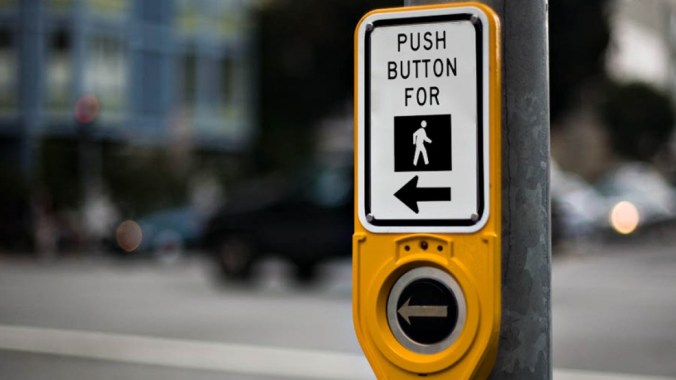
I thought of this when reader and frequent commentator here Charles Green noted in his excellent newsletter that those buttons at pedestrian crosswalks in major cities are an intentional fraud on the public, a placebo to keep us calm and feeling in control when we are not. Charles link was to my old hometown paper, the Boston Globe, but it’s behind a paywall. Never mind, though: newspapers have periodically been noting this phenomenon for years. They apparently think it is amusing. It isn’t.
The New York Times reported in 2004 that the city deactivated most of the pedestrian buttons long ago with the advent of computer-controlled traffic signals. Today there are 120 working signals; about 500 were removed during major construction projects. But it was estimated that it would cost $1 million to dismantle the rest of non-functioning mechanisms, over a thousand of them, so city officials decided to keep them in place. And people keep pushing them. After all, sometimes, by sheer luck, the light changes soon after the button has been pushed. It works!
Tribal rains dances “work” the same way.
ABC News reported in 2010 that it found only one functioning crosswalk button in a survey of signals in Austin, Texas.; Gainesville, Florida, and Syracuse, New York. Other studies have turned up similar results in dozens of other cities. To be clear, presenting a button to pedestrians that is represented as a legitimate tool to cross the street when in fact it does nothing is a lie. It is an intentional falsehood, designed to deceive.
It isn’t just the crosswalk buttons, ether. The door-close button on elevators are also fake, and have been for two decades. Working close-elevator door buttons disappeared after the enactment of the Americans With Disabilities Act in 1990. The legislation required that elevator doors remain open long enough for anyone who uses crutches, a cane or a wheelchair to get on board. The buttons are still on most elevators, though. They can still be operated by firefighters and maintenance workers who have the proper keys or codes.
You know: by the non-morons.
In its article about the fake buttons in 2016, the New York Times quoted John Kounios, a psychology professor at Drexel University in Philadelphia, who said that there was no harm in the “white lie” that these buttons represent. “A perceived lack of control is associated with depression, so perhaps this is mildly therapeutic.”
In other words, it is best for those in control to lie to the public so it doesn’t know how little control it has, and our scholarly elite are squarely on the side of our more intelligent masters.
Let me succinctly state the Ethics Alarms position on the viral spread of the fake button phenomenon. It represents a slow-frog boil from democracy into complacent totalitarianism. I do not accept being lied to “for my own good.” These are not “white lies.” The only morons are those who allow the government and others with power to mislead and deceive us for their own convenience, as well as those who tolerate a complicit journalism establishment that periodically spills the beans using a tone that says, “Isn’t this fun? It’s okay! It’s really okay. Just relax, and forget about it. You’re in good hands. Trust. All is well.”
To hell with that.
I don’t think manipulation is fun, or being lied to, or being assured that being lied to is good for me. Responsible members of a democracy have a duty to reject the manipulators as loudly and forcefully as possible.
_________________________
Pointer: Charles Green
 Ethics Alarms
Actually, morons have a very low auto accident rate, since they are concentrating on one thing – driving – and not their taxes, their mistress, their sexual fantasies…
You obviously don’t live in the DC area.
Recumbent Driver wrote, “Actually, morons have a very low auto accident rate, since they are concentrating on one thing – driving – and not their taxes, their mistress, their sexual fantasies…”
Maybe you aren’t real clear as to what a moron really is. Moron usually refers to a stupid person which refers to a person with little common sense; it’s utterly moronic (no common sense) to be driving a motor vehicle that weighs over 3/4 of a ton (at a minimum) and thinking about taxes, mistress, sexual fantasies, texting, doing makeup, reading the newspaper, shaving, etc. What you are calling morons, the ones paying good attention to driving a deadly weapon, are the intelligent people.
Get it now?
I can tell you from personal experience that Nashville, TN has a shit load of non functioning crosswalk buttons.
Remove all crosswalk buttons and stop lying to the public, period.
Talking about crossing lights. How about those bike path flashing lights that bikers push to cross 2 lane highways and expect the 55mph traffic to come to a screeching halt instantly because these idiots just ride their bikes straight out after the light starts flashing regardless of the multiple 2 ton vehicles bearing down that can’t fucking stop! Don’t these bikers know that having the legal right of way because the lights are flashing doesn’t mean that they flush all common sense or make them any less dead because they are a fucking moron?
Okay, deflection rant over.
I recently had a personal experience with this sort of thing. Our town has fairly recently installed yellow flashing lights at pedestrian crossings along one of the main drags. They are well marked and I think they are a good idea, at least for those pedestrians who like to live long enough to get to the bus stops.
But, of course, there are always idiots. I had just about reached the stop line — in a 35 mph zone going downhill — when I saw this fellow push the button and leap out into the road in the same motion. Fortunately I was not rear-ended when I slammed on my brakes and he was quick enough to get out of my way.
The worst actual consequence of this moron was that all my groceries on the back seat were hurled onto the floor — have you ever tried to pick up a pint of blueberries, one by one, when they’re scattered all over the floor of your car? I was not pleased.
==========================
On topic, though, I have personal experience with half a dozen elevators in a retirement community here, and I can testify that the close door buttons do work on those elevators. At least half of these buildings pre-date the ADA, but I’m not sure of the others.
I, too, have experience with functional close door buttons on elevators at a Fortune 300 corporate headquarters.
These buttons work in my small town. You will stand there forever without permission to cross until you press that button. It may not hasten the permission, mind you, but the next cycle you will get to cross.
Note that police review if the pedestrian pressed the button when there is a accident. While hitting a person is never okay, just stepping into a roadway is certainly a mitigating circumstance for the driver.
My experience with the buttons in the Madison suburbs is that the walk light doesn’t come on unless someone pushed the button, so they definitely do something here, even if it doesn’t necessarily change the timing (which it probably would if there were no cars to trigger the light). The traffic lights have sensors and change to flashing red and yellow at night, which is very convenient.
Extradimensional Cephalopod wrote, “My experience with the buttons in the Madison suburbs…”
Please fill in the blank. “Madison, ___________”
They absolutely work in the suburbs, where pedestrian traffic is inconsistent throughout the day, and an unneeded pedestrian phase would disrupt traffic.
Oops, this is the double post
Oy, another Cheesehead on this forum?
You want morons galore? Howse about Monroe St. with its preponderance of “Red Flag” kiosks or on campus at University & Park?
Monroe St. & campus student pedestrians truly believe they’re encased in an impenetrable force field protecting them from a fact-based Universe, no doubt due to a bubble-wrapping “friends first” parenting approach.
The “It’s All About Me” perversion of self-esteem has them convinced that no one’s schedule is more important than there’s, so damn safety and full speed ahead.
AA11B & me agreed we don’t drive-motorcycle down there because it.
Monroe St. denizen and NIMBY author David Mollenhoff correctly observes that if any of these walkers make it to Manhattan and step off the curb with the same level of cluelessness, they’ll get squarshed como las cucarachas.
It should come as no surprise that most of them are furiously engaged in critically important “Boop-Beep-Beeping” activity while meandering about.
I must confess a certain guilty pleasure watching clips of imbecilic BBBers doing headers/faceplants while BBBing.
Reckon I’m jealous…?
WI. We may be in the same area.
Thank you SO much for this post, Jack.
I can’t tell you how many times I’ve had people just flat out not believe me when I tell them “I do NOT want you to ever lie to me in an attempt to spare my feelings. My feelings will be hurt far worse by the lie.”
Why do people (even my own mother!) have such trouble with this concept?
–Dwayne
This is interesting. Probably the low I.Q. Individuals (in the 50-70 IQ range) can get a drivers license if they can read/understand the written questions and have enough concentration ability to pass the drivers test: https://www.dmv.ca.gov/portal/dmv/?1dmy&urile=wcm:path:/dmv_content_en/dmv/dl/driversafety/pm_guidelines
Then again this is how municipalities feel about us:
Chances are, the thermostat in your office is fake too.
If you work in a sealed building, like most all mid-rises and high-rises, your floor or area thermostat is there for entertainment purposes. Here’s the evolution: First, they put it in a locked plastic box, but that pissed people off and they broke the box to fiddle with the temperature. Second, as they transformed into total building HVAC control, they simply eliminated the thermostats, but THAT pissed people off and they bothered the facilities people all the time. Third, they installed dummy thermostats for everyone to mess with, but people suspected that they did nothing, and THAT pissed them off. Fourth, they wired the dummy thermostat to a small fan above the ceiling panels in the area of the thermostat, and set the circuit to turn the fan on for a few minutes when the temperature control is moved a degree or so in either direction…this results in a satisfying “whoosh” sound, just like when you turn on your furnace or AC at home!
Back to your cubicles, and please enjoy your “green” building.
The movie “Idiocracy”, set 500 years in the future, is based on that exact premise and is both hilarious in it’s execution and frightening in its accuracy.
Hmm, here in Australia (things vary a bit, we too are a federation) pushing the walk button doesn’t affect the cycling of traffic lights, but generally determines if the walk lights flash. i.e., no pedestrians, no obstruction for cars. In some places it controls when the turn light goes green.
Mind you, I am going to check it again now; just to see if all those people who call me a moron are correct!
With regards to the elevator buttons, given that they still are required for firefighter operation, what would you have done with them? Morons will still hammer on them no matter what, people who know how elevators work won’t, and firefighters will use them in emergencies. I suppose we could demand legislation that elevator companies take on the expense of changing button layouts or adding labels to emphasize that particular button only works with a fire key (not that it would stop people from pushing it), but I can’t sympathize with people who try to use it. They’re not being lied to, they’re not paying attention.
This reminds me of a story about one of our operators. He was a “tweaker”, meaning he was constantly overriding our control systems to make manual adjustments, and then he was constantly calling our E&I techs over to fix things he thought weren’t working right. So E&I installed a new knob that was supposed to control boiler pressure, but in fact did nothing. However, the operator was in the dark about this fact, and every so often, when he thought the process wasn’t working well, he would get up, adjust the knob, and then watch the process. A few weeks later, he was sending profuse thanks to our E&I shop for that knob, because the unit had never run so smoothly.
I know this falls under the “It’s for a Good Cause” rationalization, but the thing that has me pondering is, assuming all other avenues have been exhausted (such as speaking with the operator, speaking with management, making sure all instrumentation and controls are properly functioning, etc), does the fact that this action smoothed out the running of the unit, thus improving both process and personal safety, place this incident in a separate category from the fake crosswalk buttons?
Can the operator not have been given a direct command to quit overriding the system?
When guidance fails, use Direction…
When direction fails…well, now you have grounds for a failure to follow orders.
So the assumption is that the operator does not take orders from E&I, so while E&I techs can point things out, they cannot command. Management is presumed to be on the side of the operator. In other words, E&I has told the operator to stop tweaking, and the operator refused, because his tweaking was helping, not hurting. E&I talked to management, and management said they trust the operator’s judgement, since he works on the unit all the time and knows how the unit behaves, and E&I just knows instrumentation.
So in addition to everything I’ve said above, there’s also a factor of moral luck that E&I was right about the tweaker, and installing the knob didn’t make matters worse by giving the operator something fake that wouldn’t control the unit in an upset.
Is this same management you appealed to also directly over you, or is there a management above you that is peer to the operator’s management?
I’m not sure how far anyone actually chased this problem up the management chain. The plant manager is where the two management chains finally come together. So, for the sake of the ethical exercise I’m working with, let’s assume that the problem did come before the plant manager, and he listened to maintenance manager (who represented E&I) and the operations manager (who represented the tweaker) and ultimately concluded that operations was correct. Thus the tweaker received no orders to stop tweaking.
I’m wiling to bet in real life, E&I talked to the tweaker, and when the tweaker kept tweaking, they put in their fake knob without any recourse to management.
In the ethical exercise you’re working with, my gut says that, given the plant manager ultimately sided with Operations, any action taken by E&I counter to the vision that the plant manager’s decision establishes, becomes a type of insubordination or an undermining of his authority.
That could be or could not be unethical…depending on what the real risks of making the fake modification or not making the fake modification are.
I’m not sure a mere financial risk rises to the level of sufficiency.
If the risk is just financial, I would agree that the fake modification is not justified. But our units can be very dangerous (high pressures, high temperatures, H2S, etc) and the likelihood of a safety issue increases when a unit is unstable.
Now, if the refinery manager explicitly ordered that the operator should be left alone and E&I should make the repairs exactly as the operator indicates, the installation of the fake knob would be insubordination. But if the refinery manager instead said to listen to the operator because of the operator’s experience, and just focus on improving plant reliability, would the fake knob still be insubordination? After all, if E&I is convinced that stopping the tweaker would improve reliability…
So one other aspect that should also fall into consideration is what would happen if everyone acted like E&I and did what they thought would make things better without informing anyone what they did. Not only is this encouraging a complete breakdown in the management of change, but moral luck would probably quickly run dry.
If there IS a real physical risk, then the E&I team that presented to the plant manager has failed to fully communicate that risk. Their efforts must be vigorous and clear. If then, the plant manager says, “No, I don’t care about the risk”. The recourse for E&I is to notify the plant manager that they are forwarding their concerns to the plant manager’s immediate boss and then tendering resignations if no action is taken.
I think behind the scenes “lies” (which is what the knob is) opens a pandora’s box while not solving the real problem.
I think behind the scenes “lies” (which is what the knob is) opens a pandora’s box while not solving the real problem.
That’s the conclusion I’m reaching, as well.
Joke I heard, not sure where:
In the future, only two living being will be present in a factory: one man and one dog. The dog is there to prevent the man from touching any controls, and the man is there to feed the dog.
I think I’m going to hang that one on my door!
“To be clear, presenting a button to pedestrians that is represented as a legitimate tool to cross the street when in fact it does nothing is a lie.”
Is it really though? I mean…. Is the ‘hours of operation’ sign on the window of the hollowed out husk of Joe’s Diner a lie, or did they just close 20 years ago?
I’m not exactly thrilled at the idea of spending six or seven figures changing out light poles to remove a non-functional button. If the point of leaving those buttons was to deceive, or if the municipality ever installs a new standard with an obsolete button, then maybe I could buy this… But in the meantime, it just seems like prudent fiscal policy in a time where prudent fiscal policy is somewhat lacking.
No, because it’s not intended to deceive, nobody is responsible for changing the sign, and it isn’t government function.
Other than that, good analogy.
I’m sorry, I’m not awake and nice yet…
Yeah… Except you haven’t shown that the non-functional buttons are meant to deceive, only that they might. When the standards were installed, those buttons functioned, and the cost to replace them seems disproportionately burdensome.
I mean… are you really suggesting that municipalities should fork out millions of dollars to replace functioning light standards with obsolete buttons with functioning light standards without obsolete buttons, because someone might push one and have it do nothing?
We call this ‘proper system maintenance and upgrade’ in the engineering world, and the costs are taken into account when upgrading the system. You remove controls, wires, structures, etc… that are no longer needed as part of the process. This prevents liability and clears out unneeded detritus for future projects.
That cities did not do this is an indictment of their maintenance process. They simply used bad engineering practices.
If it’s industry standard to spend millions of dollars removing harmless obsolescence, then that’s a condemnation of your industry more than that of the people who didn’t follow it.
Someone needs to explain to me why, exactly, perhaps using small words my accountant brain can understand, it is a good thing to spend a million dollars, not because the standard doesn’t function, not because the standard is in need of repair, not because it is ‘unneeded detritus” in the way of future projects, but because it has a button on it that does nothing.
I mean… What if… For instance… A municipality bought a fleet of vehicles that came in with a year of SIrius included, and they all had buttons on their consoles that switched between AMFM Radio, and Sirius. Would leaving that button on the dash be unethical when after a year the subscription was not renewed? Should the municipality replace the dash consoles? Replace the whole fleet?
Remove the button or put up a sign. Don’t lie to the public. Simple. If it costs money, that’s fine: trust can’t be bought, but it can be forfeited by being pennywise and pound foolish.
For someone who often makes the distinction between someone saying something that they know to be untrue, and someone saying something untrue that they believe, you sure seem to be running hot a loose with the word “lie” here.
Poorly stated… My point isn’t that there’s a distinction between lying and saying something that isn’t true, and the city isn’t aware that the buttons don’t work, it’s that there’s another layer of distinction between proactively saying something untrue and (perhaps even negligently) not saying something.
I’m with you on this. Leaving the buttons up may be a lazy, penny-pinching bit of neglect that serves to confuse the issue and may make some people incorrectly believe they work, and the city’s failure to push an effective “The buttons don’t work” information campaign could be categorized as deceit (although, given that there ARE some working buttons, I don’t know how that campaign would work). There’s nothing to suggest the non-working buttons were INTENDED to deceive, though, and certainly not that they’re a lie to make anyone feel better.
You are all ignoring the quoted comments from “the experts” providing cover for this by saying that the lie is good for us.
Did I misread? You quoted one expert… He wasn’t a civil servant, or even working in the field (He’s a psychologist). And he referred to the buttons as a white lie? You’re right of course, why would I ignore the authority a psychologist brings to the inner workings of civil infrastructure, or the determination of whether something other people they had probably never met, or even known the names of, had said, was in fact, a lie?
Are you going to go back to your 100 Lies Trump Told debunkation, retract and apologize for not following the “expertise” of the “journalists” who determined what was and was not a lie?
HT, love you like a brother and appreciate your thoughtful posts. However…
“If it’s industry standard to spend millions of dollars removing harmless obsolescence, then that’s a condemnation of your industry more than that of the people who didn’t follow it.”
You drew on a bit of a straw man. In engineering, installed equipment that has no function is a hazard, by definition, especially when the public is involved. Your appeal to ‘harmless obsolescence’ is an oxymoron. Leaving wooden power poles in place when new metal towers are added to the grid leaves the city open to lawsuits, should someone drive into the pole, or if the no longer maintained pole falls into traffic, as an example. In addition, new city projects are blocked by the old poles, which will have to be dealt with at some point, even if piecemeal, at a greater cost. Cheaper to pull them in the first place. This is why you add the decommissioning costs to the upgrade project. (Note that I have seen welded patches where these buttons were before, as well as cover plates. So some cities do remove them.)
Given my (admittedly limited) experience with city budgets, I suspect that the plan was presented correctly with detailed line item costs, but accounting did some cost cutting that left these gadgets on the pole. 🙂 This happens quite often, and accounting is doing the job they are hired to do, following policies determined by the city they serve.
“Someone needs to explain to me why, exactly, perhaps using small words my accountant brain can understand, it is a good thing to spend a million dollars, not because the standard doesn’t function, not because the standard is in need of repair, not because it is ‘unneeded detritus” in the way of future projects, but because it has a button on it that does nothing.”
Because lying to the public is bad policy as well as bad engineering. You lose the public’s trust and it is hard to pass funding measures in the future. (Oh yeah, lying is unethical too.)
“A municipality bought a fleet of vehicles… Replace the whole fleet?”
City workers are not the public. They will also be briefed as part of their jobs on such items regularly. They can ask their supervisor a question and get an answer. This is not an apples to apples comparison.
“You drew on a bit of a straw man.”
I disagree.
I’m not talking about decrepit infrastructure that could fall into traffic… that’s a strawman.
I want to remind you…. We’re talking about a very discrete situation, in which you would literally be spending millions of dollars to replace literally thousands of light standards, because those light standards have on them a button about the size of this paragraph, that isn’t hooked up to anything.
That’s not a strawman… That’s the situation. And if it seems like the kind of thing someone might come up with when constructing a strawman, that’s possibly because the position is absurd.
“(Note that I have seen welded patches where these buttons were before, as well as cover plates. So some cities do remove them.)”
That’s fair… And maybe as opposed to millions replacing standards, you spend hundreds of thousands removing buttons or tens of thousands affixing signs…. It still seems worthy of ridicule. It’s a button. That does. Nothing. The difference in outcomes in situations where there is a functioning button, a non-functioning button, and no button is, from the perspective of the pedestrian: Exactly nothing. Eventually the light changes, and they cross the street.
“What do you want?”
“Money”
“What will you do with it”
“Replace/Remove some obsolete buttons”
“What will that change?”
“The buttons won’t be there”
“No.”
Good. This is as it should be. I wish more of the government functioned that way.
Look, anyone who thinks that it’s a good idea to *in this very narrow situation* spend scads of taxpayer money removing buttons, because someone people might push one and be fooled into thinking it worked when the light changes like it was always going to, and that them being fooled might corrode their trust in civil servants should be forever estopped about complaining about wasteful government spending.
Nowhere did I say to go back and remove the buttons, HT. They should have been removed in the first place. They were not, and then lazy policies did not inform the public. This is about how government treats its citizens.
You are fine with socialism and the attendant nanny state-ism: I understand, you live in Canada. The frog is further boiled there than here.
*snort* Wait… Really? You’re trying to say that governments spending millions of dollars removing obsolete buttons that literally do nothing but potentially hurt the feelings of people tricked into pushing them is… Not… an example of nanny state-ism? I actually laughed, Bill.
Representing the state as ‘we know best just trust us’ is nanny state-ism. Thanks for moving the goalposts.
You’re right, of course. This is all part of my dastardly Canadian commie plot: Once the government starts to make cost cutting decisions about public works projects, single payer healthcare is just around the corner.
You totally miss the point, and I am done with this conversation. I have given reasonable answers to your unethical diversions, rants, and mockery. I am a bit disappointed in your responses in this thread.
Have a good day, HT
I’m not missing the point, your point is just really… really weak.
You really should look at what I wrote and how you responded to it. My point of view is that in this case, multiple municipal governments made the correct choice not to spend public dollars on a useless project. You can disagree with me, but if you want to use that position to justify saying that I… let’s quote this… “[am] fine with socialism and the attendant nanny state-ism” because I “live in Canada.”, how I interpret that… and I’m really stretching here to give you the benefit of the doubt… Is that the government is trying to take care of, to “nanny”, people by not spending their money on something that would save them from the hurt feelings they might incur if they realized the button that they were pushing did not in fact effect the traffic lights.
If I have that wrong, please explain.
Because…. And I’m just throwing this out there… I can’t think of a better example of nanny-state-ism than thinking that it’s the governments job to save people from the disappointment incurred with the realization that their button pushing is impotent.
Alternately, I could be a closet socialist, having spent 5 years on here building libertarian credits so I could be more effective, dying on the hill of municipal traffic signals.
Yeah. If I were you, I’d walk away too.
Cheers.
What you’re saying makes sense to me as far as governments spending money so people don’t have to use their own judgment.
I think the argument (which also makes sense to me) is that even though it’s more expensive now to go back over all the walk buttons, at the time the walk buttons were being disabled in the first place there would only have been a small marginal cost incurred by simultaneously defacing them so that they would no longer have indicators of functionality. From a communications standpoint, that would have been the most ethical thing to do.
I forget if the walk buttons only make noise when the walk sign comes on (for the benefit of blind people) or if they also make a (different) confirmation noise when you press them. If so, the absence of the confirmation noise would also be an acceptable clue for the public that the button was out of order.
That’s fair, and probably the best position someone who disagrees with me could take… And I think I addressed that in a comment that nested a little ways away: It probably WOULD have been cheaper to “fix” those buttons as they were being decommissioned…. But I’m still not convinced that the cost would have been so marginal that it would be justified by the utility (And I almost cramped writing that word in this context) of the buttons not being there.
From a communications standpoint, and maybe a theoretic standpoint, they’re right, of course, it would absolutely be ideal for those buttons to be removed, but if you sprinkle in just a little bit of utilitarianism… In my opinion, the math changes quickly.
And in before “I said that they should have done it in the first place”, assuming that “The first place” was when the buttons were decommissioned, there’s no universe where doing more than what they did would have cost less than it did. Maybe it would have been more cost effective to replace the standards or cut the buttons off at that point… But it still comes at a cost. Maybe at some level the cost becomes so marginal that it IS reasonable to do it to offset the potential ‘loss of trust’. But I don’t think this gets there.
The thing I didn’t go with is I didn’t see a single official say they were left up as an intentional placebo effect. The only references by the city was that they looked at the cost and determined it was too costly to take them down (for what they perceive the value to be). The placebo thing seemed to be something dreamed up, and attached to this situation, solely by the writer.
The close door button is there to make an authentic-sounding click when someone is approaching the elevator and the current occupant pretends to push the open door button for them, followed by a mock “Sorry, too late!” shrug as the doors close.
What then is the appropriate solution for municipalities that are cash strapped to solve the problem created by obsolete technology?
A mere PSA would seem to suffice if a city simply cannot pay the money to fix the problem.
Good old Larson I don’t remember having seen this one.
Jack,
I don’t know that this is worthy of mention in an article or even a warm-up, but this news made me sad:
http://www.cleveland.com/metro/index.ssf/2017/07/gold_lunar_module_stolen_from.html
Cultural vandalism is everywhere.
Jack, was the original intent of each of the buttons to be non-functioning and therefore a lie? Or was there use overcome by events such as the American Disabilities action you’d mentioned.
Are they still putting up non-functioning buttons? If so, then you have manipulation.
From what I read they are just not taking them down due to a cost benefit analysis.
Would it be better to publically state that the buttons are no longer active and through attrition they will be slowly removed over time?
It’s only a lie when the intention is to deceive. Looking at all of the information presented that was not the case.
And yes I still push the buttons.
I do too, actually… Every afternoon on my Coffee run. And if it’s not hooked up, but the City of Winnipeg saved thousands of dollars not switching it out, then I owe Brian Bowman a drink.
I’m not sure they can even state that, since apparently there are still a few buttons that actually do work. So their statement would have to be something on the order of “most of our buttons don’t work anymore, but some do”. Which accomplishes nothing since people will still need to press them in case they happen to be one of the ones that do. That or print out a list of every functioning button still remaining that everyone can have and use. Which must be updated every time a button is deactivated in the future.
Their are a few working crosswalks in Alexandria and Fairfax, but my question is why do you get 19 seconds to cross the wide busy roads and over a minute for the small side streets. There are places on route 1 where it is near impossible to get across in the allotted time if you walk with a cane or have a small child with you.
The larger streets, which carry a greater volume of cars will create miniature traffic jams if they are locked up for too long for a single pedestrian. In that math formula, minimizing the inconvenience to dozens of drivers wins.
Quick question:
Is this a programming “deactivation”, where the buttons could feasible guide stoplight programming AGAIN, with a simple adjustment of software? Or, is this a pure hardware disconnection, where internally the buttons can no longer even send a signal to the stoplight system?
If it’s the 1st, I could see an argument leaving the buttons up, because sometime in the future, based on new policies/procedures or vehicular/pedestrian interactions, it may make sense for a city to begin allowing pedestrians to override the stoplight programming (which is what the buttons did).
If it’s the 2nd, and it was a hardware disconnect, then why wouldn’t they have removed the whole hardware then and there.
To me, option 1 seems more likely, in which case the municipalities should have simply published the intent to leave the hardware UP despite not functioning, on the possibility that they may be utilized again if different conditions arose. If, then, this were the cities’ intent, and they did NOT publicize the intent, then it IS knowingly allowing the citizens to be misled.
I don’t see a compulsion to remove the hardware *if* there is an intent to reuse the hardware. I don’t see an immediate compulsion to remove the hardware *if* it isn’t financially feasible at the time.
But both if’s, still require public notice at a minimum.
I do not know how ALL such systems work, but buttons like this historically were hard wired into a electronics package either below street level, or on the corner somewhere. The wires would have been cut when the electronics package was replaced. Removing buttons from the poles would have required visiting the poles in question, presumably at an additional cost.
I agree that public notice would have been the ethical route.
I think the problem with public notice is that not all the buttons are deactivated (at least for NYC) There are still hundreds (I think the article stated 750) that are still functioning. I’m guessing most are in certain areas, or for certain streets in outer boroughs. But outside of identifying and supplying the location of each one, it doesn’t do much good to say “Most are non functioning”.
Re elevator door close button not overriding the time delay.
What is the logic of disabling them?
Is it the belief that anyone who is not disabled will be such a ……. deplorable, that they will see someone getting into the lift and deliberately slam the door on them? As I recall, all modern lifts have optical sensors that detect an obstruction and prevent closeing.
Surely, if someone presses the close doors button, a reasonable person – an important character in much legislation – has decided it is safe and practical to do so and the machines safety interlocks can decide if someone has just stuck their crutch through the gap!
It seems like the delay might once again be designed to be seen to be doing something, whilst in practice it achieves nothing but to inconvenience the vast majority.
It’s Big Brotherism. You are right.
Living in South Florida, and having been on many cruises (where the buttons still work sometimes), I will say YES, there are a few deplorable people out there sadly. I’m not even counting the able-bodied people who rush around disabled or older people to get on the elevators before them, even when they weren’t there first.
It’s also not just that the doors will close on them, it’s that the doors open and people get off. So the normal thing to do then is stand back and give space and time for people to get off the elevator. It then takes a little bit of time for a disabled person (or anyone, I’ve had to jump forward myself to “stick the hand in the door” a few times) to get to the doors to even trip the sensors that might say that someone is there.
I’ve also seen a couple of people on the elevator who, when the door opens, immediately hit the “door close” button when it’s not their floor. Many places there are more then one elevator in an elevator bank, and you don’t see the person (until the doors close in their face), especially for a disabled or older person who does not move that fast. They might need a few moments to get over to the correct elevator that is going in their direction.
So there are valid reasons for the delay.