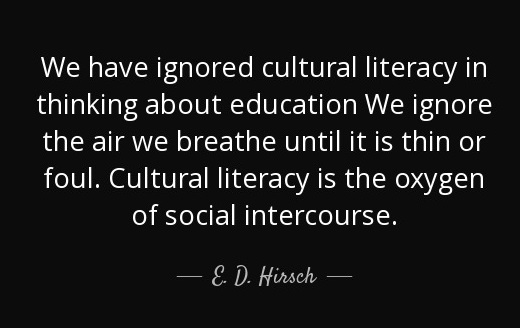
I am increasingly depressed by the widespread cultural illiteracy of the public, and not just the younger generations. I do believe it is an ethics issue, because, as Prof Hersch wrote decades ago, a lack of historical and cultural perspective makes competent citizenship, critical thinking and effective participation in society difficult if not impossible. It is a life skill that we all are ethically obligated to acquire, and that society is obligated to help us acquire for its own health and survival.
In a comment today, slickwilly wrote,
You are both mad.”
“Oh, you can’t help that. We’re all mad here. I’m mad. You’re mad.”
“Why, sometimes I’ve believed as many as six impossible things before breakfast.”
It suddenly occurred to me, with horror, that a majority of the public probably can’t identify the origin of those quotes. I wonder how many Ethics Alarms readers can. Here’s a couple of surveys/poll. No cheating, now. You’re on an ethics blog.
 Ethics Alarms
Add a poll question:
What’s more important:
1) Knowing where a quote came from.
2) Knowing what a quote means and how it is significant in discussion.
e.g.
Is is better that someone know’s that “crossing the Rubicon” had something to do with Julius Caesar but no idea that it means to fully commit to an all or nothing course of action. Or vice versa, that you are all in to a high pay off / high loss decision but have no clue it relates to the start of the Roman Civil War…?
Another question for:
Poll #1: Tip of my tongue/pretty sure
Poll #2: N/A (No kids)
The latter is more important, of course. Once a quote has become “a quote,” it takes on its own place in meaning and usage, regardless of its source.
Though, come to think of it, one of my oldest friend’s first several historical novels of his now-23 book series I had the privilege and pain of proofing (in the years before the the professional editors took over with the help of WordPress-like mechanics) is now coming to an end. The series is set firmly in The Republic and stays there. If I didn’t know where that quote came from, including its Latin tag from the last-ditch gambler “the dice are thrown” (alea iacta est), be able to find Caesar’s “crossing” position on the map, know how Pompey reacted to it, and whata the weather was like, it would be assumed I had succumbed to the mental vagaries of old age. As it turns out, I have crossed that river many times in my life and lived to tell the tale, albeit shivering in wet boots. (On occasion I have also morphed into Washington on the Delaware, arriving determined, but sadly unprepared.)
Context IS important. Perhaps this will help.
Alice laughed. “There’s no use trying,” she said: “one can’t believe impossible things.”
“I daresay you haven’t had much practice,” said the Queen. “When I was your age, I always did it for half-an-hour a day. Why, sometimes I’ve believed as many as six impossible things before breakfast.”
Man – I was gonna say it was Roger Rabbit.
I’ll confess that I had to google which one of the two books it was from. They have always been a long single one in my mind.
THAT’s reasonable. Most of the movies combine them, and they have a lot of similarities.
Cultural literacy may be the oxygen of social intercourse, though the present atmosphere seems composed of helium . . .
(A pathetic attempt at a joke, not even good for a cookie credit…)
Helium makes people talk funny.
Come to think of it, that may be a two-cookie.
I admit I considered choosing the answer to number two as a hypothetical as there is no option for no kids…
To be honest, while the second quote was immediately familiar (although was it six or seven?), I wasn’t so conversant with the first one. And couldn’t vote in the second poll unless I wanted to speak for my hypothetical kids (which is probably unethical).
Hypothetical kids are ALWAYS ethical. And above average!
I didn’t meet my three sons until they were 15, 13 and 10. Reading is not a hobby with them, so I honestly don’t know if any of them have read it. By the way, Diego, it was six. I pulled out my copy and checked.
The second poll really needs a “I don’t have kids” and/or “they’re too young” option. I’m the former; my brother is the latter (his daughter is two).\
As such, I held off on the second poll… but they’re both kinda important categories.
So I have some problems with this post. This is the third post you wrote today. I read them all at the same time. One of the first things you wrote about was why baseball needs to move towards automated systems and not human judgments.
I thought, “No fair, you changed the outcome by measuring it.”
After reading this, I wondered what do we see as culturally significant? Is Professor Farnsworth quote worth knowing (I’m guessing not)? Frankly, I don’t really care about Alice in Wonderland. It has never interested me as a Fairy Tale or as a Disney movie and I have never really seen it as something significant. However, who gets to decide on what is important or culturally significant?
I think a lot of that comes down to a few things. First, it helps better society. While not original by the time he said it, Jesus’s stance on the golden rule is worth noting. A powerful figure saying something for the betterment of humanity is worth knowing because it helps shape society, but also encourages others to be better. He isn’t the only one. Scores of people have had similar effects on society. See if you can identify them:
I have a dream that my four little children will one day live in a nation where they will not be judged by the color of their skin but by the content of their character.
“Only Thing We Have to Fear Is Fear Itself”
“And so, my fellow Americans: ask not what your country can do for you—ask what you can do for your country.”
Social expert Jonathan Haidt found that these people actually inspire others to be more prosocial and better people. When it comes to knowing culturally significant quotes, these are worth nothing.
What about other quotes such as defining moments in literature? I think that is a bit more tricky because a lot of it comes down to opinion. This is my favorite quote from one of my favorite books.
“The President, in particular, is very much a figurehead — he wields no real power whatsoever. He is apparently chosen by the government, but the qualities he is required to display are not those of leadership but those of finely judged outrage. For this reason, the President is always a controversial choice, always an infuriating but fascinating character. His job is not to wield power but to draw attention away from it. ”
I wouldn’t blame anyone for not knowing this quote. It fits the theme of the book, but the author, while famous, has no defining moment in history or in literature. However many do.
The Bard himself shaped the way the West view literature. This is why we still study his work in schools today. This is why though I have never read or seen Hamlet, I know the words “To be or not to be, that is the question” comes from that play.
It is also why I know the most often quoted line in Starwars “Luke I am your father” is the wrong quote. It should be “No, I am your father.” Starwars is a culturally defining movie.
But so is this one: “You’re a wizard, Harry.” I know this line, but I couldn’t tell you if it is a quote from the book or the movie or both. I don’t think it matters. This line as changed thousands of lives and have inspired those people to read, be involved, and create new things.
The third thing, I think is what you’re referencing. What is worth preserving?
How about John Hughes work? “Dear Mr. Vernon, we accept the fact that we had to sacrifice a whole Saturday in detention for whatever it was we did wrong. ” I have seen this spoofed or referenced a few times.
I had a teacher once offer an A to any student who could tell her where this following quote came from: “So call me Ishmael.” Today I can answer that question, but I have never read the book. For some reason, she thought it was important.
Though it has become a cult classic, “It’s just a jump to the left and a step to right.” comes from the dumbest movie I have ever seen. But boy that tune is catchy.
I think it is important to note a few things. First, culture is always changing. New defining moments will occur. I hope this doesn’t mean older things are lost, but it also doesn’t mean people are not suffering from cultural illiteracy. Second, those that seek, will find. Those that want to know, will know. “Ask and it will be given to you, seek, and you will find, knock and the door will be open”. Finally, “Not all those are wondering are lost. ” I’ve been reading this site for a few years now. There is much you know that I don’t. I would not contest that you are more cultured than I. However, that does not mean I am not. It is hard to measure something like that. Anyway, that is my two cents today.
Bonus points if you can identify all quotes without looking them up.
“No fair, you changed the outcome by measuring it.” – Werner Heisenberg?
The problem is, most quotes couldn’t be taught today because the person who uttered it falls afoul of the left’s class warfare views. The person was white, a male, a sexist, a racist, etc.
“I have a dream that my four little children will one day live in a nation where they will not be judged by the color of their skin but by the content of their character.” – Disallowed as this is now a racist sentiment. It is obviously so since it was uttered by man who may have been a Republican and who obviously espoused views supported by Republicans.
“And so, my fellow Americans: ask not what your country can do for you—ask what you can do for your country.” -Disallowed as this is obviously a statement of privilege. The government needs to take care of people, the people don’t need to take care of the government. This was obviously uttered by a white man of privilege with a Massachusetts accent to boot.
“Only Thing We Have to Fear Is Fear Itself” Disallowed as it was uttered by an obvious Fascist.
The quote is by Professor Farnsworth in Futurama. He is referencing the observer effect.
It is sad that most of what you said was in jest, but is most likely true.
Yes, but it refers to part of the Heisenberg Uncertainty Principle (I know that formally deals with the commutation of operators, but this isn’t a physics blog).
This is a COTD worthy post, in my opinion.
For what it is worth, I got all your quotes immediately. My kids would not have, much to my chagrin.
To your point about the Star Wars quote: while I generally remember that a quote exists, I have found Google a great help to check context, exact wording, and common usage. I often look up a cultural reference before using it here at EA, as I did these. This is necessary to make up for growing up in rural Texas without access to a major library and without cable TV.
Thanks Slickwilly.
I don’t think my kids would have got any of them, but to be fair, they are still pretty young. I think having things like Google are useful for looking at the accuracy of these quotes, but to quote Abraham Lincoln “Not everything you read on the internet is true.”
Update: my daughter got all except the Time Warp quote correct, and blamed me for missing that one. Seems I have not allowed her to go see that movie…
How about:
“I would prefer not to.”
I recognized the second quote immediately (though do always have to remind myself it’s NOT a Hitch Hiker’s Guide to the Galaxy reference) but couldn’t have told you the first was from the same book, to the extent I was puzzled by the lack of a suitable “I only recognize one of them” option in the poll for a bit.
I recognized the quote but have no kids so nothing to vote on the 2nd one.
I do feel like there’s a cultural gap and I am sometimes ashamed I don’t recognize things I know I should.
Part of it though is that the culture is becoming so fragmented because of an increase in content and creators.
But then I am a conservative and thus believe that all things have a trade-off.
I’m going to buck a little… I don’t think it’s important that children read Lewis Carrol, specifically.
If the expectations for what you have to have read, seen or experienced in order to be considered culturally literate is cumulative, then eventually kids will have to do nothing but read classics for several years of their education, and I just don’t think that’s realistic. Some are timeless, but others age poorly and as language changes, some are nigh unintelligible. Has anyone actually attempted to read A Tale of Two Cities? Everyone knows the first paragraph; Best of times, worst of times, important to capitalise Light and Darkness…. What about that second paragraph?
“There were a king with a large jaw and a queen with a plain face, on the throne of England; there were a king with a large jaw and a queen with a fair face, on the throne of France. In both countries it was clearer than crystal to the lords of the State preserves of loaves and fishes, that things in general were settled for ever.”
I couldn’t do it. I’d rather read Binchy describing a blade of grass, or Tolkien talking about people doing nothing but walking for 200 pages.
Regardless, my point is that culture changes. This is the problem I have with the social justice crew talking about cultural appropriation. Culture isn’t a race to do something first so you can plant your flag in it and prevent everyone who doesn’t look like you from taking part in it, Culture isn’t written in stone, brittle and aging; It’s alive, it evolves, it gives and takes and blends. Eventually, no one will have read Lewis Carrol, hopefully because something equally worthy will have taken his place.
Expecting the children of tomorrow to have read Alice Through The Looking Glass might be your own personal windmill, Don Marshall.
“What’s the goal of Cultural Memory? It cannot be the rote memorization of EVERY SINGLE great artist, producer and creator of art & culture. 1, we’d never have time to get around to memorizing ALL of it, 2, we’d never have time to get around to viewing all of it, 3, we’d never have any time to get around producing new examples of it, 4, we’d never have any time to get around doing anything else that life calls us to do.”
the rest here
Lots of things “Equally worthy” have been written, but nothing equivalent. Unique ideas, voices and observations are unique. Because they are unique, society cannot afford to lose them down the memory hole. Carroll’s books expand on critical thought, philosophy, irony, humor and nonsense. Indeed culture changes, but if it loses its intellectual moorings, it may change into something worse.
… the present.
Ouch.
I saw what you did there…
Tale of Two Cities? Yes, twice (and not just the pop-up version).
The last paragraph is pretty well-known, as well.
-Jut
My initial thought was that the quotes were from Alice in Wonderland. However, I have no recollection of these specific quotes from that book. They just seemed to make sense to be applicable to the story.
I have never been good at remembering direct quotes or specific dates in history. I do however know literary themed and relative dates in history. To me, some quote that one believes is important may not seem memorable enough to commit to memory.
What I find important is the overall point of the piece. Is it vitally important to know the origin of the idiom “don’t go down that rabbit hole” or is it just as valuable to know what the idiom means?
Every piece of classic literature has quotes. Can I quote any specific line or statement made in David Copperfield, no. But, I fully understand the plot and theme of Dicken’s classic as well as the historical economic backdrop of 19th century English society. Equally true is that I comprehend the messages in King Lear, Leviathan and other classics but please do not ask me any Shakesperian or Hobbesian quotes.
Had the poll listed classics and their themes I could easily identify which theme is associated with a classic.
I agree.
I almost attributed the quotes, and thus would have ruined what turned out to be enjoyable commentary using critical thought in these comments which did NOT relate to politics.
This was refreshing and welcome. Thanks, Jack.
I have taken your cultural literacy sermons to heart, and make an effort to monitor current cultural events, and memes (which show the pulse of our younger society) iFunny is a great tool for that. My results can be, er, interesting at times. Some memes are rude crude and socially unacceptable.
Like George Carlin in the 1970s
Who???
The guy that has “stuff”. One of his best bits ever.
Old guy with a big cigar, say goodnight Gracie.
Now there’s cultural literacy. Although when he said that, he wasn’t an old guy.
Dammit you were supposed to say George Burns so I could quote Robert Burns, move on to Robert the Bruce, Bruce Banner, Bruce Boxleitner, beatboxing, the guy we beat in the American revolution and then back to That seven words you can’t say on TV guy. I had a whole schtick planned out.
Love it
I’m sorry. I would have returned fire with Edd “Kookie” Burns, Leonard Bernstein, Frank N. Stein, Ann Frank, Anthony Weiner, Bunburying, and Casey Anthony.
There’s really no good excuse for making anyone remember Casey Anthony.
She stands for the principle that even guilty, evil people have to be proven guilty. Best example I know of.
Anyway, he was an old guy by the time I was born, When I think of him I see the guy from 18 again and Oh God. Some images stick as a sort of platonic ideal of an actor. When I watch A Knight’s Tale I see The Joker, Robert Baratheon, Lord M, Doctor Maturin, and Wash.
I think George Burns was an old guy before anyone on this blog was born. Dude looked old when he was not…
Good point about actors. I look at Alan Alda and see Hawkeye from MASH, no matter what he is in. I just expect something witty to come from his mouth. Same for the actors around him in that series, like Winchester (who has done a great many things since, and is a good actor)
Mel Gibson is Mad Max. Lethal Weapon just reinforced the image.
Dick Van Dyke never convinced me as a crime solving doctor; I expected a pratfall at every crime scene.
Jack Klugman was always Oscar, who in my childhood was the same as Oscar the Grouch from Sesame Street (who bothered me as he never had enough room in his trash can for the things that came out of there), and never a Medical Examiner (how is that for a stream of consciousness?)
Robert Downey Jr. was always a crazed druggie/ crazy iconoclast, an expectation set by his roles in Less than Zero and Air America (and his real life). However, Iron Man changed all that in my mind. Now he is forevermore Tony Stark.
On the other hand, Carrie Fisher never reminded me of Princess Leia in other roles. Kevin Costner and Harrison Ford never linked to any one role either.
Wonder why that is?
Cultural literacy? Sounds like White Supremacy. We live in a multicultural society that has no room for your dead white males.
You reveal yourself when you imply dead white males are the only culture.
While it’s true enough that for Americans, a lot of the cultural ties back to merry old, we’ve had few contributes in the arts since then from people of both sexes and all backgrounds, do you think their contributions aren’t informed by those backgrounds?
In a time of intense cultural warring it is not surprising that people come from and hold to their personal views. So, as you say to Cleophus ‘you reveal yourself’, you too reveal yourself with the counter-statement that you make.
What Cleophus refers to, I understand. What he refers to is a kind of a cold war brought out against white culture, white people, and ‘whiteness’. It is a very very complex psychological affair. Given that America really and truly is a white European creation (the idea of it, the structure of it, the philosophy of it, and the causal chain that made it possible), how odd — how almost unbelievable really! in a Nietzschean sense of ‘transvaluation of values’ — that there has arisen right in the bosom of America a movement that works to undermine the value and validity of Europe, of the attainments of white Europe, and what can only be understood as really wonderful creations.
In an emotional environment of transvaluation, inspired and underpinned by overt Marxian operatives I should add, the hands turn against the body and the brain. In the very political and social environment that had been created by these enlightened white men and by enlightened Europe, the underlings rise up in revolt and seek to topple them: their statues, their attainments, the intellectual structure that brought these things into the world. You’ve got to admit that it can all be looked at with a certain Nietzschean irony! Free your slaves through a Christian act of goodwill and in a generation or two they come for you and your children in the night.
The destructiveness of rebellion, and the underpinnings in ressentiment:
Can be examined with fruitful results. Just the idea of a ‘political unconsciousness’ in combination with the clamorings of ‘freed slaves’ and all that hang with them (some for good reasons, at least for understandable reasons), their distressed relationship to the intellectual world, and their perhaps unconscious recognition that they are not up to the task of maintaining it, and indeed will deliberately drag it down because of ressentiment: all this can be looked at and considered. I just happen to be one of the only people with a mind free enough of restraints to be able to *see* and to *say* because I have deliberately chosen a Higher Freedom over what seems to be the restraining influence of The American Civil Religion and its Political Correctness.
Can you imagine what might happen in America if the restraints were released? In our schools, in our communities, in our families?
Cleophus’ statement, therefor, requires a careful unpacking. He can only allude to all this given the intense controls established by political correctness, and it is also possible that he has not thought much of this through.
This is certainly true. Yet it is also true that these *contributions* were brought forth in an environment and an atmosphere created and engineered, intellectually, by the same people (white Europeans) who are now being attacked. And we should not (we must not in my view, a bit more emphatic) fail to recognize the profound and pathological anger that lies under the intense ressentiment that is so visible and so active in our present. That pathological anger is being harnessed by certain political operatives for destructive ends.
I admit that sorting through all of this is difficult. It may even prove impossible. But at least one can try to *get it out in the open* and hope that, like seeds planted in the mind, at some point they will grow into conversable topics . . .
[Please keep your follow-up commentary to under 5000 words, if possible!]
The second poll should have included an option for “I have no children.” This may have diluted the “no” vote some, but I didn’t see another option. Saying “I don’t know” feels dishonest, as how can you not know that someone who doesn’t exist doesn’t know something.
This is starting to remind me of that book the quote is from…
I’m eventually planning to write an article about this sort of thing. It’s essentially a concern that we’ll all end up like Ozymandias. (Cultural references can help compress concepts into easily transmissible packages, for better or worse, case in point.) For now, since I don’t have much time tonight, these somewhat disjointed thoughts will have to do.
Is the ultimate fate of all classics to become footnote? To a large extent, yes. As Nassim Nicholas Taleb would put it, fame is in Extremistan. For comparison, Mediocristan is the domain of physical properties, which often follow a normal distribution (e.g. most people are average height, and there are fewer and fewer people at heights that vary more and more in either direction from the average). Fame, however, doesn’t do that. Necessarily you have many people who are known by few and the people with the most fame are few in number.
My perspective on this issue is that everything in civilization is a scaffold. It exists to help us to get to the next place, hopefully a better one, and then it is taken down. This includes even memories, since memory is a resource that culture uses and we only have so much memory to go around, at least in our day-to-day lives. What we remember must have some functional benefit, even if that function is nostalgia. We can learn about the past, but only inasmuch as we enjoy it or as it helps us create the future. Its value is considerable, but can be concentrated more efficiently than having everyone know all the esoteric details of it at all times. Anything about the past that doesn’t help us or make us feel anything can be temporarily forgotten until such time as it becomes relevant again (hopefully before it’s too late for us to use that remembered knowledge).
If you take a bus to work, and the bus breaks down after you get there, you don’t teleport back home. Humans didn’t go extinct when their ancient ancestors did. The past doesn’t need to stick around after it’s gotten us here. As someone who is preoccupied with archives, I think we should always have access to the past if we need it, but if we have a good foundation then we can do periodic sweeps and pick out what’s relevant.
The process of taking down a scaffold is not instantaneous. We retain bits and flecks of the past in their original form (though fewer over time). More importantly, though, the concepts forming the foundation of the present evolved from the concepts of the past. It’s definitely important to study history to know how this evolution works, to have some ability to predict and influence the future. After all, the foundation of the present is merely the scaffold of the future. However, the ideas of the present will live on in the future to the extent that they need to. Timeless stories and jokes will adopt the new fashions, the obsolete ones will remain in museums, and new ones will enjoy their time in the limelight.
If there are any concerns about the fading of the past I neglected to address, please let me know.
I can’t wait for the article. COTD.
Solid
Excellent!
Nice metaphor, as far as metaphors go, but it cannot be right. No one could successfully argue that the construct of civilization is like a scaffold used to create an edifice and, when the edifice is done, is then removed.
This is the core of your assertion though. I imagine (I can only guess) that you have come to this idea/assertion through your Buddhist studies? I wish you would elaborate the lineage of ideas that stands behind this assertion.
Aliza, some scaffolds are temporary and some are permanent. In medicine nanotechnologies are used to create a permanent structure from which larger molecules are built. Then other large molecules, built upon their own unique permanent scaffolds can be combined to form compounds that are combined with other compunds to create valuable things.
Had EC used the term foundation as a metaphor instead of scaffold, it would be suggesting that culture takes on a rigid form. Scaffolds on the other hand can be altered over time to reflect the new ideas.
OK, but I could argue that even that metaphor — since we are speaking in metaphorical terms — has faults.
If there is a foundation, a foundation implies structure, solidity, and I would also suggest permanence and even immobility, constancy and the eternal. It is a basic philosophical idea related to the notion of logos. It is (of course) related to the notion of the unmoved mover ( … but that is another dimension of the problem.)
Conservatism — true conservatism and also traditionalism — is based on predicates that are said to be constant and eternal.
Liberalism (if I may speak in polarized terms) seems to reject the idea of constants, and often of the eternal, and instead builds both foundations and scaffolds that are contingent [from Latin contingere ‘befall’, from con- ‘together with’ + tangere ‘to touch’. The noun sense was originally ‘something happening by chance’.]
Unless I am terribly wrong, our present is entering a state of chaos because of the tension between two poles of thought. I am sure that you catch what I mean.
My effort is to look at what people say and write, and to try to see what ideas are ‘informing’ them. I have mixed impressions of what EC wrote here. And he is a product of this, our culture. He can only give expression, I would suggest, to ideas that are operating in our present.
I would say that this (quoted) idea, though I might not understand it fully, is more connected to liberalism and those predicates that inspire liberalism, than with conservatism and the ideas that move in conservatism.
For example, is our Constitution a foundation or a scaffold?
Why do the semantics even matter?. Everything in the long run can be changed. Foundations crumble, scaffolds collapse, even civilizations are at risk of extinction.
EC used a term related to the building process which is what culture is, a building process.
Well, what does semantics refer to?
If your question is a serious one, you would have to take any answer seriously. The semantics — the meanings — we deal with as we consider both meaning and value in our lives and our polities, matter. It is foundational that this is so.
This blogpost deals on ‘cultural literacy’ . . . I would suggest that other forms of literacy are similarly vital. Therefor, the actual meaning of things — that meaning exists and can be discussed — is definitely important.
If the struggles of our day do not have to do in the most essential, and important sense with meaning and value then I will ask you to tell me what they do have to do with. If people cannot think clearly and yes rationally about these questions, then what material are they dealing with? That right there is a very important question and circles back to Jack’s assertions:
So, in what are founded ‘intellectual moorings’? You could not now argue some radically other intellectual mooring. You would undermine your own capacity to define. Therefor, we have to *moor* ourselves within tangible intellectual notions and concepts.
I suggest that if EC is informed by contingent ideas, and if the metaphor of removable scaffolds, or even non-substantial foundations is understood to be a truthful utterance, that we must be able to locate his ideas somewhere and in something. No?
I am of the opinion that we need — desperately — to recover sound foundational value and that this will amount to a radical project and that this will involve turning against, on one level, or on some levels, the hyper-liberalism of our present. I also have the feeling that it will be difficult and demanding work with political and social ramifications.
The battle lines, I think, are forming. And one has to get clear about what one serves and why one serves it.
Thanks for the feedback; I should clarify.
The present state of civilization is a scaffold. It exists to help us construct the next state of civilization, which itself is a scaffold for the next one, and so on. The scaffold has its own foundation, so it is solid in the moment, but we’re constantly creating the future version of civilization with its own foundation, using what we have in the present to stabilize the construction. Once we have the next version, the present culture will be dismantled (and parts of it reused or recycled), having served its purpose to get us to the next version.
Of course, all these states blur together, and there isn’t always a sharp delineation between one and the next (although things change exponentially faster with technology building on itself, so you can see it happen more easily nowadays). The real pity is that people tend not to be deliberate when designing the future, and the ones who do are generally terrible at it because they try to excise or ignore anything they don’t like.
The remains of the past scaffolds still exist in records, and in famous quotes, and in the accursed cultural institutions that humans seldom think to outgrow, and in habits like morality that protect them from their worst selves without them knowing why. If they did know why, they could design a better morality using the current one as a scaffold, and then repeat the process.
Most importantly, though, the proof of the past is that we’re here, and because we did not always know what we know now, we must have gotten here through other means than our current knowledge. The most valuable knowledge of the past is what those other means were, and why we used them. That lack of hindsight bias, that sense of actually living through history and recognizing that true ignorance doesn’t feel like ignorance, is what’s missing from cultural knowledge of history. If we don’t know how the scaffold of the past got us to the present and what it was like to work on it, we won’t make effective use of the present to create the best following version, the scaffold for our imminent future.
Does that make more sense?
It makes more sense — it fills out your previous assertions — but questions remain. As I said, my object is to make an analysis and a comparison between idea-structures said to be Conservative and those said to be Liberal. I do this because I have an interest in conservatism and have some issues with liberalism (hyper-liberalism, to imply liberalism that is out of control). My interest is in seeing what core ideas operate in *statements* that we make as these are in my view expressions of metaphysics (whether we recognize it or not). How we conceive of and how we describe The World determines how our ‘imagined world’ is built. Our imagined world is one that we project and it is what we *see*. What I am saying makes good sense to me, but I am not sure if it is intelligible to you and others…
Again, and only in the spirit of sharing perspectives, I see your idea as ur-liberal. It does not begin with an specific foundation, nor anthropology, but posits that things will forever shift and change as one structure gives place to another.
Factually, I think this expresses the *general metaphysics* that are in operation in our present. It is based on a contingent perspective that posits future contingent shifts, unendingly. Let us so that a ‘conservative’ perspective would, necessarily, begin with anthropological and perhaps also spiritual predicates (the foundation) and would then propose to build on those. I do not sense a conservative foundation in the above-paragraph.
You describe the influences and forces that put pressure on (what I am calling) contingency, but then you do note that *people* do not deliberate about what they construct in their present. Or rather some do and, often, they are of a conservative bent. That is, they have established ideas about what constitutes a ‘foundation’ and a proper anthropology.
With
You only indicate that people have ‘likes’ and ‘dislikes’ — a rather vague criteria-set! — but if I am reading between the lines correctly you might refer to the standard stuff that so-called conservatives generally advocate against as what is not ‘liked’. But I would suggest that it must be much more than what is not merely ‘disliked’ and must be about what is good and bad, and also good and evil. These involve value-definitions, and value-definitions often involve profound (if you will permit that word) philosophical and existential interpretations.
But since you make no mention of either foundation or the substance that is needed to define ‘foundation’, one could not really make an assessment of your propositions. And your propositions, in this sense, are quite a bit like what goes on now in our world and in modernity: the ever-evolving force of the contingent where no one has any idea really where it goes. Yet they are in the flow of it, yet rather incapacitated (without capacity to choose, to define, to valuate).
I will suppose that here you reveal more of the ideas that operate in your structure of thinking, which is to say your metaphysics. I can’t tell completely and have to guess or interpret. What are ‘accursed cultural institutions’? The municipal parking regulation department? The institution of marriage? An education program with a traditional Occidental program? You leave it open, of course, but that could mean within the realm of the ‘contingent’. To be defined by what we ‘like’ and ‘dislike’? I would gather there is no place for, nor concept of, ‘metaphysical authority’ in your views. That is, that we invent ourselves within contingent reality according to … but according to what? Conservatism, generally speaking, defines metaphysical constants. I might suggest looking into Richard Weaver’s ideas about ‘nominalism’ (see Ideas Have Consequences).
The world that you describe, I gather, follows a naturalistic or scientific descriptive-model. And in this sense it *fits* with the specificity of the impositions that are employed in our present. But higher ideation, always, refers to solid metaphysical ‘structures’ (if you will) that stand behind mere contingency (‘what is happening’). Higher ideation imposes values, makes determinations, arrives at value-definitions, and builds, therefor, in accord with these invisible ideas.
Here
I think you reveal the essence of your views. While I agree that there is such a thing as ‘rigid morality’, and people who are not active participants in assenting to moral strictures, a ‘morality’ is most often linked to Higher Ideation, to metaphysical suppositions, and is anti-nominalistic. Obviously, the notion of ‘designing a better morality’ has links to specific ideas — revolutionary generally — and to specific historical periods and philosophers.
Thus, I believe, you reveal your basic philosophical position as that — quite precisely — of ultra-liberalism (hyper-liberalism being by own term).
Alizia,
Off topic: are you paid by the sentence, word, syllable, or letter? Is there a bonus for using certain terms, like ‘value-definition,’ ‘higher ideation,’ or ‘metaphysical constants?’ Your blogs are the most interesting written navel gazing I have ever encountered, outside of published novels.
Not complaining, just an observation. While there is nothing wrong with reflection and examination of root causes, the sheer volume of content is simply off putting for your audience.
Love you like a sister… or an Irish Setter, if that should be the case. (I would suppose that having a relationship with a cannibal would be complicated, unless it is like that of a sheep to a wolf: from the inside*)
* From Jack’s assertion elsewhere regarding the *real* Alizia:
“Though on a blog comment section, that’s a pretty abstract distinction. “Real” Aliza is not known here—for the purpose of EA, she “is” her commentary. In real life, she could be a saint, a cannibal, or an Irish Setter.” (To relate to her as a ‘Saint’ would require bona fides I am not likely to get either from her or the Church, as they are cagey about such matters, especially while the recipient still lives.)
Published novels? Like Point Counter-Point by A. Huxley? 🙂
Zoltar also quotes Jack who, some years back now, characterized my focus as ‘navel-gazing’. (And angels dancing on the heads of pins, etc.)
Jack once said that he avoids ‘formal philosophy’ because he felt that it obscured ethics and ethics-considerations. I see his point. But I differ on this.
Let me ask you this: have you ever read Ideas Have Consequences? If you had, you would know that Richard Weaver is one of the America’s grandfathers of conservatism. You would also know that it is not an *easy* book. And with that said, I would say there is nothing particularly easy about understanding our present. I was greatly influenced by both Richard Weaver and Robert Bork. If you understood how that combination works together, you’d understand my orientation better.
I have tried to express my orientation before: I see you-plural as focussing on the passing image, the passing event. You see it in great detail. But you (often) fail to see the larger context in which it sits.
One is asked to make an ethical assessment of the passing image or situation. I cannot make that assessment until I understand, better, what stands behind the issue.
I have come to understand — and I accept this — that many don’t read what I write. But I am not interested in reaching people who cannot make serious efforts. Why should I? What would be gained? One person recently said: “I have a hard time reading your posts and find them difficult, but I read [the one he was commenting on] and appreciated it”.
That is all I ask for. Even if one person gets what I am on about I feel I have succeeded.
You must understand that I operate from the assumption — the knowledge really — that intellectualism has become debased. If you want I can explain ‘intellectualism’. I am not sure you will!
If it ever happened that you did come to understand why these terms are crucial, you would better understand what I am attempting. They are crucial.
In any case, I can say that I now understand *things* much much better than when I first came on here. In the end that is what really counts for me.
There was a Bowden video that I posted once. Some guy who I have never seen again said ‘Hey, thanks for that!’ He had listened to it and it made sense to him. Something got through. No one else has made any comment, ever (on that video and of course, on what I write). But all I care about is that one person! I wonder where it took him? What did he choose to study?
The process of turning things around . . . may be impossible. But one has to work in those ideas that are, perhaps, the seeds of the future.
That’s all I can say. And thanks for tolerating my presence!
It was not this video that I’d posted before. But I found this one and, because it was posted by Republic of Texas, offer it for your consideration (Bowden has also influenced my thinking a great deal).
And it is really really short. Perfect for the American audience! 🙂
Insulting your readers is a great way to persuade.
I see what your concern is. Allow me to explain my position.
There is a term: coddling [late 16th century (in the sense ‘boil (fruit) gently’): origin uncertain; sense 1 is probably a dialect variant of obsolete caudle ‘administer invalids’ gruel’, based on Latin caldum ‘hot drink’, from calidus ‘warm’.]
There is an article (I just looked it up) with this title: Has Coddling an Entire Generation of Children Set Them Up For Failure?
Another: Coddling the American Mind.
Another: The Fragile Generation.
These come up when one does a search with the term ‘coddling’.
I am so far beyond getting offended or feeling offended that I have almost zero tolerance for this sensitivity.
In one of his (bizarre) books Carlos Castaneda has the character Don Juan say:
If you have read must of what I have written over the last few years you will know that I do not, as they say, mince words. I say what I see. I establish as a supreme and primary value saying what I see.
The American, to speak in general terms, is the ‘snowflake’ that so many (on these pages!) condemn. The Fragile Generation, the ‘coddled generation’ whose mind and feelings have been coddled. This is part of the problem!
We have to get to a point of being able to tell the truth. This is not a personal affair. And a person should not be offended.
Well? Are you going to tell me again that you were joking? 🙂
No, this time as was serious. Insulting is no way to win friend and influence people. I am not offended, just making an observation.
If you cannot take friendly critique, then there is nothing left to talk about.
Now I am done with wasting time on this thread. I bid you a good day.
Still love you like a sister, though 🙂
I’ve been disappointing people through my whole life, Slick.
Even my family won’t talk to me (except my mother, on the sly). I can only offer you a consolation prize. (I actually have the video of this concert).
It was a JOKE, my dear.
Since this is a COTD, maybe he elucidate there
I said that my children had not read those books, but my eldest is still working on the difference between “at,” “mat,” and “sat.” I believe “rat” gets added to the vocabulary later this week. This may skew your poll further.
Where’s the “Yeah, I had to cheat,” button?