Yes, It’s Bizarro World—But The Mainstream Media Anti-Trump Bias Is Still Ridiculous

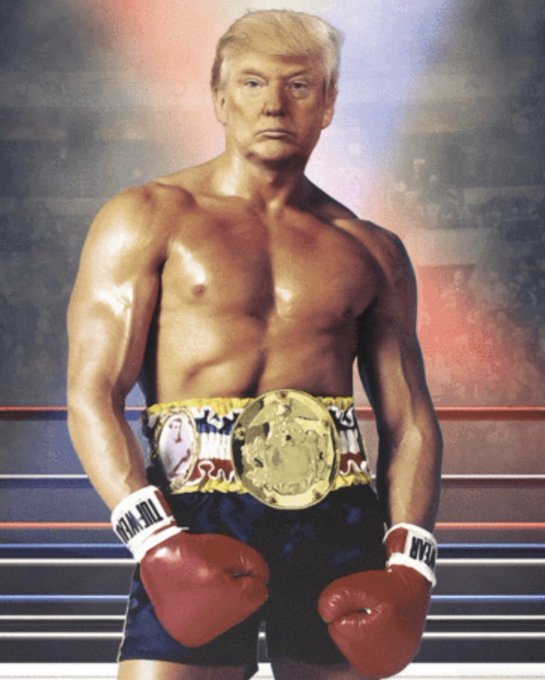
The President’s master-trolling display before Thanksgiving plunged us squarely into Bizarro World Ethics territory. I cannot imagine any previous President of the United States pulling a public stunt even close to as juvenile and silly as tweeting the photo above out to his followers and, inevitably, the world. I can’t imagine another President even considering it. The leader of the free world, the dignified occupant of the White House, the leader and role model of millions just doesn’t do something like that. He just…just..doesn’t, that’s all!

Yet there it was , just before 11:00 am on November 27. And like so many other seemingly vulgar and impetuous acts and statements that President Trump has authored, the deranged foes of the President managed to make it look like a brilliant stratagem. First the Washington Post—surely there must be some perceptive people working there, wouldn’t you think?—sent out this hurrumphing tweet:

Oh, it’s doctored! Good sleuthing, Post! Quick, add this to your recent list of Trump mendacities: he tried to make the public think that he’s built like Rocky under those blue suits, the liar!
And “unclear why”!!! Unclear why? How bone-headedly biased does someone have to be to not understand why Trump would tweet out a photo of himself as “Rocky” (in “Rocky 3”, to be accurate)? Has anyone on the Post staff seen “Rocky,” or is so stuffed with culturally ignorant naifs whose idea of an ancient inspirational movie is the ten-year-old “The Blind Side” that “Rocky” (1976) and its descendants are buried in their “Irrelevant films my grandparents watched” files? Continue reading

It Is With Great Reluctance That Ethics Alarms Concludes That As Generally Repugnant And Vulgar The Term “Asshole” Is, Mayor Pete Buttigieg Is One.

If this was just disgraceful pandering, grandstanding, and shameless virtue-signaling, he would only  have proven himself to be a jerk—a big jerk, to be sure,  but still just a jerk. But it is far more.

The new fad contender for the Democratic Presidential nomination is returning thousands of dollars in donations because they came from two lawyers who had the audacity to represent Supreme Court nominee Brett Kavanaugh as he attempted to defend himself against the contrived  ambush accusation of a sex crime, made in a Congressional hearing  on national television, a ploy designed to destroy his reputation. Buttigieg’s campaign said that it will not accept funds from people who helped secure the justice’s seat on the Supreme Court. You know. Dirty money.

Buttigieg’s campaign had received $7,200 from Alexandra Walsh, and $2,800 from Beth Wilkinson, Walsh’s law partner. Both represented Kavanaugh during his Senate confirmation ordeal. As I have vowed to point out every time some ignoramus asserts that lawyesr must be punished for the character, conduct or beliefs of the clients they represent and are responsible or culpable in any way for what those clients have said or done (or NOT done), it is a core and essential principle of our legal system that such an assumption is not only wrong but dangerous. It threatens the right of every citizen to receive competent legal representation and access to our laws and other rights.

Here, once again, is my favorite ethics rule, from the ABA Model Rules of Professional Conduct:

(b) A lawyer’s representation of a client, including representation by appointment, does not constitute an endorsement of the client’s political, economic, social or moral views or activities.

Whether the target is Hillary Clinton, Ted Cruz, Elizabeth Warren, Harvey Weinstein’s defense attorneys (also here), Larry Tribe, Gitmo defense lawyers, or Clarence Darrow, Johnny Cochran, Leslie Abramson and other defense lawyers who defend murderers and worse, the false claim that lawyers who take on unpopular, repulsive or guilty clients have done anything less than protected  the Bill of Rights and the rule of law is either rank ignorance or a deliberate effort to reduce the civic literacy of the public.

Buttigieg isn’t a lawyer, but he is very well educated and has a reasonable claim to brilliance.  Thus he knows and understands what lawyers do, but is acting as if he does not, intentionally making the public stupid (or keeping it conveniently as stupid as it already is ) for his own benefit.

Despicable.

But that’s not all. Continue reading

The Forgotten Ethics Hero: William Ruckelshaus (1932-2019)

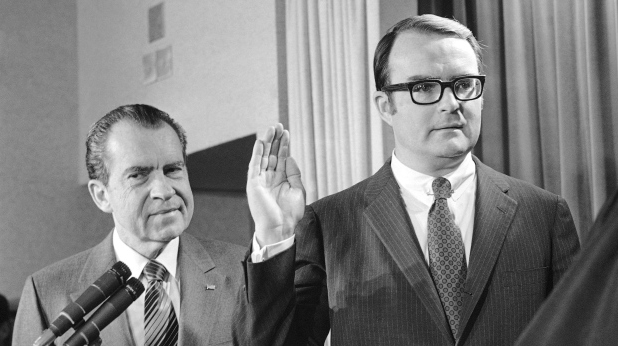
I’m supposed to be student of American Presidential history, and even I had virtually forgotten about William Ruckelshaus, who just died. It was Ruckelshaus who, along with Attorney General Elliot L. Richardson,  rejected Ethics Rationalization #15, The Futility Illusion or  “If I don’t do it, somebody else will” when the United States of America needed a hero, and got two.

His moment of courage arrived on an October night in 1973 destined to be known in the annals of American history as  the “Saturday Night Massacre.” Ruckelshaus was then Assistant Attorney General, and President Richard Nixon, was panicked that the ongoing investigation by Special Watergate prosecutor Archibald Cox was closing in on his blatant obstruction of justice. A White House-triggered burglary of the Democratic National Committee’s offices at the now-famous Foggy Bottom condo complex and hotel in Washington, D.C., seemed about to bring Nixon down, so Nixon resolved to have cripple the investigation by having Cox removed.  Ruckelshaus was the second of three officials the beleaguered POTUS ordered to fire the Harvard law professor. For some reason Nixon thought this might relieve him from having to produce the  nine incriminating Oval Office tape recordings that Cox had subpoenaed.

Ruckelshaus, under Nixon the first head of the new Environmental Protection Agency,  had been named acting head of the FBI in April of 1973, replacing L. Patrick Gray III. He was soon named the top deputy to Attorney General Elliot L. Richardson. When Nixon ordered the mild-mannered Richardson to fire Cox that fateful night, Richardson shocked Nixon by refusing, and resigning immediately. That made Ruckelshaus the Acting Attorney General, and he was suddenly on the hot seat, tasked with carrying out Nixon’s legally and ethically questionable orders.

Cox had been guaranteed complete independence by Nixon and Attorney General Richardson during the prosecutor’s Senate confirmation hearings in May of 1972.  Congress directed that he could be  be removed only for “gross malfeasance” in office, and by October 20, 1973, there had been none. “I thought what the president was doing was fundamentally wrong,” Ruckelshaus said  later. “I was convinced that Cox had only been doing what he had the authority to do; what was really of concern to the President and the White House was that he was too close. He hadn’t engaged in any extraordinary improprieties, quite the contrary.” Continue reading

Thanksgiving Dinner Ethics Appetizers, 11/28/2019: Boing Boing, Boeing, And Bears In The Woods

Have a gentle, loving Thanksgiving, everyone.

And thanks so much for visiting and participating.

Tangential question: Does anyone watch the Macy’s Thanksgiving Day Parade any more, with the lip synced musical numbers in the street, the inflatable balloons of anciet cartoon characters, the floats that are virtually identical every year, and the phony blather from the B-level celebrities in the booth? Isn’t this spectacle now something that people watch out habit, like the Miss America pageant, “Peanuts” holiday specials and the Oscars, even though it has the entertainment value of styrofoam?

1. Tucker Carlson endorses the Julie Principle! Last night, Fox News host Tucker Carlson made the shocking statement that President Trump has been less than truthful with the American people.

“We’re not gonna lie to you, that was untrue,” Carlson said. “The crowd at the 2017 inauguration was not the largest ever measured at the National Mall. Sorry, it wasn’t. Why did the president claim that it was? Well, because that’s who he is. Donald Trump is a salesman, he’s a talker, a boaster, a booster, a compulsive self-promoter. At times he’s a full-blown BS artist.”

Observations:

  • NOW Carlson is enlightening us about this? Every sentient being knew this about Donald Trump ten years ago, before the Presidency was a twinkle in his eye.
  • Has there ever been an irrelevant fabrication by any U.S. President as harped upon incessantly by critics and the media as Trump’s silly claims about his inauguration crowd?
  •  The Washington Post, aping the New York Times, manufactured another one of those compilations of Trump “lies.” As of last month, the Post says, Trump had told over 13,000 false or misleading statements since taking office, including, of course, including the Inauguration boast. If I didn’t have a sock drawer crisis to deal with, I’m sure I would find that at least a third of those “lies” are in fact nothing of the sort, but mistakes, off-the-cuff exaggerations, and obvious puffery, as in, “Trump said X was ‘the —-est,’ but Y is actually  —-er.”
  • Here is what I wrote almost exactly three years ago, before that Inauguration, in a post called, “Trump, His Critics, and The Julie Principle”:

Yesterday, many, not several but many, of my Angry Left Facebook friends posted links to stories attacking Trump’s silly tweet about him really winning the popular vote and there being millions of fraudulent votes for Hillary Clinton. “Is he going to do this sort of thing his entire administration?” one friend asked.

YES! YES HE IS! OF COURSE HE IS! DON’T YOU KNOW THIS ALREADY? ARE YOU REALLY GOING TO FLIP OUT AT EVERY SINGLE  INSTANCE WHEN TRUMP SAYS OR TWEETS SOMETHING STUPID LIKE THIS?

If so, then you are going to go nuts, and you will just become irrelevant and annoying.

Which, of course, they have. Including the Post and Tucker Carlson. Continue reading

Flashback: For Your Use When “Resistance” Relatives Attack At Thanksgiving Dinner

It all began here. How quickly we forget—or how quickly they hope we’ll  forget.

In two December 20, 2016 posts, “The Electoral College’s Day Of  Reckoning I and II,” Ethics Alarms covered the first attack on American democracy in what came to called here the “2016 post-election Ethics Train Wreck.” This has culminated in the current House Democrats’ impeachment fiasco. Make no mistake: it is a single plot, one that I never suspected would have continued this long, and caused as much damage to the nation as it has.

When your relatives start spouting talking points that they have  neither researched, thought critically about nor understand, consider reminding them where it all started, and who has really been responsible for bringing the United States of America to this sorry and thoroughly avoidable place. Most of the villains of the coup attempts to come outed themselves here: Democrats, the news media, academics, Hollywood, professionals, especially lawyers. Most had outed themselves earlier, of course, but still had plausible deniability. Not after this.

As you can see, they had decided, way back in 2016, right after the election after thaye had wept, and cursed, and rended their garments, that because they didn’t want Donald Trump to be President, they had a right to prevent him from taking office, and if that failed, then to interfere with his right to fulfill the duties of the office until they could come up with some way remove him. This is where it began, and this is what has been going on ever since.

Your resistance family members and friends have been been responsible because they enabled this. Don’t let them get away with it.

The Electoral College’s Day Of Reckoning, Part I: Revelations

After all the protests, the petitioning, the grandstanding, the misinformation and bad law and false history, after all the harassment and intimidation aimed at getting state electors to violate their pledges, duty and the trust of theirs state voters, all designed to keep Donald Trump from attaining 270 electoral votes and thus forcing the Presidential election into the House of Representatives for the first time since 1876, the results were just another humiliation for the Democrats and Hillary Clinton. Donald Trump was officially elected President of the United States, and it wasn’t close.

Four Democratic electors in Washington, a state Clinton won, voted for someone else, giving her just eight of the state’s 12 electoral votes. They will be prosecuted, apparently, for breaking a Washington statute. Colin Powell, a Republican, received three of the faithless elector votes and Native American tribal leader Faith Spotted Eagle received one, apparently because one elector decided that rather than vote for Senator Elizabeth Warren, a real Native American was preferable. Single  electors in both Maine and Minnesota attempted to cast ballots for Bernie Sanders, but state laws requiring electors to follow the statewide vote invalidated both rebellious ballots. One Hawaii elector did vote for Sanders, an especially outrageous betrayal of the vote since Hawaii went to Clinton even more decisively than California.  Never mind: this unknown, unvetted, undistinguished citizen decided that no, he or she knew better. That’s the model Democrats were promoting.

The one Republican elector, Texas’s Christopher Suprun, of Texas, who had trumpeted his  intention  not to vote for Trump despite his state heavily favoring the President Elect voted for Ohio Governor John Kasich as promised, and another Texas elector defected to vote for Ron Paul. Thus the almost six week Democratic push to use the Electoral College to pull victory from the jaws of defeat had the net effect of increasing Trump’s Electoral vote advantage over Clinton by three, with Hillary Clinton becoming the candidate with most defecting electors in over 200 years.

George Will’s favorite phrase “condign justice” leaps to mind. First the Wisconsin recount increases Trump’s vote total, and now this.

Three Ethics Observations on one of the most embarrassing spectacles in U.S. election history:

1. Ironically, the Electoral College functioned exactly the way the Founders intended it to, and rescued the nation from a regional candidate. Trump won the nation, and Hillary was elected Queen of California. The country wanted radical change, while the huddled socialists, crypto-Marxists, radical college students, illegal immigration fans and nanny state addicts were happy with things as they are.

California is a complete outlier, virtually a one-party state. As an analysis by Investor’s Business Daily points out, between 2008 and 2016, the number of Californians who registered as Democrats increased  by 1.1 million, while the number of registered Republicans dropped by almost 400,000. Republicans in the state stayed away from the polling places because they had nobody to vote for in many places. Two Democrats, and no Republican, were on the ballot to replace Senator Barbara Boxer. Nor were there Republicans on the ballots for House seats in nine of California’s congressional districts. At the state level, six districts had no Republicans running for the state senate, and 16 districts had no Republicans running for state assembly seats:

Such Republicans as there were knew Clinton was going to win the state  and its 55 electoral votes,  so there was little motivation to cast a ballot.Clinton was getting all 55 votes, no matter what. Thus Trump received 11% fewer California votes than John McCain did in 2008, as  the number of registered Democrats in the state climbed by 13% since then. If California had voted like every other Democratic state — where Clinton averaged 53.5% wins — Clinton and Trump would have ended up in a virtual popular vote tie. Laws requiring electors to follow the statewide vote invalidated both efforts.

If you take California out of the popular vote equation, then Trump won the rest of the country by 1.4 million votes.  The Founders installed a system that favors a candidate with broad-based appeal over all the diverse regions and cultures of a large nation, and that isn’t going to be easily dominated by a large voting bloc that is atypical of the rest of the population—like California in 2016.

2. Writer Daniel Brezenoff, the originator of the Change.Org  Electoral College Petition , appeared on Tucker Carlson’s show on Fox News to collect his Andy Warhol Fifteen Minutes of Fame chip. He repeated his undemocratic logic for overturning the election. Carlson accused Brezenoff of “resorting to less democratic means, putting the decision in the hands of even fewer people,” to which Brezenoff, who initially filed his petition using a fake name, responded, “That’s right, to protect the Constitution from an unfit President!”

The answer is smoking gun evidence of what was really afoot here.  Brezenoff thought Trump was unfit,just as I thought Trump was unfit, but the election showed that millions of citizens felt differently. We can’t ethically, logically, fairly, reasonably and Constitutionally come back after the election and say that a handful of not-especially-qualified electors are going to reverse the election result because our view is the right one.

We lost. The fact that we don’t like the result and are positive the winners just don’t understand is not sufficient to justify what the Democrats and progressives like Brezenoff were advocating.

3. It is disturbing and shocking—maybe I shouldn’t be shocked, but I am— that no prominent Democratic leader publicly condemned the organized efforts to turn electors faithless. This, as much as anything else, validates my late decision  that the Democrats were too corrupt and untrustworthy to get my vote. Silence, as the legal maxim goes, implies consent, and the petitioners, historical frauds, harassers and intimidators all did their worst on behalf of the Democratic Party. Nothing but harm could come to the party and its member progressives from such an arrogant, defiant and  futile scheme, and nothing but further division could have come from a success, which basic civic literacy should have informed party leaders was impossible. Nonetheless, they said nothing–Obama, Michelle, Pelosi, Reid, Shumer, the Clintons, Jimmy Carter, Bernie, Elizabeth Warren, the President. Nothing.

Was it cowardice, and the fear of tempting the rabid, angry Left from coming after them, mouths foaming? Or was it that they were willing to benefit from a Hail Mary pass, even one that destabilized the government and society? Bernie Sanders was especially cynical, telling interviewers before yesterday that he thought the Electoral College was beneficial, then calling for its elimination after the voting was over.

The worst, of course, was Hillary Clinton. Had integrity meant anything to her (we know it never has) she would have known that her unequivocal condemnation of Donald Trump for suggesting that he might not “accept the results” if he lost the election mandated a “Stop this nonsense now” message to her traumatized and infantile supporters (see photo above). She couldn’t mount the guts and principle to do it. A miniscule-to-the-vanishing-point chance that somehow, through some combination of luck and cosmic intervention, an elector uprising would give her the power she craves was sufficient to inspire Hillary to even surpass the hypocrisy she had displayed by joining in Jill Stein’s ridiculous recount efforts.

It was said of Hubert Humphrey that in his passion to attain the Presidency, he proved himself unworthy of it. Hillary Clinton has made Hubert Humphrey look wonderful in retrospect.

To be fair, so has Donald Trump.

The Electoral College’s Day Of Reckoning, Part II: Dunces, Heroes, Villains, And Fools

The failure of the ugly Electoral College revolt scheme that ended yesterday—let’s ignore the coming storm of frivolous lawsuits for now, all right?—with the official, irreversible, like it or lump it victory of Donald Trump over Hillary Clinton also settled some distinctions, some desirable, some not. Continue reading

Pre-Thanksgiving Day Ethics Wrap-Up, 11/27/2019

Be thankful tomorrow, everybody.

There’s always something…

1. On unethical misleading language, Part A: Today’s “Nah, there’s no mainstream media bias” note: I was suddenly struck after reading one, two, three, four impeachment-related stories in a row in four separate news sources that they all used the phrase “dirt on Joe Biden.” Isn’t that strange? “Dirt” isn’t a description, it’s a characterization, and a deliberately  pejorative one that assumes that Biden is a victim of a dastardly action. It’s widespread use is one more smoking gun that demonstrates mainstream media bias aimed at smearing President Trump. The term “dirt” presupposes that if the President sought to persuade the Ukraine to aid the U.S. in an investigation, something it is obligated by treaty to do, it was only to assist his re-election chances. When the term “dirt” has been used in conjunction with a politition seeking damning information on Bill Clinton, either George Bush, or Trump himslef, it was always in the context of an election campaign. Few wrote that the Mueller investigation was a “dirt” seeking operation (though in truth it was). But it’s always “dirt on Joe Biden” that the Ukraine was allegedly asked/forced/extorted into looking for. When Jeffrey Epstein was being investigated, nobody said the FBI was seeking to smear him with “dirt,” because news sources accepted that an investigation was appropriate.

Yet there are many reasons and strong evidence suggesting that an investigation of Joe Biden’s alleged machinations to benefit his son by abusing his office and misusing his influence was (and is) also appropriate. The United States should not just shrug off corruption in its highest offices because a complicit individual is running for President, but that is the thrust of the current impeachment push by House Democrats. For the media to intentionally choose terminology—and slang, which is usually not in a newspaper style-book— to lead readers away from the argument that an investigation of Joe Biden was necessary and valid whether he was running for President or not shows a disturbing disinterest in fair reporting, and a preference for anti-Trump propaganda. Continue reading

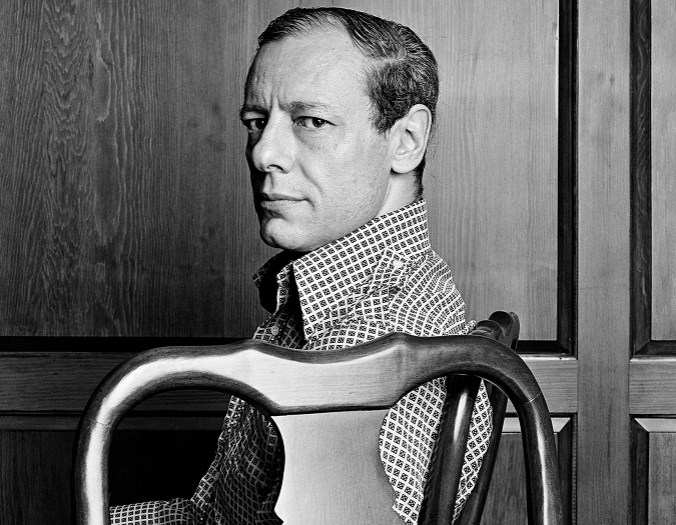
Remembering John Simon (1925-2019 ): The Day The Meanest Critic Alive Made Me Happy

John Simon, who died three days ago at the age of 94, was known as a merciless, even cruel cultural critic.  From the Times obituary:

John Simon [was]one of the nation’s most erudite, vitriolic and vilified culture critics, who illuminated and savaged a remarkable range of plays, films, literature and art works and their creators for more than a half-century…In an era of vast cultural changes, Mr. Simon marshaled wide learning, insights and acid wit for largely negative reviews and essays that appeared in New York magazine for nearly 37 years…In a style that danced with literary allusions and arch rhetoric…he produced thousands of critiques and a dozen books…While English was not his native language, he also wrote incisive essays on American usage, notably in the 1980 book “Paradigms Lost: Reflections on Literacy and Its Decline.”

I met him exactly once (and we later had an online exchange), but in that single encounter he said something that meant a great deal to me, and that I will never forget.

As a drama critic, Simon made Frank Rich seem like an old softy. I don’t care for his kind of critiques, applying rarefied personal standards so divorced from the average audience member that they give no guidance at all. Simon was fun to read if you had no stake in the play or movie he was trashing, but those who worked full-time in show business generally hated him, and it is no wonder.  In one compilation of his reviews, “Reverse Angle: A Decade of American Films” (1982), he was positive about just 15 of the 245 films he discussed.  William F. Buckley .quipped that Simon “reviewed movies in the same sense that pigeons review statues.”

He was accused of being racist, misogynist, homophobic or grossly insensitive,  denied being any of those things, and argued that no person or group was above criticism, especially those who, in his view, lacked talent and covered themselves in mantles of race, ethnicity, gender or sexual identity and used them to claim preferential treatment in the marketplaces of culture. But some of his quotes resonate with me:

  • “I do not like uniforms. I do not like people who are a professional this, that or the other. Professional writers, actors and singers are O.K., but I don’t like professional Jews, professional homosexuals, professional blacks, professional feminists, professional patriots. I don’t like people abdicating their identity to become part of some group, and then becoming obsessed with this and making capital of it.”
  • “My greatest obligation is to what, correctly or incorrectly, I perceive as the truth. Kästner says, in essence, ‘All right, the world is full of idiots and they’re in control of everything. You fool, stay alive and annoy them!’ And that, in a sense, is my function in life, and my consolation. If I can’t convince these imbeciles of anything, I can at least annoy them, and I think I do a reasonably good job of that.”

In 1998, my now retired  professional theater company, The American Century Theater, was in the midst of its 1998 production of “Lady in the Dark,” the 1940 experimental musical by Moss Hart, Ira Gershwin and Kurt Weill. At that time, it was the first full run of the show since the original had closed on Broadway.  Our star, Maureen Kerrigan, informed me that her old room mate was married to the terrifying John Simon, and that both had traveled from New York to see her in the next day’s  Sunday matinee performance. Simon was infamously disdainful of musicals, and once described a guaranteed Broadway hit as “A loud, vulgar musical about Jewish Negroes.”

This was not happy news. We had already gotten our usual pan from the Post, which had no interest in our mission of producing American stage works at least 25 years old that had fallen out of the professional theater repertoire. Now we were going to be eviscerated by John Simon. He was used to watching all-Actors Equity productions in 2000 seat theaters, with multi-million dollar budgets. Our show had what I considered to be an excellent cast, but only Maureen was Equity. We did have a brilliant director—me. Somehow I doubted Mr. Simon would appreciate our talents.

After all, it was a production of a lavish show with a huge cast in a small black box theater seating 130 at best, with a full orchestra crammed behind scenery, on a budget about 1% of what the opus would take to do justice to now. I was expecting to be humiliated.

Simon watched the performance with a critic’s poker face, and afterwards, never inquiring about his verdict,  I volunteered to drive him and his wife to the airport. They both sat in stony silence for most of the trip, and then Simon suddenly said, “I’m very glad I saw your production.”

“Why is that?” I asked. He said, “I saw the Encores production, the concert version, several years ago, and I found it incomprehensible. I wrote in my review then that “Lady in the Dark” shouldn’t be revived. Now that I’ve see the whole thing, I realize I was wrong: it deserves to be revived and get a full production. Thank-you.”

Well,  that was the whole reason we started TACT: to give audiences a chance to see American shows that weren’t being produced, and to demonstrate why they shouldn’t be forgotten. Coming from maybe the toughest, most demanding critic who ever lived, Simon’s statement was high praise. And, of course, I knew he wasn’t just saying it to be nice, because he didn’t care about being nice.

I will always be grateful to John Simon for making me feel like the theater and the dedicated “Lady in the Dark” cast and production staff accomplished something important, when he, unlike so many in the theater, didn’t hand out praise indiscriminately.

Addendum: This is as good as anywhere to finally confess that having my young, struggling theater company take on one of the most famously difficult and complex musicals of all time was reckless and irresponsible. We were always dangerously short of money, and were committed to keeping tickets under 20 dollars. Our typical show to that point had cost 10-15 thousand dollars, and some of those lost money. “Lady in the Dark” ended up costing over $50, 000, easily the most expensive in the company’s 20 year history. Had the production flopped, it would have been the end of the experiment, and nobody knew whether anyone would want to see a nearly four-hour, three-act 60-year-old musical about a troubled professional woman undergoing psychoanalysis.

Fortunately, people did. The show played to over 100% capacity, and nearly broke even.  “Lady in the Dark” did wonderful things for the company, attracting subscribers, donations, and respect. But it was pure moral luck.

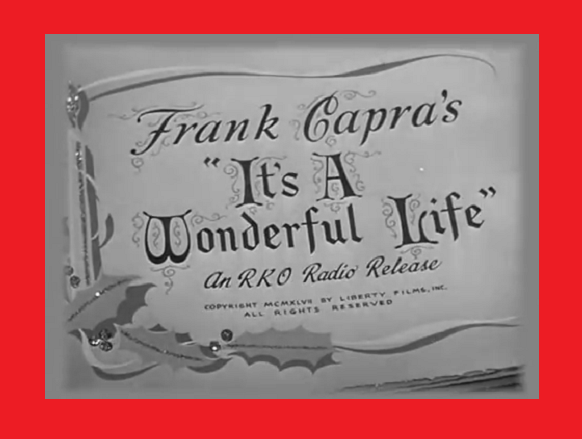
Officially Kicking Off The Holidays: The Complete “It’s A Wonderful Life” Ethics Guide, Updated And With A New Introduction For 2019


The Ethics Alarms Ethics Guide to Frank Capra’s 1946 masterpiece It’s A Wonderful Life,” perhaps the greatest ethics movies of all time, has become this blog’s official welcome to the holiday season.  Once again, I have reviewed the post after another viewing of the film. It is a mark of the movie’s vitality that I always find something else of interest from an ethics perspective.

The movie is an important shared cultural touch-point,and exemplifies the reasons why I harp on cultural literacy  as so vital to maintaining our nation’s connective tissue. The film teaches about values, family, sacrifice and human failings unlike any other. I hope its power and uniqueness disproves the assertion, made in one online debate here this year, that new cultural creations inevitably and effectively supersede older ones, which, like copies of copies, eventually the cultural values conveyed get fainter and less influential.

Last year I wrote with confidence, “No, they really don’t,” but now I am not so sure. In , I learned that my druggist, about 35, married and with children, had never seen the movie. I gave him a DVD over the summer, and suggested that he watch it with his whole family, which he said he would: he moved on to another CVS branch, so I have no idea if he did or will. I used to be  amazed at how many people haven’t seen the movie; now I am not. Last year I wrote that my son’s girlfriend admitted that she hadn’t; this year he has a new girlfriend,  and she hasn’t either.

The movie is in black and white, and many Gen Xers and Millennials disdain uncolored films the way I once avoided silent movies.  Will anyone be watching “It’s A Wonderful Life” 20 years from now? I wonder. The movie begins in heaven, and has a strong religious undercurrent. Religion is increasingly mocked and marginalized today, and  I see no signs that the trend is reversing. Aside from the nauseating Hallmark Christmas movies, most of this century’s holiday fair is openly cynical about Christmas and everything connected to it.

Here’s an example of how rapidly  cultural touchpoints vanish: I’m going to poll how many readers remember this:

Deck us all with Boston Charlie,
Walla Walla, Wash., an’ Kalamazoo!
Nora’s freezin’ on the trolley,
Swaller dollar cauliflower alley-garoo!

Don’t we know archaic barrel
Lullaby Lilla Boy, Louisville Lou?
Trolley Molly don’t love Harold,
Boola boola Pensacoola hullabaloo!

Bark us all bow-wows of folly,
Polly wolly cracker ‘n’ too-da-loo!
Donkey Bonny brays a carol,
Antelope Cantaloupe, ‘lope with you!

Hunky Dory’s pop is lolly,
Gaggin’ on the wagon, Willy, folly go through!
Chollie’s collie barks at Barrow,
Harum scarum five alarm bung-a-loo!

Dunk us all in bowls of barley,
Hinky dinky dink an’ polly voo!
Chilly Filly’s name is Chollie,
Chollie Filly’s jolly chilly view halloo!

Bark us all bow-wows of folly,
Double-bubble, toyland trouble! Woof, woof, woof!
Tizzy seas on melon collie!
Dibble-dabble, scribble-scrabble! Goof, goof, goof!

Now just answer the poll, don’t go giving away the answer. Nobody knows all the lyrics that I just posted, nobody but the author ever did. The first verse, however, was once familiar.

Maybe there is hope: it was recently announced that a new musical adaptation of  the movie may be coming to Broadway as early as next year. The songs will be written by Sir Paul McCartney, and interest in The Beatles is surging.

“It’s A Wonderful Life” would be an excellent basis for a middle school ethics course. I haven’t seen a better, richer film for that purpose come along since, and I’ve been looking. Despite the many ethics complexities and nuances that the film glosses over or distorts, its basic, core message is crucial to all human beings, and needs to be hammered into our skulls at regular intervals, far more often than once a year.

What is this message?  In an earlier posting of The Guide I described it like this:

Everyone’s life does touch many others, and everyone has played a part in the chaotic ordering of random occurrences for good. Think about the children who have been born because you somehow were involved in the chain of events that linked their parents. And if you can’t think of something in your life that has a positive impact on someone–although there has to have been one, and probably many—then do something now. It doesn’t take much; sometimes a smile and a kind word is enough. Remembering the lessons of “It’s a Wonderful Life” really can make life more wonderful, and not just for you

Finally, I hope you all have a terrific Thanksgiving, and that the holiday season is joyous for all.

And now, heeeeeere’s GEORGE BAILEY!
Continue reading

Afternoon Ethics Warm-Up, 11/26/2019: The Pooping Engineer, Fake Newspapers, And Other Things Not To Be Thankful For

As the Happy Holidays countdown continues…

1. More trivial ethics: Watching Season #2 (2015) of the excellent Stephen Bochco procedural “Murder One,” my wife and I were stunned to hear an expert witness in the trial of one of the teenage shooters in a school bus mass murder point out, while noting that most sociopaths don’t kill people, the Jack Kennedy and Bill Clinton were examples of very successful sociopaths. It’s very unusual to see favored progressive narratives challenged in television dramas. Of course, this would have been an opportunity for Trump-bashing had the show been filmed a couple of years later.

2.  Ew. Matthew Lebsack, an 18-year employee of the Union Pacific Railroad Co., defecated on a train-car knuckle three years ago, threw feces-covered toilet paper out of the locomotive window, and informed his manager that he had left a “present” for him. Lebsack’s co-workers cleaned up his droppings using bottled water and paper towels.

At the investigation hearing, Lebsack admitted the specifics of the incident and apologized for his behavior. He claimed he  was suffering from irritable bowel syndrome, and his wife had just left him at the time of the incident.

I wonder why?

Yeah, that justifies throwing one’s poop around the workplace. Lebsack was fired, shockingly. His union, the International Association of Sheet Metal Air, Rail, and Transportation Workers-Transportation Division, or  SMART appealed and the matter was sent to an arbitration board.

The arbitration board found that firing “was too harsh.” That’s good to know, just in case a clueless ethics class frustrates me so much I decide to take a dump on the podium.   Lebsack’s medical and psychological issues were deemed to be sufficient mitigation that board ordered Lebsack to be reinstated once he successfully completes a physical and a psychological evaluation. Union Pacific appealed to vacate the decision and SMART sought to enforce it.

U.S. District Judge Brian Buescher ruled that, under the Railway Labor Act, he was without authority to review the merits of the board’s interpretation of the collective bargaining agreement. Buescher said the arbitration board’s decision fell within its discretion, although he admitted that he didn’t understand its reasoning. Continue reading

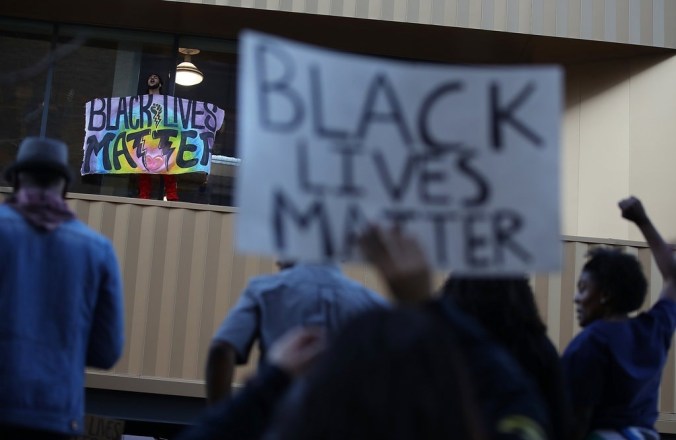
In California, A Black Lives Matter Ethics Mess

Here’s the story, and then we’ll look at the ethics miscreants who made an ethics  mess of it….

At Del Paso Manor Elementary, near Sacramento, a parent volunteer in a sixth grade class asked the teacher if she could teach an art lesson about diversity. The male teacher told her in front of the class that “his lessons would contain lessons with ‘a bunch of old white guys’ so her content may not fit.” The volunteer  was confused and “a bit concerned” by the statement, but went ahead with the project she had envisioned. She asked the students to each make  a poster that focused on something “they wanted to see changed at the school.”  Four students created Black Lives Matter posters.

The next day, the teacher told the parent volunteer that he had thrown the four posters away because they were “inappropriate and political.” The teacher asked the volunteer “whether students were getting shot at the school and demanded answers regarding why a presentation on Black Lives Matter was relevant” to the school.

The volunteer complained to the principal, who backed up the teacher and his decision, agreeing that Black Lives Matter posters are political statements and off limits for public display in the school. Then someone, perhaps the volunteer but maybe a parent, took the matter to the ACLU. The group then contacted the  school district, and argued that  Black Lives Matter posters were protected speech under the California Education Code because they “convey a student’s thoughts, ideas and beliefs in the support of black lives,” and were also protected under the California Constitution.

Ugh.

Now the ethics verdicts: Continue reading