1. For example, this stupid controversy, and surprisingly, it involves the Kardashian family. Kylie Jenner, Kim’s half-sister, is, as you may know, a “social media influencer,” which means companies pay her millions to use Instagram to promote their brands or products to the mouth-breathing idiots who follow this fatuous and useless celebrity.
Kylie recently issued a post featuring this photo of herself nude in a huge straw hat…
which rankled another “influencer,” Amanda Ensing—how can someone get paid to influence people when I’ve never heard of them?— who accused Jenner of stealing her pose. Ensling has more than one million followers on both YouTube and Instagram, where she posts her outfits, makeup looks, travel experiences, and hairstyles, and had previously appeared on Instagram like this…
She implied that Jenner had engaged inInstagram pose plagiarism, or something. (There’s no such thing.) The ever-articulate half-Kardashian lashed back, in words reminiscent of Dryden or Wilde in high form,
“from the words of Kim K ur not on my mood board but i did get my inspo off Pinterest”
This exchange justified breathless accounts in People, The Daily Beast, Cosmo, E!, Us, and dozens of other websites, as well as celebrity cable shows, spreading the false impression that what these semi-literate narcissists say or do matters, thus increasing their ability to make our young trivial and even dumber that our schools make them.
Apparently Pierre Auguste Renoir isn’t active on social media, or he might have complained to both “influencers.”
2. From Minnesota, a very different kind of stupid:In an epic example of woke virtue-signaling because Nationalism Bad, the city council for St. Louis Park in Minnesota decided to end the practice of reciting the Pledge of Allegiance at its meetings—you know, to be more “inclusive,” which means to pander to members who don’t care that much for the United Sates of America. Then they were shocked to discover that a very vocal majority of constituents found the move offensive, so the city council members did a complete 180, said, “Never mind!” and reversed themselves unanimously,though complaining bitterly and implying that Deplorables made them do it. Integrity! Principle over expediency!Continue reading →
Florida disciplinary authorities have opened an investigation into the professional fitness of a lawyer who forced a stowaway racoon off of his boat a long way from shore, and thought it was all amusing enough to post a video of the incident on Facebook. The bar’s assumption is that the animal drowned. The lawyer is now subject to prosecution for a violation of Florida’s wildlife laws.
In Florida, as in every other U.S. jurisdiction, one of the kinds of unethical conduct that can result in bar discipline is committing “a criminal act that reflects adversely on the lawyer’s honesty, trustworthiness, or fitness as a lawyer in other respects,” as stated by Rule 8.4 (b) of the Florida Rules of Professional Conduct . Should the nautical lawyer’s conduct qualify?
You may recall a far more egregious case of animal cruelty by a lawyer discussed here, where I questioned if a psychopath lawyer’s fatal attack on his girlfriend’s dog Snoopy really tells us anything about his trustworthiness as a lawyer. I wrote then,
Emotionally, I have no problem with seeing an animal abuser kicked out of my profession, but I don’t understand what values are being applied. Is it the commission of a crime? Most lawyer crimes don’t result in disbarment, if they don’t involve lying, cheating or stealing. …There is no basis on which to conclude that [Snoppy’s killer] isn’t competent, zealous and trustworthy—just keep him away from pets.
Now, you may well ask, “Isn’t this at least “moral turpitude?” That’s the character flaw that will keep applicants for bar membership from getting a license due to character deficiency. There are two points related to that. First, moral turpitude might keep you out of the law at the outset, but it is not one of the official no-nos that will get you kicked out of it one you are a practicing lawyer. The legal definition of moral turpitude is an act or behavior that gravely violates the sentiment or accepted standard of the community. Brutalizing an animal would certainly qualify. The ABA, however, greatly narrowed the definition as it was applicable to legal discipline:
The 1983 Model Code (periodically amended by the ABA House of Delegates over the last 32 years) rejected the prohibition against “illegal conduct involving moral turpitude.” The ABA’s reason, which it included in a Comment to its Rule 8.4, was quite simple: “Moral turpitude,” the ABA advised, is a “concept can be construed to include offenses concerning some matters of personal morality, such as adultery and comparable offenses, that have no specific connection to fitness for the practice of law. Although a lawyer is personally answerable to the entire criminal law, a lawyer should be professionally answerable only for offenses that indicate lack of those characteristics relevant to law practice.” The American Law Institute’s Restatement of the Law Governing Lawyers § 5 (Third) (ALI 2000), agreed. It also concluded that “moral turpitude” is vague and may lead to discriminatory or otherwise inappropriate applications.”
This looks like an Ick Factor case to me. The abuse of poor Snoopy is so viscerally repulsive that the bar and the courts can’t keep their ethical priorities in order. It is also, as particularly ugly discipline cases often are, a matter of public relations and self-preservation for the legal profession. The bar association knows that not banning a lawyer like Pastor—one hopes there aren’t many–signals to the public that the bar welcomes brilliant advocates who may be monsters in their spare time. That is a dark and dangerous road the profession would rather avoid.
The lawyer in the Florida video also has some defenses the poodle-stomper did not. Raccoons are wild animals, and cute as the are, they also bite. I wouldn’t want to be trapped on a boat in middle of the ocean with one, though I wouldn’t throw the critter overboard either, unless it was me or him. (My father had a home movie of me jumping out of a canoe and swimming to a lake’s shore when I saw a large spider in the vessel. Of course, I was only 15. All right, I was 26….) The raccoon may have also been a better swimmer than everyone assumes: unlike in the case of poor Snoopy, the lawyer wasn’t trying to kill the animal, just get it off the boat.
I do not, however, second the opinion of Law professor Dane Ciolino, writing on his Louisiana Legal Ethics blog, who says in discussing the case, “A Maryland lawyer was suspended for microwaving a cat. But a racoon? I think not.”
Wait—is the professor really saying that microwaving a live raccoon would not justify bar sanctions, but a cooking a cat does? That’s animal bigotry, but it is consistent with what I detected in the Snoopy case. If that lawyer had stomped to death a raccoon that wandered into the apartment, I doubt that he would have been disciplined.
Yet animal cruelty is animal cruelty. If gratuitously killing a dog or a cat shows that a lawyer is unfit to practice, so does unnecessarily killing a raccoon.
Is shooting a big, beautiful male lion who was minding his own business ethical?
The two lovebirds are Canadians Darren and Carolyn Carter, who like killing big, beautiful wild animals. They also are in the taxidermy business, so they create the “art” of preserved beautiful dead animals for those who also either enjoy killing them or who like having the stuffed dead creatures, or just their heads, as trophies or decoration.
It is fair to say that at this time in human culture in North America, simply killing big game for the thrill of it is considered cruel and wrong. The fact that the Carters are taxidermists gives them a little more ballast in a utilitarian argument. In general, killing anything just to kill it is unethical: it ends a life, and life has positive value. Killing an animal to eat it helps balance out the ethical considerations, as we regard human life as having higher value than animal or plant life. Killing a lion to save a human life—as in the situation where a lion is deliberately stalking and killing people, like the two “Tsavo Man-Eaters” responsible for the deaths of construction workers on the Kenya-Uganda Railway between March and December 1898 (dramatized in the film, “The Ghost and the Darkness”) would also be ethical.(Those lions are stuffed and on display in the Marshall Fields Museum in Chicago.)
If one doesn’t deny the value of taxidermy as art, furnishings or as museum exhibits for historical or educational purposes, then maybe the practice has sufficient value to human life to sustain the argument that killing even a harmless lion to stuff it is ethically defensible. Personally and professionally, I find that to be a weak and rationalization-stuffed argument, but let’s give the Carters the benefit of the doubt for now.
The killing was legal. It was, however, the result also a so-called “canned hunt” in South Africa, where a company called Legelela Safaris arranges opportunities to shoot magnificent wild animals for a fee. If it’s sport, it’s barely sport, and, of course, there are many, many sports that do not require killing anything. If one can do something without causing harm (like killing a living creature), it is unethical to deliberately do it while causing harm. Yes, the circumstances surrounding the kill are ethically dubious at best.
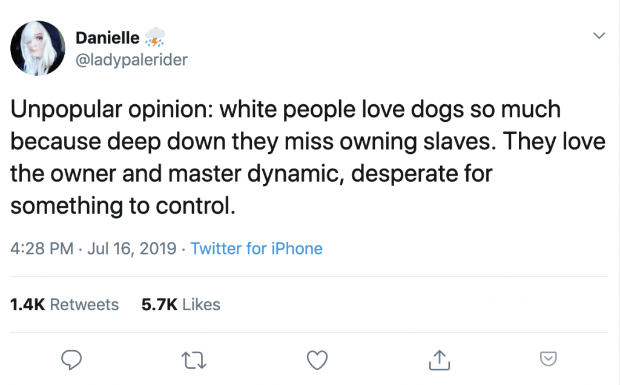
I know this is too stupid to even comment on, but since my mind is still very much on my recently departed Jack Russell Terrier Rugby, and because this tweet really meets the definition of racist, unlike some other recent tweets being labelled as such, I won’t resist posting on it. I could resist, but I won’t.
Here’s the tweet:
What an idiot. Also…
Twitter hasn’t suspended the account.
Nobody who has actually owned a dog would ever analogize the relationship to slavery.
Nobody who thought for twenty seconds before tweeting this would make that analogy either.
What about all the African-Americans who own dogs? Oh, right: slavery was practiced by African tribes too. I guess that explains it.
Human Events Managing Editor Ian Miles Cheong tweeted back, “Listen, I just wanted to thank you for driving more people towards the right.Trump wouldn’t be president without people like you.”
All right, that’s enough stupidity for one day. Between the anti-manspreading chair and this, I’m way over my limit.
In case you haven’t caught up, “manspreading” means “the practice of a man sitting on public transport with his legs wide apart, taking up more space than he needs and preventing other people from sitting down.” Of course, this is a stupid definition even if it does come from the Oxford English Dictionary. Someone sitting like that doesn’t prevent anyone from sitting down, nor does it prevent anyone from saying “Please move your legs,” or, if necessary, “Please move your damn legs; I want to sit here.”
But Laila Laurel, pictured above, has invented a chair that she says will physically prevent men from “manspreading” by forcing their knees together. The female chair, to the left, allows woman extra space and to sit more comfortably. Laila’s a design student at the University of Brighton (that’s in England) and won an award for her invention.
1. Today’s ridiculous note on the heartbreak of Self-Awareness Deficit. Republican Mark Sanford, the defeated former U.S. congressman from South Carolina who is best known for having to resign as governor after going AWOL to visit his South American mistress, said yesterday that he is considering mounting a primary challenge to President Donald Trump. (Psssst! Mark! The RNC has already said that there would be no debates, and the primaries are a mere formality.) Sanford says he will decide in the next month or so whether to oppose Trump for the 2020 presidential nomination.
The basis on which to run against Trump is character and ethics. Of the entire universe of legitimate potential challengers, an ex-governor who escaped impeachment by resigning after making a spectacle of himself has to be near the bottom, if not lying on it.
Somebody tell him.
2. Update: The Red Sox and the late Ken Poulsen’s son are still resisting common decency, I’m sorry to report. I wrote about the on-field presentation to Brett Poulsen last week, when he was awarded the 1967 World Series ring that his father had inexplicably never received despite being part of the that magical Red Sox season. Then we learned that the Sox infielder’s daughter Kendra had never been contacted by the team or her brother, so she and her children, Ken’s grandchildren had been left out of the ceremony. I’ve tried to alert the team and have passed the story along to a baseball writer friend, so far to no avail. Last night, NESN, the Red Sox-owned cable network, interviewed Brett in the stands during the Sox-Blue Jays game. Once again, the false impression was left that he is the only offspring of Ken Poulsen.
The ABA Journal finally provided a brief, clear, fascinating account of exactly how it was that George Harrison was found to have “unintentionally” plagiarized the Chiffons’ “He’s So Fine” when he wrote his biggest hit single as a solo artist, “My Sweet Lord.”
It also clarifies what I always suspected: when courts have to decide the question of when a song is too much “like” another, anything can happen.
George Harrison’s first solo album “All Things Must Pass” was released in 1970, the same year the Beatles officially broke up, with “My Sweet Lord” the triple album’ s signature hit. I remember the first time I heard the song, and thinking, “Wow, that reminds me a lot of ‘He’s So Fine’!” Others thought so as well, including Bright Tunes Music Corp., which held the copyright on the Chiffons’ 1963 classic. It sued Harrison’s publishing company, Harrisongs Music Ltd., for copyright infringement.
As litigation proceeded, Harrison admitted in court filings that he was familiar with “He’s So Fine”—how could he not be?—but denied that he had used it to create “My Sweet Lord.” At trial, Harrison brought his guitar to the witness stand to demonstrate how he had composed “My Sweet Lord.” This, onlookers agreed, was sufficiently convincing to persuade the judge that George was not guilty of intentional infringement. Continue reading →
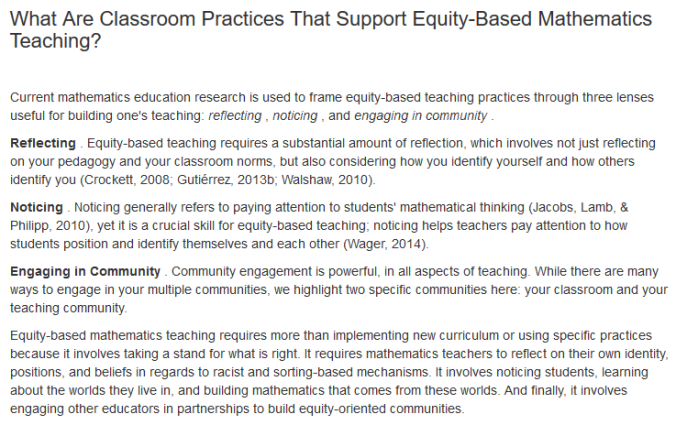
What…the HELL…is that supposed to mean? What does it have to do with mathematics? Aside from the part that is basic to all teaching, like paying attention to one’s students, how does this help students learn math? “Racist and sorting-based mechanisms” are what, grades? Rewarding and recognizing correct answers and techniques over mistakes and confusion? I know mathematicians aren’t known for their facility with language, but was some consultant paid to write this drivel?
Tell me if I’m mistaken, but this reads like a political cult initiation pledge, not legitimate guidance for math teachers. And indeed, that appears to be what it is. The College Fix reports,Continue reading →
…and trying any of the officers involved would be unethical.
Naturally, Eric Garner’s family immediately is attacking the decision of the Justice Department today not to bring federal charges against the New York police officers whose ugly and violent arrest of Eric Garner in 2014 led to his death. This incident came in the midst of several high-profile police shootings following the triggering Trayvon Martin killing, and led directly to the emergence of Black Lives Matters as well as launching one of several catch phrases connected with the movement, “I can’t breath.”
The Department of Justice took a long time reviewing the incident and the evidence, and could not determine that Officer Daniel Pantaleo willfully committed misconduct, an “essential element necessary to bring federal charges,” a senior department official told reporters at a briefing today. Considering all the elements of the crime required to be proven under the law, the DOJ official said, the conclusion was that the police conduct did not “fit within the statute.”
In deciding not to bring charges, U.S. Attorney General Bill Barr sided with federal prosecutors in Brooklyn. The Justice’s Civil Rights Division had favored bringing charges.
The main problem facing the Justice Department and the New York prosecutors was that a conviction would be unlikely, making a prosecution more of a show trial than a real one, much like the George Zimmerman trial for allegedly murdering Martin. That trial was brought unethically to slake activist thirst for vengeance against Martin’s shooter, despite the glaring evidence indicating self-defense. Prosecutors may not use the process itself to punish citizens. If a trial can’t be won, or if the justification for charges are dubious, then it is professional misconduct to bring them.
Were police negligent and reckless in using such aggressive measures to bring down a suspect who was resisting arrest? Absolutely, and this was addressed, as it should have been, in a civil trial. (Garner’s family was awarded 4 million dollars from the city.) Did the cops intend to kill Garner? It takes real anti-police bias to conclude that. The video shows a huge, morbidly obese man resisting arrest by a group of much smaller officers, who pretty evidently over-reacted. Although the ME attributed Garner’s death to “compression of neck (choke hold), compression of chest and prone positioning during physical restraint by police,” the defense in a criminal trial will have no trouble finding persuasive expert testimony to the effect that what ultimately killed Eric Garner was his weight and poor health. Continue reading →
It’s ethical dilemma time for a Red Sox fan. I have an opportunity to get two excellent seats for Sunday’s game in Baltimore. It will be about 99 degrees, and the seats are without any protection from old Sol. Loyalty and dedication demand that I go and support the Sox, whom I have not watched in person for two years. Survival and common sense—non-ethical considerations—argue that this would be nuts.
As Jack Benny said when a robber stuck a gun in his ribs and said, “Your money or your life!,”
1. Funny! Revealing! But still wrong. Campus Reform utilizes a James O’Keefe- inspired wag named Cabot Phillips whose signature stunt is to get college students to reveal their ignorance and unthinking social justice warrior ways. He typically does this by lying to them, as when he gives them quotes from Barack Obama or Hillary Clinton and tells them that the speaker was Donald Trump. Outrage and hilarity ensues.
This time, he traveled to the University of Miami and presented students with a fake petition demanding that the college remove its famed mascot and team name, “Hurricanes,” because the name might be offensive and hurtful to students who’ve been “negatively impacted by hurricanes throughout their lives.” Sure enough, many of the students he spoke with agreed withe the premise. Phillips then posted the video of the students making fools of themselves.
Human beings are wired to trust other human beings, and these stunts take advantage of that. Trust is essential to a healthy and cohesive society, and any exploitation of trust, be it for political purposes, financial gain or amusement, damages society.
It’s not worth it. In this case, the same point could be made by asking, “Would you a support an effort to ban the “Hurricanes” nickname as being potentially hurtful to the victims of tropical storms?”
2. “Spinquark” A helpful reader sent me a link to this website, which purports to expose “big tech companies that don’t respect your privacy..that aren’t transparent and consistent in their algorithms and policies or who use their platforms as a type of privatized online government, a government without recourse or representation.” Continue reading →








 Ethics Alarms