Now I Almost Regret Quitting Twitter…

Mace tweet

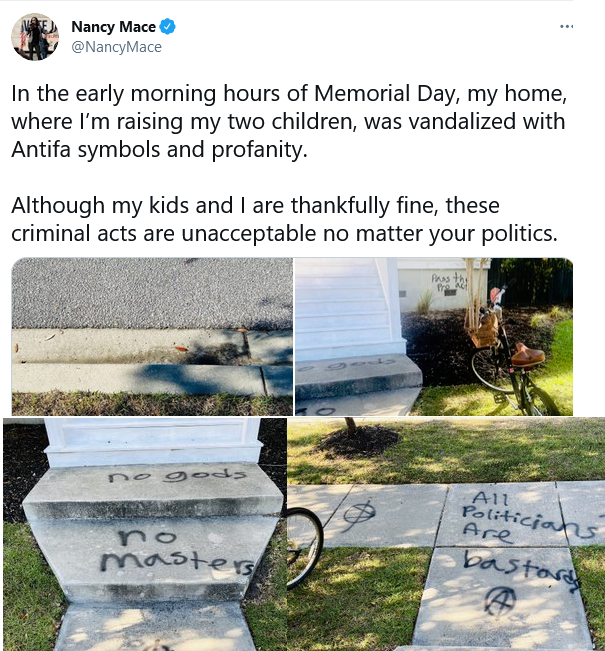
There have been a lot false flag vandalism and supposed racial harassment episodes lately, like here, and here. This one, if it is what it appears to be, is special. A Republican congressional candidate in South Carolina named Nancy Mace took to Twitter to bemoan the state of the nation after, she said, her home had supposedly been vandalized with “antifa symbols” and other attacks.

Fox News and other conservative sources quickly reported the story and extended their sympathies and expressions of horror. On Twitter, however, a string of cyber-sleuths poked holes in her account, and even made a credible case that the candidate’s handwriting matched the writing on her sidewalk. It’s a very entertaining thread that would make a good movie. Read it all. Suspense! Comedy!

No, I’m not 100% convinced that Mace faked the vandalism, but it sure looks suspicious, and if she did fake it, she’s an idiot for the ages.

______________________

Pointer: valkygrrl

Two Wins For Law And Ethics Over Ideology

DC RULES_blind justice

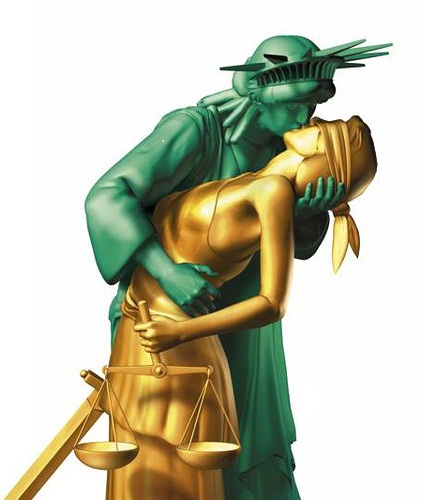
Judges are proving less partisan and ideologically driven than the increasingly totalitarian Left had hoped.

1. In Vitolo v. Guzman, the 6th U.S. Circuit Court of Appeals at Cincinnati ruled last week that the federal government violates the equal protection clause when it considers race or sex in in allocating Wuhan virus relief funds. Following the same track as the earlier case discussed here, the Court agreed that the U.S. Small Business Administration violated the Constitution by giving preference to minority- and women-owned restaurants.

Antonio Vitolo and his wife own a restaurant called Jake’s Bar and Grill. Vitolo is white, his wife is Hispanic, and they each own 50% of the restaurant. Of course, Jake could have gamed the easily manipuated SBA system by just handing his wife the extra 1%. The government requires small businesses to be at least 51% owned by women, veterans or “socially and economically disadvantaged” people to jump to the head of the line, because someone is presumed to be socially disadvantaged if they are a member of a designated racial or ethnic group. A person is considered economically disadvantaged if they are socially disadvantaged, and they face diminished capital and credit opportunities. In such a system, whether the business owner being given preference has actually been disadvantaged doesn’t matter. He or she is presumed to be disadvantaged. This nicely follows the circular logic of Critical Race Theory.

The group preferences are taken into consideration during the first 21 days in which the Small Business Administration awards the pandemic grants to restaurants. After priority applications submitted during that period are processed, the Small Business Administration processes grant requests in the order that they were received. That is, white men come last.

The 6th Circuit majority said Vitolo and his wife are entitled to an injunction forcing the government to grant their application, if approved, before all later-filed applications, and that their color and gender should be irrelevant. The government did not demonstrate a “compelling interest” justifying preferences based on race or sex.

Continue reading

Comment Of The Day: “The Classical Music Critic Of The New York Times Thinks That Symphony Orchestras Should Choose Members According To Race, Gender, And ‘Other Factors’ That Have Nothing To Do With Music”

The Comment of the Day that follows by David Rohde is welcome for many reasons. First, he is a professional musician, and a skilled one. Second, he defends the author of piece I criticized vociferously (and will continue to). Third, I think this is an important issue. Fourth,, a new voice here is always welcome, and we haven’t been getting as many as I would like of late. Finally,, as required for COTD, it is well written and worthy of considerations and debate.

Not that I agree with it, but that has never been a criteria for Comment of the Day honors. Here’s David Rohde’s Comment of the Day. on the post,The Classical Music Critic Of The New York Times Thinks That Symphony Orchestras Should Choose Members According To Race, Gender, And “Other Factors” That Have Nothing To Do With Music.”(I’ll be back with my reaction at the end.)

***

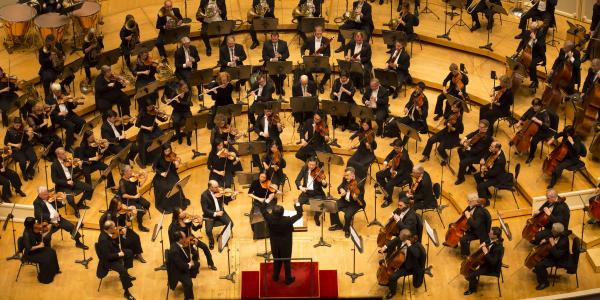
It may be that using blind auditions has elevated the performance level of symphony orchestras. Or it may be serious overkill in an era of a supply-demand imbalance for classical musical talent. But either way, simply rolling this issue into what I know is this blog’s current obsession with – in other words, against – identity issues misses a lot that’s going on here.

First of all, you have to admit that hiring people without knowing who they are in ANY field is kind of strange. In particular, you certainly wouldn’t use blind auditions to cast people in a show, now would you? I know I know, different genres, different requirements. Roles in theater are individual, while 30 or 40 violinists in a symphony orchestra are doing much the same thing.

But I would argue that live classical music IS showbiz, and the sooner that people in that field realize it, the better. If the product is just “the music,” and many people assert that the overall technical performance level is higher than ever, then why is classical music struggling at all?

Second, I think you have to remember what the main impetus of blind auditions was in the first place. While I’m oversimplifying, the essential problem was (or shortly became) the inability of women to secure places in symphony orchestras. A quick check on YouTube of recent orchestra performances now versus 30 or 40 years ago will demonstrate the resulting change. Part of Tommasini’s argument is not to let solutions to problems become so institutionalized that they run past their sell-by date while different problems fester.

Continue reading

A “Welcome June!” Ethics Warm-Up

That song, of course—I hope “of course”—is from the Rodgers and Hammerstein musical “Carousel.” We should recognize that unless we can turn back the cultural clock from half-past sanity, this show, and pretty much all of the R & H musicals, are doomed to political incorrectness hell. That’s far too high a price to pay for woke grandstanding, but The Great Stupid is powerful in the arts, and the kinds of destructive uprising in theater departments that we discussed over the long weekend here and here (in Rick Jones’ excellent guest post) are going to be difficult to put down, especially if the leaders in the artistic community continue to reveal the backbones of annelid worms. “The King and I” is impossible to produce if the the entire cast has to be Asian, and “yellowface” is now considered racist. “Carousel” is a period piece set in an all-white New England fishing town, making the sudden injections of African Americans into the cast for “diversity’s” sake jarring; besides, the the hero is a domestic abuser. “South Pacific” has too many woke violations to count. Can black and Asian characters be shoehorned into 1930’s Austria as the Nazis take over? As a director, I wouldn’t do it, and that show is already imperiled by the fact that the stage version is so inferior to the film. Maybe “Oklahoma!” can be finessed. I have my doubts.

1. Ethics documentary tip...If you have not seen the documentary “Five Came Back,” I recommend that you do. It’s on Netflix, and tells the under-reported story of how five of Hollywood’s most celebrated directors risked their lives, health and careers to volunteer to make films supporting and documenting the war effort during World War Two. All of the five—John Ford, George Stevens, Frank Capra, John Huston and William Wyler—were harmed physically, mentally or emotionally by the experience. They also produced some remarkable film, including some that were deemed too intense by the military and suppressed for decades. I did not realize, for example, that Stevens directed the horrific Dachau death camp footage that was finally shown to the public in “Judgement at Nuremberg, nearly 20 years after the war.

Continue reading

Ethics Observations On The Naomi Osaka Affair [Corrected]

Osaka2

On Ethics Alarms yesterday, the controversy involving the current top female pro tennis star, Japan’s Naomi Osaka, was relegated to the morning warm-up rather than a stand-alone post. If you were not following EA yesterday, here’s a quick summary:

Citing her annoyance with repetitious questions from the news media that undermined her confidence, the 23-year old announced that she would violate the 2021 official Grand Slam rulebook, which requires players to participate in post-match news conferences. Violations result in fines of up to $20,000, but since Osaka made over 55 million dollars last year alone, more than all but the most elite U.S. professional athletes, this fine would be like a late fee at the library to normal people. I wrote in part,

This is literally an example of a star announcing that rules are for lesser mortals. Verdict: Ethics Dunce. The reason Osaka makes so much money is that athletes are paid heroes and entertainers, and submitting to the idiocy of reporters is part of their job. Fines obviously aren’t enough: a tennis player who refuses to fulfill her obligations to the sport should be banned from competing until she does.

Yesterday, after winning her first round match at the French Open, Osaka was fined (but only $15,000), and tennis officials proved that they read Ethics Alarms (I jest) and told Osaka that continuing her boycott of the media would result in her being suspended from the current tournament and others. Good. The organization had no other choice, unless it wanted to directly endorse the King’s Pass (Rationalization #11). If Osaka was allowed to snub the media with minimal consequences (for her), then no other player would feel obligated to cooperate either. Rennae Stubbs, a former player who is now a coach and ESPN analyst, stated the obvious while most of the players and former players were expressing sympathy for Osaka: “You cannot allow a player to have an unfair advantage by not doing post-match press. It’s time consuming, so if one player is not doing that and others are, that is not equal.”

Continue reading