The Ethics Alarms post regarding the Harvard-Harris poll showing that Americans between the ages of 18 and 24 had wildly diverging beliefs from the rest of the population in supporting “woke values and victim culture” ended with the plaintive query, “Now what?”
Michael R, in his Comment of the Day to “Now Here’s A Scary Poll Result…,” answered the question thusly:
***
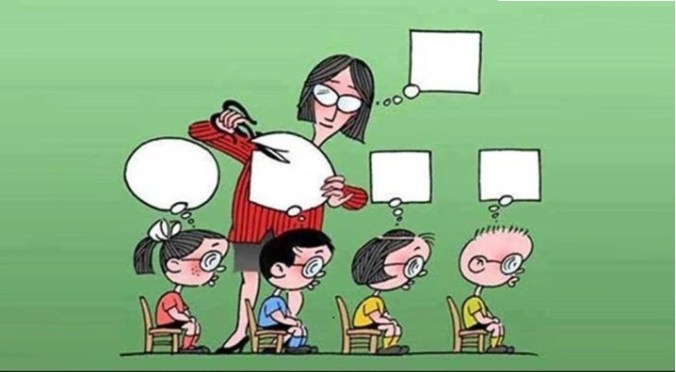
Hmm… So, maybe you CAN’T allow people who hate this country and what it stands for teach the children. Maybe you CAN’T let them control the media including the news. Maybe you CAN’T let them be hired by the government and take over the 4th branch. We have allowed this for 50 years and now we are surprised by the results.
Who could have predicted this would be the outcome?
Of course, everyone with a brain predicted this at least since the 1970’s. Now, the problem is what to do about it? You can’t fix the education system.
- You can’t hire teachers that aren’t fixated on spreading the woke mind virus because the people doing the hiring only hire people who have appropriate brain washing.
- You can’t become a teacher if you don’t support the woke mind virus because the education faculties will throw you out otherwise.
- Even if the faculty don’t want to throw you out, the professional standards call for DEI, pronoun usage, etc. It is a requirement of the program that you believe these things.
- If you don’t pledge allegiance to the woke agenda, you don’t meet the requirements of the teacher ed program. Even if that is ignored, the accreditation body would remove the department’s accreditation if they allowed an outsider to become a teacher.
- Even if you somehow overcame that, the teacher’s union would eliminate any teacher hired who didn’t conform.
There are a couple obvious options.
(1) Put every certified teacher and teacher’s union member up against the wall. This is probably illegal. Even if it were legal, I don’t see many people desiring this. It is however, the only way the current educational system could be fixed. That is why this option is here. To fix the current school system, you have to eliminate EVERYONE involved in the previous bullet points. That buys you about 40 years until the leftists full infiltrate the system again.
(2) Change to complete school choice. Allow parents to decide what school their children go to and have the taxpayer support follow the child. Eliminate the teacher’s union and teacher certification. Bad schools die, good schools thrive. Parents decide what a good school is. The only problem is, the next generation of children will be raised by the woke young adults who want to finish Hitler’s job.
Leftists eventually take over every institution because they are the only one who use weaponized ideology. They push all other people out. Now, this eventually kills private companies. Look at Twitter. They were dead. Musk had to eliminate most of the employees and still has more to go. The problem with government entities is that they don’t ever die, no matter how bad they are. Many of our biggest public school systems have 90+% failure rates on educating students even with ridiculously low standards. The result is that they are rewarded with higher pay and more funding for their failure. Even at 100% failure, they would still be fully funded and get great raises.
You can’t reform these agencies.
They have to end.
 Ethics Alarms
This where the states should take the lead. Those red states should create legislation that earmarks school funding to the child who can be enrolled in any certified education program including home schooling. If your wait for the feds to do something you will probably be putrefying in your grave before such legislation is even sponsored at the federal level.
There is nothing more democratic than the ability to vote with your feet. There is nothing that promotes efficiency and superior products than competition. Those are the arguments that should be made.
The average school system spends upwards 15,000 dollars per year per student. (This is a conservative average because many school systems spend considerably more per pupil)
Virtually all of the funding for actual instruction comes from state and local resources because federal funding is used to finance progressive initiatives and administrative personnel. A student/ teacher ratio of 15 to 1 would allow nearly a quarter of a million dollars to finance a class. Assuming an average salary of $75K plus 40% for benefits would cost $115K. Of course a classroom of about 600 square feet is necessary to seat 15 students and 1 teacher I am sure one could find adequate rental space at $30-40sqft amounting to 18-24K in rent/utilities. Now we are up to about $140K leaving us about $85K for materials of instruction (MOI), a supervisor shared across 5 classrooms and other administrative costs. Assuming a supervisor is paid $100K annually along with that 40% benefit package that amounts to a per class allocation of $28K. An allowance of $200 per student for books would amount to $3K so a bare bones education without a lot of administrative overhead might leave us $54K to cover transportation costs of students, MOI and whatever absolutely required dedicated management overhead is used.
This is just a back of the napkin breakdown and I know I have left out professional development costs and probably some other minor but less necessary expenses. However, none of these funds are allocated to those that home school their children yet the children get educated anyway.
https://nces.ed.gov/programs/coe/indicator/cmb
In 2019–20, of the $17,013 spent on total expenditures per pupil nationally,
current expenditures—which include salaries, employee benefits, purchased services, supplies, tuition, and other expenditures—accounted for $14,789 (87 percent);
capital outlay—which includes expenditures for property, buildings, and alterations completed by school district staff or contractors—accounted for $1,760 (10 percent); and
interest on school debt accounted for $465 (3 percent).
Per pupil spending on these three types of expenditures varied by state in 2019–20. As a percentage of total expenditures, current expenditures per pupil were
lowest in Oregon and the District of Columbia (75 percent in each) and Texas (79 percent); and
highest in Rhode Island and Vermont (96 percent in each).
Capital outlay per pupil was
lowest in Rhode Island (2 percent), Vermont (3 percent), and Massachusetts (4 percent); and
highest in the District of Columbia and Oregon (19 percent in each).
Interest on school debt per pupil was
lowest in Hawaii (0 percent), Wyoming, North Carolina, West Virginia, and Vermont (less than one-half of 1 percent in each); and
highest in Oregon and the District of Columbia (6 percent in each).
This COTD reminded me of this quote from Ross Perot:
“There is no accountability in the public school system – except for coaches. You know what happens to a losing coach. You fire him. A losing teacher can go on losing for 30 years and then go to glory.”
The first step is actually to eliminate the Department of Education. We are addicted to giving the federal government money. We give the feds $1 and they give us back $0.35 and we thank them for it. So much of educational funding comes from. Because of the ‘federal’ funding and the power of the teacher’s union, states won’t move against public education.
This is a bigger problem of the government employees being an important voter group. That is a conflict of interest. They are being paid by the taxpayers but get to vote themselves raises. I don’t think government employees should be allowed to vote. Because they don’t vote in those elections, they shouldn’t have to pay taxes for those either. Federal employees shouldn’t vote in federal elections or pay federal taxes. State employees shouldn’t vote in state elections or pay state taxes. Think of how the spending dynamic of the government would change instantly.
Michael, this COTD was well-earned.
Chris, I very much appreciated your dive into actual numbers. Our kids have school-aged children and there have been times they have voiced frustration with their school administrations. I have talked with them on more than one occasion – at a high level – about your concept of a “home-school” school (I think you have mentioned this in the past)…one in which groups of parents banded together, pooled their resources, hired a teacher, and let their children be taught that way.
The scope is really not that different from the “one-room” school we read about in history books or watched on “Little House on the Prairie.” It was successful then, why couldn’t it be now?…particularly if one lives in a state where education dollars could be directed to such an endeavor rather than a “public school” system that’s ultimately controlled by the federal government.
Sure, there are some things that are much more difficult. I’m thinking of music programs, sports…all of the extra-curricular stuff. But while those (especially music) have value, they are secondary to the actual 3-R learning that now seems so fundamentally lacking in a great number of public systems.
School choice is a powerful tool, which is why the Education Department and the teachers’ unions rail so hard against it.
Maybe compulsory schooling should be abolished.