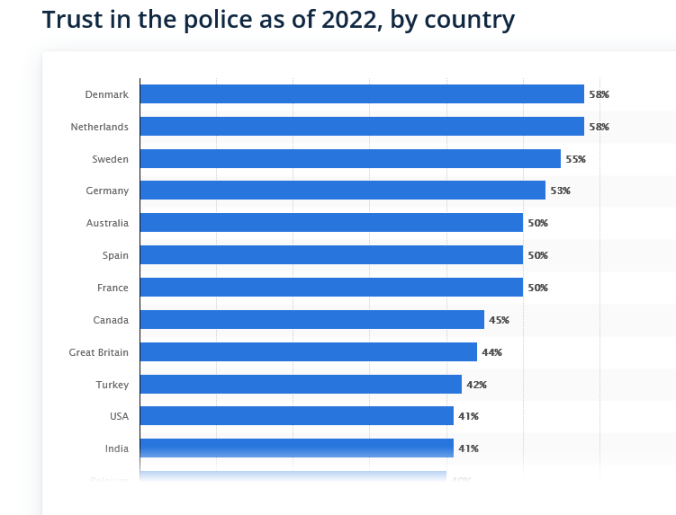
I guess the first step is admitting that it’s untrustworthy. [ I guarantee the 2022 level of trust represented above has declined.]
Out of Colorado comes the disturbing news that Yvonne “Missy” Woods, a Colorado Bureau of Investigation DNA scientist, breached standard testing protocols, manipulated data in the DNA testing process and posted incomplete test results in a staggering 652 cases.The agency called it “an unprecedented breach of trust.” I’m not so sure about the “unprecedented” part, but it certainly doesn’t encourage the trust of the public, or perhaps more importantly, juries. The affected cases occurred between 2008 through 2023, but there may be more: an investigation is reviewing Missy’s work dating back to 1994. She worked for the lab for 29 years, but the CBIonly became aware of irregularities in her work last September. She was placed on administrative in early October and retired a month later. [Pointer: valkygrrl]
The problem is that this is hardly a unique occurrence; there is pervasive ethics rot across all levels of law enforcement coast to coast. The Uvalde report recently demonstrated that the police there responded to that school shooting with overt cowardice and incompetence, dooming children who might have been rescued with a quicker response. The FBI has revealed itself to be corrupt and political, though to watch how fawningly the agency is portrayed in popular network TV shows one would think that today’s FBI makes Elliot Ness’s ghost puff out his chest with pride. We are watching the wildly unprofessional conduct of a high-profile DA unfold in Georgia; last December, it was reported that about 100 prosecutors across Ohio violated standards designed to preserve defendants’ civil rights in criminal trials, and none of them have been sanctioned or disciplined.
Let us say that it seems unlikely that this is a phenomenon restricted to the Buckeye State.
Our republic has too many crises and festering problems to focus on it seems, but enforcing the law is very close to being the foundation of civilization. It must be trusted by the public, which means that it must be trustworthy. I have to reluctantly conclude that despite the pro-law enforcement propaganda the public is subjected to in the entertainment media, the reality is tragically different. From New York comes that head-exploding news that Gov. Kathy Hochul is dispatching National Guard troops to police the subway system in addition to the 1,000 New York City police officers who were ordered to patrol subway lines and do security checks in response to an attack on a conductor and a spike in other subway crimes. New York City is one of many where woke DA’s are refusing to prosecute all but the most serious crimes, as fighting “over-incarceration”—-meaning too many people are breaking laws—has become the priority over protecting law-abiding citizens.
Now what?
 Ethics Alarms
I guess she was possessed by the ghost of Joyce Gilchrist, aka Black Magic, an Oklahoma pathologist who matched DNA in the 1990s no one else could, but who was finally sacked after it became obvious she was embellishing. 12 people were executed on her work. She died in 2015, after never having been charged with or convicted of any crime.
As for the FBI’s portrayal on TV, you can blame Dick Wolf for that. After the man built an empire between New York and Chicago in the Law and Order and One Chicago franchises, the next step was to build one with the Feds. Recycle some of the actors from L&O (Alana de Garza and Jeremy Sisto were both L&O alumni), bring in some new ones with a touch of DEI (Zeeko Zaki’s OA Zidan was originally supposed to be a Latino with a different name, but he so impressed them in his audition that they rewrote him as an Arab, which is even better for DEI), keep ripping from the headlines, and off you go.
Even before the Wolf-Pack of FBI propaganda, shows like “Without a Trace” and “Criminal Minds” was representing the FBI as noble and infallible heroes.
They also portrayed them with horrible ethics and played out the king’s pass on a regular basis. I can’t remember the episode name and didn’t find it after a short search… but I quit watching after what was a murder by an agent. The suspect was going free, and the agent killed him. It was clear what happened, but the other agents covered for her.
NYPD Blue was probably the worst in that regard. Episode after episode featured threatened or actual torture of suspects to get confessions. No one seemed to bat an eye at it, the show was disgusting in that regards.
Well said. Also disgusting?…being exposed to Dennis Franz’s butt.
…and Fred Zain and all the Massachusetts lab techs that faked their data, and the entire Houston crime lab, and…
Most forensic labs have a conflict of interest. They work, at some level, for the prosecution. Our justice system is very one-sided. On one side, you have the government, with their police, DA’s, crime labs, and often the judges, with vast amounts of taxpayer money. On the side of the defendant is their attorney and any resources the defendant has at his or her disposal. The ‘team player’ mentality is going to result in corruption under any circumstances. The only way to bring some impartiality to the system is to divide it a little more equally.
For the crime labs, they need to be independent and the rules of evidence need to change. Right now, the evidence is ‘owned’ by the DA. The prosecution decides what evidence is tested and what tests are run. The defense has to request evidence from them. This results in evidence being withheld and evidence not being tested if it would likely benefit the defense (show that the wrong person is being prosecuted). The labs need to be independent and need to be accessible to both the prosecution and the defense. All evidence needs to be deposited with the lab, not the police department. The defense and the prosecution should be able to request testing and results should be sent by the lab to both defense and prosecution. The lab personnel should be allowed to testify for the defense and the prosecution. The lab personnel should especially be free from coercion from the police department and the prosecution. The labs also need to be accredited and inspected not by forensics agencies, but by analytical chemistry and medical lab accreditation bodies with quality assurance through the routine testing of ‘fake’ samples. This won’t fix everything, but it will help.
Qui custodiet ipsos custodes?
Maybe I’m reading this wrong, but it feels to me that the breakdown of trustworthiness of law enforcement parallels, with some lag, the breakdown of trustworthiness of public educators. Political activism leads working conditions that become more and more intolerable, with bloated bureaucracies that hamper effectiveness, and an atmosphere that discourages the best people from signing up or sticking around.
Of course, the lag is due to the time it has taken to properly program the budding activists in public school, and then college, and then through law school, so that all the lawyers taking the field now are against enforcing the law as written, but applying it according to privilege/victim status.
I think destroying the woke influences on our education system will go a long ways to fixing many, many other problems, including the law enforcement breakdown, but that will not be an overnight fix. We might be reaching the point of peak stupid, as we’re seeing a number of woke policies being ramped down, overturned, or replaced, but healing from the damage will take time.
My gut tells me that if I were an upstanding, qualified, honest person in law enforcement in 2020, I would have been looking for another profession. Who does that leave us in the police forces? When you punish a whole group for the offenses of the few, the innocent and capable will leave and only the guilty and incompetent will remain. Who would want to go into law enforcement in a major, leftist city today? They have had to lower their test standards, they are even hiring people who fail the psychological exams and are noncitizens.
We have bullies and people acting as officers who are so terrified of doing their jobs that they mag dump into people because of an acorn or because they see a gun. Current-day police culture has instituted ‘officer safety’ as job 1 to the extent that the lives and civil rights of everyone in society are to be sacrificed to make officers feel ‘safe’. How is this going to work out? The ‘police reform’ people have made the police orders of magnitude worse.
*Oh yeah, the ‘acorn cop’ was formerly a Special Forces Captain (ranger tab) who served in Afghanistan.
Punish them.
Were the talented Ms. Woods’ transgressions distributed fairly and without discernable prejudice or did they favor/punish certain…um…demographics?
PWS
I’ve been binge watching ‘The Rookie’, sadly. It is brilliantly crafted to promote every progressive talking point to perfection. We are doing prosecutorial over-charging at the moment, and one of the few white heroes is going to apply for a job with the DA so that he can ‘change the system’.
Half the reason I’m still watching is a challenge, which it isn’t, to pick the next bit of propaganda.
I’m sure that many who are/were watching it will be strongly influenced in their thinking, and it is easy to believe this is a deliberate intention of the program. I keep wondering if there was any intention to entertain, which it does, or to make money; or if it is entirely a propaganda exercise that was seen as a justifiable expense designed to move the Overton Window.
Frankly, the best thing possible is widespread, aggressive lawfare against agencies that will not police themselves by the US justice department. Today they make agreements with so many glaringly corrupt agencies and take a kid glove treatment waiting for slow progress.
In so many of these cases, the employees of the state are committing federal felonies regularly. Stop treating crimes by officers as “a mistake”. Non cops don’t get to use the “mistake” argument when we commit a crime. Stop accepting ignorance as an excuse, we don’t get that one either. Qualified immunity is a creation of the courts that only protects against civil actions; the use of criminal prosecution faces no such restriction. Use the falling opinion of the public about the police to scare the crap out all of the agency’s employees. Aim high, and aim at union officials. Anyone who helps cover up gets an accomplice charge. Use the unlimited federal purse to bankrupt the unions that defend the cops. Getting indictments is easy. Even when you lose, you win as that is money that no longer can defend the next officer.
Obama demonized the police, but he didn’t get this ball rolling when he could have.
–That’s part one… now for part two–
As you correctly note, de-fund is NOT the answer. I have a fairly cynical position, the police are a necessary evil. We give the state a LOT of power, one that should be used very carefully. But that power should be used. Conservatives can be rightly criticized for their boot licking tendencies that enable the thin blue line. Conservatives love handing out the king’s pass. But now it is time to rip on the liberals. Crimes that involve violating other’s life, liberty and inalienable rights deserve SEVERE punishment. They can carry on about cops, but your life is more likely to be upended or even ended by a common criminal than a cop. We should have careful, ethical above reproach police and prosecutors. But once found guilty, long sentences are a must. Repeat offenses deserve more. Three strikes laws are just, as they represent multiple instances of victimizing others. Full prisons should only be a concern when those in there are innocent. So long as we keep that one criteria clear, stop fretting over a full prison. A full prison means society is safe and government is doing it’s job.
Conservatives get this, but liberals don’t. The size of police departments is based on crime. Most of the crime is driven by catch and release and / or short sentences for criminals. It’s the same few cycling back through the system generating most. The aggressiveness of police is greatly driven by fear, and the same sociopaths are coming through over and over again.
PS: I’m glad to see you coming back around Jack. US law enforcement is REALLY out of whack, and much of the swaying public opinion is due to the public paying attention.
“Now what?”
The answer, in a nutshell, is “ethics.” The objective is to build an ethical police agency that can effectively maintain law and order with the support and participation of the members of the community. Building an ethical police agency is at once the simplest (in principle) and the most complex (in practice) of endeavors.
First, it is critical to remember that public safety (“law and order”) is not just the responsibility of law enforcement. Creating competent public safety services is a responsibility shared by, and requiring substantial effort from, both the police and the community. Citizens can’t just remain uninvolved and then in good faith complain when their police don’t meet their expectations. The police rely heavily on trust and cooperation from the public to effectively fulfill their mission and serve their communities, just as the public depends on the trustworthiness (integrity) of its police to ably enforce the law, fairly and consistently.
Second, policing in the United States is largely under state and local control rather than national control. This is as it should be, but it does make the establishment and enforcement of consistent standards (ethics, hiring, training, promotion, discipline, etc.) much more difficult. (Compare this to the police of Britan or Israel which are nationally rather than locally or regionally directed.)
In addition to differences in established performance standards, agency leadership styles (and leadership ability) can vary greatly from agency to agency, and also within police organizations. This means that accountability and control mechanisms are often quite inconsistent from agency to agency as well as among different bureaus or divisions of the same agency.
The police (other than elected sheriffs) are also answerable to the local political power structure (mayors, council members), which often has its own agenda that is frequently at odds with (or unsupportive of) ethical police leadership. So, the first essential ingredient for reforming a police agency is the political will to make it a priority for the jurisdiction. This involves prosecutors and judges as well. Many of these officials are elected and tend to be politically responsive on the big issues like public safety.
Whatever the obstacles, the new leadership of a troubled agency must be chosen for integrity and ability and given a mandate to bring the agency up to a high ethical standard. The right people must be recruited, hired and trained. Hire for integrity and train for competence. The “wrong people” must be identified and “given the opportunity to excel elsewhere.” The agency needs a strong sense of mission and a clear understanding of the values that underpin ethical policing. (Sir Robert Peel’s “Principles” from 1829 aren’t quite worn out yet and are a good start.) Building a culture of ethical and effective police service begins at the top. High standards of conduct and performance must be established and enforced.
In my experience, the agency culture is of paramount importance to ethical leadership because culture is quite often predictive of organizational behavior. I believe it was Peter Drucker who said that “culture overwhelms strategy.” This works both ways, of course; while a strong, virtuous, public interest serving culture can bolster leadership’s efforts to deter personnel from choosing the easy, unethical path over the more difficult, honorable path, a rotten culture can reinforce unethical and unlawful conduct and undermine the staunchest efforts to achieve reform. Maintaining an already principled and ethical culture, or creating one from scratch (for example, in starting up a completely new agency) is one thing, but turning a corrupted, dysfunctional culture around is orders of magnitude more difficult and time-consuming. Culture must be more than mission statements and motivational posters. It has to be “lived in the halls and not just written on the walls,” as someone once said. Every hire, every promotion, every management decision either upholds or undermines the ethical culture.
It is the responsibility of the police to reach out to the community and initiate efforts to secure the trust and cooperation of the community. The sheriff or chief, command staff and field supervisors must first meet with a variety of community leaders and groups in order to identify community concerns about crime and disorder problems and their satisfaction (or lack thereof) with the agency. Although they can come ready with all sorts of crime and calls-for-service data, charts and graphs, their primary role initially is to listen. This often means getting yelled at, at first, then patiently sifting through what is said to get to the real issues that motivated the community response. Later meetings can include patrol officers and investigators being present to address more specific community crime concerns and explain police capabilities and tactics. Community partners (businesses, non-profits, churches, schools, other public service agencies) must be identified and involved. Community members should be reminded of their shared responsibility for public safety and the agency must create opportunities for community involvement and assistance. Community leaders must be challenged to lead in positive directions. There is usually much more common ground between the police and the community than first impressions might suggest.
Agencies must consider ways in which their structures, policies and procedures could be changed to better meet community needs. They must create processes for getting crime data (and other agency information) out to the communities more promptly and ensuring transparency for victims in crime investigations. All this builds a foundation for the agency and community to move forward together.
The recent anti-police movement among progressives has been especially problematic for police retention and recruitment. This is affecting agencies of all sizes, from coast to coast. At least six municipal and county agencies in my area report great difficulty in filling vacancies. The larger agencies are offering premium pay in response to the need, which takes experienced personnel from the smaller agencies that can’t match the larger agencies’ pay. The smaller agencies must resist the temptation to fill those vacancies with recruits they would normally consider unsuitable, just to fill the ranks. When agencies run short-staffed, morale often suffers, which can further aggravate retention issues.
So, as I said at the outset, creating an ethical police agency is simple, but it sure ain’t easy. A police agency has to do it one day at a time, one decision at a time, one citizen interaction sat a time. If it were easy, anybody could (and hopefully would) do it.
(I apologize for the length of this comment. I could write a book on this stuff.)