
2024 INTRODUCTION
Last year I concluded that “It’s A Wonderful Life” really belonged in the Thanksgiving movie canon, not Christmas, but I still waited until the pre-Christmas madness to post the 2023 version. This year, I’m finally putting the classic where it belongs. I have always identified with George Bailey, though this year it is for different reasons. Like George, I often feel like I didn’t achieve and experience what I could and should have, that my choices too often didn’t pan out, that I barely missed some breaks (but not all) that I needed when I most needed them. This year, which has been clouded since Leap Year by the sudden death of my wife, best friend, business partner and #1 fan—that’s Grace Elizabeth Bowen Marshall in all categories—I have never felt the lesson of “It’s A Wonderful Life” more powerfully: “No man is a failure who has friends.” I don’t believe that, frankly, but my friends, neighbors, clients, colleagues and blog readers have sustained me generously in this difficult period, and I will always be grateful for that.
Last year I wrote, “This is a tough time for my business and my family, and a lot of the problems are the result of my own selfish choices and mistakes as well as my hard-wired proclivity to cause trouble and not back down after the consequences start becoming clear. I’m seriously considering not celebrating Christmas this year, and we have always been a big Christmas family, because several recent disasters require the money to go elsewhere.” In retrospect, this reminds me of a joke my father was fond of: “One day as I sat musing, sad and lonely without a friend, a voice came to me from out of the gloom saying, ‘Cheer up. Things could be worse.’ So I cheered up and sure enough—things got worse.” Everything got much worse after I wrote that last year.
I re-watched the movie last night in preparation for revising the Guide. It made me cry at the end, because Grace so loved the final scene, and would tear up at Harry Bailey’s toast, “To my big brother George, the luckiest man on earth.”
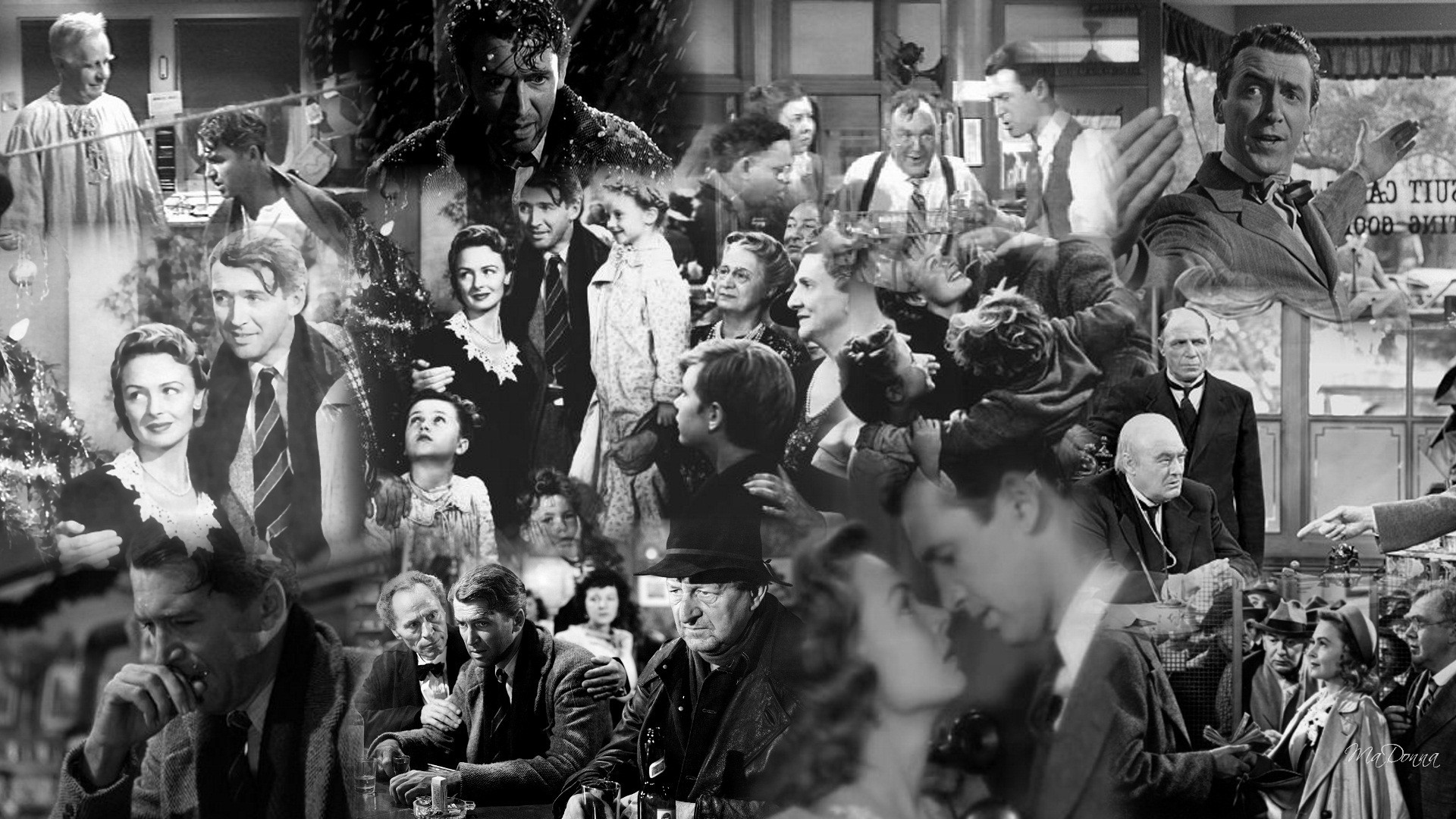
Frank Capra must have felt that the movie was bitterly ironic. It was a huge flop, and destroyed his infant project with some other prominent directors to launch a production company called “Liberty” because it would give directors the liberty to put their artistic visions on the screen without interference from the studios. “It’s A Wonderful Life” was the first and last film produced by Liberty: it not only killed the partnership, it just about ended Capra’s career.
James Stewart was, by all accounts, miserable during the shooting. He suffered from PTSD after his extensive combat experience, and the stress he was under shows in many of the scenes, though to the benefit of the film. It is interesting that the movie is scored by Dmitri Tiompkin, a Russian expatriate who is best known for scoring Westerns like “Red River” and “High Noon.” He wasn’t exactly an expert in small town America, but his trademark, using familiar tunes and folk melodies, is certainly on display. Clarence, George’s Guardian Angel (Second Class), is frequently underscored with the nursery rhyme “Twinkle Twinkle Little Star” because he is represented by a star in the opening scene in Heaven. The old bawdy tune “Buffalo Girls” is another recurring theme, an odd one for a wholesome film since the buffalo girls were prostitutes.
As usual, I noticed details in the film this time that escaped me in earlier viewings, and for better or worse, I have appended the Guide accordingly. I also must say that although I wrote the Guide, I enjoyed reading it, and, amazingly, some of my own words made me feel a little better at a time when my spirits are near an all-time low. In particular, the section on regret resonated with me. Good point, Jack!
Now let’s go to Bedford Falls…but first, a stop in Heaven…
1. A Religious Movie Where There Is No Religion
The movie begins with the sounds of a succession of characters we haven’t met yet praying for George Bailey, whom we also haven’t met yet. This immediately dates the film: I can’t imagine a film today making it seem like praying to God is what average Americans do. It is a sour note right at the start: this is how far organized religion, community morality and faith have declined since World War II, and it would be hard to ague that the nation is the better for it. The opening also exemplifies how, in its era, white Christians were widely regarded as the template for “typical Americans.” Only two black people appear in the movie and only one has a meme, a housekeeper whom Mammy from “Gone With The Wind” would have considered an offensive stereotype, There are no Jews in evidence.
Prayer as a theme recurs several times in IAWL, and yet there is no presence in the film of any religious figure, no priest or minister, and Bedford Falls doesn’t seem to have any churches.
The first flurry of those prayer leads us to heaven, where a couple of angels debate how to answer them. Yet this is an ethics movie, not a religious one. The protagonist George Bailey lives a (mostly) ethical life, not out of any religious conviction, but because step by step, crisis after crisis, he chooses to place the welfare of others, especially his community and family, above his own needs and desires. No reward is promised to him, and he momentarily forgets why we act ethically, until he is reminded. Living ethically is its own reward.
We are then introduced to George Bailey, who, we are told, is in trouble and has prayed for help. One has to wonder about people like George, who resort to prayer as a last resort, but they don’t seem to hold it against him in Heaven. The heavenly authorities assign an Angel 2nd Class, Clarence Oddbody, to handle the case. He is, we learn later, something of a second rate angel as well as a 2nd Class one—the two supervising angels, on of whom is named Joseph (THE Joseph, with the colorful coat? Saint Joseph, Mary’s husband? Joseph of Arimathea?) agree that Clarence has the IQ “of a rabbit.” Gee, they’re mean in heaven! It is interesting that whether or not George is in fact saved will be entrusted to less than Heaven’s best. Some lack of commitment, there— perhaps because George has not been “a praying man.” This will teach him—sub-par service! Good luck, George!
2. Extra Credit for Moral Luck
George’s first ethical act is saving his brother Harry from drowning, an early exhibition of courage, caring and sacrifice. The sacrifice part is that the childhood episode costs George the hearing in one ear. He doesn’t really deserve extra credit for this, as it was not a conscious trade of his hearing for Harry’s young life, but he gets it anyway, just as soldiers who are wounded in battle receive more admiration and accolades than those who are not. Yet this is only moral luck. A wounded hero is no more heroic than a unwounded one, and may be less competent as well as less lucky. The scene we are shown from George’s childhood also reveals how far the culture has come in protecting, or trying to, children from the perils of life. This month, a Georgia mother was arrested for neglect for allowing her 10-year-old son walk home alone. Wow. What would the authorities do to a mother who allowed her kids to play near a frozen pond?
The episode sets a theme: good deeds are not necessarily rewarded in life. One of George’s delusions is that he thinks they should be, that doing good things and being ethical ought to culminate in life success. Lots of people velieve this. It would be nice if they did, but they often don’t. “No good deed goes unpunished” is more than cynicism.
3. The Confusing Drug Store Incident.
George Bailey’s next ethical act is when he saves the life of another child by not delivering a bottle of pills that had been inadvertently poisoned by his boss, the druggist Mr. Gower, who is addled by grief and drink after learning about the death of his own son. George’s act is nothing to get too excited over, really—if George had knowingly delivered poisoned pills, he would have been more guilty than the druggist, who was only careless. What do we call someone who intentionally delivers poison that he knows will be mistaken for medication? A murderer, that’s what. We’re supposed to admire George for not committing murder.
Mr. Gower, at worst, would be guilty of negligent homicide, but they are tough in Bedford Falls as we learn later. George saves him from that fate when he saves the child, but if he really wanted to show exemplary ethics, he should have reported the incident to authorities. Mr. Gower is not a trustworthy pharmacist—he was also the beneficiary of moral luck. He poisoned a child’s pills through inattentiveness as well as being inebriated on the job. If his customers knew that, would they keep getting their drugs from him? Should they? A professional whose errors are potentially deadly must not dare the fates by working when his or her faculties are impaired by illness, sleeplessness or, in Gower’s case, grief and alcohol.
One could take the position that Mr. Gower “just made one mistake.” But trustworthy professionals don’t get to make such mistakes, not if they expect to still be trusted the next time. Trust is easily destroyed, and should be. The narrators in Heaven seem to believe that the fact that George never told a soul about the near poisoning is evidence of his virtue. How would they feel if Mr. Gower eventually killed someone by mistakenly putting poison in some capsules after a bender? (And why does he have a big bottle called “POISON” around anyway? ) Here the film, not for the only time, celebrates loyalty over responsibility. It’s a bad ethics lesson.
The fact that George doesn’t reveal that Bedford Falls has a druggist who is prone to getting smashed when his personal life is awry and is capable of putting poison in prescriptions yet nobody ends up dead is classic moral luck. It is not hard to imagine an alternative scenario where George’s youthful embrace of loyalty results in someone dying. And what if Mr. Gower’s victim in this alternate reality would have saved all those men on the troop ship?
But let’s not get ahead of the story.
Mr. Gower also slaps George on the head several times. Today hitting a child like that is regarded as child abuse by a parent; when another adult hits a child, it’s grounds for arrest. This is one of many examples of evolving societal ethics in “It’s A Wonderful Life.” When the film was made, Mr. Gower’s conduct in slapping a child employee was considered forgivable. If the local pharmacist slapped my son, I’d swear out a criminal complaint, and he still might end up shambling bum like Mr. Gower in the film’s alternate reality section.
I have always been puzzled why George didn’t just shout out about the poison when he was first given the package to deliver, and not later, when he was being slapped around. After all, that big container labeled “poison” was just sitting there.
4. The Uncle Billy Problem.
As George grows up, we see that he is loyal and respectful to his father. That’s admirable. What is not admirable is that George’s father, who has fiduciary duties as the head of a Building and Loan, has placed his sketchy brother Billy in a position of responsibility. As we soon learn, Billy is a souse, a fool and an incompetent, and he keeps squirrels for pets, just like that suspect in the Zodiak killings (and this guy). This is a breach of fiscal and business ethics by the elder Bailey as well a classic conflict of interest, both of which George engages in as well, to his eventual sorrow.
It is, to be fair, also a very common breach of ethics, the unreliable family member or friend kept working by a compassionate owner. One of my college roommates continued to employ a close friend after he sustained permanent brain damage in an auto accident. Doing so requires extra supervision, and some risk. How does one criticize generosity and loyalty like that? Yet it creates a very real ongoing conflict of interest that the film fails to condemn.
5. George’s Speech.
When his father dies, George delivers an impassioned speech to Mr. Potter, the owner of the only other financial institution in town, who proposes that the Bailey Building and Loan be closed down. Potter has a point. For example he points out that Ernie the cab driver was approved by for a home loan by George, who is his good friend. Yes, it’s a small town, but still, this is a suspect policy and more importantly, a conflict of interest with the appearance of impropriety.
Two of the most clearly stated and correct ethical principles are articulated in this scene by Potter, the film’s villain. First he says that “high ideals’—ethics, essentially—don’t work without common sense. That’s right, and is an ongoing theme on Ethics Alarms. The second is when Potter mocks the legitimacy of George approving loans to his friends. Potter is also right about that. It should not be allowed. No responsible and trustworthy financial institution would allow it.
When Potter impugns George’s father however, George has a rebuttal:
“Just a minute. Now, hold on, Mr. Potter! You’re right when you say my father was no business man. I know that. Why he ever started this cheap penny-ante Building and Loan, I’ll never know. But neither you nor anybody else can say anything against his character, because his whole life was… Why, in the twenty-five years since he and Uncle Billy started this thing, he never once thought of himself. Isn’t that right, Uncle Billy? He didn’t save enough money to send Harry to school, let alone me. But he did help a few people get out of your slums, Mr. Potter. And what’s wrong with that? Why…here, you are all businessmen here. Doesn’t it make them better citizens? Doesn’t it make them better customers?”
“You…you said that uh… what’d you say just a minute ago… They, they had to wait and save their money before they even thought of a decent home. Wait! Wait for what? Until their children grow up and leave them? Until they’re so old and broken-down that they… Do you know how long it takes a working man to save five thousand dollars? Just remember this, Mr. Potter, that this rabble you’re talking about… they do most of the working and paying and living and dying in this community. Well, it is too much to have them work and pay and live and die in a couple of decent rooms and a bath? Anyway, my father didn’t think so. People were human beings to him, but to you, a warped, frustrated old man, they’re cattle. Well, in my book, he died a much richer man than you’ll ever be.”
Capra, as was his habit, stacks the deck by casting the advocate for fiscal responsibility as Potter, whom the heavenly spokesperson has already identified as “the meanest man in Bedford Falls.” But George’s speech, delivered by Jimmy Stewart in his best “Mister Smith Goes to Washington” fervor, is pretty close to the philosophy that set up the U.S. for the housing and mortgage meltdown in 2008 that wrecked the economy. George’s speech could probably have been recited with equal sincerity by various well-meaning members of Congress at the time, like Barney Frank and Ted Kennedy, who were pressuring financial institutions to hand out mortgage loans to hundreds of thousands of aspiring homeowners who would never have qualified for them under well-established banking principles. It might sounds familiar now as President Biden continues to try to have student loan debts forgiven, and after one of Kamala Harris’s vote-buying ploys, promising government subsidies for first-time homebuyers.
Peter Bailey’s “plan,” if one can call it that, was to give mortgages to people who couldn’t afford them, and then not press the good people to keep up with payments when they couldn’t afford them. In short, he was irresponsible, fiscally and otherwise, and his poor business sense, matched here to generosity and compassion as if one justifies the other, was guaranteed to be ruinous to investors, the unqualified homeowners, and ultimately the Building and Loan. Ethical borrowing means committing to pay back loans on the terms of the loan. The greater the risk of a loan not being paid back, the more proof of collateral is needed. Neither Peter Bailey, nor George, nor Frank Capra knew how to somehow loan money to people who can’t pay it back, not foreclose on the property, and yet keep the altruistic loaner solvent. They just knew it was“the right thing to do”…which when used in such a context, is a rationalization: #60, The Ironic Rationalization. From the definition on the Ethics Alarms Rationalizations List:
This rationalization can sometimes be a fair statement of fact rather than a rationalization. But “It’s the right thing to do” is routinely used to end a debate when it is only a proposition that must be supported with facts and ethical reasoning. Simply saying “I did it/support it/ believe in it because it’s the right thing to do” aims at ending opposition by asserting virtue and wisdom that may not exist.
The question that has to be answered is why “it’s the right thing to do,” and “Because it’s just right, that’s all,” “Everybody knows it’s right,” “My parents taught me so,” “That’s what God tells us in the Bible,” and many other non-answers do not justify the assertion.
Maybe it’s the right thing, and maybe not. Just saying it conduct is right without doing the hard work of ethical analysis is bluffing and deflection. “It’s the right thing to do” you say?
Prove it.
The problem is that a plan that can’t possibly work is never ethical. It is by definition irresponsible, and thus not the right thing to do.
How did Peter Bailey’s lunatic business plan become regarded by one political party as sound social policy? If one borrows money, one has made an obligation to repay it, with interest. A mass amendment to that principle of “But, if it’s too hard, that’s all right, you won’t really have to pay it back!” undermines personal responsibility and the willingness of loaners to loan.
6. George’s Fork in the Road.
George Bailey’s decision to give up his plans to go to college to save the Building and Loan is clearly not motivated by his personal dedication to the institution; he doesn’t like the place. He says so over and over again. He admires his father’s motivations for starting it, but if Potter had not sparked his resentment with his nasty comments about George’s late father, George would have been out the door. His passionate speech in rebuttal of Potter’s words put him on the spot: after those sentiments, turning down the Board’s appointment of him to be the new operating manager of the S&L would have made George a hypocrite in his own eyes, and rendered his passion laughable. If George has any integrity, then he must accept the appointment. This is a common experience in our lives: talk is cheap, but when events make us have to live up to our words, we often reject them.
It is one of the most interesting ethical moments in the film, because it represents a realistically complex ethical decision. George does what he does for selfish reasons as well as altruistic ones, and irrational reasons as well as considered ones. He wants to respect himself; he fears what might happen to his family and the community if Potter becomes the only financial power in town, and knows he will feel guilty if the consequences are bad. He feels like not staying will be taking Potter’s side over his father’s—completely irrational, since his father had given his blessing to George’s college plans, and wasn’t alive to be harmed by whatever he chose to do anyway. A large proportion of George’s decision seems to be motivated by non-ethical considerations, for he doesn’t like Potter—even hates him, perhaps—and wants to stick it to the old tycoon by foiling his victory. There are few ethical decisions in real life that are made purely on the basis of ethics, and Capra makes George’s decision wonderfully impure.
Still, this may be the single most important decision in George Bailey’s life. It changes everything, for him and for the town. Most important of all, perhaps, it probably is the tipping point in the formation of George’s character. Many of us face ethical decisions that require us to embrace or reject core values. Once a value has been rejected, down-graded in our priorities, we may be permanently changed as human beings. Choosing non-ethical considerations —self-interest—over honesty, integrity, loyalty or fairness one time will make that choice easier the next time, then a habit, then a character trait, then a personal philosophy. George faces that fork in the road and chooses integrity, respect, fairness and caring…because of the man he was at that moment, a caring and ethical one. Had he chosen to leave, thus opting for new experiences and ambition over the values he had once thought paramount, George Bailey might have become less like his father and more like Mr. Potter. (Or he might have become an early Elon Musk, or Buckminister Fuller: this is Chaos Theory territory, “Back to the Future” stuff). Luckily for George, he recognized this pivotal moment in his life and character when it occurred. Too often we make life and character-altering decisions in the heat of the moment, without playing ethics chess and thinking about the possible consequences.
George also makes his life-altering decision under pressure, another condition that leads to unethical acts. When we have such decisions to make, the wise course is to delay, take time to consider, and consult with others. As “It’s a Wonderful Life” shows, however, this isn’t always possible.
Is it fair for the board of directors to put all of this on George? I think so: their fiduciary duties include trying to keep the institution open, and they reasonably see some obligation in the fact that George is the deceased founder’s son. The move still breaches a Golden Rule analysis here, for what young man would want to have his life’s plans turned inside like this? Still, this is a utilitarian decision, and a valid one. The whole town’s future is at a stake, and that outweighs George’s plans. Nonetheless, he doesn’t have to sacrifice his future for the “grubby town” as he calls it. Once he lets the board push him into his fateful decision, he can’t keep blaming them.
One aspect of this episode has always bothered me: why was Potter on the board of the Building and Loan? George’s father says at one point that he had hoped being on the board would cause the evil mogul to be more generous and reasonable in his dealings with the establishment. How did he come to that conclusion? This was more incompetence by Peter Bailey.
7. Harry’s Betrayal
George gives his college money to younger brother Harry, an ethical act if there ever was one. All he asks in return is that Harry return after college and take over the Building and Loan, so George can get on with his life. Harry, however, returns to Bedford Falls with a new wife, who has other plans. Harry plays George like a violin, and lets George be a martyr and waive Harry’s obligation.
I regard this as a despicable double-cross by Harry Bailey, aided by the new Mrs. Bailey. He had made a deal, and benefited greatly from it. By the time he got back home, his wife should have already been told in no uncertain terms that he was taking the weight of the S&L off of George’s weary shoulders, and that he was turning down her father’s offer to employ him. Harry knew George and what he was like—his brother’s penchant for sacrificing his own needs for others. The script shows Harry putting up a perfunctory fight when George lets him off the hook, but he simply should have refused to accept George’s arguments. Harry had an obligation, and a big one. He took an easy route to avoid it, and closed his eyes to the Golden Rule answer staring him in the face. Harry knew what was fair, knew what George wanted, needed and deserved, and still accepted George’s waiver.
Yes, George is accountable and responsible for his own actions. At this point, he is a candidate for a diagnosis of toxic altruism; he’s a probable altruism addict, a professional martyr. He consents to being taken advantage of, and then is bitter about it for the whole movie. I bet you know people like this. I sure do.
Thus we have to face the fact that George is a screw-up. Many of the things that lead to his emotional break launching the climax of the film are his own fault, though Capra wants the audience to have complete sympathy with him. Yet he is substantially accountable for his fate.
8. Sam and Mary.
George’s next ethical dilemma occurs when his mother urges him to try to steal away Mary, the lovely local college girl (played by radiant Donna Reed) who is supposedly the main squeeze of George’s obnoxious friend, Sam (“Hee-haw!”) Wainwright. The movie’s view is that since Sam is a jerk, there’s nothing wrong with George stealing his girl and Mary slyly encouraging him to do it. Capra even shows Sam with a floozy in his office when he’s calling Mary, so we know he’s a louse. Sam obviously considers George a friend, however, so George’s motivations and conduct in this episode are still less than admirable. He and Mary do foil Sam’s well-intentioned efforts to turn them into inside-traders, something that was not illegal at the time, but still unethical.
George certainly is a rude jerk to Mary, apparently holding repressed anger against her because her attractiveness temps him to again nail himself to the town he hates, and because he was pitching woo to her when he learned that his father was stricken. It’s lucky that she sees the good in George, because he’s hiding it well. Lashing out at others for your own self-fueled misfortune is a really unethical habit. I wouldn’t let George have a dog, because he’d probably kick it.
This year’s viewing led me to another realization: George has repressed rage, and when it is released, he is not a nice man, and even a bit scary. These are the scenes in “It’s A Wonderful Life” where Stewart’s PTSD may have given George Bailey an edge that he might not have shown if pre-war Jimmy were playing hm.
9. The Run on the Bank!
The second great ethical turning point in “It’s A Wonderful Life” and the fictional life of George Bailey comes when there is a run on the Building and Loan just as George and Mary are leaving on their honeymoon. Yet again, George makes a huge personal sacrifice and uses the money he saved for the trip to keep the bank from closing and out of Potter’s clutches yet again. A few things to keep in mind:
- He had no obligation to use personal resources for this purpose. Rationally, he could have required at least some interest, as long as it wasn’t excessive.
- When Potter offers to pay off the S&L’s obligations at 50 cents on the dollar, George has no right to reject the offer unilaterally—it’s not his offer to reject. He needs to consult his board, or at least try to, and if they vote to accept Potter’s gun-to-the-head deal, George can’t over-ride them. If he can’t reach the board, then his ethical obligation is to act as he thinks they would, and he knows they almost certainly would accept Potter’s offer. George’s conduct in this situation is personally courageous and generous, but a blatant fiduciary breach of trust and an abuse of his authority.
- Mary is the one who offers up the couple’s money, and she does it without consulting George. She also has no right to do this. She may presume, from watching George go through life offering himself up as a human sacrifice, that he would approve, but it is irresponsible and disrespectful for her to risk the couple’s resources on a bad bet like the Bailey Building and Loan, during a financial crisis, without discussing it with her husband first. (How does the Building and Loan weather the Great Depression, by the way? It’s one of the big holes in the plot. Well, it’s only a movie, after all.)
It also appears that George and Mary steal a house. How do they end up living in the abandoned mansion? The film makes it look like they just moved in—in fact, just Mary moves in, and mighty quickly too. During a rain storm. Surely somebody owns the house and the land it’s on.
10. Potter’s Offer…
Mr. Potter’s next tactic is to try to hire George away from the Building and Loan with a large salary. George views the offer as an invitation to corruption, and nobly turns it down. There is no wrong, or unethical, solution to George’s dilemma. He could justify taking Potter’s offer as ethical because it allows him to better the lives and future of his family and children, and perhaps he should. Surely whatever obligation he feels to his father’s project and the community has been more than fulfilled by this time. George, however, is blocked by cognitive dissonance. He detests Potter and all he stands for; if he agrees to work for the man, he cannot avoid embracing Potter’s values, or at least becoming connected to them. He will have to be loyal, because he is always loyal; he will be dependent on a man whose ethics he reviles. This is how people become corrupted.
Does George have an ethical obligation to risk corruption of his core values—remember, none of us are as immune to corruption as we think we are (this is called Restraint Bias)—for the benefit of his family and children? Wouldn’t this be the greatest sacrifice of all for the altruism addict, selling his integrity so his children have a better future? Or would he be corrupting them, too?
I think George is right to uphold his integrity and avoid allying himself and his family’s welfare to someone with deplorable values and who is, after all, untrustworthy, perhaps because I would (I hope) make the same decision in his shoes. Nevertheless, it is not the ethical slam-dunk that Capra would have us believe, and it wouldn’t take much more than a solid argument to tip me to the other side. My father held a series of jobs that he detested, under unappreciative superiors not worthy of him, because he wouldn’t travel frequently (and he loved to travel) and wouldn’t sacrifice his parenting duties to be more financially successful and to have more career options. I often wonder what he would have thought about George’s decision.
George at least should have consulted Mary. If she is anything like my mother, she would have said, “Are you nuts? Take the offer!”
This might be the most profound and useful scene in the movie. Many of us, perhaps most, face this kind of choice in our lives, sometimes more than once. George-like, I have often second-guessed my decision to devote so many unpaid hours to building a professional theater company for 20 years (my wife REALLY questioned it), and to focus my professional life on the inevitably non-lucrative field of ethics and the risks of operating a small business rather than getting a regular and significantly larger paycheck. (I did, however, have a disturbing tendency to get myself fired.) Most of the time, when this has happened, someone I respect has been near to convince me that I have made the right choices even if they continue to involve some sacrifices.
Watching the scene again this year, I realize that it raises the eternal question, does everyone have a price for which they will abandon their principles? The value of $20,000 in 1946 today is $305,653.33. Yikes. I’d be sorely tempted to abandon the ethics business for a guaranteed contract for that amount, and I’m not as strapped for resources as George was. That salary would solve many problems. I believe I would turn the offer down if it meant working for someone like Potter. I hope I would.
[This year, in 2024, I actually was presented with a Mr. Potter-George Bailey moment. I have a lot of financial problems, some stemming from the pandemic lockdown, some arising from my wife’s problems managing our affairs and the business in the year before her sudden death, and many because of my own incompetence and idealism. An entrepreneur and statistics whiz had devised a way to make a killing in the mass tort area and wanted me to be his partner, in great part to give ethics cover to his scheme. I am an expert in this increasingly corrupted field, and when I reviewed his business plan, I could see that 1) he is brilliant 2) his plan would probably work 3) it is, for now, legal and 4) it is unethical. To accept his proposal, which guaranteed me seven figures of income within a couple of years, would have meant abandoning ethics as a profession for a lucrative business enterprise. It also would have meant rejecting everything I have been advocating on Ethics Alarms and in my work for more than 30 years. I said no.]
11. Uncle Billy screws up, as we knew he would.
In a montage showing us what many of the main characters did during World War II, we are told that Mr. Potter headed up the draft board. He supposedly shows his meanness by categorizing several men as “1A.” Well, maybe they all should have been 1A. Moreover, Potter didn’t have to do anything to support the war. He was older than dirt and in a wheelchair. Apparently he placed some values above his own interests after all.
Christmas Eve arrives in Bedford Falls, and Uncle Billy manages to forget that he left the week’s deposits in the newspaper he gave to Mr. Potter. Thus more than $8,000 is missing on the same day that the bank examiner is in town.
Why in the world is Uncle Billy still working for the Building and Loan? He’s working there because George, like his father, is putting family loyalty over fiduciary responsibility. This is unethical, and is one of the reasons nepotism is often forbidden in ethics codes. Even if George felt the need to employ Billy, there is no excuse for entrusting important responsibilities to a man who keeps a free-running squirrel in his office. An why didn’t someone warn him that this was an unacceptable risk? Eustis. Mary. Somebody.
Potter, of course, is a thief; by keeping the lost money to trap George, he’s committing a felony. Moreover, as a board member on the Building and Loan, Billy’s carelessness and George’s negligence in entrusting him with the bank’s funds would support charges of misfeasance. Mr. Potter, had he played fair, might have triumphed over George legitimately, and no Christmas miracle or guardian angel could have saved him. But this is the inherent weakness and fatal flaw of the habitually unethical: since they don’t shrink from using unethical devices, they often ignore ethical ways to achieve the same objectives that would be more effective.
Since we are focused on whistleblowers these days, it is a good time to point out the cowardice and complicity of Mr. Potter’s lackey who pushes his wheelchair. He sees the crime in progress. If he had any ethics at all (and spine) he would have 1) warned Potter than he saw what he was doing, and would report him and 2) blown a very loud whistle if Potter continued with his plot. As it is, he’s an accessory.
12. George folds under pressure.
Faced with an unexplainable deficit (since “We lost it” would not endear the bank to regulators) George panics. This is a remarkable feature in the screenplay and Stewart’s portrayal, because George’s reaction when faced with a personal crisis reveals him to be less courageous, principled and admirable than we thought, and more importantly, than he thought. All of George’s pent up rage bursts out at everyone around him.
This is a brave move by Capra, and an instructive one. George Bailey’s story is a good example of how it is relatively easy to stick to ethical principles when one feels in control and relatively safe, but when desperation and fear set in, the ethics alarms can freeze up, leaving only primitive “fight or flight” instincts. That’s where George is on Christmas Eve. He verbally and physically abuses poor Uncle Billy, who feels badly enough already, and whom George shouldn’t have trusted in the first place. When a fool acts foolishly, the person at fault is the one who placed him in a position where his foolishness could be harmful. Thomas Mitchell may have been too good an actor here: when Stewart grabs him by his suit and looms over him in a threatening manner, all of the sympathy is with Billy, whom George calls a “stupid old fool.” Billy is certainly that, but still.
George is full of rage and frustration that all his self-conscious martyrdom has bought him no breaks in life, so he rails about conditions that were the results of his own choices. He hates the Building and Loan, which his actions have kept operating; he says he hates the “drafty old house” (Who agreed to live there?); he asks, “Why do we have to have all these kids?” (Do we need to explain it to you, George? This is another example of George self-flagellating for the consequences of his own decisions.). He snaps at his children, who are excitedly preparing for Christmas, and is insulting and rude to his daughter’s teacher, not because of anything she’s done, but because he’s mad at the world.
Now we understand a little more about George Bailey. Like many heroes, leaders, and regularly virtuous people, George Bailey is a narcissist. His obsession with helping others and sacrificing his own needs was to feed his vanity and self-esteem. He needed others to respect and admire him, and he needs to admire himself. What he is facing now is scandal and diminished respect from others—things that undermine his carefully constructed self-image.
So with the walls closing in, where are his ethical principles? Gone. He doesn’t share his crisis with Mary, for example, though she has a right to know that her whole family is imperiled by the crisis. Incredibly, he goes to Potter, and begs to make the deal with the devil that he righteously rejected when he felt in control of his fate. Now, he’ll trade his integrity, the Building and Loan and the welfare of Bedford Falls for Potter’s help, because he can’t accept the results of his own mistakes.
One lesson: even the most ethical people usually have their breaking point, the point at which ethical principles will be trumped by personal interest. Watching just the first part of “It’s A Wonderful Life,” we might have believed that George Bailey was the rare idealist who would stand true even when he was at personal risk.
Nope.
Another lesson is that regret is one of the most destructive and insidious of human instincts. This is also the lesson of Stephen Sondheim’s “Follies,” (which I directed in one of the theater productions I am most proud of) and whether it takes a movie or a musical to get it though your head, the lesson is one that must be learned.
I was lucky: my father made a fetish of rejecting regret. He emphasized that what mattered was what lay ahead, not the mistakes and carnage left behind. Regret leads to anger, rage, guilt, bitterness and depression. We must learn from our bad choices, not get confused by the good ones that went wrong because of moral luck, and avoid beating up ourselves and others about events and consequences we can’t change.
Mary’s behavior during George’s meltdown make less sense to me every time I watch it. Gee, Mary, do you think something really terrible has happened to your husband? What was your first clue? He comes home looking like the Devil is pursuing him. He is irrational in the phone call with the teacher; he is abusive with his kids, and he erupts in violence by destroying the long-time physical reminder of his abandoned dreams of being an architect. George is in a crisis: the response of a competent life partner is to send the kids to their bedrooms and to find out what’s up. Instead, Mary lets George walk out, and immediately goes to the phone because “Daddy’s in trouble.” If she was so sure, why did she let George leave?
13. George heads for the bridge…
After being turned down by the Devil, Potter, only then does George resort to God, whom he clearly has ignored up to this point. Now he prays, the classic hypocrite’s prayer, a foxhole conversion. Then he gets drunk, which is pure escape: it’s not going to help matters, just make them blurrier. George is a coward after all.
As a coward, he seeks the ultimate coward’s solution, suicide. [ Note: many have objected to this characterization of suicide. I stand by it, in the context of this movie. I don’t deny that suicide can be justified, even brave, or that it is often the product of mental illness. When it is used as George chooses to use it, however, it is cowardly. ] This is the watermark of the narcissist: at this point, he doesn’t care about Mary, his children, the bank, or his obligations. He just wants to escape accountability and consequences. The usual excuse given for George’s deplorable conduct is that our hero is having a “breakdown.” No, this is just George being human…and unethical.
Suicide is also insurance fraud in this context: George is moved to try it because Potter suggested that he’s worth more dead than alive, thanks to the policy. But he really isn’t. The insurance company won’t pay for a suicide. Even if it would, George is going to drown himself with his life insurance policy in his pocket. Brilliant.
I lay this one on Capra: it’s a rare botch for the director. How does George have his insurance policy with him? He didn’t have it with him at work presumably. We never see him grab it in his home before he throws his fit and walks out. The prop isn’t even necessary: George could have mentioned it to Potter as possible collateral without physically producing the document.
14. Welcome to Pottersville!
George meets Clarence, his tattered guardian angel, who tricks George into rescuing him instead of drowning. George is relentlessly nasty to Clarence—rude and disrespectful, more of George/Jimmy’s rage coming out. If Clarence didn’t have a job to do and a personal objective to accomplish—he wants those wings—he would be ethically justified in telling George Bailey to go to Hell. It is noble to continue to help someone in the face of abuse, disrespect, contempt and incivility, but it isn’t ethically mandatory.
There is also the intriguing question of why Clarence doesn’t just tell George that Potter stole the money. Then he could have Potter arrested, and the town, presumably, would be better off. Apparently there are “rules” that prevent this, and, I suppose, Clarence wouldn’t get his wings this way. Transforming the entire world into a dystopian Hell seems like an awfully baroque way to solve George’s problems, when a simple tip to the police would be just as effective. Clarence isn’t very bright—an incompetent angel. No wonder it takes so long for him to get his wings.
After Clarence grants George his wish that he had never been never born, we see what Bedford Falls and it occupants would be like without the Building and Loan. It looks and sounds a lot like New Orleans, really, but the idea is that Pottersville is a coarser, cruder place than its Alternate Reality in the Park with George. The businesses we see are all sin-related or pawn shops, and the people are different too—meaner, more irresponsible. Bert the cop even fires his gun into the crowd when George slugs him and runs away after accosting Mary—who, despite being about the most adorable, lovely and sensitive woman in the world, has somehow been unable to find a husband without George in it.
Suuuure.
It’s easy to make fun of Pottersville, but the sequence’s main point is still valid: without the Building and Loan to symbolize caring and a mutually supportive community, the ethical culture of the town has rotted, and rotted the ethics of everyone in it. Cultures do rot, which is why, for example, the fantasy that America can just round up all its illegal aliens and march them at gunpoint and without their children back to where they came from is dangerous, and so is the reverse dream that ignoring laws when people break them for good reasons will do anything but undermine civilization.
A nation that would do either has turned the corner towards Pottersville. We must always be vigilant about spotting and avoiding cultural tipping points that will erode our basic ethical values.
I feel that I have to mention that Capra’s version of Chaos Theory’s “Butterfly Effect” with George as the butterfly is a little one-sided. There are always perverse and unanticipated reactions when something is taken out of the cosmic equation, and it would have been more realistic to show someone being significantly better off with no George, like if Mary had gone on to marry old Hee-Haw and become a fabulously rich and famous movie star who wins an Academy Award for “From Here to Eternity” and goes on to star in an iconic 1950’s TV sitcom. (A classic episode of “Married with Children” took this perspective, with selfish slob Al Bundy learning from his guardian angel, played by the late Sam Kineson, that if he had never been born, everyone he knows and the world in general would have been better off.)
Clarence revels in showing George the tragedy and havoc that would have occurred without him: Violet a drunken floozy; Mr. Martini apparently vanished or deported; Nick, now a mean bully, running the bar; George’s mother somehow mutating into a nasty old crone. Graves sit where George’s houses were; Ernie the cabby is without a wife and bitter, like everyone else; Uncle Billy is insane, the soldiers on the transport Harry saved are all dead,because Harry drowned when he was eight, and Mr. Gower is a shambling beggar after being sent to jail for poisoning that boy,all because George wasn’t there to stop him. It’s interesting that Clarence never tells George about what happened to that boy he saved, since he was piling it on. Maybe that kid grew up to be a serial killer. Surely some of the men on that transport ended up causing more pain than joy in the world. Clarence would rather George not know about that butterfly effect.
Many have noted that ironically Potterville seems like a lot more fun than Bedford Falls, and perhaps better off financially. Writes one wag,
It looks like much more fun than stultifying Bedford Falls the women are hot, the music swings, and the fun times go on all night. If anything, Pottersville captures just the type of excitement George had long been seeking.
Is Pottersville a resort town, peddling gambling, sex and entertainment to tourists? Why isn’t that better for the residents than living in dull, economically stagnant Bedford Falls? Capra’s answer, just like Clarence’s, would be that money isn’t everything.
Back to Bert the cop…as I noted, he fires his gun at the fleeing George, and doesn’t seem all that concerned about hitting an innocent bystander by accident. Did the absence of George in this alternate universe make Bert a trigger-happy idiot? Why would that be? It is because the cultural rot that has set in because of the community’s corruption had totted Bert too. obliterating kindness, empathy, and more.
Here is a good example of ethics evolving: when the film was made, an officer shooting at a fleeing suspect was neither unusual nor regarded as wrong. Now, it is likely to be called murder if such a suspect is shot dead.
That’s progress.
I guess.
15. “The richest man in town!”
After George talks his way out of No George Hell, he joyfully returns to his Bedford Falls home to be arrested. He arrives to find that Mary has inexplicably left her brood of small children, including sick Zuzu, alone in the house, pretty irresponsible parenting even by the relaxed standards of the Forties.
Note how casual the authorities are, allowing George to run around the house and play with the kids, rather than getting down to business, cuffing him, and dragging him off. Strange values and priorities: today we reject shooting at a fleeing suspect, but our police would arrest George and haul him off the second he walked in the door.
In the grand finale, the entire community rallies to save George and the Building and Loan, out of gratitude for his many unselfish acts through the years, filling his table with more than enough money to cover the deficit. This is the uber-ethical moment in the film, a massive display of unselfish thanks, compassion, community, charity, loyalty, generosity and gratitude, proving what an essentially ethical and caring place the town—now Bedford Falls again, and full of those virtues since George is alive—has grown into thanks to George’s influence. Just enjoy it and cry, like my wife did every time, when Harry raises his glass to toast “My brother George, the richest man in town.”
Still…
- Where is the town’s priest, minister, rabbi, pastor? Surely the religious leaders in Bedford Falls would rally to George’s rescue if anyone would. When George returns to Bedford Falls from Pottersville, “The Bells of St. Mary,” Bing Crosby’s sequel to “Going My Way” in which Bing plays a priest, is the feature at the local cinema. The first song the crowd at George’s house break into is “Hark the Herald Angels Sing,” not “Frosty the Snowman”—they are apparently believers in Bedford Falls. The absence of religious authorities in the town had to be a conscious decision by Capra.
- Harry owes George a lot more than a toast, since his ingratitude put him in this situation in the first place.
- George can’t ethically accept more money than the deficit, since it isn’t intended for him personally anyway. How is he going to be responsible and give the extra money back? How will he decide who gets a refund on their remarkable generosity?
Are the donors now his partners? Ethically, George was obligated to organize the orgy of good will going on in front of him, since it was technically a complex business transaction.
- And he’s still got to fire Uncle Billy tomorrow, or maybe the day after Christmas.
Of course, we know he won’t. There also has to be an investigation. What did happen to the $8,000? George is ethically obligated to find out…and if he does, then what? Will the town have the integrity to have Potter arrested and imprisoned, when he owns most of the businesses and is the source of most of the town’s capital? In an old Saturday Night Live skit, a “lost reel” of the film shows the happy mob at the Baileys’ being tipped off to what Potter did, and confronting the old man, followed by everyone stomping Potter to death.
That would be unethical.
- As for the happy bank examiner, swept up in all the Christmas spirit, he needs to be fired too. He’s abdicating his responsibilities. The deficit is still unexplained; the S&L is still in violation of regulations. If he thinks George absconded with the money, the fact that he can now pay it back doesn’t mean he didn’t commit the crime.
- The sheriff, similarly, is breaching his duty by tearing up the warrant for George’s arrest. It isn’t his to tear up; only a judge could do that. It’s a legal document. Good will and gratitude don’t suspend the law.
- Finally, there’s Sam Hee-Haw Wainwright. What a prince! George steals his girlfriend, he and Mary treat Sam like a disease through the whole movie, and yet he comes through with an open-ended loan! Of course, once everyone hears that, George should start handing everyone back their money. He doesn’t. And he and Mary probably still make fun of Sam after New Years Eve.
And George? He’s happy and ethical again, because everyone is showering him with love and admiration. Later, we should hope, Mary will have some words with him about candor and trust in the marital relationship. For his part, George Bailey needs to reflect on how his principles folded up like a telescope once things got tough, and think about how he can control his narcissistic tendencies to make more responsible and ethical decisions in the future.
I bet he can, because he has absorbed the message. His life has had meaning after all, and there’s still a long way to go.
And so it is for all of you.
Happy Thanksgiving….Happy Holidays…. and Merry Christmas!
 Ethics Alarms
Absolutely superb play-by-play; I’m loath to confess I’ve never seen IAWL…when I finally do, I’ll know what’s coming…
Happy Thanksgiving, Jack, & to everyone else!
PWS
What?? Oh, watch it on Amazon Prime or some other place without ads. It’s high time…
Of course, this is a fascinating and erudite exploration of the ethical and unethical situations in this movie. And I do appreciate the broadening of my understanding of the movie. And I have often wondered about some of these very things. But I still watch it and appreciate it as the fairy tale that it is.
(As you should. As everyone should.)
You need to mention, when the police officer fails to subdue Clarence and he demands the Taxi driver to “help me find him”, he’s establishing a posse without a judge’s authority, right?
I do.
Also, when the husband of the school teacher is at the bar, when he should be at home consoling his wife OR heading to George’s house to have an assertive conversation with George, instead he’s at the bar getting drunk. Likely to give himself the courage to enact violence on George (which he does).
At least he’s extra ethical enough to demand to pay for the drink he got before being thrown out. That’s some level of integrity.
I’ll add that next year. Good catch!
What if in alternate history where George doesn’t exist – Martini’s deportation back to Europe ends, after a series of comedic turns, with Martini driving a car in Berlin in the early 1930s where he accidentally runs over Adolf Hitler?
Should Clarence show him this aspect of history that’s different without him?
I love that approach, and it’s completely plausible. That was what was so good about the IAWL spoof on “Married With Children”, with Al being shown that if he had never been born, everyone he knew would have been better off.
I think the thing about It’s a Wonderful Life is it operates in a realm of Gemeinschaft or “community” and portrays those “rules” to a viewing audience that is fully in circumstances best defined as Gesellschaft “society”, while the most of the audience can remember a time in their past when most people lived in community.
In “community”, when values are far more homogenous, personal relationships matter exponentially more because odds are you pretty much know at least by name others in the community.
I’d be willing to wager that a large portion possibly more than half of the ethical violations of IAWL go away when viewing Bedford Falls as a community and not an entity so large most people don’t know the others and so a rigid set of contractual rules must govern ethics.