
Maybe the President’s assault on partisan colleges and universities is having the desired (and necessary) effect.
A new NBC News poll claims that only 33% of American agree that a four-year college degree is “worth the cost.” 63% believe that it’s “not worth the cost” because “people often graduate without specific job skills and with a large amount of debt to pay off.”
Four per cent don’t know what college is, are too dumb to compose any answer, or answered “Fish!” or something.
Of course, the pollsters themselves proved that college was worthless by defining the justification for the time and expense as “because people have a better chance to get a good job and earn more money over their lifetime.” No mention of “critical thinking skills,” “becoming a better citizen through learning for its own sake, or the “education” thingy. I’m hardly surprised. Forty years ago, as I know I have related here at one point or another, I was sneered down at an education conference for asking why a panel on the goals of higher education only mentioned jobs and income rather than personal betterment and intellectual growth.
Why most now think college isn’t even worth the cost of their (meaningless) degrees, thanks to grade inflation, was highlighted by the recent report on one of Harvard College’s “residential deans.” In my tenure at Cambridge they were called “House Masters” until the term was labelled racist (Take me now, Lord!). The “deans” are faculty members who oversee the college’s Houses, which break the student body down into smaller, manageable communities after they leave Harvard Yard. Gregory Davis, the Allston Burr Resident Dean of Harvard’s Dunster House, illustrates what Harvard thinks is appropriate for mentors and stewards.
In 2020, mid-George Floyd freakout, Davis posted,
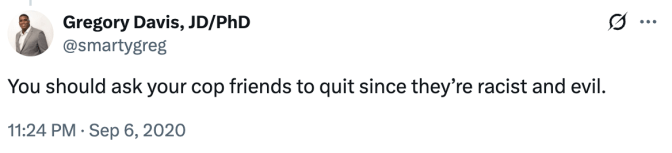
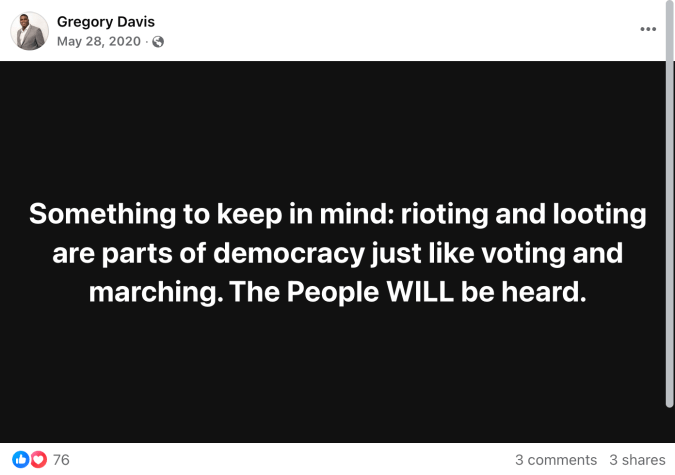 Nice values there, Greg! Later that year, he followed it up with…
 A few years earlier, he had wished death on Donald Trump, cheered the death of Rush Limbaugh, and posted,
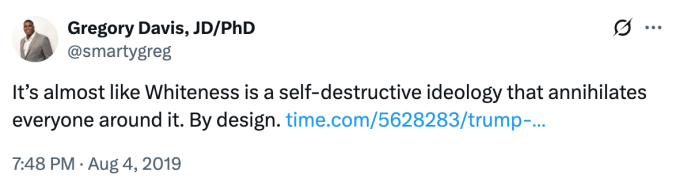 Then he moved into his current position at Dunster House, where he has bombarded the students living there, using his official email account, with advocacy for “Indigenous People’s Day” (because the U.S. “displaced, dispossessed and genocided them”), International Trans Day of Visibility, and DEI policies. In a more recreational vein, he promoted “International Condom Day,” writing,
“Come by the Dining Hall for free condoms (along with sushi and other sex supplies). Restock your reserves, and prepare for your best Valentine’s Day yet.”
Why was this guy hired by any responsible institution of higher learning? Well, because, as seems to be dawning ever-so-slowly on the populace, colleges are woke indoctrination factories, and actual education is an afterthought.
 Ethics Alarms
In defense of (some members of) this younger generation, I’ll share my first-hand experience. As an old electrical engineer/computer scientist, I have the opportunity to host 10-week (paid) internships for undergrads (in math, computer science, and engineering, of course), and I’ve been pleased with the 9 students that I’ve mentored over the last few years. This includes two three males, five females, and one self-identifying as non-binary. (I don’t care what their genders are, since breeding them isn’t part of the program.) They all brought abilities to the problems at hand. I’m sure that THEIR education was worth the time, effort, and expense that they put into it.
This tale is not to dispute the statistics in your essay, but to emphasize what isn’t advertised enough by journalists: SOME DEGREES ARE WORTH MORE THAN OTHERS! (“Journalism” is not one of the good ones, which may have something to do with the previous sentence.) “Just go to college”, they’re told, “and figure out the details later”. Hope is not a strategy, and change is not a plan.
“Hope is not a strategy, and change is not a plan.”
Words to live by!
Genocide…..verbified?
FF‘sS; the world is being shaven by a drunken barber!
PWS
I understand the argument about education for education’s sake, but education covers a great deal more than formal studies at a university for degree credit. $100,000 plus four years or more of potential earnings are quite a price to pay for “education for education’s sake”. For ordinary people, such an investment of time and money must be justified by pecuniary returns, and there’s just no way around that.
Saying one needs a college education to become educated in the classical arts is like saying grade school kids need tablet computers to learn to read and write. It is a false argument. The benefit of true classical education comes from being given a structure from which to learn and few colleges provide that now. Hillsdale is one that does and offers a great deal for free.
College degrees are primarily screening tools for employers. Today, in a general sense, the employer uses it to identify applicants who are functionally literate. In the case of hard sciences, the employer uses the degree to segregate those who have proven themselves to be capable of understanding the advanced mathematics or language skills to be trained further by the employer. No employer gives a recent graduate a high level position. For that they have to earn it through experience which is the most effect method to learn something.
For employers who accept any degree, the diploma serves only to say that this person stuck it out for four years and was able to get through some form of rigor. The entire rationale for wanting an Ivy league grad is that the graduate was able to successfully navigate a highly rigorous academic environment. If that were not the case these schools would have lost their prestige years ago. Unfortunately, many are exposing themselves as diploma mills whose graduates are hardly great thinkers and doers.
Not so long ago, employers took young adults fresh out of high school and trained them in house to perform what we call skilled workers today. Hospitals trained young women to be RN’s but today they have outsourced that function to community colleges. The reason for this is that so many young people today graduate from high school without the most rudimentary skills in Language Arts, Math and Science so they need remedial training on the common body of knowledge needed to be successfully trained in a skilled craft. This is not to say that all potential skilled workers need remediation but because a sizable number do the employer outsources the entire initial training to colleges. In health care, nurses have taken on a much larger role which does require advanced coursework which is probably why the minimum requirement for advancement as an RN in many places is a BSN and not just an AA degree.
The problem with this system is that we associate degrees with knowledge and that is a mere assumption. I know many who are far more learned than I on many subjects relating to history and government who have no degrees whatsoever. Those individuals were vociferous readers of original texts and shun the propaganda espoused in text books. I can often learn more from those who have few if any degrees than I do from those with specialized degree who believe that because of that degree they have advanced knowledge on nay given subject.
Davis’s “apology:”
[Davis] wrote in the Wednesday email that the posts “do not reflect my current thinking or beliefs.”
“I deeply appreciate the responsibility inherent in the Resident Dean role and I value the trust that individuals have placed in me,” he wrote. “I regret if my statements have any negative impact on the Dunster community.”
In an apparent nod to his previous comments regarding police officers, Davis added that he has “enjoyed the opportunity to work collaboratively with members of HUPD and other colleagues across campus.”
“I respect the work they do to support our community,” he wrote.
Humina, humina, humina.
What a jerk. DEI had evidently bred an entire generation of entitled brats of color.
Our last semester at Hamilton College, Teddy Leinwand wrote a scathing piece in our college newspaper detailing his realization that after studying literature for four years, he was unemployable. English used to be the most popular major at the college (early ’70s). Economics has been the most popular major ever since. Of course, even in my time, there were hosts of guys who were smart enough to be economics majors and would go to Harvard to get an MBA or directly to Goldman Sachs upon graduating. (David Solomon, the current Goldman CEO is a Hamilton grad.) I, of course, had no idea what an MBA was or what an investment banker was or did. I worked odd jobs for a few years, then taught grade school and high school and worked odd jobs for another three years and then went to law school so I could support my family.
But the bottom line was while we were in college, we seemed to know if you wanted to get a high paying job after graduating, you either had to get a degree in economics or go on to a professional graduate school. Ironically, Teddy Leinwand went on to get a Ph.D. in English and worked as a professor all his working career. Others went on to law school or medical school or architecture school or graduate schools, but we all enjoyed the hell out of those four years fairly isolated on a leafy hill in upstate New York reading all sorts of books and talking about them with very smart professors and learning to write better than we could when we had graduated from high school. And our parents could afford to pay the tuition, room and board, which was probably around nine or ten thousand for the four years. And, as I recall, my brother paid $3200 for a brand-new Pontiac GTO in 1972. So, maybe the cost was comparable to current cost. I see you can spend upwards of $80,000 for a pickup truck these days.
And my English degree turned out to be pretty good preparation for law school. Reading cases is a lot like explicating poetry and I was able to write onto the law review and serve as articles editor. But I still treasure my four years as an undergrad, maybe foolishly. Of course, that was before the lefties took over the academy and ruined it.