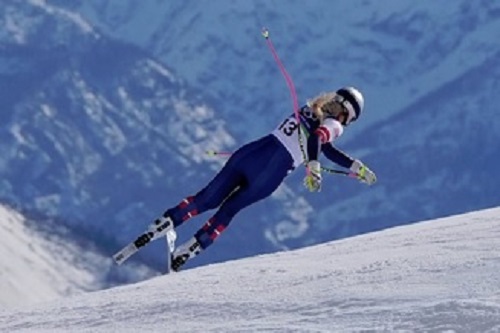
For a while it looked like star American downhill skier Lindsey Vonn would lose the leg she broke a week ago when she crashed 13 seconds into her run and was airlifted off the course by helicopter. Vonn suffered a complex tibia fracture that will require multiple surgeries to repair. Her third surgery was completed successfully.
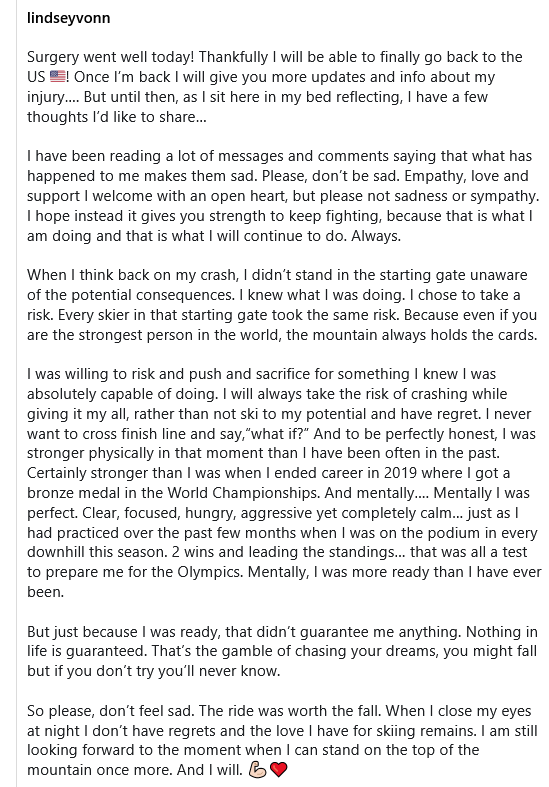
I came across Vonn’s post about her injury and the state of mind that led to it while I was completing the last post about inspiring poems. In the last Open Forum, there was some criticism of the athlete for subjecting herself to the risk of further injury by insisting on competing despite a recent and unhealed ACL tear. Her Instagram post below persuasively addressed such critiques. It also struck me as perfectly embodying the lessons and values contained in Kipling’s “If,” my father’s favorite poem and one of the inspiring works of poetry schools no longer teach.
Lindsey wrote,
Perfect.
 Ethics Alarms
Vonn has handled the entire thing beautifully.
I have spent most of my career involved, in one way or another, with the ski industry – the first 25 years or so working at ski resorts or resort operating companies. That work enabled me to interact with a lot of elite-level skiers – World Cup and Olympic – in both Alpine (Slalom, Giant Slalom, Super-G and Downhill) and Freestyle (moguls and aerials – slopestyle, big air and halfpipe disciplines came online after those days). The freestylers were a fun bunch – we had a lot of real talent at my home mountain – but the Alpine skiers were a different breed altogether. Perhaps that was because the freestyle events are judged, where having a big personality really helps, and the Alpine events have but one judge: a clock. The drive to shave hundredths of a second off your time is all-consuming.
Measured by wins, Vonn is the second-most successful woman skier the US has ever produced (the first-most successful woman skier is also the most successful skier PERIOD, having won more events than any other skier in history, regardless of gender – that, of course, is Mikeala Schiffrin, who is still active).
The ignorance and blatant rudeness of much of the initial commentary after Vonn’s fall was mind boggling. People instantly assumed it was due to her knee injury (and it wasn’t). Others critiqued her for racing in the Olympics at her age (41) and implying that her presence meant someone else couldn’t compete.
This reveals complete stupidity on the part of these commenters. Skiing in the Olympic Downhill isn’t the same thing as getting lucky in a ticket lottery to see Taylor Swift. You need to earn your way in, but success on the World Cup circuit, and Vonn, prior to her fall, was doing very well on the circuit this season. She was outskiing other competitors ten or fifteen years younger. She was absolutely qualified to ski in that race, and she chose to do so.
At this point, it’s hard to imagine that Vonn will make another run at things. The next Olympics will be held when she’s 45, and her injury appears severe enough that recovery could take well over a year before she’s really in a position to compete at even the World Cup level (frankly, Alpine skiers consider the World Cup a lot more important than the Olympics; Olympic races are one-off events that sometimes produce fluky results, while the World Cup is a season-long series that affords a much better measure of overall skill and endurance).
But there’s no doubt that Vonn has handled this entire thing with class, grace and no small amount of gratitude – both for those that helped her post-accident, and gratitude that she was in a position to compete in the first place. As may be – it’s the rare athlete that can perform at an elite level at the age of 41, particularly in a discipline that demands as much as Downhill. So it could be said she’s grateful for the good genes that put her in a position to do it. But there’s no question: it was her own drive, determination and commitment that took her the rest of the way.
Heal up fast, Ms. Vonn.
I’ve never skied more than once on a bunny hill, Arthur, but I’ve torn my ACL (back in the late ‘sixties when all they did was drain off the fluid). To have a torn ACL and do anything other than have it surgically repaired and then recuperate is nuts and, I’m pretty sure, impossible without all sorts of unhealthy medical interventions. If she were anything other than the indispensable head and income generator of a fairly good-sized business, she’d be walking around on crutches while her leg healed. Nor do I believe the injury had nothing to do with her crash. Pure PR damage control.
You’d be surprised. The average person would certainly not be able to do it, but elite athletes – including no small number of NFL and other players – have in fact been able to compete following an ACL rupture. The leg musculature in these individuals is so well developed through weight training so as to provide a remarkable amount of stability. External hardware in the form of braces under the speed suits do the rest. Do I think this wise? No, but I’m a more or less average person and, again, Alpine skiers are a different breed.
It’s not the money. Vonn is financially secure and has been for a long time; she did very well from endorsement deals prior to her retirement and has done well this year.
I’d like to see the release she signed for her attending physicians.
There are many athletes who put their well-being at risk by competing. The amount and type of risk varies from sport to sport, and the risks extend from toes to head. Athletes may feel compelled to compete despite their knowledge of the risks, as Vonn apparently did, but none are forced to do so. Yet, some would ban popular sports because of the risk of injury, and consider it unethical to even watch such sports.
The ethical question, then, is who gets to decide what is banned.
As I write this, Olympic hockey, a sport that seems to have some built-in violence, is on the telly.
As a lifelong non-athlete, I am in awe of men and women who excel at sports. The skill, strength, strategy, agility and grace of world-class stars is mind boggling. Whether or not there are controversial elements to Ms Vonn’s participation at the Olympics, her post was eloquent and inspirational. She is most definitely not a whiner …. Best of luck for her recovery.
Oh and I did bowl a 210 once …. but maybe bowling is not a sport?
If curling is a sport, bowling is a sport.
Hi Old Bill …. wondering about your moniker? Is it Old Bill vs New Bill, or are you just getting old?
I broached the ethics of this incident in one of my comments to the French judge scoring the French ice dancing team higher than the U.S. team. Scandal in ice skating scoring? I am shocked there is gambling in Casablanca, too.
There was a bit of discussion about Vonn on that comment thread, so I feel like I have to defend my position because I thought the IOC, the US team, and physicians breached their ethical obligations to safety of competitors by allowing a knowingly injured skier compete in what is an inherently dangerous event. If my comments left that impression, then it was poor writing on my part and I hang my keyboard in shame.
I get that Vonn is an elite athlete and possibly one of the greatest women’s skiers of all time. I also get that competition is part of an elite athlete’s DNA, so I am not surprised that she wanted and intended to compete. I also understand that athletes at that level of physica fitness heal faster and better than others – we saw that with our son*. I don’t fault Vonn – she is a mutant in the best sense of the word and has high aspirations and paid a terrible price. Elite athletes are simply not your average skier or runner or cannonballer.
Case in point: Federica Brignone from Italy competed twice, both times winning gold after a terrible accident last April requiring surgery and extensive physical therapy. She, though, was physically healed. The question was whether Brignone could still compete at that level where Vonn was still suffering from the injury she sustaine two weeks ago and the question should have been, “should she compete given her health?”
I don’t question Vonn’s drive, ambition, determination, or dedication to the sport. She is talented and a fierce competitor. She is guided by another muse than we mere mortals. Also, I do not question that she knew and assumed the risks. I also know that her arrival in Milan was part of the Olympic drama. If she competed and won, then we would be bowing in awe that she did what she did. Hell, I am both pleased for and admire Brignone for what she accomplished. That, though, is moral luck.
I do question the “powers that be” allowing her to compete. Her doctor or the team doctor needed to advise her differently. At a certain point, someone – possibly her family or doctors or the team or the IOC needed to step in and say, “Hold on. You are still hurt. You are not physically ready to push your body beyond o its limits. You could get hurt or even worse. Our commitment to sport must give way to reason and safety.”**
As an aside, AIM wrote, “People instantly assumed it was due to her knee injury (and it wasn’t).” That is hard to know. Was her crash due to weather and snow conditions? Was it due to her knee? Did her ski catch ice or a rut causing her to crash? There will be discussions from experts with all sorts of conclusions. I cannot and do not know but I would have to think that a damaged knee was a contributing factor in the crash. Also, I did not criticize Vonn for wanting to compete (see above). I get that drive: When our son left swimming behind, we were worried he would have that “what if . . .?” question in his mind but he made his decision and left when he realized that he could not compete at the levels of a Michael Phleps or Katie Ledecke and would have no real future in pro-am swimming, so he concentrated on school and his career goals.
jvb
*Ed. Note: I have mentioned before that our son, who competed at pre-Olympic levels in swimming (he stopped swimming about 4 years ago but has maintained a dedicated physical fitness regime along the same lines since that time), was seriously injured in a car/motorscooter accident in August 2024, resulting in breaking his left wrist and breaking his left knee in 5 parts. His doctors told him he was have to be in a cast then a full leg brace and wrist tension brace for four to six months after knee and wrist reconstruction surgery and would require 6 to 12 months of physical therapy after that. His knee and wrist healed in 8 weeks and his physical therapist was mad after losing a year of income when our son was effectively recovererd 8 weeks after the brace removals, Aside from occasional pain and some rather gruesome scars, he is fully recovered. His physical fitness prior to the accident accelerated his healing process tremendously.
**Ed. Note: For all I know, they had that conversation and she simply said, “Cool. Got it. Where are my skis and goggles? I gotta hit the slope.”