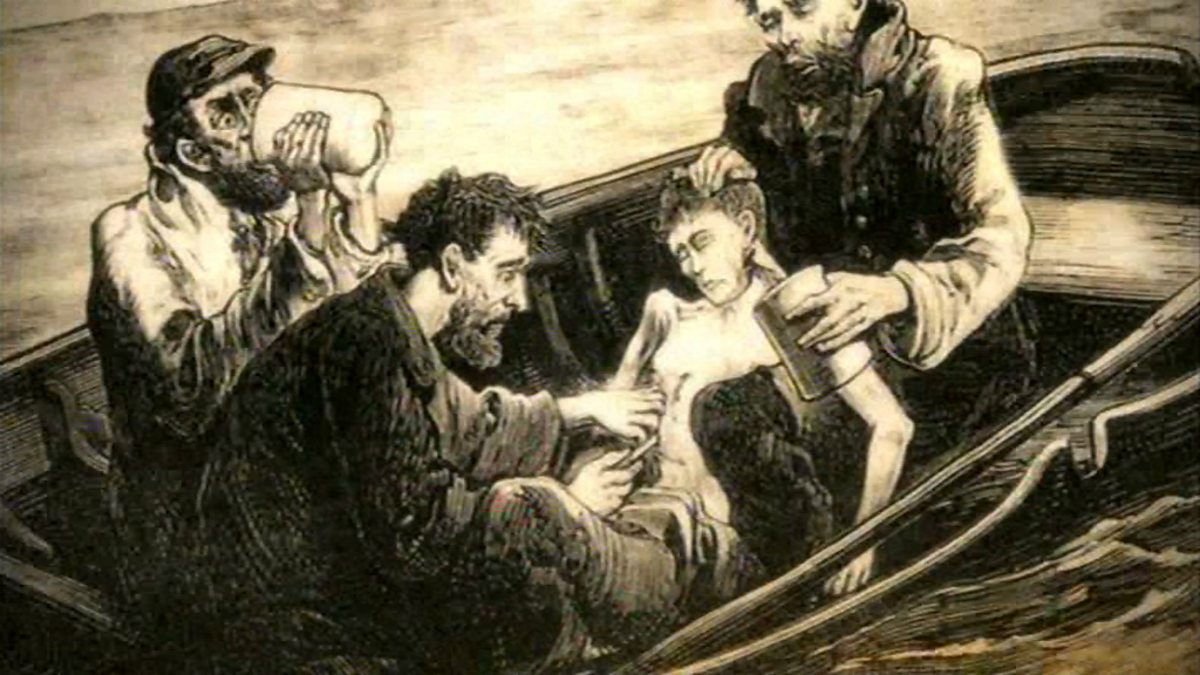
I’ve been hearing and reading debates about the old (1884) criminal case The Queen v. Dudley and Stephens since law school, and I must say, I’m a bit sick of it.
A wealthy lawyer from Australia purchased bought a yacht named the Mignonette and hired a Captain Dudley to sail it to him it from England. Dudley and his three crew members encountered a violent a storm off the coast of Africa, and the Mignonette was swamped. Its captain and crew escaped in a lifeboat with minimal provisions. After more than three weeks adrift, the captain decided that all of them would die of hunger and thirst unless extreme measures were taken, so he took them. He decided that cabin boy Richard Parker, a 17-year-old orphan, should be slaughtered and eaten. The captain’s reasoning: Parker was already delirious from drinking seawater, so he was deemed the weakest and least likely to survive anyway. The three men killed to boy, collected his blood in a bailer and drank it, then removed his heart and liver and ate them.
It worked! They were rescued in time, just a few days later in fact. Dudley and the First Mate Edwin Stephens were also prosecuted and found guilty of murder, a result that was considered revolutionary, since resorting to cannibalism in such dire circumstances was considered a normal course of action, “the custom of the sea.” In the U.S. at the time, the courts widely accepted the “necessity doctrine,” which excuses some illegal acts if they are performed in good faith to prevent a greater harm.
 Ethics Alarms
Even more dire, they could see just on the beach within swimming distance was an Arby’s.
I would still choose the sick cabin boy….
Arby’s in 1884 in South Africa? I didn’t know the international food chain was that old.
jvb
would it be unethical for the cabin boy to oppose your Option 3?
can he oppose it by force?
Deadly force?
I don’t think 3 gets you out of the problem.
-Jut
Sorry, cannibalism is one of my bright lines. The survival of anyone in the lifeboat is already moral luck. Mere survival is not enough. Seeing England again is not enough. How are the survivors going to return to a society that doesn’t allow cannibalism? Society could turn a blind eye to what happened, but how would anyone individually interact with someone who at seventh and last killed and ate another?
In short, the murder is not the issue, the cannibalism is. There are some things a civilized man should NOT do…
I don’t know. I think the murder is the issue. You are right they are surviving on pure luck at this point. But murder to increase your luck? Nope.
Once one dies? Maybe you’re all too far gone to take advantage but maybe you aren’t. And then cannibalism is a horrible but tolerable thing at that point.
Agreed, the murder is the bigger issue over the cannibalism. See also Uruguayan Air Force Flight 571.
Not directly related, but in the Soviet Union, cannibalism of the naturally dead was life in prison; murder and catabolism was death.
I don’t think they valued life, per se, but were more embarrassed by the famine caused by the failure of communism….
Is it murder? Murder it typcially defined as the illegal or unlawful, premeditated taking of a human life without justification. In this situation, killing the cabin boy might not be unjustifiable because of the needs of those on the lifeboat. Self defense or defense of those on the lifeboar may militate against a murder charge.
jvb
I feel like I am in Jonathan Haidt’s classroom, where he is presenting a series of trolley problems, and other ethics challenges (e.g. dealing with taboos), where the students tend to arrive at a choice, but are often dumbfounded when asked to defend their moral choice. In “The Righteous Mind” chapter 2 “The Intuitive Dog and Its Rational Tail” Haidt argues that people arrive at ethical judgements rapidly and intuitively, followed by slow and sometimes tortuous process of justification. The conclusion is that judgment and justification are two different processes. Judgment uses older parts of the brain and has a stronger involvement of emotions, while the process of justification is rational and uses the slower prefrontal cortex.
The point of all the trolley problems in Haidt’s ethics class is not to actually solved the particular ethics problem once and for all, but to highlight that ethics is an imperfect process that is not purely rational although we prefer to think it is. Instead all ethics is based on rationalizations. There is no objective ethical truth. The capacity for ethical thinking is evolved in the Darwinian meaning of the term. Our ethical intuitions are shaped by various influences such as our personality structure, but also our personal relations, our interests and preferences.
So now here at Ethics Alarm we have some sort of trolley problem based on a real event. And just like in Haidt’s classroom I am afraid that there is not right solution. In the post the philosophy of Kant (deontology) is mentioned and the philosophy of Bentham and Mill (utilitarianism). Neither system is perfect. Both system may lead to different answers, in which case the ethics problem cannot be solved rationally due to a lack of an objective standard of ethics.
Then there is the ethical zugzwang in which all solutions are unethical. In that case it does not really matter which choice you make from an ethical point of view. Any ranking of unethical options tend to subjective, based on preferences.
Option 1 will most likely not result in a volunteer. Option 2 (the captain) will most likely result in everyone’s death. Option 3 (the cabin boy) raises the possibility that the cabin boy disagrees and musters his little power to fight back or beg for his life. Do I want to live with myself after killing and eating him? Did we perhaps cross a bright red moral line nobody should cross, namely the killing of an innocent human being? Is the cabin’s boy life less valuable than my life even if he is already ill? How do we explain our actions to his mother and sisters? How to explain it to God? Option 4 is to sort it by a poker game, while drinking the remaining rum. Have some grim fun while dealing with matters of finality or death. Real sailors option.
Maybe there is an option 5. We would rather die than kill a mate or leave him behind. Survival does not always trump ethics, and mere survival is not the highest good.
Did we perhaps cross a bright red moral line nobody should cross, namely the killing of an innocent human being?
Cees: No because it’s not a bright moral line, but a fuzzy, rare ethical one. The Ethics Incompleteness Principle covers this: even with “absolutes,” there are always anomalies that just don’t fit, and you have to solve them without using the usual rules and principles. The life boat, spelunkian explorers, Donner Pass and Andes airplane crash all fall into the anomaly category: the description “murder” doesn’t fit. It’s something else, just like the absolute ethical ban on torture doesn’t work with the lone bomber who knows where the hidden nuclear device is going to go off in a major city.These are exceptions. The exceptions don’t invalidate the rule, but you can’t pretend the rule applies.
“the description ‘murder’ doesn’t fit.”
How does it not? Legitimate question.
Their survival was never guaranteed. If they had the strength to murder and dismember him, they had the strength to live another day. Or two, or three.
They could no more predict they wouldn’t be rescued in a few hours than a few days, or never be rescued.
They could’ve all died 3 days prior. A storm kicks the boat over, etc.
Since when does luck, moral or otherwise, absolve murdering another to benefit oneself?
They should’ve hanged for it.
I think Jack was referring to Donner Pass and the Andes plane crash. The need to kill someone was not present because members of the group had already died. The decision, then, was to resort to cannibalism.
jvb
Indeed. Just stunned that our proprietor calls murder in a completely unpredictable situation ethical.
Love Jack dearly, not taking a cruise with him.
Now now…I specifically said that the lifeboat situation was ethics zugzwang, meaning that any solution is unethical. Then we are thrown into the “which is less unethical than the rest.”
That said, the following: “Show courage, try to eliminate bias, and do the best you can under terrible circumstances without counting on moral luck to bail you out.”
How this is not exactly the case here?
Good Lord, with powered boats, helicopters and long range airplanes it’s incredibly difficult to find a small boat, let alone 1884.
“There are only unethical solutions, and the only completely indefensible decision is not to choose one.”
Some things are indefensible.
I agree with that. But making a hard choice to deal with this ethics conflict is not one of them. Except maybe letting everyone die to avoid accountability for a societally taboo solution.
It would help immensely if you could describe the ethics of it if they all died anyway.
If ethics can be reduced to the most expedient solution for oneself in a dire circumstance, does it really serve a purpose other than selfish ambition, ultimately?
If it’s a tool to make a “right judgement” then right must be an absolute, no matter how hard it is to find it – which seems to me to be the purpose of the exercise (of ethics).
We have the word of the three survivors as to the condition of the 17 year old – whatever testimony they gave will be tilted to saving their own skin, which was the point of the exercise they engaged in to begin with.
The reality is the 17 year old would be the most resilient to any ailment and most likely to recover of any of them.
They did the least ethical thing possible, and if they didn’t outright lie, they certainly shaded things in their favor.
I’m going to call it immoral luck in this instance.
The torture for the nuclear bomb is covered well in the movie “Unthinkable” with Samuel jackson and Carrie-Ann Moss.
The case for “mere” surviving another day versus the death of a City is not exactly a fair comparison.
“The Mist” has some good gray situations and an ending that the author found a better one than as written.
individual survival versus thousands gets into the Tale of Two Cities and that conundrum is still argued over today.
Is an individual’s survival worth violating another’s, if they are the one’s starting the violence? As a veteran I can answer this. It depends on the circumstance and starving in a being in a lifeboat is NOT one of them.
Jack I think the approach to ethics in this post illustrates that rationality may fall short in some cases, and that morals sometimes gives a better result. The bright line is given by the sixth commandment “Thou Shalt Not Kill”; this commandment has enumerated exceptions but killing an innocent person and cannibalizing him is not one of them.
Lean Kass, , former chair of the President’s Council on Bioethics, refers to the “wisdom of repugnance” as a guide to ethics, as there are immoral actions so horrific that they defy, or are beyond, the capacity of rational argument to fully explain why they are wrong. Cannibalism is one of them. Butchering a human being like an animal for consumption is one of them. It is something that makes us instantly recoil. We should trust our instincts or our gut as well when making ethical decisions. But I am willing to admit that a gut growling with hunger may be a mitigating circumstance.
“wisdom of repugnance”
Even Africa with all of its problems, as far as I know, does not resort to cannibalism to supply supplemental fat and protein during its periodic famines.
Ick isn’t ethics.
Soldiers is war have been required o perform acts that under strict moral codes are far worse than cannibalism Feelings like “repugnance” are there to ping ethics alarms, but they can also be false alarms. In the sick ethics movie “Would You Rather?” captive desperate people are given choices between immoral, unethical or repugnant acts with the alternative to doing neither is dying. Would I rather eat a dying cabin boy than drop an A-Bomb on Nagasaki? Easy choice.
good job, now you are guilty and the villain still drops the bomb. You have no real choice here. The only way through is not to play. This is just a magicians force. The illusion of free will.
Dropping the bomb on Nagasaki ended World War II.
There enumerated exceptions to the command “Thou Shalt Not Kill”; these are a) legal execution b) acts of war c) self defense. The bombing of cities in World War II falls under exception b. Killing in war is considered honorable, despite the fact that war is hell.
Moral codes do not admit any exceptions, however. I also argue that the first A bomb would have ended WWII, and the bombing of Nagasaki was excessive and unnecessary, and thus both immoral and unethical.
Jack, did you just judge the event from 70 years after the event? The decision was made based on their “lived experience”. A 2nd bomb versus the estimated casualties from an invasion. 10000s versus a million casualties, as you say easy choice.
From my reading, even at the time there was good reason to believe the Japanese would have surrendered after Hiroshima.
Is the commandment “Thou Shalt Not Kill” or “Thou Shalt Not Murder”? In Hebrew, it is written as “The 6th commandment is “לא תרצח” (Lo Tirtzach), meaning “You shall not murder.”
There is a difference. While the Commandment embraces the sanctity of human life, it also recognizes self preservation and self defense. The language also refers to the unjustifiable and unlawful killing. Jesus seems to follow that tradition. For example, in Matthew 5:21-22, He says, “”You’re familiar with the command to the ancients, ‘Do not murder.’ I’m telling you that anyone who is so much as angry with a brother or sister is guilty of murder.”
jvb
I feel like I am in Jonathan Haidt’s classroom, where he is presenting a series of trolley problems, and other ethics challenges (e.g. dealing with taboos), where the students tend to arrive at a choice, but are often dumbfounded when asked to defend their moral choice.
My view is that the situation that developed in real life was so unlike any situation that any actual person, dealing with typical issues would ever have to deal with, that their and our ‘solution’ to the ethical issues is unreal.
We can all project ourself into the situation, but we cannot really ever be there in it. One can only superficially imagine oneself in that situation, and so one superimposes onto oneself what one *imagines* what one would do. If someone said: “I would allow myself to die rather than to kill or to become a cannibal”, might well be lying, or ignorant of what one really is capable of if forced by ‘cruel circumstances’.
In the most extreme situations people do horrible things. In my larger way of viewing *reality* (the world of Nature we are involuntarily incarnated into) it is Nature that is in the most essential senses unethical. Hardly anything that we would consider ethics exists in the natural world. In Nature creatures have no choice but to hunt and consume other creatures. Life feeds on life. To be alive means that someone or something is hunting you. And it is a giant ecological system from which there is no escape.
At the very base of the issue is the most basic and physical survival issue: that of involuntarily starving to death because life (the elements in the natural material world and their unfavorable actions against the ship) put them into a situation where the most basic rule of civilized life had to be broken. In this sense the choice to make, and the one they did make, superseded the possibility of considering things as one might consider them in daily life, and certainly in a classroom. They had to had arrived at a point where the *decision* was not really made by ‘thinking man’ but by an ultimately tyrannical hunger and thirst.
There is an odd ‘solution’ that those men might have taken but it would have depend on perhaps how they view life in some *ultimate* sense. They could have optioned to have killed themselves rather than have to resort to such action that might impact their *immoral souls*. That is, if they did believe that their soul is immoral and that life does not end when the body ends.
People do make this sort of *ultimate sacrifice* choice and it come up in literature and in theatre and film where the hero see that to achieve some *good* that he (sometimes she but mostly it is a masculine ethic unless it is a mother considering for her child) must take an action that will result in his own death.
AT wrote: In the most extreme situations people do horrible things. In my larger way of viewing *reality* (the world of Nature we are involuntarily incarnated into) it is Nature that is in the most essential senses unethical. Hardly anything that we would consider ethics exists in the natural world. In Nature creatures have no choice but to hunt and consume other creatures. Life feeds on life. To be alive means that someone or something is hunting you. And it is a giant ecological system from which there is no escape.
I have been thinking of the book Pagan America: The Decline of America and the Dark Age to Come.
“We live in an anxious age. Long-held certainties, cherished beliefs, and social trust are crumbling. Don’t expect things to get better. For too long we have taken our Christian heritage—the heritage upon which America was built—for granted. But we’re rapidly, and now inevitably, losing the Christian culture that shaped the American republic. What will take its place is a despotism—and a new paganism, worse than the old, because it will be based on a hatred of Christianity.“
Since I cannot very much think about men on a boat having to decide to eat or not eat a weak companion, I will likely keep my focus on the larger issue (that some, mostly more on the Dissident Right side) think about: The destruction of Occidental civilization.
Presently, the decisions being made are less those arrived at by men thinking in high ethical and philosophical terms, and certainly not in any ‘Christian’ terms, but rather in extremely raw and very basic physicalist terms. Power does what power decides it must. And then it rationalize the choices. And this, today, is done through all sort of tricky rhetorical mind-games and self-lying.
To the degree that we become physicalist and materialist, or that we revert to those basic motives, is the degree that we sacrifice higher principles and certainly metaphysical principles. What will become really interesting is when the Machines (AI systems) are brought in to help make, or to finally determine, physicalist choices. What ultimate decisions will the Machine make when it comes to securing resources, destroying (annihilating) the enemy, and ridding society of these peoples who think thoughts contrary to what Machine believes is right and good (necessary)?
That is why, of course, the issue of what is actually going on TODAY and right now in our present must both 1) be thought about deeply and 2) not thought about at all!
The despotism that is being constructed today can, certainly, be projected outward onto *them*, which is certainly the all-too-human choice; or it can be seen as what we ourselves are developing or will allow to develop.
It should be noted that in a heavy nod to the old customs, the two death sentences in the case were commuted to six months in prison.
And then, of course, there’s THIS CASE
This is one of those times where you are looking for the least unethical solution. I think they made the right choice. If the cabin boy was already delirious, he would not have survived even if they had been rescued earlier (at the time they decided to kill him). Researching it, at this stage, intensive modern medical intervention is needed for even a chance of survival and even then, the chance of survival is described as extremely low. The rest of the crew did actually survive, so the solution did achieve the goal of keeping everyone else alive until rescue. If the 17-year old was in such bad shape, the rest of them were probably not far behind. Even though they were rescued just a few days later, there is no guarantee they would have survived several more days without food and water. Remember, this wasn’t several hours, this was several days. You go a few more days without water in tropical heat and no shade and see how easy that is.
The choice was to kill him immediately and save the rest of the crew, or wait a day or 2 until he inevitably died and risk more of the crew reaching the terminal stage. The captain decided to save those of his crew that could be saved and sacrifice the one who couldn’t. I think this was the least unethical choice.
Any arguments “for” are predicated on the fact that they lived.
If they were all going to die anyway, does the calculus change?
The “ethical” excuse that they survived is the same mentality that allowed the Germans to turn a blind eye to the Nazis.
This is not a hard one, imo.
I guess the rest of you think the golden rule has two options:
A. Do unto others as you would have them do unto you.
B. Do unto others before they do unto you.
And God help ya if you have the flu that day and your name isn’t Walter Payton.
The Captain volunteers himself. If his skills in navigation and leadership are critical to getting the boat rescued, then this choice has to be off the table. As the leader, however, he has the greater ethical obligation to do what is in everyone’s best interest.
Funny enough, I’ve been rewatching The Good Place, where they cover the trolley problem. This was the solution I came up with and the one the show uses in a later episode.
If you believe in a soul and eternal damnation, then you only have one objective: save yourself from an eternity in hell.
Now, all religious folk are some amount of “take it” or “leave it” with the lines they’re willing to cross and what they think will actually qualify them for eternal damnation. That said, the test for a person’s soul is rarely in comfortable environments and often when pressed to the extreme condition.
Morally, defending the helpless and refusing to participate in taking human life fits many of the popular moral codes and religious doctrines. To me, sticking to your morality is always ethical so long as the “moral obligation” isn’t something harmful like a lashing or an honor killing. Turning a living human into meat for sustenance may be helpful to some, but harmful to at least one person.
So we aren’t talking about morality with this situation, we’re talking ethics.
1) Is it ethical to take an known unethical action that one fully believes is necessary to survive? Yes.
2) Did one show good ethics by rationalizing a way to do the most good with the least amount of harm? Yes.
Ethically, I think they’re good, but we all know ethics and legality are different beasts. Some ethical actions are illegal and some legal actions are unethical.
Thus, we get to the point why this continues to live in the annals of law school. What does the law say, regardless of the morality or the ethics? Was it murder? Is there an exception to murder? Should mitigating circumstances influence sentencing?
I honestly can’t answer your original question of “what would I choose?”
I would hope I would have the capacity to do what I need to in order to survive. I would also hope I would have the strength to save my soul and protect others. In these extreme circumstances, I have absolutely no idea how I would act in response.
If I had to venture a guess, I would expect that my answer would actually be quite simple: I’m the cabin boy and I need to decide if I’m going to put up a fight against three ravenous cannibals.
I’ve seen this ethical dilemma before in several varieties. Something that sticks in my mind from many years ago and is sort of related was in a test related to the military. We were instructed firmly that, without exception, it was mandatory to answer every question, and one of the questions was, “Who would you rather kill? Your mother or your father.” I declined to answer that one, and, so far as I know, suffered no punishment for failing to answer every question.
Much more recently, I was muddling over a newly announced ethics rationalization (newly announced, because surely the ethical concept at issue was not really new). The rationalization, announced as 31A, was “The Hypocrite’s Balm, or Any Port in a Storm”. As of today, I have not found a full definition of 31A, so I’m kind of shooting in the dark here.
My initial thought on 31A was that it cannot stand as an ethics rationalization, because sometimes taking an unethical course of action produces a greater good. Consider: How bad is the storm (contemplated action)? Are we all going to die if nothing is done? Is there an ethical solution? May we choose an unethical solution for the greater good? If one may be killed to save several, is that the ethical choice?
Or, are these just ethical rationalizations, as in, ‘any port in a storm’?
Maybe they are not. Maybe they are taking action, showing courage, fixing a severe problem in the best way that we can?
My thought on 31A now? It’s great for an academic analysis of what someone else has done when drastic action was needed and there wasn’t a whole lot of time for reflection. And, it might be useful in giving a leader pause before a selection of one of several seemingly unethical actions. But, still, a more specific explication of just what it is would be helpful, along with a debate of other potential applications more in the world that most of us live in, as opposed to a small boat with a few people foundering at sea.
Zugzwangs? Ah, gotta love ‘em for the thoughts they provoke.
To #1, Survive for how long? I think it’s fair to speculate they were pretty certain they were going to die. They just figured the sick guy was going to die first, so why not live a little longer, then die.
Is hope a guarantee? Does hope come with a 51/49 calculation?
History, modern and ancient, is filled with people who survived when they shouldn’t have.
Is it ethical to murder someone just because YOU think they’re going to die? What if they wouldn’t have died?
Is it ethical to murder someone so you can live a little longer, then die anyway?
Again, the premise seems to be based on the fact they lived. Does it change if they all died?
Would it be ethical for the biggest guy to throw the smaller ones out in the middle of the storm because it made the boat more stable?
#2 Least amount of harm for who?
And unless you are a cabin boy of exceptional strength and ability, your decision to fight won’t matter compared to three stronger, healthier opponents. You’re going to lose and die.
It’s ok, though, they’re doing you a favor in a very ethical manner.
For the people who are still insisting this is murder, don’t look too closely at the organ transplant industry. Most organ donors are much healthier than this kid. They don’t take most organs after you die, your heart must still be beating, your lungs breathing. This kid was delirious because his brain was gone and it wasn’t coming back. If he had been transported to a modern trauma center, they likely would have put him on a respirator, given him IV fluids, then opened him up to see what they could use. Is it murder only because they didn’t pay an M.D. to harvest the organs and blood for them?