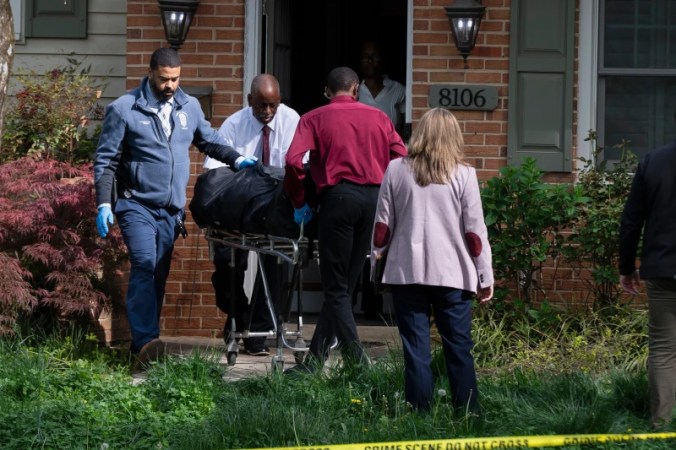
Yesterday, the horrifying news was that former Virginia Lt. Gov. Justin Fairfax, once considered a rising star in the Democratic Party (you know, like Jasmine Crockett and Eric Swalwell) whose career was derailed by sexual assault allegations, murdered his estranged wife and killed himself.
The knee-jerk defenders of Fairfax among Virginia Democrats were head-exploding in 2019, as this EA post from February of that year reminds us. I held at the time that two rape allegation from two different women was sufficient to mark Fairfax as untrustworthy and unfit for office considering the factors surrounding them. I would not have guessed that they portended a murder-suicide, but I must admit that Fairfax’s violent and tragic last act didn’t shock me either.
***
From the Washington Post today:
“A Maryland woman said Friday she was raped by Virginia Lt. Gov. Justin Fairfax (D) in a “premeditated and aggressive” assault in 2000, while they both were undergraduate students at Duke University. She is the second woman this week to make an accusation of sexual assault.
The woman, Meredith Watson, said Friday in a written statement through her attorney that she shared her account immediately after it happened with several classmates and friends. Watson did not speak publicly Friday and her lawyer did not make her available for an interview.
Watson was friends with Fairfax at Duke but they never dated or had any romantic relationship, the lawyer, Nancy Erika Smith, said.
“At this time, Ms. Watson is reluctantly coming forward out of a strong sense of civic duty and her belief that those seeking or serving in public office should be of the highest character,” Smith said in the statement . “She has no interest in becoming a media personality or reliving the trauma that has greatly affected her life. Similarly, she is not seeking any financial damages.”
Now what?
An unrelated accusation of conduct X does not mean that a previous unsubstantiated accusation of the same conduct is true. However…
- In the case of habitual or characteristic misconduct—like being a sexual predator or a sexual harasser—the likelihood that there have been more, undisclosed episodes involving the individual accused is high.
- Thus the absence of a credible second (or third, fourth, and onward) accuser in a matter like this is legitimate evidence arguing for the innocence of the accused. An example would be Clarence Thomas.
- When subsequent allegations are substantially similar to the original accusation, they are especially damning. Bill Cosby is the poster case for this variation. Another exampole: Kevin Spacey.
- When the second and additional allegations are suspiciously timed, as during an election or a political controversy, when they involve general misconduct only, lack named accusers or when they are sketchy in their facts and proof, they should be regarded with extreme skepticism. The add-on Kavanaugh accusations fit this description.
- The fact that a court decision or an official investigation has not definitively determined that misconduct has taken place does not require individuals, groups and the public to discard commons sense, if they can eliminate bias from their decision-making. O.J. Simpson, it is fair to say, is guilty of murder, and it is completely fair to regard him in that light. Barry Bonds used banned and illegal drugs to enhance his major league baseball career. Harvey Weinstein is a sexual predator who traded professional advancement for sex. We don’t need admissions here to come to informed decisions.
Now what does all of this mean for Justin Fairfax, next in line to be Governor of Virginia if Governor Northam decides, as an honorable public servant should, that he has made such an irredeemable ass of himself by his obfuscations, double-back flips, and tap-dancing around the question of whether he had a photo of himself in blackface in his yearbook that no Virginian in his or her right mind could possibly feel secure trusting such a boob to handle the affairs of the Commonwealth? What is fair?
If Fairfax indeed raped or sexually assaulted one or both of these women, and only he knows, then he should resign. No state should have a felon, charged or not, convicted or not as governor. If he did not rape either woman, then his decision is political as well as ethical. Can he do a good job as governor of Virginia if he cannot clear his name and convince objective observers that the accusation is false? Will sufficient numbers of Virginians trust him? Will substantial numbers of Virginians want to be governed by a plausibly accused rapist? The fact that he may want to be Governor, feel he deserves to be Governor, and that his career is being derailed unfairly are irrelevant to the decision. If he cannot do the job, if he will not be trusted, if his continued tenure in defiance of the accusations harms the state, the public, and the party, then he is ethically obligated to step down. innocent or not.
The second accusation does not render him guilty.
I think it does render him unable to serve.
Addendum: to my Democratic Facebook friends, some of them lawyers, who opined today that Fairfax should remain because they would rather have someone who is a double-rapist by Governor than allow Republicans to run the state, you are seriously and sadly corrupted, and I’m ashamed of you.


I think too much ink is being spilled over this guy. If there has never been a conviction after accusations then he is innocent irrespective of the number of timely accusations.
The constant barrage of news yesterday of the double homicide/suicide was unnecessary and offered just to titillate the public. Fairfax is no more important than any other whose lives were not public ones. All this coverage, while initially newsworthy, fails to consider the two teenage children who are now orphaned because the adults in their lives exercised very bad judgement.
Chris,
Maybe you should have written “…he is considered innocent until proven guilty…” not just “…he is innocent…”.
Fair point. I left the operative word “considered” off by mistake. However, there should be little difference in how we treat an accused. Unfounded or unproven allegations to smear someone are in my mind unethical. If you are going to level a rape allegation or other sexual abuse crime then you better be prepared to demand a prosecution when it occurs. For example I absolutely detest Eric Swallwell but I find the accusations suspicious given the Democrats needed to trim the field to help preferred candidates such as for Harris and Porter.
Oh, I think it adds to a legitimate ethics issue we are seeing catching ablaze with the Kristi Noem-Eric Swalwell-Tony Gonzales stories: the American public is being given bad people to vote for as their leaders, the parties are irresponsible, the partisan defend the bad people when they are exposed, and there are no consequences or accountability. NBC reminded us yesterday that when Fairfax ran in the Democratic primary for governor in 2021, he said during gubernatorial debate he was being treated like George Floyd and Emmett Till. This was a despicable, Machiavellian creep, and committing murder and then being too cowardly to face the consequences, hence the suicide, is consistent with that assessment. Besides, what other example can you give of a high state or federal elected official who was part of a murder suicide? It’s kind of a juicy story, isn’t it?
Follow-up: I did some searching. Apparently no other high elected official in US history has killed himself or herself after murdering someone.
I don’t like “juicy” stories because they are designed to appeal to our most base instincts. No doubt it is unusual but no more unusual as the death of Mary Jo Kopeckney at the hands of Edward Kennedy.
Why do we revel in the tragedy of others when they are powerful, rich or famous? To me, it seems disingenuous to want to say this is important and thus the need to find out more information to get all the juicy details when 2 kids of 12 and 14 get gunned down on a DC street and all we want for news is for it to go away.
Because elected officials and leaders are supposed to be the best of us, Chris. If an elected official gunned down two kids in the street, that would also be newsworthy….and an alarming development.
I wonder if that is true. Think about it. Everyone of has some sort of skeleton in our closets. I wouldn’t run for public office because I wouldn’t want to expose my family to the kind of scrutiny the press is absolutely supposed to employ. So, that leaves us with lots of nasty individuals who are, at best, ethically inert, or at worst, simply despicable people, running for office. We end up with the Swalwells and Gonzalezes and Crocketts and Newsomes as a result, not to mention the other creeps that run the shows from behind the scenes or as heads of important agencies (yes, Dr. Fauci, I am looking at you!). Rarely do we find someone like Fetterman (who seems to be a decent person) in office.
jvb
There is a book entitled “Everythig I Needed to Know I learned in Kindergarten”. Among the things I learned in Kindergarten was to keep check on your zipper, and do not touch anyone. Members of Congress should be given a copy of the book along with Robert’s Rules of order. Perhaps, then we would not have so many issues with open flies and illicit touching of others.
NOTE FROM JACK: I’m in a mass tech breakdown and without access to a computer. Please post a comment or two noting that I’m not dead and will be back posting ASAP?