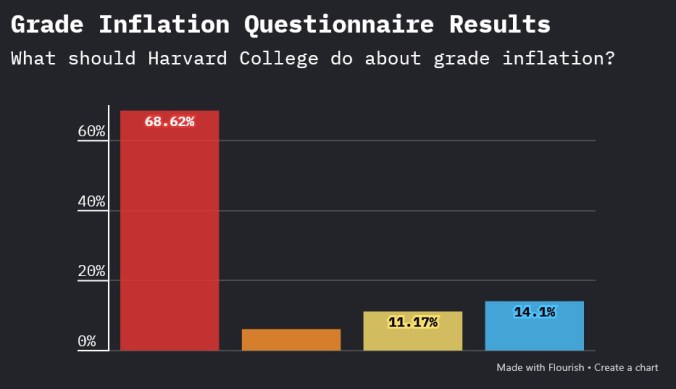
The chart above reflects the results Harvard got from its alums when it asked last month in its alumni magazine what the school should do about its absurd grade inflation, which Ethics Alarms examined here , here, and here.
The red bar shows the percentage of readers who felt that Harvard should “Implement recommendations from a Faculty of Arts and Sciences subcommittee, such as imposing a 20-percent cap on A’s in every class and awarding internal honors based on “average percentile rank” instead of GPA.” In other words, fix the problem. In other words, establish a grading system with some integrity. In other words, ensure that a Harvard College diploma means something other than that a student somehow got admitted to the iconic and supposedly challenging institution.
What should be troubling to Harvard—and us— is that the other options got as much support as they did:
- 14.1% think that the school should “Grade all classes pass-fail; take A’s out of the equation.” This doesn’t address the problem at all. Harvard doesn’t fail anyone already: it is harder to flunk out of Harvard than almost any U.S. college. The pass-fail option just substitutes one false standard for another.
- 11.17% chose the “solution” “Nothing; students work hard and it’s unfair to change the rules.” Morons. Who says they “work hard”? Effort doesn’t mean success, achievement or mastery: one can work hard and accomplish nothing. It’s unfair to change what obviously doesn’t work? How does an intelligent, educated person reach that bizarre conclusion? Revelation: over 10% of all Harvard grads are incompetent and irresponsible.
- 6. 12% voted to “Implement changes, but only if other schools do it too.” Wow. There’s leadership for you. 6.12% of all Harvard grads are apparently weenies.
In related news, the embarrassing Harvard student petition opposing grading reform at Harvard University as “racially harmful” has been removed from Change.org. The petition urged Harvard to abandon the plan limiting top grades because doing so would “mirror and reinforce existing racial and socioeconomic hierarchies.” I had expressed my dismay at the petition here.
 Ethics Alarms
I don’t like the red bar solution. I think the classes should be graded based on a percentile rank. Let’s take the equation below.
Weighted grade = 2(grade/median grade)
We then get a ‘traditional grading scale’ that lets us know how average the student is. It is self-correcting for faculty and course section. It also can be applied retroactively to study grades.
Example 1. A student is awarded a B in a class and the median grade in the class is a C.
Weighted grade = 2(3/2)=3.
The student is awarded a weighted grade of B (3). The student was above average in this section of the course.
Example 2. A student is awarded an A in a class where the median grade is also an A.
Weighted grade= 2(4/4)=2
The student is awarded a weighted grade of C (2), they were average in that section of the class.
Professors can award any grades they want, but if they don’t differentiate, the students in the class will all be judged average (as they are). If they want any students to get high weighted grades, their median grade must come down.
I would love to see a study that runs past grades through this analysis.
I agree that your formula is superior. But it wasn’t in the report….
I was coming to say something like this.
The simple answer is to give them the grade they earn. No bell curve, no highest gets an A, everyone gets bumped up, no turning in things late, just an individual mastery of the material and an ability to conduct yourself in a classroom setting. But as far as I understand it, that really isn’t the issue.
I suspect the larger issue to grade inflation is not that students aren’t meeting the grade but they aren’t the same quality of students 30 years ago.
I think what they need to do is look at what they were teaching/testing on 30 years ago, and what they are teaching/testing on now. If a 400 level math course that is now teaching/testing on 200 level material, that would identify the issue.
I would like to see how close we can get to objective measurement criteria for competence in a subject or skill. If the whole class is brilliant or they’re all incapable, that’s something we should be able to see in their grades.