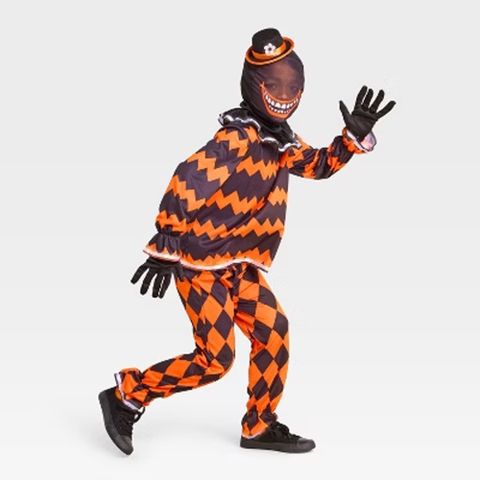
Is it stupid woke Halloween controversy season already? Sadly, it is.
Target removed a Halloween clown costume from its website and presumably its stores after social media mobs claimed that it was racist, evoking blackface and minstrel shows. As we know, companies are infamous weenies any time the race card is played against them, and virtually always grovel an apology. Thus Target sobbed on social media this week,
“An apology from us: We removed an offensive Halloween costume that should never have been part of our assortment. It is no longer for sale. As a company, we got this wrong, and we are deeply sorry. We know this is especially hurtful for our Black guests, team members and partners. Removing the costume is an important first step, and we are looking closely at how this happened and what needs to change to ensure this won’t happen again.”
I am strongly inclined to view this as another “Gotcha!” exercise from the race-obsessed. Talk about a case of “If you hear the dog whistle, you’re the dog” ! Let’s see: what aspect of the costume evokes blackface or minstrelsy? Did blackface performer swear orange costumes like that? Noooo. Did they wear black gloves on their hands? No! Did they wear little clown hats? Ruffles around their necks like Bozo? Also no. So what exactly creates the “minstrel show” vibe?It’s the fact that Target hired a black kid to model the costume! Put a white child in that thing and it looks like what it is: a clown costume.
Let me get this straight: Admirably, Target doesn’t see racist images at every turn, and hired a black model, when it should have hired a white model because the black kid made race-obsessed victim-mongers think of blackface. That wasn’t blackface, that was a child’s black face!
Is it the smile that’s the problem? You know, evoking this…
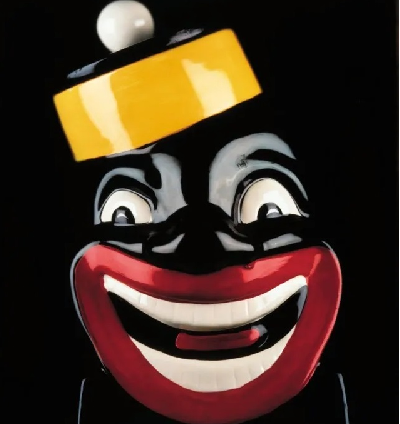
…? Again, it’s the actual black face wearing that smile that triggered the easily race-triggered. As for the smile , which the race-hustler think deliberately evokes “Mr. Bones” above, it is a creepy, killer clown smile, as worn by the murderous clown in Season 4 of “American Horror Story”…
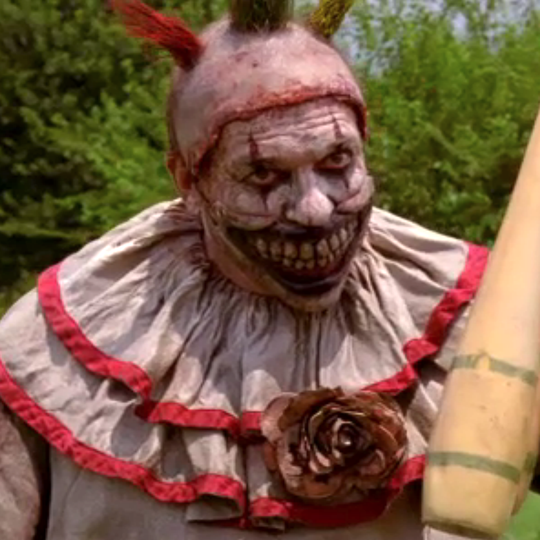
Does that character evoke blackface and minstrel shows?
We are never going to get out from under the iron boot of race hustlers until companies and celebrities stop capitulating to race-baiting like this. On the other side of this ugly coin, what realistic, sound business options did Target have? Well, it could have asked whether its critics want the company to discriminate against black models. It could have educated the public and its customers about what is and isn’t blackface and minstrel imagery. It could have put a warning in the constume’s package, “Do not buy if your kid is black. The Woke and wonderful will think he’s in blackface.”
Or is this another example of the ditty, “He was right, dead right, as he sped along, but he’s just as dead as if he were wrong”? If standing on principle loses a company sales and public support, is it ethical?
Your Ethics Alarms Early Halloween Ethics Quiz of the Day is…


Hilarious. Aren’t all advertisements supposed to be staffed with people of color? Target followed the rule and put a black kid in the advertisement, and they’re being attacked for doing so? Wouldn’t they have been attacked for NOT putting a black kid in the costume in the advertisement? Okay, an Asian or Hispanic kid would have been acceptable as well, but not as good as having a black kid in the suit.
The race hustlers might as well be Yosemite Sam making Target dance, pardner.
GREAT HORNYTOADS!!!!
“I live by my own code: shoot first, argue later.”
John Wayne, in one of his excellent turns on “Rowan and Martin’s Laugh-in,” appeared in a black-out saying, “An old cowboy once told me, ‘Shoot first and ask questions later.’ I wanted to ask him why, but I had to shoot him first….”
Talk about the right guy for that line…
You have made it very clear, I think, that a business can ethically fire someone for a statement, even if true and not offensive to many, that affects their personal sensibilities and/or business. You used a theater actor and his social media post as an example recently; the production’s producer, in effect, apologized to the public. Is Target a business? Can that business relay their own public relations apology? Suddenly the content of the “offending” material makes a difference when it didn’t before? There’s your answer.
PS: Speaking of theater, we once mentioned, along side Shirley Booth, Elaine Stritch and Thelma Ritter as those wisecracking “seen it all” types. I would add Eve Arden to that list.
Absolutely. Eve was one of the best: she got waylaid as a TV sitcom queen, but in movies like “Anatomy of a Murder” showed that she could hold her own with Thelma or any of the rest. Let’s not forget the great Mary Wickes (“White Christmas,”Sister Act”) and Mildred Natwick, who got the wisecracking matron roles in John Ford’s rep company.
Right. And Joan Blondell. I would even suggest that Audrey Meadows had one foot in that space given her “I’ve seen Ralph” — but she didn’t earn the “I’ve seen the world” in quite the same way as the others.
Yes. Joan Blondell belongs.
Like nations such as Canada with multiple official languages that require both languages to be on product packaging, we should have Congress pass a law that defines officially recognized races and another that requires product advertisements to include at least one of every race in adds which include people.
I think we’re already there.
Target is getting hit from all sides – is it the teachers’ union that is calling for a boycott because Target is remaining silent on political issues in Minnesota?
Corporations still haven’t learned that staying away from political and social issues is the right move. Just stick to your retail mission, and leave the rest alone.
Is it unethical to pull the product? Should they have tried to educate? Race baiters are relentless and have already proven that it takes one objection to derail anything, so the company may have made the smart call. But it will never end for them.
BTW – clowns are creepy, irrespective of race.
Is this an Ethics Zugzwang situation?
Hear me out.
In the beginning, the relationship was between business and customer. When ethics sometimes failed, government became involved to regulate some business activities for the benefit of the consumer. Now, we are including activists in this relationship.
A business should listen to its customers to determine what is or is not working; what product is or is not acceptable. If between business and consumers only, this can be a beneficial relationship. However, we now have activists inserting themselves into the business relationship and using pressure in unethical ways.
This is not activism to prevent businesses from selling products harmful to the public. This is not activism to protect consumers from fraudulent advertising. This is activism to control what a business can and cannot do through the lens of an ideological doctrine.
Target is pressured to include more minority representation. This includes African-American models in its advertisements. This particular costume, however, reminds someone with too much time on his or her hands of a minstrel caricature because of the African-American child model wearing it. The ideological doctrine is at odds because DEI Models Good vs Inappropriate Caricature Bad. And it’s at odds because the sole reason the costume is offensive is because of the skin color of the person wearing it. Even then, the accusation stretches credulity.
Nothing Target does here is going to help. It can dig in its heels and say, “This is not a minstrel character or caricature. This is a child wearing a clown costume that looks nothing like a minstrel character. You are looking for offense where none exists” only for activists to get louder and more vicious than J.K. Rowling’s opponents on social media and accuse Target of being insensitive to racial history and racial advertising.
Or it can apologize for putting a black child in a costume that might evoke Stepin Fetchit in some people’s minds and upset the increasingly vocal anti-woke activists who are tired of everything being about race.
There’s nothing in between because most of Target’s customers – black or white – don’t care. It’s a creepy costume to put on a child anyway and I could have seen this ending up clearanced after Halloween were it not for the Streisand effect.
So here we are. It’s ethical to remove a product that genuinely upsets a large part of your customer base. That’s how business works. It’s unethical to remove a product just because a few loud activists pitch a fit about it. On the other hand, they have the bullhorn these days and the squeaky wheel does get the oil.
And the Niggardly Principles don’t really help here either. Target didn’t mean to cause offense by putting a black child in a costume that people were going see racism in, so the first does apply. The second could also apply because Target could easily accomplish its legitimate goal of selling the costume by putting a white child in it (though the activists would then have to agree not to bash them for white-washing or erasing a POC. I’m not holding my breath because the purpose of race-huskering activists is to constantly move goalposts). The third certainly applies because Target is under pressure to cave in to a perceived slight and bow to ideological doctrine. Is the costume worth not caving in, though?
So that’s why I wonder if this is Ethics Zugzwang.
My second question is: Is it ethical for a business to allow itself to be victimized in this way? This is not blaming the victim but it may come close to Rationalization #36. Victim Blindness, or “They/He/She/ You should have seen it coming.”. Target threw itself into some of the DEI fad so it should not have been caught unawares when the activists decided they had other grievances.
Recently, I watched an episode of “The Office” I’d seen before. I started looking at it from an ethics perspective. There is a small family paper company in an area in which Dunder-Mifflin (the paper company featured in the show) hopes to expand. Michael is asked to scout out the business and get some information about it.
Michael takes Dwight to the parking lot of Prince Family Paper where Dwight notices that there’s no foot traffic in or out and that there’s no sign of expansion. They agree that Michael will pose as a potential client and Dwight will be a prospective applicant.
Michael goes into the business and claims to be the owner of a law firm. The owner of Prince Family Paper quickly assesses what he thinks Michael’s paper needs would be; however, Michael immediately turns the subject to Prince Paper itself. He asks questions about how long they’ve been in business, how many clients they have, etc. He demonstrates far more detailed knowledge of paper than the owner of a law firm should have. Within a couple of minutes, Dwight arrives asking about open positions. The owner explains they aren’t hiring. Dwight suggests he fire his son and hire Dwight in his place.
While Dwight and the owner’s son have a separate conversation. Michael asks to take a picture of the owner’s wife as she stands near a territory map on the wall. He refuses to show her the photo after he takes it.
After the owner hands over a list of his top clients so Michael can contact them for feedback on Prince Paper, Dwight approaches Michael and asks for a ride. These two presumed strangers leave together after Michael agrees to give Dwight a lift without asking where he’s going.
That’s the body of the episode. More happens in which Michael feels sad about using all this information to harm a nice family (which Dwight responds to by giving #15 “The Futility Illusion: If we don’t do it, somebody else will”), but the gist of my question is to determine if Prince Family Paper is unethical for being that naive? They handed two suspicious strangers all the information necessary to destroy their company (and, indeed, a few episodes later, we learn that Prince Paper went out of business). In this scenario, it wasn’t government regulation or activists who interfered in the business-customer relationship, but competitors.
And, yes, this is somewhat remiscent of Rationalization #36 or even #36B: “The Patsy’s Rebuke, or “It’s not my fault that you’re stupid!”
So circling back to Target, were they unethical to want to tap into minority consumer bases? Were they unethical to open the door, allowing race-baiters and gender extremists to pressure them into catering to small percentages of the population? Are they unethical for being stupid enough to allow activists to harm their business constantly by repeated accusations of offense?
At this point, what difference does it make what they do?
None. It’s an excellent example of Ethics Zugswang. Great comment.
Agreed. Honesty compels me to write that I skipped over this comment several times because of its length, but knew I would eventually come back to it (it’s A.M. Golden, after all). This was an excellent response.
And somewhere, in the back room of Target’s HQ, some PR and advertising people are sitting around a table with mostly-empty bottles of Ice Mountain water, surrounded by whiteboards filled with lines and boxes and words of various colors, and they’re wondering how they got here and why they even bother trying.
I like innovative costumes, but I confess I’m not sure what this costume is supposed to be. It has a clown suit and hat, and a monster clown smile, but the hands are jet black and the full head mask is black and semi-transparent, so we see a darker version of the child’s head behind the mouth. Is that what we are meant to see, or are we meant to imagine a completely shadowy being in a clown outfit, with only an overly large mouth visible? Is this costume based on a specific fictional character? Would adding a technicolor wig have helped?
I don’t think there’s anything inherently racist about the costume, but I do think that we need to build more trust among human ethnic groups before we can start relaxing around costume design that makes the wearer appear darker.
I agree. I’m no race-baiter, but the instant I saw the picture I understood the complaint, and I’m surprised nobody involved in the costume’s design, marketing, or on the retail end, saw this coming. I’m not even sure the kid is black, since the hood is like a dark pantyhose. I can kind of see what they were going for; a Halloween-themed clown, but the grin all by itself doesn’t fit the standard clown look, and with the darkened head and hands does give off a cartoon chimp or minstrel appearance. What I would’ve done is made the hood and gloves white, and added more features to the face, like orange makeup.
it would have been a better design if the hands and face were orange.
-Jut
But…Orange Man Bad!
Egads! You just HAVE to bring him up in every topic entirely unrelated. This is monomania!
On a lighter note, I’m surprised the UT Volunteers aren’t protesting the use of their colors to make this creative masterpiece. Is Target “targeting” their players of color? So much to see, so many reasons to be offended these days. With that said, that costume should never have reached the sales shelf. It’s uglier than a butchered pumpkin! Ethical to cave you ask, I ask what were they thinking?
Or the Baltimore Orioles…
Orange, black and green are the typical Halloween colors, so I understand that element. A little curly hair might have made a difference. Still creepy.
Lots of great comments. But Danny noticed something – if the model weren’t posed in that way, would the effect be the same. The hands and arms outstretched as though he is dancing in a jazzy fashion are definitely conjuring minstrel.
A white child just standing with a trick or treat bag – would we see the same image?