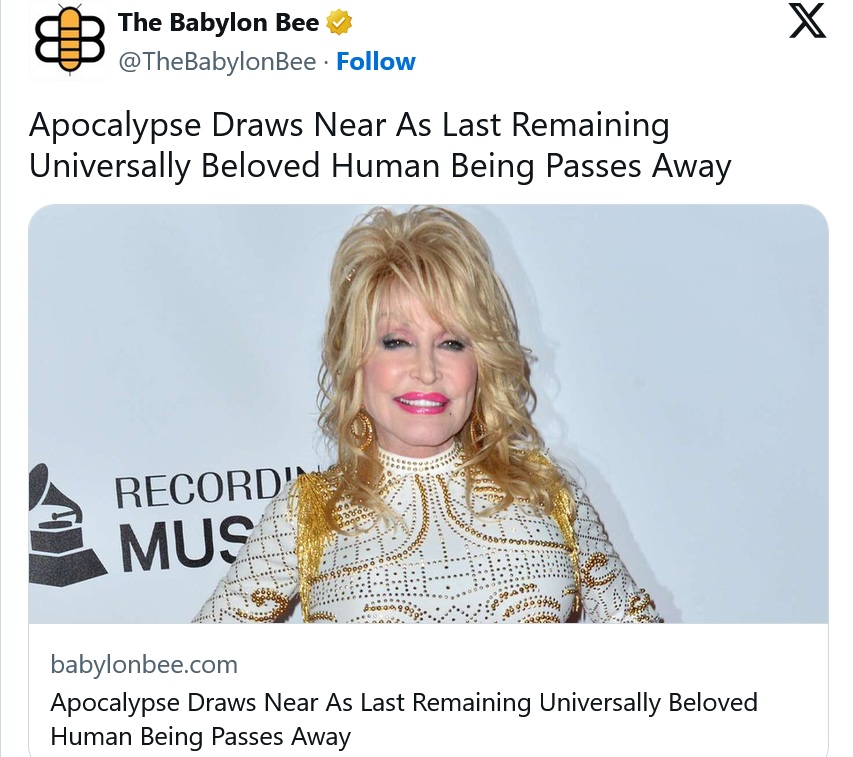
As you must know by now unless you have been in a submerged submarine with a broken communications system like the one in “Crimson Tide,” Dolly Parton died yesterday at 80. Why her death is being described as a shock is a mystery: as my father said when he hit 80, “It’s the Red Zone, son. I can kick off any second from here on!” Nonetheless, the public and official outpouring of grief, love and admiration is unlike anything we’ve seen at least since Princess Diana’s demise in 1997.
The tectonic reaction is certainly not based on Dolly’s singing, acting or song-writing. Personally, I was never a fan; Dolly’s singing voice always sounded to me like someone who has inhaled helium. Her songs were pleasant but unremarkable to my ear. As an actress, I place Dolly Parton in the large category of experienced public performers who can project their own personalities effectively into roles and stories where their personalities seem appropriate, a diverse group that ranges from the late Fred Thompson to the late Bob Newhart to the not-quite-late Ringo Starr.
Clearly, the reason Dolly is being mourned so vigorously is that her public persona was entirely benign, virtuous and lovable, even aggressively so. She literally gave nobody any reason not to like her. In 2020, as the Great Stupid was grabbing American society by the throat, Hollywood producer Rob Long wrote an appreciation of Dolly in “Commentary” exploring her universal popularity. He wrote in part,


Not that I’ve given it much thought, but I’d say Dolly Parton embodied “the girl next door.” And she was good at it.
I don’t know if it’s telling about the progressive psychology but 76-90% of the progressives I know on various social media platforms are swooping in frantically to claim Dolly Parton as their own.
I wonder how they propose to do that. Country music, a traditional conservative community. A Southerner. An openly religious woman. Is the theory that her role in “9 to 5” about a sexist boss getting his just deserts makes her a feminist? Mighty thin…
I don’t think they concern themselves with a justifiable “how”. They just do it. As they are just doing it now.
Obviously this is my opinion, but Dolly Parton was, first and foremost, a business woman (and a VERY astute one), and her entire business played on her roots as one of a dozen children born in backwoods Tennessee. And unlike so many people who become superstars, she never let fame get in the way of that business. She didn’t seem to be obsessed with the notion that her opinions about socio-political matters mattered one whit when compared with the success of her business.
She maintained a simple, humorous, self-deprecating, not-above-her-raising persona. As you noted, she steadfastly refused to get involved in political debate. On social issues, she offered the barest of sentiments, and talked about her religious views sparingly. She knew taking sides on hot-button topics was fraught with peril, and generally bad for business.
She was a small-town country singer who struck gold with her writing talents and steadfastly refused to sell any material from her written library. Famously, Elvis Presley’s management approach Dolly with a request to record “I Will Always Love You”. When Dolly said yes, the manager added, “Well, Elvis has a desire to own the rights to anything he records…are you prepared to relinquish the song to him?” At that point, Dolly rejected the offer. Two decades later, Whitney Houston covered the song, and Dolly pocketed a pile of gold that would make Smaug jealous.
She was universally loved because she refused to do the one thing that businesses like the recently-mentioned Target, Annheuser-Busch, Gillette, and far too many contemporaries of hers did: believe that her brand could survive her taking sides on issues that divided the population in half.
Well, that was a bit scattered, but sometimes my thoughts are random.
I think that is right. I am by no means a country-crossover music fan – you can say that I loathe and detest it and/or I would rather have my fingers chewed by rats than listen to it. Yet, even I recognize that Parton was a totally different performer who used her talents to her greatest abilities and, frankly, made the world a better place.
Parton made wise financial and business decisions, especially when she realized that retaining publishing rights was the key to her future success. She licensed “Will Always Love” you to Houston and the movie but she retained the publishing rights. The revenue from that song alone is the envy of many a bank account.
However, Parton was also a very good songwriter and a gifted lyricist in the mold of the great storytellers. “Jolene” is a perfect example of telling a terrific story with a touch of whimsy.
She was not an overly flambouyant guitar player – and the 30″ finger nails didn’t help – but she knew how to make the right statement to fit the song. When she collaborated with other performers, she knew how to mesh her skills to theirs to accomplish the song’s goals (I am reminded of her song with Emmylou Harris and Linda Rondstat). She let her voice fill out the song but did not overpower her collaborators, and she worked with gobs of massively talented performers.
Then, there is her charitable work. I understand she donated huge sums of money from “Always Love You” to underprivileged black kiddos in Tennessee to fund schools, libraries, etc.
Parton was a force of nature, with a wonderful self-deprecating sense of humor. She could laugh at herself but was not cruel to others.
She will be missed.
May she rest in peace.
jvb
Great comments.
There’s just something about her … the smart, bodacious, lovely girl next door, so nice you can’t be jealous, the sort of woman who’d help you in any pinch, give you the shirt off her back. And her nearly six decades marriage to the same man – inspirational. She truly was America’s Sweetheart.
An excellent summation!!
Dolly will be missed.
I’ve never been a huge fan of her style of music but it has its unique niche in my massive playlist, that said…
In my opinion; Dolly Parton was 100% true to her roots and it appears that part of that was fully employing the Golden Rule in all aspects of her life. It appears to me that by all measures, both personally and publicly, Dolly was absolutely genuine in that what you see and hear is true to her core. I’d be so bold to say that, Dolly likely didn’t have a public dark side to her character, I suppose it’s entirely possible that she had no dark side at all.
If there were more people like Dolly in this world, the world would be a far better place.
I really admire Dolly Parton.
You forgot to mention her infectious laugh – it was natural and made you feel well.
jvb
Dolly Parton is respected because she earned it. She also gave back in spades to her community she came from. She has a free book program for children, there’s simply nothing but kindness to her public persona. She was savvy enough to avoid all the pitfalls for decades, and I respect her immensely for that. Very few people are savvy enough to avoid public “gotcha” traps, but she did it over and over again, and it wasn’t even obvious.
One of the things that you missed in why she is so loved and admired is the massive amount of charitable work she does. She doesn’t just talk the talk, she walks the walk.
Her book program, Imagination Library, is probably the prime one people know. It send a book, for free, to any child up to 5 years old, and you can get them all the time. It sends out about 3.5 million books per month. A huge amount of books go out, and just one of the many programs she has done and created.
Tim Curry also apparently.
Dolly would probably never have agreed to co-star with Dr. Frank-N-Furter or Satan.
According to the news story I heard, Dolly Parton was celebrated for her music, her acting, and her “larger than life … personality”.
Did I miss anyone mentioning Tom Hanks as an almost universally loved person?
Great actor, patriot, but weenie groveler to the woke in Hollywood. And this. Here, he said he couldn’t play Forrest Gump or a gay man dying of AIDS today “and rightly so.” He’s too beholden to the left to be universally beloved.
I don’t know. His right wing coded series and consistent genuine nods (unlike the make-smile fakery of the average Democrat) to veterans are big hits in conservative circles-
Saving Private Ryan
Band of Brothers
Greyhound
Etc