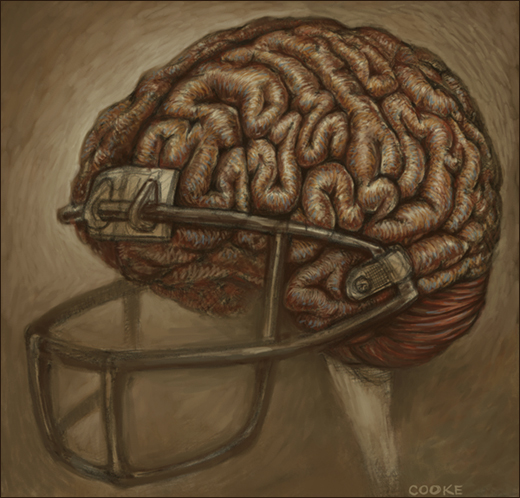
Item: From the New York Times…
New data provides a sobering indication: At least one in four of all the people who have played in the N.F.L. might expect to end up with chronic traumatic encephalopathy, according to a study of hundreds of cases over a recent six-year period.
Researchers considered every former N.F.L. player who died from 2016 to 2021. There were 878. Some died in their 20s, some in their 80s, most in between.
The study’s main finding was simple math: At least 215 of those 878 former players — 24.5 percent — had C.T.E.
The actual prevalence could be far higher. The roughly 25 percent rate does not consider the 643 brains that were not examined. Some of those, maybe many of them, likely had C.T.E. too.
C.T.E. is a progressive neurological disease caused by repeated impacts to the head. It can be definitively diagnosed only by examining the brain after death.
Studies have shown that the rate of C.T.E. in people who have not sustained repeated impacts to the head is nearly zero.
If the new study’s statistics were applied to today’s players — 1,696 on the league’s 32 regular-season rosters, not including more than 500 members of practice squads and those ineligible due to injury — at least 400 of them would be diagnosed with C.T.E.
Experts say that the rate of brain disease represents an occupational safety hazard with little comparison in the American workplace.
I have written this before, and had this story on the EA runway for a long time because it makes me angry. People who cheer on football are literally encouraging young men to cripple themselves for their entertainment. It is unethical, and indefensible.


I have forbidden my children from playing football even though all of their friends do.
My only exception has been if they want to be a kicker. One of them nailed a 45yd field goal on his first try. But, I have always said “your brain is your greatest asset, after your need”. So far, none have taken the offer to be a kicker yet.
Perhaps in contradiction, I allow them to play soccer but with the warning that heading the ball is a nearly useless maneuver unless you are merely deflecting it. There is no win by “putting a head on it” as a coach will yell. And I specifically counsel my guys to defy the coach and quote me.
That said, I am easily convinced with MRI etc of CTE. My question about CTE is not its fact, but connecting credibility to action.
There are many people who would purchase a cheap shovel for digging and have to buy a new one every week because they could still afford their soda for lunch. They struggle to connect the abstract long term reality of spending less in the long run but more up front. So, with CTE. Little Johnny isn’t playing “that much”.
If parents of children have not connected talk of CTE to credibility to action yet, are they unethical for cheering little Johnny? If they have not connected carbohydrates to heart disease are they unethical for feeding Johnny sugary beverages because they make him happy? Is American Football culture and resistance to reform of the sport just an manifestation of civic religion?
It isn’t “at least 25%”, it is between 25% and 98% and we don’t know what the actual number is. The last part, that we don’t know what it is, should terrify everyone. The earlier studies, where they looked at brain damage and found it in almost all the players leaving college should have been followed up. That study gave the NFL their ‘out’. How do you know ‘we’ caused the damage? The study showed they were damaged when they got here.
The next logical step was to do brain scans on high school football players, but if it was found that THEY had detectable brain damage, it would have ended football. You can’t advocate for a sport that causes brain damage to minors. We don’t let parents sign waivers for kids to work in coal mines anymore, and we can’t allow waivers for this either.
I don’t have statistics, but I’m not a big fan of the fighting sports, either. What little of them I’ve seen, mostly portrayed in movies, is so brutal.
If a completely new professional football league started tomorrow, was fully transparent about the neurological risks from day one, and every player knowingly accepted those risks, would it still be unethical to watch and support it?
If we had a gameshow where we ask poor men to cut off parts of their body on TV to provide scholarships and trust funds to lift their children out of poverty, would it be ethical? I mean, they consented. They knew that they would permanently be losing parts of their body and there was a decent chance that an arterial bleed couldn’t be stopped and it would kill them. They are the ones who chose to sacrifice parts of their bodies and possibly their lives for their families. What could be wrong with that?
What if we allowed them to sell themselves into slavery?
I’m not arguing that consent makes every conceivable transaction ethical. I’m asking whether this activity remains unethical when the participants are fully informed and voluntarily consent. Thanks
But this is a transaction that could almost certainly lead to brain damage. Not just brain damage, but brain damage that can make you violent and harm your family. How is that better than someone agreeing to have a finger or toe cut off? I would be much less disabled missing all my little fingers and toes than unable to control my emotions and beating my family.
As a society, we generally don’t believe that it is ethical to coerce someone into a transaction that will have such damaging long-term consequences unless the alternative is dire. We would allow people to risk a likely death to save a bunch of schoolchildren. We would allow someone to risk future cancer if they stay and prevent a nuclear reactor from breaching, etc. However, this is entertainment. We don’t let people agree to work in a factory that just doesn’t have proper ventilation and will cause cancer or emphysema. We don’t let them use machinery that will amputate fingers because of a lack of proper guards. If we did, no one would make the workplace safer and the employee’s choice would be ‘agree to be injured or starve’. So, how does OSHA allow the NFL? Prosecutorial discretion?
The other part of your proposal is that to play in this league, children must have been exposed to probable brain damage. You don’t become a highly skilled football player by starting at 18. Before they even agree to this league, they probably already have brain damage.
FROM YOUR HOST: “Marisa” has been banned since March. She snuck in with comments on this post while I was doing an ethics seminar, so I’m stuck with her earlier comments, and I even replied to this one,
“is your answer yes, that the league I described would still be unethical to watch even if every player were an informed, consenting adult?”
…which exhibits the same ethics ignorance that was a factor in her banning.
That’s my answer. Players are being paid to cripple themselves. By watching, you help pay them. I compare it to the movie “Would you Rather?” a horror movie where desperate people agree to a game where the winner will win millions in exchange for agreeing to do terrible things, like slicing an eye with a razor. Morover, there are more stakeholders than just the players. The devastation of families when a father and husband starts suffering from premature dementia is well-documented. Have they given informed consent for the consequences to them?
So then it follows that it’s unethical to watch boxing and MMA fighting.
Yes. Duh.