Author: Jack Marshall
The End Of Chief Wahoo
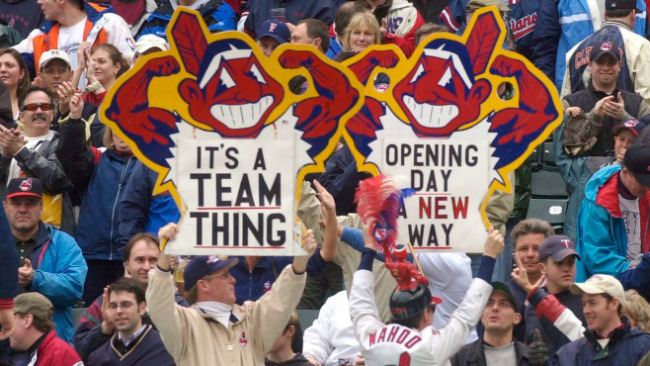
The Cleveland Indians will yield to political correctness and ditch the team’s 70 year-old logo, Chief Wahoo. Baseball commissioner Rob Manfred pressured Indians chair Paul Dolan into making the change, which had been demanded by Native American activists for decades. A version of the red-skinned, hook-nosed caricature of a Native American first appeared on the Indians’ uniforms in 1948, when the team won its first American League pennant after many frustrating years. The logo caught on in part because the team’s fans had good associations with the image—the cognitive dissonance scale strikes again!—and then grinning indian became part of team tradition.The various groups that bullied other teams to change or eliminate names or logos with any hint of ethnicity on spurious grounds made banning Wahoo a priority, along with the Atlanta Braves “tomahawk chop” and especially the Washington Redskins nickname.
Apparently Manfred used the 2019 MLB All-Star Game as leverage, telling the club that either Chief Wahoo goes or the All-Star Game would end up somewhere else.
I have no affection for the logo, which is grotesque and anachronistic, but as with the Redskins, the protests were part of a power play by the Left and not the result of genuine, widespread offense affecting Native Americans. Nobody was made into a racist or caused to hate Native Americans because of Chief Wahoo, and sometimes a cartoon is just a cartoon. There was no racist intent: people do not associate names and images that represent what they hate with teams they love. (The cognitive dissonance scale again. Is there anything it can’t explain?) As with the Redskins name, I feel as if the Cleveland Indians logo needed to stay as a matter of principle. Again, the attack on team names and symbols is about power, and bending others to their will. Polls and surveys showed that most Native Americans didn’t care. But this is just another brick in the wall, and the censors of art, history, tradition, thought and language will never stop. Continue reading
Afternoon Ethics Warm-Up, 1/29/2018: Alexa, Hillary, The Grammys, And The LED Rocket Copters

Good afternoon.
(Where did the morning go?)
1 Regarding Alexa the Feminist: I had said that I would wait for 20 comment before revealing my own answer to the recent Ethics Quiz, which asked readers whether it was ethical for Amazon to program its Artificial Intelligence-wielding personal assistant Alexa with the rhetoric and the sensibilities of a feminist. As usual, Ethics Alarms readers covered a full range of considerations, from the fact that consumers weren’t being forced to take a feminist robot into their homes, and could choose a non-woke personal assistant if they pleased, to the pithy,
“My screwdriver should not tell me it is a communist. My toothbrush should not tell me it is a Republican. My lamp should not tell me it is Hindu. My car should not tell me it likes polka music. My sunglasses should not ask me if I’ve heard the good news. My refrigerator should not tell me I should have more meat in my diet, and by no means should it be vegan.”.
I don’t trust the big tech companies, and the more I see them becoming involved in politics and culture, the less I trust them. It is unethical for Amazon to try to indoctrinate its customers into its values and political views, and if that isn’t what the feminist Alexa portends, it certainly opens the door. If there is a market for communist screwdrivers, however, there is nothing unethical about filling it.
As long as consumers have the power to reject AI-imbued tools with a tendency to proselytize, there seems to be no ethics foul in making them available. It’s creepy, and since these aren’t women but pieces of plastic and metal, it’s absurd, but in the end, so far at least, Alexa’s feminist grandstanding is “ick,” not unethical.
2. If you think that there was nothing wrong with Hillary’s surprise cameo at the Grammys, you’re hopeless. Continue reading
Comment Of The Day: “Morning Ethics Warm-Up, 1/27/2018: ‘If You Want It, Here’s How To Get It’ Edition”

Extradimensional Cephalopod was moved to write his wry Comment of the Day based on this partial post by Harold I. Ziegler ,which I quoted to illustrate the kind of reasoning that drives libertarians crazy…
Recently, videos have circulated on social media showing teens deliberately eating Tide Pods laundry detergent packs. All of this is part of what some call the “Tide Pod Challenge.” These pods contain highly concentrated laundry detergent under pressure and explode when bitten into, releasing their toxic contents and causing rapid ingestion and inhalation of dangerous chemicals. In my capacity as a toxic chemical researcher and consultant, I have investigated and seen several instances of the horrendous consequences that result from laundry pack ingestion: permanent burning of the mouth, throat, digestive tract, and lung tissue, and in some cases even death.Procter & Gamble (P&G), the manufacturer of Tide Pods, as well as other companies selling laundry detergent packs, have acted in the past to stem the misuse of their products. But these safety measures have failed.
It’s clear that laundry pods as they currently exist are too dangerous to be sold to the public. If P&G and other manufacturers can’t figure out a way to reduce the more than 10,000 injuries they cause each year, laundry packs need to be taken off the market.
I used to work for the trial lawyers association; I think product liability law is important, and that manufacturers need to consider consumer safety. The argument that anyone but parents are responsible when their toddlers eat Tide Pods, and worse, that anyone but the teens themselves are responsible for what happens when they put the detergent in their mouths knowing that it is detergent, however, is societally corrosive, as toxic as the pods themselves. Parents have the responsibility to keep poisons away from children. Teens have the responsibility to not take stupid dares they see on social media. If you can make Tide shelve its pods because teens are eating them, then you can ban knives with points because there’s a social media fad promoting knife-juggling. EC humorously expresses my feelings about the “if one stupid teen is saved” mindset.
Here is Extradimensional Cephalopod’s Comment of the Day on the Item #1 in the post, Morning Ethics Warm-Up, 1/27/2018: “If You Want It, Here’s How To Get It” Edition:
At first I was relating the argument for discontinuing detergent pods to the character of Wonko the Sane from the Hitchhiker’s Guide to the Galaxy. After seeing instructions printed on a toothpick container, he concluded that the world had gone mad, and put it in an asylum with himself as the warden (he turned his house inside out). After all, if you can discontinue laundry detergent because people old enough to know better are using it for a dangerous unintended purpose and parents can’t keep their cleaning agents in a safe place, then you can use that argument against literally any physical product, because someone can deliberately hurt themselves with it. Making it taste bad just adds to the challenge of self-harm.
However, after reading the article, I got an idea from the part where the author says that the companies have been dragging their feet as far as making their products less tasty-looking is concerned. Continue reading
Ethics Quote Of The Month, Terrifying Thoughts Division: Daniel Greenfield
“The Mueller investigation is about removing President Trump from office and overturning the results of an election. We all know that. But it’s not the first time they’ve done this. The first time a Republican president was elected this century, they said he didn’t really win. The Supreme Court gave him the election. There’s a pattern here. Trump didn’t really win the election. Bush didn’t really win the election. Every time a Republican president won an election this century, the Democrats insist he didn’t really win. Now say a third Republican president wins an election in say, 2024. What are the odds that they’ll say that he didn’t really win? Right now, it looks like 100 percent. What do sure odds of the Dems rejecting the next Republican president really mean? It means they don’t accept the results of any election that they don’t win.
“It means they don’t believe that transfers of power in this country are determined by elections.
“That’s a civil war.”
—–Writer and journalist Daniel Greenfield in a speech he delivered last week.
Oh-oh.
 I don’t want to believe Greenfield is right, though I have written essays noting the same phenomenon, and long before “the resistance” tried to take down Trump. This is essentially the reason I decided late in the 2016 campaign that I could not vote for Clinton even though I would not vote for Trump. Since the election, my analysis has been confirmed, though I spend time each day wrestling to the ground the inevitable conclusion that follows, because I don’t want to believe it, so I don’t. Greenfield, however, declares it outright in his next section, saying,
There’s no shooting. At least not unless you count the attempt to kill a bunch of Republicans at a charity baseball game practice. But the Democrats have rejected our system of government.
This isn’t dissent. It’s not disagreement.
You can hate the other party. You can think they’re the worst thing that ever happened to the country. But then you work harder to win the next election. When you consistently reject the results of elections that you don’t win, what you want is a dictatorship.
Your very own dictatorship.
The only legitimate exercise of power in this country, according to the left, is its own. Whenever Republicans exercise power, it’s inherently illegitimate.
The attacks on Trump show that elections don’t matter to the left.
An Apology To Bradford Dillman, And Introducing The Dillman Rule

I owe Bradford Dillman, the movie and TV actor who died on January 16, an apology. I hope I learn something from it.
If you had asked me during the Seventies and Eighties who I regarded as the epitome of a hack actor, it would have been Bradford Dillman. For most of the period he was a guest star on every TV drama imaginable, usually phoning in the same performance as a serious, tense, often nasty weasl or jerk. I came to believe that he was a serious, tense, often nasty weasel or jerk; otherwise, why would he only play such roles? Although Dillman’s career began well, with his portrayal of a fictional version thrill-killer Dickie Loeb in Compulsion, the film version of the Leopold-Loeb murder and trial. “Bradford Dillman emerges as an actor of imposing stature as the bossy, over-ebullient and immature mama’s boy, Artie,” A. H. Weiler wrote in a Times review. Dillman shared best actor honors with co-stars Dean Stockwell and Orson Welles at the Cannes Film Festival, and that was about the last honor he ever got. His career went downhill from there.
I never forgave him for appearing as John Wilkes Booth in 1977’s horrible “The Lincoln Conspiracy.” I am a Lincoln assassination buff, and looked forward to the movie, braving a blizzard to see it and dragging my bride to be along with me as one of our first dates. I was embarrassed. The film was so bad I walked out of it, one of only five movies to force me out of the theater since I was a kid (The others, for the record: the original “Dawn of the Dead,” “The Silent Scream,” “JFK,” and “The Wicked Dreams of Paula Schultz.”)
As usual, it wasn’t that Dillman was bad, it was just that he was predicable, and the material he was acting in was lousy. Oh, now and then , a major film like “The Way We Were,” a couple of the Dirty Harry films, or a decent TV show like “Columbo” had a Bradford Dillman character, so they got, reasonably enough, Bradford Dillman to play him, but by then the cognitive dissonance scale—

—was working against Dillman. Bradford was already lodged at the bottom. If he was in it, whatever it was was pulled down below zero in my mind. Bradford Dillman? Yechhh.
This was a bias. I stopped really watching Bradford Dillman, and only reacted to him based on old grudges and assumption formed so long ago that I couldn’t even recite them. It was prejudice. It was unfair. It breached the Golden Rule. I never gave him a chance, for decades. Continue reading
I Know, I Know, But I Swore I Would Never Let A Bad Barry Bonds Defense Go Unanswered

There are a few reoccurring assertions that Ethics Alarms readers know I am duty bound to defenestrate, no matter how repetitious it is for them and me. The gender gap argument in salary is one; election night in 2016 spawned another, when hack historian Doug Brinkley falsely claimed that the same party seldom holds the White House for three straight terms. That Bill Clinton’s sexual misconduct was “private personal conduct” unrelated to his professional trustworthiness was long on my list, though that one seems to be, finally, discredited. There are others involving gun control, marriage, illegal immigration and more; I should list them in one place some day.
None annoys me any more, however, than the rationalizations mounted to claim that steroid cheats belong in baseball’s Hall of Fame.
It happened again this week, as it will every time the Hall of Fame ballots are counted this time of year. On the MLB Channel on Sirius-XM, two alleged experts, analysts Casey Stern and former pitcher Brad Lidge each gave their list of ten former players who belonged in the Hall of Fame, and both listed Barry Bonds and Roger Clemens as deserving. When Lidge went through his “reasoning”—I hate scare quotes, but here they are unavoidable—I wanted to leap through my car radio and throw him out his studio.
It wasn’t just the unethical opinion that infuriated me. It was the sheer ignorance and intellectual laziness of it. The man clearly has never practiced critical thinking in his life. Nobody taught him. Like the President, he literally doesn’t know what ethics are, and reasons by rationalizations and conventional wisdom, meaning that if enough dolts say something, it becomes a persuasive position to him. It is unethical—malpractice, negligence, incompetence—to argue like this when you are holding yourself up as an expert, and addressing the public through mass media. You are making the public more ignorant and stupid, and less able to think clearly, with every word. Stern, who is about five times smarter and more articulate than Lidge, used slightly less moronic arguments to defend Bonds, but only slightly.
So I’m sorry if you have heard this before, but I made a promise to myself, my readers, and baseball, which I love. Here are Lidge’s arguments to allow Bonds into the Hall of Fame, and why they are crap.
- Bonds was on his way to a Hall of Fame career before he used steroids.
Yes, and that brilliant scientist was on the way to a Nobel prize before he falsified his data. This idiotic argument–maybe the worst of the worst—absurdly holds that if something would have occurred if a disqualifying event hadn’t happened, the disqualifying event shouldn’t count. It also embodies the “he didn’t have to cheat, so his cheating was no big deal” fallacy. This would have excused Richard Nixon: after all, he won by a landslide anyway, so what difference does it make that he tried to illegally undermine the McGovern campaign? Ugh. It makes me crazy even writing about this one.
- Bonds cheated during a period when cheating was rampant, so a lot of the player he surpassed weren’t disadvantaged.
Comment Of The Day “Morning Ethics Warm-Up: 1/27/2018: “If You Want It, Here’s How To Get It” Edition”
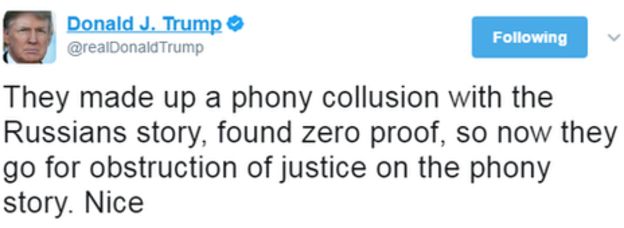
Chris Marschner, who has had several, scored another Comment of the Day today with his reflections on the strange nature of “obstruction of justice ” charges, when justice would in fact be for no charges to be brought at all.
He was focusing on #3 in today’s warm-up, which discussed yesterday’s “resistance” theory that allegations that the President wanted to fire the Special Prosecutor (but didn’t) prove that he was trying to obstruct justice when he fired James Comey, who so, so deserved it.
I see unmistakable signs that the “resistance” is losing its already tenuous grip on reality, and is increasingly yielding the raw hate and fury that long ago supplanted any rational criticism of Donald Trump. Consider has-been Leftist documentarian Michael Moore, who with fellow progressive performers Mark Ruffalo, Whoopi Goldberg, Rosie Perez and Cynthia Nixon, who have to do something between jobs, is pushing Monday’s Counter-State of the Union , which is only slightly more sensible than the “scream pointlessly at the sky” event. Remarkably, among Moore, Whoopie, Rosie, Cynthia and Mark there isn’t a single political science, history, economics, or government major. In fact, there isn’t a single college degree of any kind between them, or business, government or executive experience of any kind.
Michael Moore, speaking on behalf of MoveOn.org (Do the Time’s Up and #MeToo crowd recall that Move-On was spawned to protest Bill Clinton facing accountability for his cover-up of sexual misconduct? Nah.), sent out an email that read in part, before the fundraising pitch,
This situation is a nightmare. And the only reason that things aren’t FAR WORSE than they already are is that millions of us have come together to engage in our democracy, resist, and organize.
But our problems go far beyond one sociopath president. The mission that we are on and the work that we must do is to tear down the rigged system that produced Trump in the first place. We must imagine the America that we want to live in. We must create the post-Trump America.
And this is actually possible: The fierce, determined Resistance movement that began after Trump’s election could create an avalanche at the polls this November. Together, we can stop Trump and the GOP and begin the work of creating the country that we imagined.
The country the Moore imagined was called the USSR. But I digress.
Here is Chris Marschner’s Comment of the Day on the post, Morning Ethics Warm-Up: 1/27/2018: “If You Want It, Here’s How To Get It” Edition: Continue reading
The Michigan High School Ethics Bowl

More than 100 high school students from across lower Michigan will gather February 17-18 at the University of Michigan for the fifth annual Michigan High School Ethics Bowl. The winner will represent Michigan in the National High School Ethics Bowl held at the University of North Carolina at Chapel Hill in April. The Ethics Bowl is organized by A2Ethics, the University of Michigan Department of Philosophy Outreach Program and the high school faculty coaches in the High School Ethics Bowl League. During the two-day competition, judges evaluate teams’ responses to case studies written by local community members.
See? There is hope!
Here are the case studies the students will analyze, fifteen of them. I may do posts on a few of them suggestions are welcome. One of them, #2, I have discussed in several legal ethics seminars:
The Michigan Rules of Professional Conduct forbid lawyers from revealing information received in confidence (information protected by the “lawyer-client privilege” of a client), and similarly from using that confidential information for the advantage of a third person, unless the client consents.
You are a lawyer whose practice is focused almost exclusively on criminal defense. You have been active in the criminal defense bar association for several years, and you represent criminal defendants at both the trial and appellate (appeals court) levels.
One of your clients, Gilbert, age forty, is in prison for murdering a woman named Alice. You represent Gilbert in the appeal of his conviction and life-without-parole sentence. During confidential meetings with Gilbert, he confesses to you that he also murdered Bob, and he acted alone when he did. Although you were not involved with the case of Bob’s murder, you are somewhat familiar with it and know that a man named Enrique was convicted of Bob’s murder and is consequently serving a sentence of life without parole. Enrique’s conviction and sentence were recently reaffirmed after a thorough, years-long appeals process. Unless new evidence comes to light, he will not be able to appeal again.
After you are unsuccessful in challenging Gilbert’s conviction and sentence for Alice’s murder, you speak with him about Bob’s murder. He repeats his confession, this time in more detail, but refuses to consent to your request to reveal the confession on Enrique’s behalf.


Conservative journalist David Greenstein made a provocative speech before a Tea Party group in which he posited a “civil war,” defined by him as when a political party rejects a lawful Presidential election and refuses to accept the legitimacy of any government it does not dominate. I admit that offering up such inflammatory analysis for comment is the pedagogical equivalent of tossing a hand grenade in a room, but there is method to my madness, beginning with my conviction, documented here since November 2016, that much of the Democratic Party is denying the legitimacy of the last Presidential election, and is actively working to find a way to remove President Trump without having to defeat him in the next one. I believe that this is among the most damaging and dangerous political developments, and ethics outrages, in U.S. history, and one that has been intentionally covered up by an unethical news media with the same agenda.
Greenstein’s speech placed the matter front and center, and I guessed, correctly, that it would get a lot of attention, though the speech has been largely ignored by progressive commentators, even as numerous Democrats, announced that they would boycott the State of the Union message, a traditional yearly symbol of a unified people. I also assumed that it would pose an interesting challenge for readers here, specifically the challenge of keeping bias out of their analysis, since, as we all know, bias makes you stupid.
Chris Marschner did an especially good job of this, and here is his excellent Comment of the Day on the post, Ethics Quote Of The Month, Terrifying Thoughts Division: Daniel Greenfield: