The “White Christmas” Ethics Guide 2020

2020 Introduction

I have some very dear friends who are still angry with me for writing this admittedly harsh analysis of their favorite Christmas movie. Maybe that’s why I didn’t post it last Christmas season; I don’t know. It really is an ethics mess, however, and as I’ve stated elsewhere this week on Ethics Alarms, if you are going to make an ethics movie, someone involved ought to have functioning ethics alarms. The heartwarming ending—I still get misty when the old general played by Dean Jagger, gets saluted and serenaded by his reunited army unit—doesn’t make up for all the gratuitous lying and betraying going on in the rest of the film.

I have never mentioned this here before, but the movie was the result of an ethical act by one of the most unlikely people imaginable, Danny Kaye. If you search for Danny here, you will find that I have more connections to him than to any other entertainer, primarily through my co-writing and direction of an original musical about him, written by his long-time publicist and my friend. I credited Kaye with my interest in performing, musicals, and comedy, but my research into the real man was disheartening: in stark contrast to his persona and his public image, Danny was a miserable, paranoid, selfish, mean and insecure sociopath when he wasn’t playing “Danny Kaye,” which could be on stage or off it. “White Christmas” had been conceived as a re-make of “Holiday Inn” with the same cast, Bing Crosby and Fred Astaire. Fred couldn’t do the project, so his part was re-written for Donald O’Connor, who became ill so close shooting that there was no time to retool the script and have the film ready for its target holiday release. In desperation, the producers asked Kaye if he would play Bing’s side-kick even though it meant 1) playing a support, which he had never done in a movie since becoming a star 2) playing a role that couldn’t highlight his special talents 3) subordinate himself to Bing Crosby, who was indeed the bigger star and box office draw, and most daring of all, expose his own limitations by doing dance numbers created for Donald O’Connor. Kaye was not a trained dancer, just a gifted mimic and athlete who could do almost anything well. Danny (actually Sylvia, his wife, agent and and career Svengali) had his price for the rescue: he demanded $200,000 and 10% of the gross.

Everyone around Danny Kaye was shocked that he agreed to all of this. Not only did he agree, he also amazed everyone by not playing the under-appreciated star on set, by doing O’Connor’s choreography as well as he did, and by knowing how not to steal focus from the star, something he infamously refused to do when he was in “Lady in the Dark” with Gertrude Lawrence. The movie was the top grossing film of 1954, and the most successful movie musical up to that time.

Danny’s good deed was punished, because today it is by far the most seen of his films, and is likely to be the source of his public image as time goes on. Yet it is not his best movie, or a fair representation of what made him a unique and popular supporter. Like Darren McGavin, a fine and versatile dramatic actor cursed to be remembered only as the father in “A Christmas Story,” Danny’s slice of immortality also minimizes his legacy and talent. Watch “The Court Jester.” With your kids or grandchildren.


1. The First Scene

Continue reading →

First Snowfall Ethics Accumulation, 12/16/2020 [Corrected]

For the record, I believe that Dean Martin’s is the definitive version of this holiday favorite. It’s the perfect vehicle for his inimitable style, which always makes me smile. I miss Dean; indeed I miss all of the great singers whose Christmas offerings come up on the Sirius-XM “Christmas Traditions” channel, because they are all dead, every one of them. In one short trip, I heard Bing, Dean, Rosemary Clooney, Burl Ives, Nat King Cole, and Karen Carpenter. All gone. Christmas songs shouldn’t make you sad.

1. No, “doctor” doesn’t mean “teacher.” The disingenuous nonsense defenders of Jill Biden and anyone else who insists of being called “Dr.” because they have a doctorate is stunning, and the hypocrisy is hilarious. When the pompous one was a Trump White House aide, the biased media mocked him. Now that the insecure title-wielder is a Democrat, the rules are different. Got it.

One particularly off-base defender of the non-medical “Dr.” in the comments writes, “Doctor means teacher.” No, it obviously doesn’t, or all teachers would be called “doctor.” My best high school teacher, Miss Rounds, who taught Latin, actually had a PhD but never asked her students to call her “Dr.,” because, you see, that would be stupid. Funny: none of the lists of synonyms for “doctor” include “teacher,” and none of the lists of synonyms for “teacher” include “doctor.”

But mirable dictu! The embarrassingly Orwellian Miriam Webster Dictionary, as it showed in this episode, has as its #1 general definition of “doctor” is “a learned or authoritative teacher.” I thought it had changed the definition to cover for Jill, just as it had changed a definition to follow the Democratic narrative in October (and as Dictionary.com did this very month). But no, Commenter Phlinn found that Miriam Webster has its outlier definition at least since January, hence this correction.

Now, if only on-line dictionaries were trustworthy and didn’t pull their partisan games, I wouldn’t suspect them. But they do, I am, and I am not wrong to be.

Continue reading →

“My Cousin Vinny” Meets Zoom

vinny

Once again I have to say “I don’t understand this story at all.“

If you recall “My Cousin Vinny,” as almost all lawyers do (and fondly), Joe Pesci’s fish-out-of-water defense lawyer annoyed imposing Southern judge Fred Gwynn by first appearing in court wearing a leather jacket, and then showing up in the suit above because it was the only one he could acquire at short notice.

At least he tried.

While Ethics Alarms has taken the unalterable position that when children are forced to attend school via Zoom, what may appear in their homes are not, in fact, “in school,” a lawyer who appears before a judge via Zoom is still, in fact, “in court” and before a judge. Why? Because the judge says so, that’s why. And as Vinnie soon learned, when a judge says “Jump!” the only responsible response is “How high, Your Honor?”

Perhaps a Delaware lawyer named Weisbrot has never seen the movie. He complained to Delaware Vice Chancellor Joseph R. Slights III i ex parte “that [the court] would not consider an application from him because he “was not wearing a tie.” The Vice Chancellor responded, “That is true, as the record reflects.” BUT…

What the record also reflects is that Mr. Weisbrot appeared in court for trial (via Zoom) on Tuesday in either a printed tee-shirt or pajamas (it was difficult to discern).

In other words, “It’s true you weren’t wearing a tie, but a greater problem is THAT YOU WERE WEARING FREAKING PAJAMAS!”

Mr. Wiesbrot responded by channeling his inner (and outer) Vinnie by, in his next appearance via Zoom before the same judge, in something less than the kind of attire he had to know the judge expected:

Continue reading →

Ethics Quote Of The Week: Cornell Law Professor William Jacobson

Election 2020

“I don’t blame people for fighting these legal fights. I said all along, and stand by it, that we should let the legal cases play themselves out. There is a strong sense that something went very wrong here; tens of millions of people have that sense. I certainly do.”

—-Prof. William Jacobson, Cornell law prof. and proprietor of the conservative Legal Insurrection blog, in a post yesterday about the 2020 Presidential election; it was titled, “Where things stand at this hour.”

He continued,

“The court proceedings and legislative hearings have exposed a lot of problems with the election. Shining a light on the threat of mail-in voting and election practices was a public service, and should serve as a warning for 2022 and 2024.“

Professor Jacobson’s thoughtful wrap-up of the 2020 Election Ethics Train Wreck, as it is tagged here at Ethics Alarms, should be read by both critics of the election and critics of the challenges to it, because he is eminently reasonable, and most of the hyperventilation on both sides of the political divide on the matter has not been. “The strong sense that something went very wrong here” is an accurate and fair assessment, and echoes the early posts on the election here that emphasized the appearance of impropriety. There was more in both the lead-up and the actual execution of this Presidential election to legitimately create the appearance of impropriety to objective observers than any U.S. election in at least 60 years. Even anti-Trump fanatics and the most committed Democrats and progressives ought to concede that. They have not, and that also adds to the appearance of impropriety, or in a single word, suspicion.

The professor also points out some things in his analysis that need to be understood, like…

Continue reading →

“Miracle On 34th Street,”An Ethics Companion,Chapter 5: Boy, This Guy Sure Doesn’t ACT Like He’s Santa!

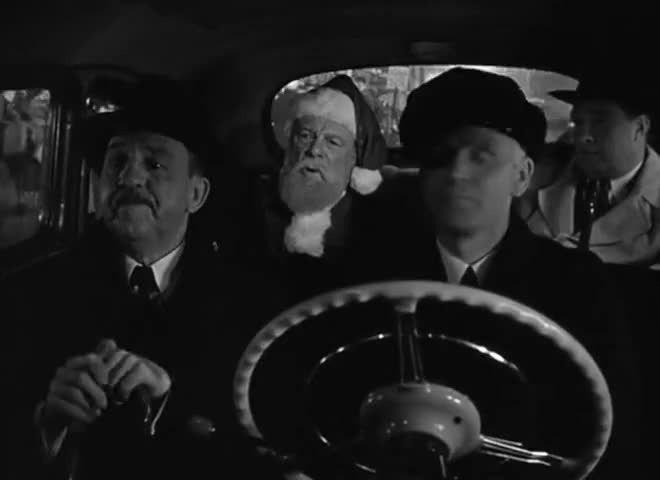
Bellevue ride

(The Introduction is here.; Chapter I is here.;Chapter 2 is here; Chapter 3 is here; Chapter 4 is here.)

Everything so far has been laying the foundation for the climactic and justly famous courtroom scene. But before that can happen, there needs to be a pretext for getting the story into court. Of course, the fact that Kris committed assault and battery on Mr. Sawyer would normally be enough to get him there on a criminal charge, but that wouldn’t have anything to do with Santa Claus, so we have a lot of dubious plot machinations that make no sense at all. in rapid succession—got to get to that courtroom scene!—we get…

Sawyer’s Perfidy

First, Sawyer acts like he’s been grievously wounded so he can credibly insist that Kris be committed. He’s a liar as well as a weasel. He’s also not very bright. He knows Macy’s has been using Kris a public relations cornucopia. He has to know that in any feud with a store Santa Claus who has made money for Macy’s, he’ll lose. Sawyer’s antipathy towards Kris to his own likely detriment makes no sense at all.

Doris’s Failure

Doris refuses to have anything to do with sending Kris to Bellevue, the NYC mental hospital, to be examined. She is, however, unlike Sawyer, responsible for Kris, and has said as much. Her duty is to Macy’s, and her employee attacked someone. This is where conflicts of interest get you in the workplace, and she should have seen this coming. Her job is to fix the problem, and instead she acts helpless. I find this to be nascent sexism in the film: “just like a woman,” Doris is being sentimental when she needs to be practical and decisive.

Actress Maureen O’Hara, a notorious tough proto-feminist, must have been seething.

Continue reading →

Thoughts On The Entertainment Industry’s Cultural Brainwashing Regarding Diversity.

15interracial

Statistics on this are inherently inexact, but approximately 8-9% of the marriages in the U.S. are interracial, and that’s including Hispanics and Latinos as “non-white.” However, if you have been watching movies, TV shows or commercials made in 2020, you would get the impression that the percentage is closer to 80-90%, and maybe higher. This parallel universe has been a special bonanza for actors of Indian extraction, who seem to be the default “lovers of color” that casting agents use when they have decided that another African-American-White mixed race couple would be boring.

I really don’t care if Hollywood and Madison Avenue want to create their own fantasy U.S. and madly virtue-signal at the same time, except that I don’t like having my arm twisted, metaphorically or for real. I would happily volunteer to be permanently dyed whatever generic color was decided upon if we could just stop all the posturing, excuse-making and drama over race; the sooner everyone is the same shade the better say I. It is, however, not the job of entertainers and ad execs to shove diversity down our throats., and that’s exactly what’s happening.

Right now, the situation is literally laughable. When we are watching a recent production in which a white character is about to introduce his or her significant other, my wife and I try to guess whether the Mystery Friend will be black, Asian, Hispanic. Indian, or just some kind of unidentifiable non-white. If a white actor shows up, our first thought is, “oh-oh, something’s wrong with this pair.”

The clear message being sold is that if you aren’t part of a mixed race couple, then you’re a racist.

That message is not fair or true.

Continue reading →

Morning Ethics Warm-Up, 12/15/20: Bye-Bye Bill Barr!

bye bye

1. Bill Barr’s resignation. The Attorney General is leaving, and so would I, in his place. Unlike his predecessor, who endured unprofessional and destructive sniping from the President, Barr decided enough was enough. He issued a respectful letter of resignation, and said “bye-bye.” This was in contrast with other digruntled Trump officials like Mad Dog Mattis, who lived up to his name with a resignation letter guaranteed to give the Trump-hating media more fodder. I assume the final straw was Barr raking fire for correctly not using the Hunter Biden investigation as a GOP campaign weapon. With even half-competent and responsible news media coverage, the Justice Department’s silence about what they are supposed to be silent about would never have been an issue.

The President’s lack of loyalty, respect and gratitude toward his staff and associates is one more ugly character trait that motivates his critics.

2. Another unethical bait-and-switch. I have written about this issue too many times to devote a whole post to it again.. Yesterday Republican Michigan Rep. Paul Mitchell told CNN that he will change his party affiliation to Independent because of President Donald Trump’s refusal to concede the 2020 presidential election and

Mitchell said he has put in a request to the Clerk of the House to change his party affiliation to “independent,” in an interview with CNN, and in a letter it is “unacceptable for political candidates to treat our election system as though we are a third-world nation and incite distrust of something so basic as the sanctity of our vote.” CNN, being incompetent, did not ask the necessary question, which is “Since you are lecturing the President and your party on ethics, why do you think it is ethical to run for re-election as a Republican, get the votes of Republicans in your district, and then change your party affiliation a month later?”

The ethical way to do it is to resign, and then run again under the new banner. A few party-switchers in the past have had the integrity to follow this procedure, notably former Senator Phil Gramm of Texas.

I would support a law requiring any elected official who switches party mid-term to have to resign. As the Ethics Alarm credo goes, “Where ethics fails, the law steps in.”

Continue reading →

Comment Of The Day: “’Miracle On 34th Street,’An Ethics Companion,Chapter 3: Kris Joins The Macy’s Family!” And An Explanatory Note On The Holiday Movie Ethics Guides

Grinch

As promised, I am finally completing the “’Miracle On 34th Street’ Ethics Companion,” which I began a year ago and took so long to complete that I ran out of 2019 holidays. As a refresher, I am also, in this post, presenting a Comment of the Day on Chapter Three from all the way back to January 1 of 2020, an excellent analysis of a feature of the story that I missed, by A.M. Golden.

Yesterday’s latest installment attracted some flack from commenters. “Wow, what a Christmas downer, Jack. Channeling Scrooge or the Grinch?” wrote one. “I suspect we could poke holes in any film with respect to morality and ethics if we wanted to.” On the last observation,

  • I want to, because it’s my job
  • Movies are excellent for tuning up ethics alarms
  • Christmas movies, which are seen by children, have a special obligation to teach the right lessons, both prominently and subliminally, and
  • No, in fact you can’t poke holes in any film, at least not fairly.

I suspect this will be the last of the traditional holiday film fare to get the ethics work-over, along with “It’s A Wonderful Life” and “White Christmas,” which will have the annual Christmas season re-posting with updated text up today. The three classics were chosen for different reasons. IAWL was designed as an ethics movie with very important and profound ethics messages, and the more one examines it, the more there is to think about. Nonetheless, its cheats on the way to its most important messages are pretty flagrant—justified, but flagrant—and deserve to be flagged. “White Christmas” is different: it’s a musical, for one thing, and musicals never make sense (why are these people singing?), but it also is story about ethics, so it is fair to examine it on that basis. Moreover, one doesn’t need to poke holes in it, the story is full of ethics holes. None of them bothered me before I became a full time ethicist: Bing Crosby and Danny Kaye are two of my favorite entertainers of all time, and the ending still moistens my eye. But the movie is almost impossible to watch now, with my ethics alarms on, and even with my brain on. I had an obligation to dissect it. As for “Miracle,” I accept it as a classic, but the story was constructed to reach the climactic trial gimmick, and scant attention was given to consistency or playing fair. Moreover, I am a legal ethics expert, after all. You can’t honestly expect me not to analyze a trial like that.

You will never see me try to “poke holes” in the greatest of all Christmas stories, and arguably the best ethics story period, “A Christmas Carol,” because it is pretty close to perfect. (AND I now see that the link to the text on the home page has gone bad; I’ll be fixing it ASAP!). “A Christmas Story” is off my list because it is seen through a child’s eyes, and ethics has nothing to do with it. Critiquing “Holiday Inn” would be like shooting ethics eels in a barrel, but it’s just not worth the trouble.

There are also holiday films and ethics films that are written superbly, and have few if any ethics holes to find. Among these are “Toy Story,” “Finding Nemo” (most of the Pixar movies, in fact), “Mary Poppins,” “The Sound of Music,” “Babe,” and even “Groundhog Day.” I’m not the Grinch, but if you set out to make an ethics movie, you had better pay attention to ethics.

Now here almost a year late, is A.M. Golden’s Comment of the Day on the post, “’Miracle On 34th Street,’An Ethics Companion, Continued…Chapter 3: Kris Joins The Macy’s Family!”

Continue reading →

“Miracle On 34th Street,”An Ethics Companion,Chapter 4: Is Kris Crazy, Or What? [Corrected]

Miracle-on-34th-Street-2

(The Introduction is here.; Chapter I is here.;Chapter 2 is here; Chapter 3 is here.)

When we last saw Kris Kringle, he had become a big hit at Macy’s by sending shoppers to Gimbel’s, and even was making inroads on young Susan’s precocious skepticism after she heard him speak Dutch. The story really begins going off the ethics rails at this point.

Doris decides that it would probably be responsible to have Kris checked out by the company psychologist, Mr. Sawyer, since her Santa is, after all, nuts. Yah think? In truth, it is per se irresponsible for Macy’s to knowingly employ a Santa Claus operating under the delusion that he is really Santa. The first authority a store would consult in real life, yes, even in the 1950s, would be a member of the legal department. If anything happened to a child in Macy’s store while sitting on the lap of a man who openly claimed to be a mythological figure, the lawsuits would write themselves. Thus the story really takes a turn toward an indictment of capitalism and corporate ethics: Macy’s is willing to put children at risk for some extra profit. Luckily, nobody has noticed in the past half-century.

Here we have a famous breach of competence by the screenwriter, George Seaton. While boasting to Doris about all the mental acuity tests he has passed, Kris says,

“I’ve taken dozens of them. Never failed one yet. Know them by heart. “How many days in the week?” Seven! “How many fingers do you see?” “Four!”….No damage to the nervous system! “Who was the first President of the United States?” George Washington! “Who was Vice-President under John Quincy Adams?” Daniel D. Tompkins! I’ll bet your Mr. Sawyer doesn’t know that!”

He doesn’t know that because it isn’t true. Tompkins was Vice-President under James Monroe, the fifth President, not Adams, #6. It drives me crazy when Hollywood allows historical misinformation to pollute the minds of the historically ignorant public, because there’s no excuse for it. Even before the internet, this fake fact could have been checked using any dictionary or encyclopedia. Nobody cared enough to bother. To make the mistake worse, John Quincy Adams’ VP was, unlike Thompkins, an important historical figure, John C. Calhoun.

Continue reading →

Dr. King’s King’s Pass

King sculpture

Maybe everyone knew this, but I sure didn’t. Or maybe most people didn’t know this because we aren’t supposed to know it.

The story came to my attention while discussing this post, about the title “Dr.” being used in dubious circumstances. I was looking at the degrees of other famous figures knows as “Doctor”—Dr. Ruth (like Jill Biden, just a doctorate in education, nothing medical) , Dr. Joyce Brothers (a PhD in psychology), Dr. Phil (once a medical doctor, but he lost his license), Dr. Laura (a degree in…physiology???) and others. Then a commenter mentioned Martin Luther King, Jr., who was frequently and still is frequently referred to as “Dr. King.” The civil rights icon had a doctorate in philosophy from Boston University (my Methodist minister father-in-law had a doctorate in theology from Harvard, and it never occurred to me that he was a “doctor,” nor did he ever suggest that anyone address him as such), but that’s only half the story.

I discovered this, from 1991:

Continue reading →