Believe it or not, that’s Sarah next to the bear….
To be absolutely transparent, my mind’s made up on this one: I think it’s unethical. However, I admit to be a hard-liner on this issue, which is “The duty of leaders not to debase their positions or former positions for personal gain or ego gratification.”
Let me introduce this horrific cultural episode by saying that I regard the TV show involved, “The Masked Singer,” among the Top Ten Stupidest Shows in the history of network television, and I’ve seen a LOT of network television, far more than is good for me. Its existence is an insult to the public, its taste and intelligence, and the United States of America. Maybe the species too. Adam and Eve.
Now here is the video clip. Consider yourself warned: it cannot be unseen or unheard:
Yes, Sarah Palin dressed up in a rainbow teddy bear suit and rapped “Baby Got Back” on national television.
The lyrics from Sir Mix-a-Lot’s Noel Cowardesque 1992 hit:
Oh, my, God Becky, look at her butt It is so big, she looks like One of those rap guys’ girlfriends. But, ya know, who understands those rap guys? They only talk to her, because, She looks like a total prostitute, ‘kay? I mean, her butt, is just so big I can’t believe it’s just so round, it’s like out there I mean gross, look She’s just so, black
I like big butts and I can not lie You other brothers can’t deny That when a girl walks in with an itty bitty waist And a round thing in your face You get sprung, want to pull up tough ‘Cause you notice that butt was stuffed Deep in the jeans she’s wearing I’m hooked and I can’t stop staring Oh baby, I want to get wit’cha And take your picture My homeboys tried to warn me But with that butt you got makes (me so horny)…
Nice. Classy!
Your Ethics Alarms Ethics Quiz of the Day:
Was Palin’s appearance on “The Masked Singer” icky, funny, or unethical?
Like accusations of racism and xenophobia, claims of sexism, gender bias and misogyny are increasingly useful to activists as swords as well as shields. Especially egregious recently have been the claims of Elizabeth Warren and her supporters that it was bias against women, and her not her own redolent awfulness as a candidate and a human being, that had the Massachusetts Senator running behind an ancient Marxist and poor, addled Joe Biden.
This is a problem when the objective is to build a fairer and a more ethical culture. Contrived accusations of sexism makes society more leery of genuine and justified complaints. Worse still is when alleged women’s activists shrug off or ignore the sexist attacks on women who they don’t admire or agree with.
The hypocrisy was in evidence when the repugnant HBO progressive scold Bill Maher referred to conservative women Sarah Palin and Michelle Bachmann as “cunts” and “twats” while his audience of enablers hooted. Feminist groups were silent until criticism from people like me (not me, but people like me who actually have more readers than the population of Mayberry) prompted a couple of them to make mild statements chiding Bill. Two years ago Democratic Congressman Cedric Richmond made a disgusting sexist joke about Kellyanne Conway, no feminist activists, nor Elizabeth Warren, Nancy Pelosi, Kamala Harris or any prominent progressive women, criticized Richmond. Conway, like palin and Bachmann, deserved to be denigrated because of their gender, apparently.
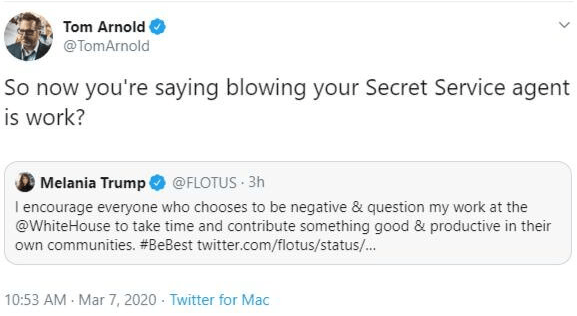
Over the weekend, B-list celebrity Tom Arnold issued this tweet:
This blog certainly forces me to defend some unsavory characters.
Woody Allen is one among the small group of artists who I find so personally repellent that I can’t enjoy their work even while recognizing and appreciating its excellence. That does not mean, however, thatAllen’s work is not important nor that his life and career lack cultural significance. As I wrote here,
“I found myself unable to enjoy any of Allen’s films after he cheated on his de facto wife with his de facto daughter. I also don’t believe in enriching, even indirectly, horrible people in their professional endeavors if I can conveniently avoid it.”
That, however, is a personal choice that I would never impose on others, nor on the arbiters and trustees of culture, as it would be unethical to do so. Thus I wrote, just a few days ago, of Ronin Farrow’s demand that his publishers refuse to hand Allen’s memoirs because he believes his sister’s account that Allen sexually abused her when she was a child,
“I yield to no one in my contempt for Woody Allen as a human being, but he is a major figure in film and cultural history, and his memoirs are of obvious value and interest. Farrow’s publisher’s obligation is to readers and stockholders, not the sensibilities of one author.”
Hachette Book Group on Friday dropped its plans to publish Woody Allen’s autobiography and said it would return all rights to the author, a day after its employees protested its deal with the filmmaker. “The decision to cancel Mr. Allen’s book was a difficult one,” a spokeswoman for the publisher said in a statement. “We take our relationships with authors very seriously, and do not cancel books lightly. We have published and will continue to publish many challenging books. As publishers, we make sure every day in our work that different voices and conflicting points of views can be heard.”
But she added that Hachette executives had discussed the matter with employees and, “after listening, we came to the conclusion that moving forward with publication would not be feasible for HBG.”
There are those pesky rationalizations again! Oh, it’s a hard decision, so that excuses it from being a bad decision. This is 19 B. Murkowski’s Lament, or “It was a difficult decision” again, which I reviewed yesterday. Next, we get this nauseating sequence, which perfectly embodies 64, Yoo’s Rationalization, or “It isn’t what it is!”
The statement says that “We have published and will continue to publish many challenging books. As publishers, we make sure every day in our work that different voices and conflicting points of views can be heard,’ and follows it up by saying that it will not publish this “challenging book” and thus this different voice and conflicting point of view will not be heard. Seldom does such complete hypocrisy define itself in the span of so few sentences.
The “difficult” decision that contradicts the company’s stated values results from nothing better than cowardly capitulating to a mob carrying out the goals of cancel culture. In this case, those goals include infringing on free speech and the public’s right to know, if they want to know. Our democratic ideals and the principles enunciated in the Bill of Rights have no chance of surviving if those who own and run companies like Hachette emulate the spineless administrators of educational institutions and dissolve into pools of passive submission every time holding to those ideals and principles threatens to entail a risk of sacrifice or adverse consequences. Continue reading →
It’s been a long day. But I still have some items to review in my waning moments of clarity…
1. Again, movie Bowdlerizing. Why does this keep happening? I know it was routine in the Sixties to bleep and cut vulgar words out of movies on TV, but even then it was a practice that marred films great and small, ruined the directors’ and the screenwriters’ craft, and warped character, humor and intensity. Now, when Congress members spit out charming epithets like “motherfucker” at will, the sensitivity to tender ears makes no sense at all. Why don’t studios and directors stand up for the integrity of their work? All the “Forget you!” exclamations are bad enough, but sometimes memorable exchanges are lost to dumb Puritanism.
Last night I watched the end of “Stand By Me” before I went to bed. In the climactic scene where Ace and his gang of hoods tries to take the dead body from the four 12-year-old protagonists, young Gordie LaChance (Played by a pre-“Star Trek” Wil Wheaton) points a revolver at the gang leader ( Kiefer Sutherland). When Ace accuses Gordy of bluffing, the mild-mannered kid cocks the gun and says, with chilling intensity, “Suck my fat one, you cheap dimestore hood.” That line was excised completely, as was the humorous retort by Chris (River Phoenix) after the gang retreats, “Suck my fat one? Who told you you had a fat one, LaChance?” To which Gordie replies, “Biggest one in four counties.”
2. More on Schumer… I’m desperate to find a full transcript of Schumer’s Senate remarks today defending himself against Mitch McConnell’s absolutely fair and accurate condemnation of Schumer’s threatening rant against the two Supreme Court justices yesterday. I heard it live this morning, and I thought, “Wow! This may be the most impressive array of non-stop rationalizations to try to excuse the inexcusable that I’ve ever heard!”
I know this: it culminated in #64, Yoo’s Rationalization or “It isn’t what it is, ” when the Senator said, “Of course, I did not intend to suggest anything other than political and public opinion consequences for the Supreme Court, and it is a gross distortion to imply otherwise.” Of course! It’s a gross distortion to imply that Schumer meant what the clear meaning of his words conveyed, rather than something that his words didn’t suggest at all. Continue reading →
Desperately trying to get this post out before the walls close in. I’m doing a program for an always receptive BigLaw firm in Atlanta, and its a program I know well, and I’m still anxious about it. It doesn’t help that I have some kind of cold, but the show must go on…
1. Super Tuesday musings…
Last night, I stumbled on a Fox News panel discussing the Julie Principle at length regarding Joe Biden’s brain farts and Trump’s Tweets! They didn’t use that term, of course, but it would have helped explicate what they were trying to say, which was that once you’ve decided to accept the flaws of a candidate, more evidence of those flaws won’t change your support.
Speaking of… Joe Biden got his sister and his wife mixed up during his victory speech. If there was ever a question of how much the country doesn’t want socialism, the fact that so many Democrats preferred to vote for this sad husk than capitulate to Bernie should answer it.
How proud I am of my home state, which told the world that even voters who know best, and presumably support to some extent, Elizabeth Warren don’t think she should be President. Thus they validated Abe Lincoln’s rule: you can’t fool all of the people all of the time. Warren was the 2020 field’s worst demagogue and biggest hypocrite, as well as one of the most shameless liars. As I write this, she hasn’t dropped out yet, perhaps because she doesn’t want to help Sanders, whom she still resents for saying that a women couldn’t be elected President. Well, he was right as far as she is concerned. Good.
Warren was easily my least favorite of the Democratic contenders from an ethics standpoint. After I posted on Facebook about one of her many deceptions, a friend, apparently seriously, commented that I seemed to have a real bias against her. It reminded me of one of Martin Short’s brilliant improvs as idiot celebrity interviewer “Jiminy Glick,” when he cracked up Mel Brooks by asking, “Now what is it that you have against Hitler?”
2. Wait, he did WHAT??? Cedric Sunray, a college recruiter from Oklahoma Christian University, visited Harding Charter Preparatory High School in Oklahoma City last month and met with 110 juniors and four teachers in the gymnasium to talk about opportunities at the college. He then asked the students to line up from darkest to lightest skin complexion, and then line up from “nappiest” to straightest hair. As the students lined up, some of the teachers left to report the request to school administrators, who intervened. Sunray was quickly fired.
Sunray later wrote that the exercise was meant to be an “icebreaker” and that he has made the same presentation dozens of times at other institutions. Really? And nobody complained?
The president of Oklahoma Christian University, John deSteiguer, visited the prep school to apologize to students and staff members. Too late, I’d say. Any school that would let someone like Sunray represent it is too inept to be trusted. Continue reading →
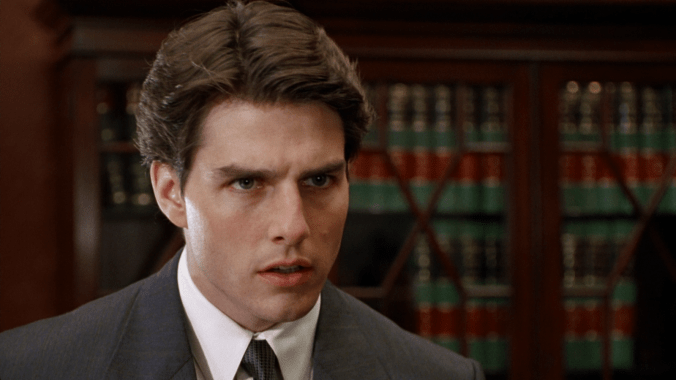
Remember how, in the film adaptation of John Grisham’s “The Firm,” the young lawyer Mitch McDeere (Tom Cruise)who is trapped in a mob-owned law firm wiggles out of his dilemma in part by proving that the firm’s lawyers were routinely over-billing clients?
Judge Mark L. Wolf concluded that the two firms double-billed for their attorneys’ work on a class-action lawsuit involving State Street Bank, and even billed for the work of other attorneys not employed at either firm. Thornton’s managing partner, Garrett Bradley, listed his brother as an attorney on the case and charged $200,000 for his time even though Michael Bradley was barely involved. Uncovering this scandal was another triumph of the Boston Globe Spotlight Team, the investigative reporting division that uncovered Boston’s predator priest cover-up in 2002. Continue reading →
For some reason there has been a breakdown of civility in the comments lately. This has happened from time to time; something in the air or too many social media rants or something; I don’t really care. You all know where the lines are; you cross them intentionally when you cross them. I appreciate the use of a vulgar word or harsh phrase as much as anyone; “asshole” is particularly tempting, because there is no non-vulgar term that quite captures the essence of its meaning. I also prefer to keep moderation light here, and for the most part, the select commenters who have passed my standards and answered the three questions at the bridge correctly usually make me proud, especially when I see what crawls onto other sites’ comment sections. The would-be Ethics Alarms participants who send in entries like “Your a Trump-loving fuckface LOL!” are all stacked up in the spam vault, and you would not believe how many of those I have to read to maintain the high level of participants here. I do not care to read that kind of gutter residue on the blog itself.
I just trashed a full comment by a regular commenter here, something I have not done in over ten years, and I’m not happy about it. Let’s keep that lapse the anomaly that it is.
1. From the “When ethics alarms don’t ring” file. Pop Quiz! If you were on the staff of a fashion show about to begin at what the New York Times calls “New York’s famed Fashion Institute of Technology”—which I have never heard of—and several of the models appeared backstage preparing to go out looking like this…
…what would you do?
The answer is that no matter how high or low you were on the metaphorical totem pole, you would be obligated to throw a fit, phone the brass, tell everyone in sight that they are out of their minds, and do everything short of calling in a bomb threat to halt what you know without a shadow of a doubt will result in a public relations disaster.
Incredibly, not a single person raised the obvious objection except an African-American model-who refused to don the giant lips and monkey ears. After the predictable uproar, two F.I.T. administrators were suspended, and the school’s president, Dr. Joyce Brown (who is African-American) issued a public statement admitting that the Feb. 7 show, intended to demonstrate the work of recent graduates of the school’s M.F.A. program, “failed to recognize or anticipate the racist references and cultural insensitivities that were obvious to almost everybody else.”
Wait—if they were obvious to almost everybody else, why were they not obvious to anyone involved in the show?Continue reading →
Rationalization #11, The King’s Pass or The Star Syndrome, is more than a rationalization. For America’s celebrities, star performers and elite athletes, the super-wealthy and the politically powerful, it is a way of life. From the description on the Rationalizations List: “Celebrities and powerful public figures come to depend on it. Their achievements, in their own minds and those of their supporters and fans, have earned them a more lenient ethical standard. This pass for bad behavior is as insidious as it is pervasive, and should be recognized and rejected whenever it raises its slimy head.”
Most of the time, however, the King’s Pass is not rejected, and as long as the miscreant involved hasn’t dared to wind up on the wrong side of a political divide, his or her fellow “kings” will make the biggest stink since the skunk factory exploded when one of the elite club is forced to tow the lines drawn for their inferiors.
Two weeks ago, Carolyn Baumann was forced to resign as the director of the Cooper Hewitt Smithsonian Design Museum in Manhattan after a government investigation found that she had engaged in conduct connected to her wedding that made inappropriate use of her position for personal benefit. The Smithsonian’s inspector general had looked into irregularities regarding the procurement of her wedding dress and the wedding space after a complaint was made by a museum staff member, and didn’t like what he found. Continue reading →
If you don’t know what I’m talking about, you should. Frederick is the overly duty-conscious and somewhat dim-witted hero of Gilbert and Sullivan’s “The Pirates of Penzance,” one of the Savoy duo’s so called “Big Three,” the Victorian operettas that have been performed the most over the years. (The other two are “H.M.S Pinafore,” and the currently unfairly besieged—but arguably the best of them all—“The Mikado.”) They aren’t my three favorites, mind you, but like seven of the other G&S masterpieces, they are damned good, and have aged better than most American musicals, especially the Rogers and Hammerstein classics. Poor Frederick was apprenticed to a pirate until his 21st birthday, but due to a cruel twist of fate and legalistic nit-picking, his 21st birthday didn’t arrive until 1940, because he was born on leap year. Today is his 41st birthday, though he is 164 years old.
I apologize for the stupid subtitles in the clip from the movie. Unlike most G&S performers, the diction of Kevin Klein, Rex Smith and Angela Lansbury is excellent.
(I’m hurrying because I’ve learned from cruel experience that traffic on Saturday after 12:30 slows to crawl..)
1. Thus ends Black History Month. I do not favor tribal distinctions in our days and months. It is inherently divisive, and Black History Month smacks of honors affirmative action. The history of black Americans is American history, inextricably intertwined with the history of the rest of us. Our entire history ought to be taught and learned without bias and spin, and no race or ethnic groups should hesitate to take pride in the accomplishments of other Americans regardless of their color or ancestry.
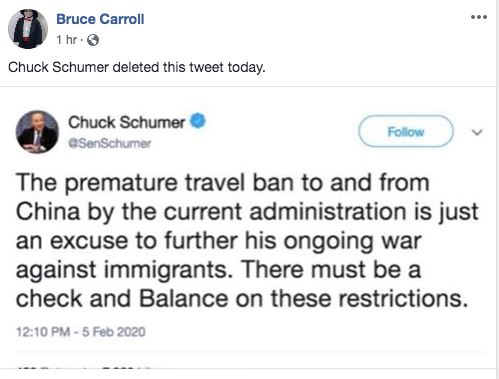
NOTICE of CORRECTION! Item #2 below has now been shown to have been based on a hoax. More after…
2. Res ipsa loquitur:
Obviously the note in Chuck’s tickler file came up: “Today transition from saying Trump was doing too much in response to the Corona virus to saying that he isn’t doing enough.”
What awful, awful hacks these people are.
They are still awful hacks, but I hate being caught by these hoaxes. This one was especially sinister, because the fake tweet is completely consistent with what the Democrats and the news media had been saying about the President’s move to stop travel from China. However, insisting that a faked message is still “true enough” is what Dan Rather did in the scandal that ended his career as a respectable journalist.
We now know that the tweet is a hoax because ProPoblica, a nonprofit journalism organization, maintains a database of tweets deleted by politicians called Politwoops that uses Twitter’s Streaming API to find tweets from politicians that have been deleted. Schumer’s tweet is NOT in the database, thus we know it wasn’t posted.
[T]here are the Tilli Buchanans among us, who want to tear down social norms, not really knowing what the consequences will be over the long term, just for the hell of it. In addition to being irresponsible and disrespectful, they are also lousy citizens.
They are not, however, criminals. She should be able to walk around naked in front of her children, just as we allow parents to engage in all sorts of other dubious practices. That she can doesn’t mean she should, but this is part of a long, long list where we must rely on ethics rather than law.
Facing being placed on a sex offender registry for 10 years, Tilli agreed to a plea deal with her pleading guilty one class B misdemeanor lewdness charge and paying a $600 fine while serving probation. The charge will be dismissed if Buchanan can keep her shirt on for a year.
4. More “The rest of the story,” uber-jerk division. In 2018, Saturday Night Live performer Pete Davidson mocked GOP Congressional candidate Dan Crenshaw for his eyepatch, the result of a combat wound. Davidson said that he looked like “a hitman in a porno film” and dismissed the origin of his disfiguring injury as something he got in “war or whatever.” Veterans, their families and others who don’t usually pay attention to SNL anymore since it has become partisan, shrill, and lazy protested loudly, and Davidson apologized while Crenshaw appeared on a later show, where he was funny, gracious, and forgiving
It was obvious to me (and, I’m sure, Crenshaw) that Davidson was forced to apologize, but it takes a special breed of jerk to come back after he has left the scene of his insults and say so.
In Davidson’s new stand-up special, “Alive from New York,” Davidson, says,
“So I made fun of this guy with an eyepatch and then, like, I kind of got forced to apologize. My roommate thought I should apologize so that I didn’t get shot in the face. People were like, ‘You hate America!’ And I’m like, ‘No, I just didn’t want to be incorrect about how he lost his fucking eye. Is that a crime?! The only thing I did do, which I am guilty of — and I apologize for — is I did make that guy famous and a household name for no reason, right? I did what, like, Ariana Grande did for me, right? I sucked his dick at ‘SNL.'”
This is what you lost your eye for, Dan.
5. You could show this to your Bernie Bros friends, but I doubt they could understand it. At the Foundation for Economic Education, J. Kyle de Vries does an excellent job of explaining the Social Security cheat, and why it has to be reformed. The system no longer makes sense, but the socialist enablers refuse to consider the problem. de Vries writes in part,
Millennials and Generation Z: Do you want to fund my Social Security benefits with higher payroll taxes than I paid in the past? Especially when the likelihood is high that your benefits are not going to be as lucrative as mine?
I am lucky. My Social Security benefits will be funded by you and other workers, and I plan on living to 140. If you are younger, that should concern you. Right now, you and your employer are forced to contribute 12.4 percent of your income into a fund that goes into a black hole, financing some other guy’s retirement. Wouldn’t you rather put that 12.4 percent into a fund you manage?
…Assume a self-employed 25-year-old makes $75,000 this year. Further assume she is required to set aside 12.4 percent of her income into a protected, tax-deferred trust, just as she must do for Social Security. But this is her account, managed by her, just like a 401k plan. If she realizes a 3 percent increase in income each year and can earn 6 percent on a conservative mix of stocks and bonds during her lifetime, her trust will accumulate to over $3,500,000 at age 70. At 8 percent growth, that number will be an astounding $6,142,000.
Would you rather have accumulated these much larger sums to augment your retirement income than get the average $1,500 per month Social Security check issued today? Lesser potential income is just one of the problems with the present system.
…Contrary to popular belief, payroll taxes are not invested in a fund to secure benefits like most other pension plans. Since the beginning, payroll taxes went first to make payments to current retirees with the balance “borrowed” by the feds for spending on things other than Social Security benefits. For most of the program’s history, the amount of payroll taxes the feds received was much higher than the Social Security payments, meaning the feds had a lot of money to spend on other things. Because of demographics, that situation has changed perilously, threatening the future of the Social Security system.
…What all this means is millennials and Gen Zers will see higher taxes for Social Security across the board, perhaps many times. They will also most likely see reductions in promised benefits, especially if they accumulate a lot of money over their working lifetimes.
…Wouldn’t you rather have your own retirement fund you manage yourself instead of the flimsy promise of government IOUs? Increasing payroll taxes today only delays the day of reckoning. The current unfunded liabilities for Social Security are over $34 trillion. Let’s not double down on a failed experiment that will bankrupt our country in the future and leave millions destitute in retirement.
Wouldn’t it be nice if Donald Trump was articulate enough and organized enough to explain this in a debate, or in a national address to the public? Wouldn’t it be nice if young voters would pay attention, and if the news media could report on the issue fairly?
Wouldn’t it be nice if I could fly to Disney World by flapping my arms really hard?
Not thrilled to be up before Virginia’s sunrise, but looking forward to it…
1. It’s sad what happens to Ethics Alarms expatriates...One upon a time, uber-progressive blogger/cartoonist Barry Deutsch, aka Ampersand, was one of the most prolific, open-minded, articulate and reasonable commenters here. Then Barry banned himself because he didn’t like my pointing out that his blog is an echo chamber, after he censored my comment there noting that his SJW throng’s position on the Trayvon Martin-Zimmerman affair was intellectually dishonest. So Barry retreated to his self-made bubble. I check in on him now and then, and that admirable open-mindedness has disappeared in the marinade of relentlessly woke and intolerant fans.
Here’s how bad it is for Barry: this what he wrote on his “Alas! A Blog”recently: “Conservatives are against all immigrants (or at least all non-white immigrants), not just unauthorized immigrants.”
Tragic. Barry Deutsch now believes that anyone who disagrees with his far left world view is a racist. The Ampersand who followed Ethics Alarms would never think such a thing, much less publish it.
2. The trouble with billionaires. The class warfare being fomented by Bernie Sanders and others for a cynical and destructive power grab is an old formula that, when it works, always brings chaos in its wake. Throughout history, it has succeeded more often than basic economics and common sense would dictate in part because so many of the ultra-rich persist in being jerks. Does being a jerk make one more inclined to get rich, or does becoming extremely rich have a tendency to make one a toxic jerk?
That’s a question for the ages, but the behavior of people like billionaires Peter Nygard and Louis Bacon make things easier for class warfare demagogues like Sanders, Elizabeth Warren, and Rep. Ocasio-Cortez, just as it did for Lenin and Robespierre before them. This story, about their absurd and costly feud, illustrates how extreme wealth can permit one’s ethics alarms, not to mention sense of proportion, go dead.
The Bahamian pleasure palace featured a faux Mayan temple, sculptures of smoke-breathing snakes and a disco with a stripper pole. The owner, Peter Nygard, a Canadian fashion executive, showed off his estate on TV shows like “Lifestyles of the Rich and Famous” and threw loud beachfront parties, reveling in the company of teenage girls and young women. Next door, Louis Bacon, an American hedge fund billionaire, presided over an airy retreat with a lawn for croquet. Mr. Bacon preferred hunting alone with a bow and arrow to attending wild parties, and if mentioned at all in the press, was typically described as buttoned-up.
The neighbors had little in common except for extreme wealth and a driveway. But when Mr. Nygard wasn’t allowed to rebuild after a fire, he blamed Mr. Bacon. Since then, the two have been embroiled in an epic battle, spending tens of millions of dollars and filing at least 25 lawsuits in five jurisdictions. Mr. Nygard, 78, has spread stories accusing Mr. Bacon of being an insider trader, murderer and member of the Ku Klux Klan. Mr. Bacon, 63, has accused Mr. Nygard of plotting to kill him.