I had a friend who was sure the lyrics were about “ducks in the wind.” Dust, ducks, dusk…whatever. Never liked the song, but it suits my mood after today’s farewell to an old friend, maybe the sweetest person I’ve ever known or ever could know, at Arlington. Here were old friends, many who hadn’t seen each other in many years, standing around, six or more feet apart, trying to talk through masks and to recognize each other.
This is no way to live.
1. I have to say this: At a time when Gilbert and Sullivan is being “cancelled” by the sick combination of hyper-sensitivity to fantasy gender stereotypes and the ignorant belief that “The Mikado” is racist—morons!—I should not be forced to listen to Lifelight’s badly set, forced, incompetent parody of “The Major General’s Song.” I could write better lyrics than that, yes, even about vegetable meat substitutes, with half my brain tied behind my back. There’s no excuse for such lazy, lousy writing, especially for compensation. Was the writer the company CEO’s 12-year-old niece? Gilbert and Sullivan were geniuses; their work shouldn’t be desecrated like that.
2. Shut up, David. David Price, who couldn’t be bothered to play baseball and help relieve the public’s stress for a paltry 10 million dollars, is home and sniping at Major League Baseball for not shutting down after 14 members of the Florida Marlins tested positive for the Wuhan virus. Well, some of his colleagues need their salaries, unlike Price, who has a 150 million or so in the bank unless he has a gambling habit, and baseball, to its credit, is determined to gut it out, much as it did during the 1918 Spanish Flu pandemic. Good. Thank-you.
3. How can anyone take an award seriously that does something like this? On the other hand, it’s comforting that after all these years, the Kennedys are still hyper-partisan, hypocritical, and silly. 2020’s Robert F. Kennedy Human Rights Ripple of Hope Awards, which supposedly honors “changemakers” who are advancing human rights, equality and justice, have been awarded to, among others, Dr. Fauci and Colin Kaepernick. The Kennedys’ game could not be more transparent if they admitted it. Kaepernick, whose questionable contribution to human rights has been kneeling where he shouldn’t and cashing in with Nike, but he’s a walking Black Lives Matter ad, and so it’s a poke in the President’s eye. As for Fauci, the message is that he’s brilliant, so Trump is the reason why the pandemic has raged.
Here are some recent award winners: Obama, Hillary Clinton, Joe Biden, and Nancy Pelosi. Continue reading →
1. I don’t understand this behavior at all. Who are being more irrational and anti-social, the fanatic mask police, or the renegade maskless? Clearly the latter. Take this story, for example :near El Paso, Texas, customers retaliated after they were asked to put their face masks on inside Dapper Doughnuts at the Fountains at Farah. Surveillance footage shows an unmasked couple arguing with Dapper Doughnut staff, then throwing a box of doughnuts at the woman for asking them to comply with the City of El Paso’s mandate that anyone over the age of two must wear face masks inside public buildings or public outdoors spaces if social distancing is not an option. Sure, I think it’s quite possible that we’ll eventually learn that the whole mask fiasco was hooey, but, 1) if it makes others feel safer, fine, and 2) a business has every right to require them. There is no ethical argument for not wearing masks around others in public, and absolutely no excuse for throwing tantrums over it.
Yet I am reading about this kind of incident virtually every day.
In the silliness above, the people who snapped like twigs in the wind demanded a refund—for the doughnuts they threw away?—and when that demand was refused, they stole the change mug.
2. Unfortunately, I don’t have a clip of someone saying, “Hopeless! Hopeless!” Polls on the Presidential race have now reached maximum absurdity. In the same day, last week, I saw one poll showing Trump behind Biden by 12 points, and another one with him within two. When the “science” is that unreliable, it’s time to stop feauring polls as “news.” You might as well interview psychic. The news sources, naturally, treat whichever poll they want to be true, as true.
However, until Joe Biden comes out of hiding, gets questioned routinely by interviews not tossing softballs, and picks a Vice-President, no poll relating to him has even passing credibility. He is essentially that always popular candidate called “anyone other than Trump” at the moment, even though whoever he chooses as VP will be a) presumed to be the real Presidential candidate by much of the electorate, since about half think he’s one or two ticks from wearing his shoes on his face, and the other half will come around once they see him trying to speak without a teleprompter. Did you read about Joe saying that most people don’t distinguish between Asian nationalities? If Dr. Seuss were alive, he’d write a kids book called, “Oh, the Gaffes You Will See!” and b) will immediately alienate a significant group of voters. Continue reading →
The Barn Door Fallacy is one of the most striking example of persistent human and bureaucratic incompetence, as well as one of the most destructive.
It is just as illogical as the old saw it is named after, yet the reflex reaction to almost every accident, tragedy or chaotic event is to immediately adopt extreme measures that are deemed necessary to prevent what has already happened. This occurs despite the fact that most such events were in situations already operating with known risks and virtual certainty that the disaster that eventually prompts the Barn Door response would occur. Nevertheless, taking reasonable measures to prevent the catastrophe is somehow never recognized until after the bodies stack up, and then being reasonable is no longer an option.
Examples of this phenomenon, a triumph of incompetence, emotion and fear of responsibility over responsibility and reason, abound: the aftermath to 9/11, the over-reaction to the Oklahoma City bombing; the end of airship travel after the spectacular explosion of the Hindenburg, the death of nuclear power in the wake of Three Mile Island and Chernobyl. The pandemic will undoubtedly lead to some manifestation of the Barn Door Fallacy. It even infects sports: all it took was a televised career-threatening injury to a franchise star catcher to make Major League Baseball drastically alter the rule regarding collisions at home plate, and a freak accident breaking the leg of a player in a take-out slide at second base during post-season play-offs to prompt MLB to ban a routine aspect of the game—and an exciting one— practiced and accepted for over a hundred years. Continue reading →
Bulgaria has a holiday called “July Morning” that celebrates freedom, friendship, and love of life.
Maybe I’ll move to Bulgaria…
1. I cannot believe this doesn’t alienate more people than it pleases. I watched the Red Sox-Orioles game last night to open the Strangest Baseball Season Ever in Boston, and would have enjoyed it completely ( the Sox won 13-2) had I not had to constantly avert my eyes from the Red Sox management’s ostentatious virtue signaling, if you can call it that, since pandering to Black Lives Matter is far from virtuous.
Not only was the special BLM MLB logo at the back of the pitcher’s mound (BLM MLB is a palindrome!), but the full Black Lives Matter name was emblazoned on a banner, about 250 feet long, across the empty bleachers.
I’d love to know how many Red Sox executives, or if any of them, actually know what the “movement” the team is pimping for intends. My guess is that the decision to promote BLM was a cynical go along to get along decision that had nothing to do with substance, but rather was made in fear and expediency.
2. On the Fox News harassment accuser. The sexual harassment lawsuit filed against Tucker Carlson by Cathy Areu now appears to have fatal flaws. Continue reading →
I am most grateful—I think—to Ethics Bob Stone for bringing this story to my attention. It gives me hope, it really does, that we are quickly arriving at the point where the George Floyd Ethics Train Wreck will be revealed to all as being driven and enabled by people so silly and stupid, that there will be an ear-splitting slapping sound across the land, as Americans of sense and perspective bring their palms to their foreheads in the humbling realization that they have been taking seriously the blathering of fools and ignoramuses.
And with a ripple of embarrassed laughter, the suddenly enlightened will immediately begin going about life as they once did, devoid of self-flagellating guilt for believing in a land and a system where people are, or should be, judged by their talents, enterprise, accomplishments and the content of their character, and not, whether black, Black, white or other hues and shades, the color of their skin, their ancestors, or what their ancestors did or didn’t do. Thereafter this period of unrestrained hate and statue-toppling, the cancel culture, fear, groveling, virtue-signaling and grandstanding will come to be known as “The Great Stupid,” and we will collectively wonder, as with the Dutch Tulip Mania of the 17th Century and Disco, how the Hell something so mad could have happened, and for so long. Continue reading →
After Gabe Kapler opened the kneeling gates, and the sickening green light from Major League Baseball allowing, indeed encouraging, player to parade their social, political and partisan views on the baseball field, I assumed that my home town team, the Boston Red Sox, would buy a first-class ticket on the Woke Train, nauseating many in the process. The Boston franchise has been awash with guilt since it was more than a decade late in breaking the color line, finally promoting journeyman infielder Pumpsie Green to the Show after every other team had added at least one black player. In addition, we must never forget that this is Massachusetts, where citizens continued to elect Ted Kennedy to the Senate knowing full well that he lied his head off while ducking accountability in a clear-cut case of manslaughter. I love it dearly, but the Bay State is the land of symbolic liberalism at any price, appropriate or not.
Thus it was not a shock to see the Red Sox unveil a massive pro-Black Lives Matter billboard this week. The 250-foot thing is adjacent to Fenway Park, and facing out to the Massachusetts Turnpike. The huge sign reads “Black Lives Matter,” with the team’s logo at the end. The billboard includes the URL of the Red Sox Foundation website, where Red Sox President and CEO Sam Kennedy has a statement titled, “Social Justice, Equity and Inclusion.” It is illogical, virtue-signaling pandering. You know: the usual. Continue reading →
Only slightly more disgusting than this truncated season’s use of the abortion of an extra-inning rule that will put a runner on second base to begin extra innings in tie games are MLB’s “social justice promoting” regulations for players.
It makes me physically ill just having to post them.
Baseball announced guidelines today allowing players “to support social justice and diversity and inclusion” on the field—also on their own, but I don’t case waht players choose to do a private citizens, as long as they don’t abuse their postions as baseball palyers. “MLB supports the players’ need to express themselves,” we are told.
Yes, the NFL and NBA have poisoned baseball.
Players have no need to express themselves politically on the field, and should not be allowed to do so. But Major League Baseball, as it has been most of its existence, is run by venal fools, and they are terrified by the players union. The announcement of the green light for players to be overtly political while the game allows promotion of the racist organization sparking violent riots and vandalism across the country just happened to be announced almost simultaneously with an expanded play-offs format. Continue reading →
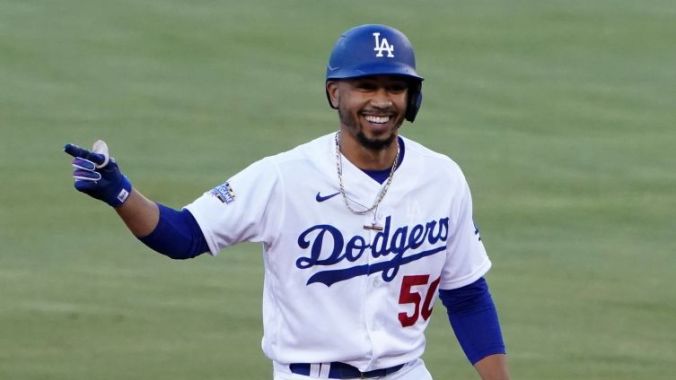
It is being reported that the Los Angeles Dodgers are about to sign an extension with new right-fielder Mookie Betts, acquired over the winter in a stunning trade with the Boston Red Sox, for an estimated 12-13 year contract at about 35 million dollars a year.
When I was giving my lecture to the Smithsonian about baseball this week, I mentioned writer Bill James’ argument that baseball is not “just a business” as detractors like to say. He has pointed out that because baseball’s market does not treat it as a business, but as a pastime, entertainment, a cultural touchpoint and a community institution, baseball teams are not run as rational businesses. Indeed, they are frequently run irresponsibly and incompetently, based on emotion and sentiment.
‘Twas not always thus. In the early days of professional baseball right up the end of the Calvin Griffith era in Minnesota, many teams were run as the sole sources of income by their owners, though by the time Griffith died, he was the last of that species. Beginning with Tom Yawkey’s purchase of the then perennial doormat Red Sox, however, the baseball owner as community philanthropist was born. Yawkey was a rich lumber tycoon, and he spent money lavishly on Boston teams to win games and make fans happy. He certainly increased the value of his sports franchise asset, but from a business standpoint his management was often irrational.
The Dodgers contract with Betts is in this tradition. Betts is a free agent after this year; that’s why the Red Sox traded him, because he was going to put himself up for sale to the largest bidder. The Dodgers sensed that the virus-truncated season changed the equation for them and the player: Mookie, one of the most talented, productive and likable players in the game, would not have a chance in 60 games to enhance his value, and each year passed for a player is depreciation. Betts will be 28 this season, and most players peak at that age. Continue reading →
1 .Another shoe drops: The Boston Red Sox announced that they would “support” any players who chose to kneel during the National Anthem when The Strangest Baseball Season since World War II, when teams fielded 16-year-old infielders and one-armed outfielders, commences tomorrow. The announcement was no surprise, and this team in particular had little choice.
Boston’s AL team is forever viewed with suspicion on race issues because it was the last major league team to break the color line, and because it passed on opportunities to sign some of the early black stars. Last season a visiting player claimed to hear a racist slur hurled his way from the Fenway Park bleachers, and the Red Sox management has been ostentatiously “woke,” cancelling Tom Yawkey from the Fenway environs though the team owes its existence to the long-time owner’s beneficence. He was rumored to be a racist, however, and that was enough to justify erasing his name (except from his initials in Morse Code on the scoreboard).
2. Bad service only matters for drug stores, apparently. State regulators in Oklahoma cited and fined CVS for conditions found at four of its pharmacies, including inadequate staffing and errors made in filling prescriptions. Staffing just about everywhere is unfriendly to consumers—indeed, most stores were understaffed even before the lockdown, now half-lockdown while the teachers extort the country.
Our local CVS, where I have many ethics adventures, now has minimal staff, including in the pharmacy, because there are so few customers lately. Hilariously, the store’s auto-scan checkout option is one of the features that requires staff: the damn things don’t work half the time, or a staffer has to lead some confused senior through the process.
3. Unfortunately, it’s more difficult than ever to believe sexual harassment allegations. #MeToo so egregiously overplayed its hand and has been so schizophrenic in its standards that I have to look at any high-profile allegations as potentially motivated by politics. In an action that must have been well underway before the Washington Redskins suddenly caved and agreed to change the team’s name (yet another poll, a new one, has indicated that the vast majority of football fans and Native Americans have no problem with “Redskins”), 15 female ex-employees told The Washington Post that they were sexually harassed while working for the organization. Shortly thereafter, a Fox News staffer and periodic on-air guest filed suit in federal court alleging they had been harassed or raped by Ed Henry, the Fox News reporter who was fired for “willful sexual misconduct in the workplace,” The suit also alleges harassment by Tucker Carlson and Sean Hannity, the latter perpetually on “the resistance’s” hit list and the target of boycotts, and Carlson recently becoming a force as a pundit. Therefore he must be destroyed.
Do I find it hard to believe that the Redskins, or any NFL team, has a culture hostile to female employees? No. Do I think that Fox News has effectively banished its pervasive workplace sexism and misogyny since the forced exits of the late Roger Ailes and Bill O’Reilly? Absolutely not. Do I think weaponizing sexual harassment allegations has become a predictable and unethical tactic on the Left, (See: Mathews, Chris) thus making the timing of both of these sets of complants suspicious?
Is Bismark a herring?*
4. More things now as predictable as they are indefensible. The University of Southern California’s School of Cinematic Arts will remove its John Wayne exhibit as part of the school’s efforts to address “systemic racism” in society with obnoxious, shallow and foolish gestures.
The Duke graduated from USC, of course (he was raised in Iowa), and the justification for his dishonoring was an admittedly dumb interview he gave Playboy in 1971, where he was obviously (to me, anyway, at the time) trolling a liberal and hostile magazine by saying exactly the kinds of things the Wayne haters expected him to say. (I always assumed he was drunk during that interview.) This move by USC was expected—California, universities: you know, morons. As Spiked noted, Wayne’s importance to the culture and the history of film by virtue of his on-screen portrayals should not be diminished by any interview the actor did.
As an actor and a director,Wayne was careful to portray characters who respected blacks and other minorities as human beings. In “The Cowboys,” for example, he is routinely reprimanded and shown up by his black cook, played by the great Rosco Lee Browne. In many movies, like “McClintock!,” “Hondo” and “Fort Apache,” he demonstrated sympathy and respect for Native Americans; Wayne also prominently featured Chinese-American actor H.W. Gim in his films whenever feasible from 1942 on, notably as his landlord Chin Lee in “True Grit.”
If his character was a racist, Wayne didn’t hesitate to represent racism negatively, as when he opposed his black ranch hand (Woody Strode) learning to read in “The Man Who Shot Liberty Valence” because Wayne’s character is hostage to archaic traditions, or when he seems determined to murder his white niece (Natalie Wood) because she has lived with Native Americans and presumably had sex with a chief.
All of John Wayne’s wives were also Mexican, meaning that his four children are “Persons of Color.”
Never mind. Wayne’s legacy and hold on the culture is unbreakable. Just last week I stumbled about four of his films on cable. They’ll get Mt. Rushmore before they shoot down the Duke. [Pointer: Pennagain]
__________________________
*Cultural literacy bonus points for identifying the source.
Yeah, I knew it was probably coming, and I even should have been able to guess the team and the manager, but nonetheless, this is nauseating. I assume the craven response from Major League Baseball in the coming days and weeks will be even more nauseating. Great. Welcome back, baseball!
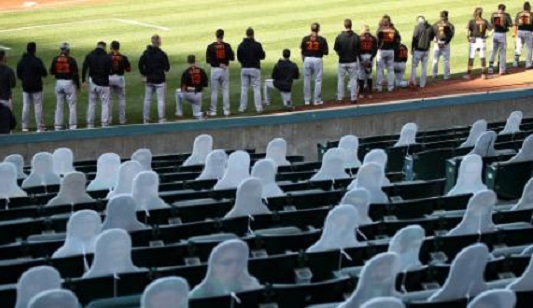
San Francisco Giants manager Gabe Kapler led several coaches and team members as they did a Kaepernick during the National Anthem before their first exhibition game in the Bay Area Monday. And I had just finished my Smithsonian presentation that night explaining why baseball has been a vital unifying influence in communities and the nation throughout its nearly 200 year history. How ironic.
Rookie manager Kapler, coaches Antoan Richardson and Justin Viele joined players Mike Yastrzemski (Yes, Yaz’s grandson), Austin Slater, and Jaylin Davis in taking a knee, according to NBC Bay Area. Shortstop Brandon Crawford stood between Richardson and Davis, who are both black, and placed his hands on their shoulders in an apparent sign of support.
Although the Giants did not announce before the game against the Oakland A’s at Oakland Coliseum that some members would kneel, Kapler said he had informed the team of his plans. Then he blathered out his explanation, which while considerably more coherent than what Colin Kaepenick said after the first time he imposed his political views on his team, the game, and spectators were offensive nonetheless.
None of those cardboard cut-out people in the stands would go on the record later, but reportedly they were not pleased.
Here’s Gabe:
“I wanted to share what my plans were and I did that because I wanted them to know that I wasn’t pleased with the way our country has handled police brutality. I told them that I wanted to amplify their voices and I wanted to amplify the voice of the Black community and marginalized communities as well. I told them that I wanted to use my platform to demonstrate my dissatisfaction with the way we’ve handled racism in our country. I wanted to demonstrate my dissatisfaction with our clear systemic racism in our country. And I wanted them to know that they got to make their own decisions and we would respect and support those decisions. I wanted them to feel safe in speaking up, and so we had these kinds of discussions for the last several days and will continue to have them.”
Asked if he and other Giants would continue kneeling, Kapler said, “We’re going to have 60 chances during the regular season to make the same decision that we made today, to either stand or kneel or do something different.”

 s
s

 Ethics Alarms