Morning Ethics Warm-Up, 5/29/2021…Down The Rabbit Hole! An Unethical Ghost, A Stupid Newsreader, And A White-Hating Dean Walk Into A Bar….

Rabbit

Ghost Ethics! I just watched an Amanda Seyfried Netflix movie called “Things Heard And Seen,” which I recommend neither seeing nor hearing. What I got out of it—spoiler alert, if indeed a crummy movie can be spoiled—is that ghost ethics are a little bit “problematic” as Prof. Turley would say. The spooks don’t quite get the “Fix the problem before it’s too late” obligation. In this movie, the benign ghost of a murdered woman who had been the original owner of an old house bought by an ambitious, sociopathic college professor takes the professor’s victimized wife under her spectral wing, knows that the husband is up to no good, but only does anything proactive to get rid of the husband after the monster has killed F. Murray Abraham (who still looks like Salieri!), run a woman who was on to him off the road, putting her in a coma, and finally chopped up lovely Amanda, who plays the wife, with an ax. THEN the ghost drags the husband to Hell, which we know the ghost knew was going to be his fate before Amanda got the Lizzy Borden treatment.

Talk about locking the barn door after the horse is gone…

1. Isn’t it good to know that news readers all over the world are just as ignorant and incompetent as ours are? Bill Shakespeare, the first man to get a pandemic vaccine, died last week of non-virus causes. A Spanish newscaster, Noelia Novillo, as photos of the Bard’s namesake flashed on the screen, announced the story this way:

‘We’ve got news that has stunned all of us given the greatness of this man. We’re talking about William Shakespeare and his death. We’ll let you know how and why it happened.As we all know, he’s one of the most important writers in the English language – for me the master. Here he is. He was the first man to get the coronavirus vaccine. He’s died in England at the age of 81.”

No word yet regarding whether the station fired this ignoramus. Why bother? She’ll just get a job at CNN…

2. Speaking of locking barn doors…actually more like locking the cellar door after the horse has escaped from the barn…Southwest Airlines announced yesterday that it will not resume alcohol service in June as previously announced, because a woman attacked a flight attendant on a recent Southwest flight in an incident that had nothing to do with alcohol consumption.

Ethics Alarms is so fond of the practice of punishing innocent members of the public for the isolated conduct of a single wrong-doer (Should I call it “The Chauvin Solution”?) and this is even worse. There is no nexus between the incident and Southwest’s response at all, except the unproven theory that if passengers have become unusually cranky during the pandemic (with Southwest insisting that passengers re-mask between sips of Coke), they’ll be even crankier once they’ve had a few little bottles.
Continue reading

Integrity Test: What Does It Tell Us When Black Lives Matter Emulates The Westboro Baptist Church?

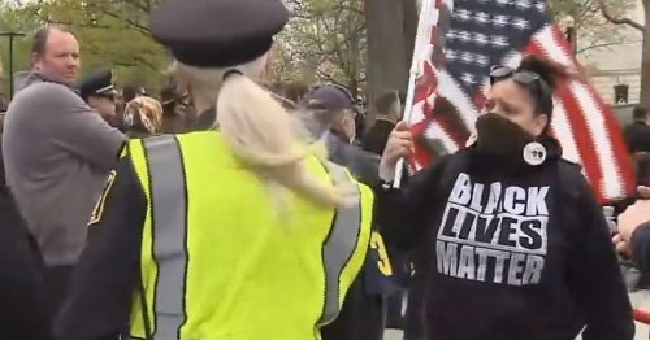
BLM protest

The Westboro Baptist Church, aka “the Phelpsians,” infuriated the Left and Right by disrupting services for fallen soldiers with anti-gay chants, epithets and signs. Now Black Lives Matter is adopting that despicable groups’ tactics and ethics. If you are surprised, you haven’t been paying attention.

On May 7, fallen police officers were finally honored on Capitol Square in Madison, Wisconsin at the Law Enforcement Memorial. For most of 2020 and 2021, law enforcement officers who died in the line of duty couldn’t be properly remembered because of pandemic restrictions

As reported by Madison’s WEAU-TV, six names were added to the honor roll last week as law enforcement officers and their families gathered in the square to see those heroes added to the 285 names already on the memorial. The governor and attorney general joined a police procession as the ceremony began. But minutes into the event, Black Lives Matter protesters began disrupting it and talking over the speakers . A protester with a bullhorn began shouting, “Do you support Black Lives Matter?” “How come the African-American national anthem wasn’t played?” a heckler added, in one of the more civil exclamations. “I’m begging you motherfuckerers to stop killing people that look like me!” was more typical. Rap music with lyrics like “fuck the police” was playing during a moment of silence. A pastor began to deliver a prayer, and she was booed. A protester yelled, “Murderers!”as she finished.

The courts have determined that such harassment is constitutionally protected as expressive speech: Black Lives Matter can thank the Phelpsians for that, as well as for perfecting their tactics. But both the Westboro Baptist Church and BLM exemplify the abuse of free speech, and demonstrate by their hateful and cruel behavior their deep, deep ethics rot. One group was dedicated to anti-gay bigotry; the other is advancing an anti-white, anti-police, anti-rule of law and anti-America agenda. The Phelpsians were marginal and more of an irritation than anything else. Black Lives Matter, in contrast, has a street with block letters honoring it in the middle of the nation’s capitol. Its name was emblazoned across the Fenway Park bleachers last baseball season, and featured on every NBA court. The Democratic National Committee and the current Vice-President of the United States cheered on their riots, which cost billions.

Continue reading

Photography Ethics, Richard Prince And NFTs, Whatever The Hell They Are

NFT big

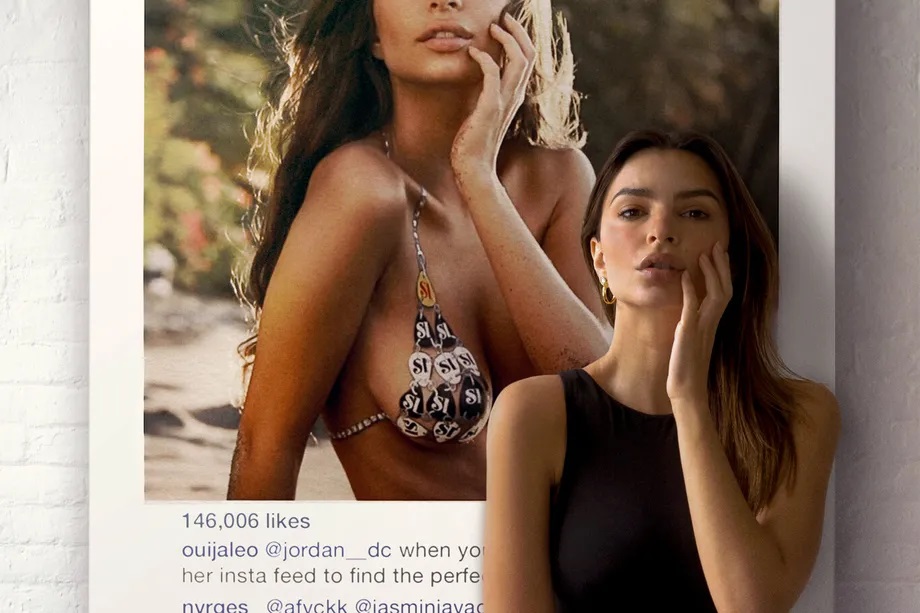
Since late last month, April 25 in fact, I have been periodically researching the topic of NFTs or “nonfungible tokens“. The damn things were back in the news yesterday when a digital-only photograph of supermodel Emily Ratajkowski standing in front of a photograph of herself with a smaller, different photograph of herself in the corner sold at auction at Christie’s for $140,000 ($175,000 after fees). Here’s Yahoo!’s description:

It’s not that the photo can be seen only by the buyer or even that the buyer can physically mount it in a frame (though one supposes the buyer could project it on a wall or screen and put a frame around the projection); it’s that the equivalent of the certificate verifying the authenticity of the digital file of the main photo is unique. It’s really the certificate that cannot be replaced exactly by a copy….NFTs have recently enjoyed a heyday. Nonfungible.com, which tracks such sales, shows massive spikes through the first quarter of 2021 over the last quarter of 2020, with sales volume reportedly in the range of $2 billion already this year.

Right. I can read that over and over, and it still makes no sense. As far as I can tell, these are like digital tulip bulbs from the Dutch tulip craze crossed with cyber-currency, and people who have so much money they don’t know what to do with it are buying what amounts to metadata as investments. But I may be completely wrong. I eventually gave up on trying to understand NFTs when my sock drawer started looking taking to me.

There is are underlying ethics issues, however. Ratajkowski created her NFT in part to troll Richard Prince, a photographer who has exploited the blurry ethics and copyright laws involving photography to make a lot of money and to infuriate many people, especially celebrities like Ratajkowski. Prince is the master of the digital age of Appropriation Art. When Andy Warhol essentially copied the design of a Campbell’s Tomato Soup can and made millions from it, that was the beginning of the trail of metaphorical bread crumbs that led to Prince. Thousands of photographs are placed online every day and appear all over the web, to be copied and re-used in on Pinterest, Instagram, Facebook and many other cyber-spaces. It is often impossible to track down the original photograph or its source even if one wants to give it attribution or ask permission to use it from the creator—this is something I do know something about, as I deal with it every day. Taking an individual’s image, however, treating it as one’s own and selling it is widely regarded a breach of photography ethics, and arguably a breach of law. “Fine Art,” however, creates a large loophole, and in the loophole dwells the much despised Richard Prince.

Continue reading

A Scandal That Compels The Question: If This Can Happen, What Other Ethics Rot Lurks In The Justice System?

Texas attorney Weldon Ralph Petty Jr was a busy guy at the Midland County courthouse. By day he appeared before judges as an assistant district attorney. By night, he worked as a law clerk for some of the same judges, sometimes advising them regarding the criminal cases he was prosecuting. This went on for more than a decade.

You don’t have to be a legal ethics whiz to figure out that such conduct isn’t ethical. Prosecutors are barred from privately communicating with judges about cases or matters even indirectly related to their cases. Judges and their clerks are forbidden from disclosing the discussions and in chambers considerations regarding cases to prosecutors or defense attorneys.

Thus Petty, 78, was flagrantly violating ethics rules by simultaneously acting as a prosecutor and a paid adviser to supposedly impartial judges, who were also breaching judicial ethics to a spectacular degree by allowing him to do so. A February story published by USA Today first reported that Petty was paid by judges as a clerk in at least 350 cases from 2001 until his retirement as an assistant district attorney in mid-2019. Seventy-three defendants, maybe more, that Petty prosecuted are in prison. A court opinion issued April 28 calls for overturning Midland County’s only death penalty case due to Petty’s prosecutorial misconduct and the judge’s failure to recuse himself, so Clinton Lee Young, who has been on death row since Petty prosecuted him in 2003, will get a new trial.

Continue reading

Most Ethical Quote Of The Month Apologized For After Being Called Unethical

Singing Conductor

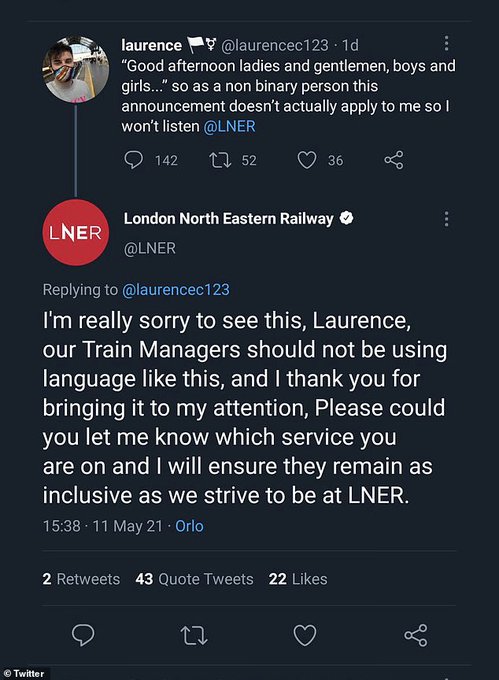
“Good afternoon, ladies and gentlemen, girls and boys!”

—A British railway conductor to his train’s passengers. After a “non-binary” passenger complained, the London North Eastern Railway apologized profusely.

The complaint, via Twitter, stated, “As a non-binary person, this greeting doesn’t actually apply to me, so I won’t listen.” As is now the pattern, the railway’s management grovelled,

grovel2

The better response would have been, “Thank-you for alerting us. In the future, we will have all our conductors greet the passengers with “Good afternoon, ladies and gentlemen, girls and boys, and assholes!” so you feel included.”

I’m kidding…but barely. The presumption by extreme minorities that they have justification to claim mistreatment if society does not distort its traditions, customs and procedures to include every variation of the norm, no matter how exotic, is pure narcissism and imaginary entitlement. The railway’s management’s response would have been appropriate for a conductor who spewed obscenities and blasphemy, not a cheerful welcome that conservatively applies to 99.9% of the population, and those who it does not apply to are in such outlier category based on a conscious choice: intersex individuals once did the practical thing and picked a gender. That was before they realized that power and victim status lay waiting for them by remaining ambiguous.

Did non-English speakers on the train complain bitterly that the conductor’s greeting wasn’t repeated in their language? Were deaf passengers offended that the conductor didn’t sign? I wonder if an expectant mother felt that her unborn child was being snubbed because the conductor didn’t welcome fetuses…

“Laurence” set out to get an innocent conductor disciplined or fired so in the future conductors would be less welcoming to everyone.

Maybe I wasn’t kidding.

The Scott Rudin Reckoning

Rudin

If you are not a active follower of show business, you may not recognize the name Scott Rudin. Heck, I am an active follower of show business, and I only began actively registering his name in my RNA lately because of the sudden shift in his fortunes. Rudin, in case you’re normal and barely noticed, has long been one of the most celebrated and powerful producers in Hollywood and Broadway. His productions have made billions; he has created too many stars to list, and his work has earned an Emmy, a Grammy, an Oscar and 17 Tony Awards. The problem, except that it wasn’t a problem until recently, is that Rudin is a toxic, bullying, abusive jerk who makes working with or for him a living hell. He’s not a sexual predator, like Harvey Weinstein, so his misconduct has not been strictly illegal. Moreover, while he is an extreme case, his obnoxious type has hardly been rare in show business. One could say it is closer to the norm.

Yet suddenly, Hollywood, Broadway and the entertainment business have begun a cultural shift. It was undoubtedly spurred by #MeToo, but in the end it may be more significant that #MeToo. This highly influential industry is beginning to reject the King’s Pass. As much as I hate to say anything good about show business culture, this is an unquestionably ethical development that could have wide reaching effect far beyond movies, plays, TV shows and music.

The King’s Pass is described in the Ethics Alarms Rationalizations List thusly:

11. The King’s Pass, The Star Syndrome, or “What Will We Do Without Him?” One will often hear unethical behavior excused because the person involved is so important, so accomplished, and has done such great things for so many people that we should look the other way, just this once. This is a dangerous mindset, because celebrities and powerful public figures come to depend on it. Their achievements, in their own minds and those of their supporters and fans, have earned them a more lenient ethical standard. This pass for bad behavior is as insidious as it is pervasive, and should be recognized and rejected whenever it raises its slimy head.  In fact, the more respectable and accomplished an individual is, the more damage he or she can do through unethical conduct, because such individuals engender great trust.

It is one of the most pervasive of all ethical perversions, and throughout human history, as reliable as an aspect of human nature. If you are successful and valuable to organizations and people, you can get away with bad, even terrible conduct that ruins lesser mortals. The rule reigns in business, academia, politics, government, sports and, of course, entertainment. One can speculate on why Scott Rudin’s unexpected fall has become a possible catalyst for weakening the iron grip of The King’s Pass, but for the moment, let’s focus on the fact that he has.

Continue reading

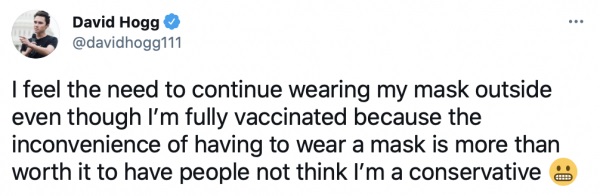
Unethical Tweet Of The Month: David Hogg

Hogg tweet2

This is so evidently a case of res ipsa loquitur that I probably shouldn’t comment on it. It is also signature significance: no one but a bigoted and arrogant child would think this way, much less announce such a mindset in public.

Hogg, an unwounded victim of the Parkland shooting tragedy, was willingly exploited as a mouthpiece for anti-gun/NRA/Second Amendment fanatics for more than a year. CNN built a “town hall” and a rigged debate around him with Don Lemon as his cheerleader. Despite a sub-adult biological age and a sub-teen emotional age while suffering the after-effects of a terrible experience, Hogg was held up as a respectable authority on matters he knew little to nothing about. Harvard even accepted him into its freshman class based on his political posturing alone.

In the tweet, he reveals the shallowness of his reasoning and the irrationality of his ideological certitude. We shouldn’t need the tweet, based on what we’ve heard from Hogg already, but some people sufficiently addled by “Think of the children!” need a bit more proof.

Incidentally, I have felt the need not to wear a mask outside since the very beginning of Pandemic Panic so that intelligent people wouldn’t think I am a gullible, submissive fool.

Now THAT Was A Stupid Lie!

caitlyn-jenner

Ah, memories! On the old Ethics Scoreboard, I had a feature called the David Manning Liar of the Month. From the description:

David Manning was an imaginary movie reviewer that Sony quoted when one of its movies was so lousy no real movie reviewer would praise it. When this long-running public fraud was brought to Sony’s attention, the company’s response was, in effect, “So who believes movie reviews?” Thus Sony’s phony critic and the company’s cynical defense of him stand for the dubious proposition that as long as your self-serving lie is in a trivial arena (usually entertainment) where dishonesty and misrepresentation are commonplace, or is a lie that nobody believes, it isn’t reprehensible. The fact is that these casual, obvious or trivial lies and the liars who spread them (almost always for profit) further degrade the value of honesty in American society, and pave the way for more destructive lies and liars waiting in the wings. All public deception is harmful, so The Ethics Scoreboard regularly recognizes The David Manning Liars of the Month, and urges the public to make them come clean…

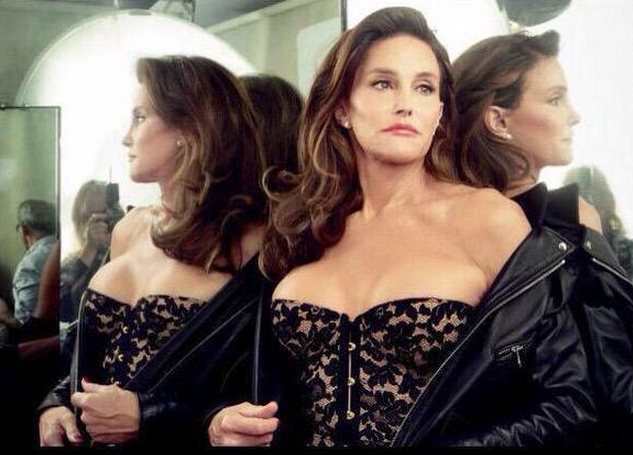
Thus it gave me a warm, fuzzy feeling, like finding an old toy, to read that Caitlyn Jenner, running for governor of California to revive her flagging celebrity now that the Kardashian gig is over, issued a completely pointless lie that was bound to be discovered.

CNN’s Dana Bash asked Jenner if the transgender former Olympic champions had voted for for Donald Trump in last year’s election.

“I didn’t even vote,” Jenner replied. “Out here in California, it’s like, why vote for a Republican president? It’s just not going to work. I mean, it’s overwhelming. It was voting day, and I thought, the only thing out here in California that I worry about, which affects people, is the propositions that were out there. And I didn’t see any propositions that I really had one side or the other. And so it was Election Day. And I just couldn’t get excited about it. And I just wound up going to play golf and I said, eh, I’m not doing that.”

But the record showed that she did vote. It was easy to check. Writes Politico, “Her claim to be a non-voter in that seminal 2020 election was baffling for a gubernatorial candidate trying to establish her political credibility, especially since records show she did participate in the contest.”

It’s not baffling. It’s typical: a disturbing number of Americans, especially celebrities and politicians, believe that lying is no big deal, so they don’t think being caught in obvious lies damages their reputation. Their attitude is “Hey, it’s worth a shot!” When they are caught, their reaction is, “Whatever.”

The disturbing thing is that they may be right.

Three Ethics Metaphors: The Rise, The Presidency And The Fall Of Donald J. Trump, Part I

dog pilot

I have to cleanse the blog of Trump related markers, like having “The Presidential Impeachment And Removal Plans, 2016-2020” link under the home page banner, and the “This Helps Explain Why Trump Is President” categories to tag articles. I’m not nostalgic or anything, I just hate blog housekeeping. But It’s also time to close that chapter with an ethics assessment of the Trump Presidency.

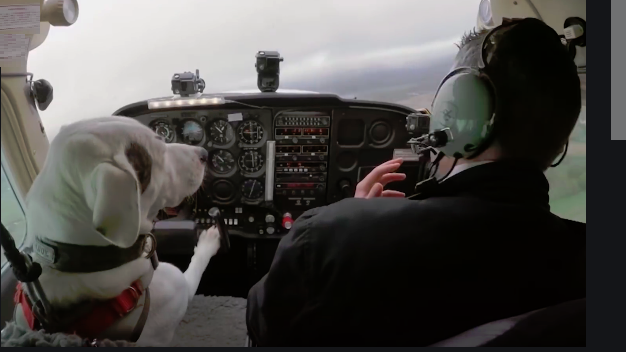
Three metaphors I applied to the nation’s Trump adventure nicely encapsulate what went on, I think. Beginning in late 2015, I derided the idea that electing (or nominating) Donald Trump to be President was the equivalent of the passengers in an airplane navigating a storm voting to let a dog (in some versions, a chimp) try flying the craft. The metaphor was apt, and it’s still apt, even though the dog/chimp equivalent did not crash the plane and kill everyone in it. That was moral luck, as pure as it can be. It was madness for this country to permit a man with Trump’s well-documented character flaws and proven proclivities both and executive and a human being control the destiny of the nation in 2016. Concluding otherwise is indefensible. A valued commentator here has apparently abandoned commenting here because he objected to my tendency to designate what he considered opinions as facts. I’m sure that he considers this one of those, but he’s wrong and I’m right. It’s a fact that Donald Trump had proven beyond the shadow of a doubt that he was unfit to be President before the 2015 debates, and he did nothing during the campaign to undercut that conclusion. It’s a fact that a dog shouldn’t fly a plane, and similarly, it’s a fact that Donald Trump should not have been allowed to come within miles of the White House, except as a visitor. Hillary was right: for the most part, those who were advocating Trump’s Presidency were deplorable: ignorant, reckless, irrational, walking and voting examples of the perhaps fatal flaws in democracy. She was just the worst possible individual to make that observation, since giving Clinton and her party the power she sought, while different from allowing a dog to fly the plane, was still wrong. It was just more like allowing a kamikaze pilot to fly the plane.

Continue reading

Ethics Movie Ethics Quiz: “The Edge” (1997)

Anthony Hopkins winning an upset Oscar this year reminded me of the action film he made with (yecchh) Alec Baldwin 25 years ago. I would have written about it then, but 1) I didn’t see it then, being driven to my sock drawer at the thought of paying for any movie with Baldwin in it, and 2) it was a long time before Ethics Alarms.

The film explores survival situation ethics, a topic that “The Walking Dead” has thoroughly beaten to walking death in the last decade, with the assistance of some sharp David Mamet dialogue. Hopkins, a wealthy, cocky and obnoxiously competent businessman, survives a small plane crash that dumps him and two other men in the middle of the Alaskan wilderness. One of them, the younger Baldwin, is secretly having an affair with Hopkins’ super-model trophy wife, whom they left back at the hunting lodge.

Hopkins’ encyclopedic knowledge of everything and Eagle Scout-level survival skills keep his wilderness ignorant companions alive and hopeful until a rampaging Kodiak bear eats the man who isn’t Baldwin (thus showing good taste). Then the remaining two become the hunted. Eventually, after many scares and narrow escapes, Hopkins and Baldwin solve their hungry bear problem and find an abandoned cabin conveniently stocked with food, guns, and a canoe. Baldwin, confident that he no longer requires Hopkins’ expertise to survive long enough to be rescued, takes a functioning rifle, loads it, admits that he’s having the affair with Hopkins’ wife, and marches Hopkins outside to shoot him. But Fate takes a hand: Baldwin falls into a pit before he can shoot and is rendered helpless, with a broken leg and other life-threatening injuries.

Continue reading