Once Again, Foes Of A Looming Progressive Dictatorship Are Depending On An Unethical Pol To Save Them

insider_trading_ban

It would be nice if Senator David Perdue, one of two Republicans in Georgia Senate run-offs that will determine whether the Democrats’ last four years of sabotaging President Trump’s Presidency is considered a success or a failure, was an ethical, trustworthy official. But as if Perdue already didn’t have enough obstacles to winning re-election, like the ridiculous attempted boycott of the run-offs some Republican wackos are pushing (the boycott plan narrowly beating out holding their breath and setting their heads on fire as alternatives to voting), there is also this: he appears to be among the worst of Congress’s inside traders.

I’ve written a lot about this ongoing scandal. (The chart above is from one of the earliest posts.) The practice continues because both parties’ members make so much money from it that they refuse to police themselves adequately. Perdue is just the latest offender to come under public scrutiny. This time, the motivation for the exposure is the critical nature of the Georgia races, prompting the now open and obvious committed ally of the Democratic Party, the New York Times, to do a front page hit job on the Senator their Dark Masters have to destroy. But just as being paranoid doesn’t mean they aren’t out to get you, being biased doesn’t mean you can’t be right. The Times article about Perdue is damning, and not especially surprising, since I would believe the same of most members of Congress. This is literally sanctioned corruption, and has been for a long, long time.

From the Times article:

Continue reading →

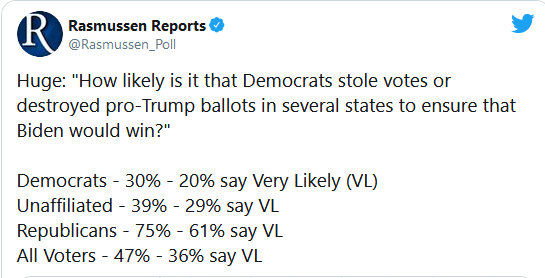
Ethics Dunces: Apparently 30% Of Democratic Voters

Rasmussen Tweet

We must begin with the fact that polls of all kinds have the approximate credibility of palm readers. Rasmussen, however (and Gallup) disgraced itself rather less than its competitors in measuring the election trends before November. The verdict of Ethics Dunces would still hold if the percentage was 20%, 10% or 100%, however. The polling results above were published on November 20; maybe fewer people are convinced now that the election was stolen, since the various challenges filed in court have been failing. The statistics above still prompt these observations:

1. If Democrats think that their party steals elections, making it a threat to Democracy, why do those Democrats continue to identify with a party that cheats? The only explanation can be that they do not support Democracy, and believe that their will should be imposed on their fellow citizens by illegal means, They are totalitarians by philosophy and nature.

Continue reading →

The Vanderbilt Female Kicker Ethics Mess

Fuller

I’m not even sure what to call the display of dishonesty and posturing that unfolded over the weekend at Vanderbilt. Disrespect for the game and intelligence of fans? Lack of integrity? Incompetence? Dishonesty? Shameless exploitation? Patronizing and insulting women? I’m not sure, but whatever it is, it was all unethical.

Let’s look at the components of this ethics mess (it’s not coherent enough or significant enough to qualify as an ethics train wreck):

1. Derek Miller, the coach of Vanderbilt’s football team, had all of his kickers turn up positive for the Wuhan virus, on game week, so allegedly in desperation, he made Vanderbilt women’s soccer goalie Sarah Fuller the first woman to play in a Power Five conference football game by handing her the job of kicker. She had never kicked a football in a game in her life.

Nobody, literally nobody, believes that there weren’t many members of the team, and maybe all of them, that would have been a better bet to rely upon than Fuller. The team was 0-7 before the game against Missouri—and 0-8 after it, by the humiliating score of 41-0—and the attempt to appeal to campus feminists and woke alumni seems like a desperation move by Coach Miller to save his job. Of course, that meant sacrificing the team’s interests for his own, which is unethical management. Whatever hismotive, it didn’t work: he was fired the next day. In his farewell statement, Miller referenced coaching and mentoring “hundreds” of young men and “one courageous female.” From Tuesday through Saturday afternoon.

2. Sure enough, the coach’s cynical use of Fuller got massive publicity, all positive. Since the team never scored or got within range of a field goal, Fuller got to kick the ball exactly once, to begin the second half. She delivered a 30 yard squibber that gave Missouri the ball on its 35 yard line. The pathetic kick went only 20 yards in the air and rolled another ten before the Missouri team saved face for her by jumping on the ball before it went out of bounds and drew a penalty.

For that performance, the SEC named Fuller the special teams “Player of the Week.” As Kamala Harris has proved, in 2020 a woman can be regarded as a standout by simply showing up. Performance doesn’t matter, just chromosomes.

3. Then Fuller revealed that she had the audacity and bad taste to lecture her team mates for a day on the right way to play football.

Continue reading →

Morning Ethics Warm-Up, 12/1/2020: Satchel Paige Edition

Satchel

Why Satchel Paige? The legendary Negro Leagues pitcher and member of baseball’s Hall of Fame once said, “How old would you be if you didn’t know how old you was?” Satchel wasn’t fooling: having played most of his career when blacks were blocked from the Major Leagues, Paige was still good enough at 42 to join the 1948 Cleveland Indians as a relief pitcher, and was effective enough to be contender for Rookie of the Year. Then he became the oldest pitcher to start a Major League game, shutting out the Boston Red Sox for three innings at the age of 59.

In my case, the answer to Paige’s question would be about 18, or perhaps 10. Surely not the age my arithmetic tells me, which is depressing and a little frightening. Every December first since 2009 has been a day with bad connotations: I found my father dead in his favorite chair that year, when I checked to see if he was going to have dinner with me as we had planned. This year there are two. Well, Dad soldiered on to have 19 more productive and mostly happy years after he reached my age, and he was being treated for cancer by than, and I’m not. There aren’t many ways I can top my father, but at least that’s gives me something to shoot for.

1. Wow. You don’t get to see such naked bias and hate just put out there in the media like this very often…Just think: a Washington Post editor okayed this article attacking the White House Christmas decorations and using them to excoriate Melania Trump for existing. How petty and ugly can a writer be and still get published? I guess it depends on whether or not your target is the Trumps.

The “money quote”: “[T]he defenders of Melania have always insisted on comparing her to her predecessor, Michelle Obama, and it became hard to believe that “elegant” was a code word for anything other than “White.” Melania is “elegant” because she represented a very specific kind of White femininity: silent, lovely, delicately fingering the ornaments that her staff had assembled.” The author is Monica Hesse, the Post’s gender writer. She is a biased, vicious, jerk. It is so obvious that Melania Trump could design Michelle Obama’s White House decorations and Michelle could secretly design the Trumps’, and Hesse would pronounce what she thought was Michelle’s inclusive and brilliant, and would condemn what she thought Melania created.

You know, pretty much the way her paper covered the Obama and Trump administrations.

Continue reading →

Rainy Monday Ethics, 11/30/2020: Statues, Dogs And Lies

Also getting me down, Karen Carpenter songs. As with great movies with O.J. Simpson or Gig Young in them, these are hard to enjoy now, at least for me. One of the most lovely natural voices in pop music history was silenced by the pernicious disease of anorexia, exacerbated by, among others, her brother, her family, and music industry executives, who made Carpenter so self-conscious about her weight and appearance that she slowly starved herself to death before her 33rd birthday. I wish I could hear her sing—and I will do that a lot in the days approaching Christmas—without thinking about that, but I can’t.

1. Proposition: any nation’s historical figures who had the impact on those nations that Margaret Thatcher did in Great Britain over a significant period of time deserve to be memorialized with statues, absent some cataclysmic disqualifying act, like Richard Nixon’s Watergate scandal. Even in Nixon’s case, I would support a public memorial to such a historically influential figure.

In the English town of Grantham, where Thatcher grew up, an 11-foot pedestal awaits the arrival next year of a large statue of “the Iron Lady.” Apparently many in Britain, and a large proportion of Gratham’s working class residents, disapprove of Thatcher’s conservative politics and policies, and thus oppose the statue, which will be in immediate danger of toppling the minute it is erected.

Morons. One doesn’t have to personally agree with a historical figure’s position or even admire her to appreciate the impact that figure had. The criteria for memorializing prominent citizens should center on whether future generations need to know who they were and what they did, not whether their achievements and conduct are approved of according to often fleeting political, social and cultural values. Charles Moore, who wrote an authorized biography of Mrs. Thatcher, says, “It’s obvious there should be statues to Britain’s first woman prime minister. But…but…George Floyd! The New York Times’ article on the controversy says that statue toppling has become a world-wide phenomenon since the death of George Floyd. Now that makes sense: one of Great Britain’s most successful and important leaders should be robbed of her legitimate honors because a rogue cop accidentally contributed to the death of a black criminal in Minnesota.

Continue reading →

Sunday Ethics Insomnia, 11/29/2020: No Wonder I Can’t Sleep!

1. I hate 99.9% of the petitions offered at Change.org. but I’m signing this one . It reads,

Professor Dorian Abbot, a tenured faculty member in the Department of Geophysical Sciences at the University of Chicago, has recently come under attack from students and postdocs for a series of videos he posted to YouTube expressing his reservations about the way Diversity, Equity, and Inclusion (DEI) efforts have been discussed and implemented on campus.
In these videos Prof. Abbot raised several misgivings about DEI efforts and expressed concern that a climate of fear is “making it extremely difficult for people with dissenting viewpoints to voice their opinions.” The slides for each of Prof. Abbot’s videos can be found here, and his own account of events and his opinions can be found here. Nowhere in these materials does Prof. Abbot offer any opinion that a reasonable observer would consider to be hateful or otherwise offensive.

Shortly after uploading the videos, Abbot’s concerns were confirmed when 58 students and postdocs of the Department of Geophysical Sciences, and 71 other graduate students and postdocs from other University of Chicago departments, posted a letter containing the claim that Prof. Abbot’s opinions “threaten the safety and belonging of all underrepresented groups within the [Geophysical Sciences] department” and “represent an aggressive act” towards research and teaching communities.

[Pointer: Pennagain]

2. “Hello, Newman...” According to the Postal Service’s own records, more than 150,000 mail-in ballots were not delivered in time for them to be counted on election day. This is, of course, as I and anyone else who was paying attention expected and predicted, because the USPS is undependable

I am surprised that the number was that low.

Continue reading →

Ethics Alarms’ Annual Holiday Re-Posting Of The Complete “It’s A Wonderful Life” Ethics Guide, Updated And Reconsidered, With A New Introduction

Clarence

2020 Introduction

There is no better year to watch Frank Capra’s masterpiece “It’s a Wonderful Life.” I sincerely hope that President Trump screens it again, assuming he has ever seen it.

“It’s A Wonderful Life,” as I wrote last year, “would be an excellent basis for a middle school ethics course. I haven’t seen a better, richer film for that purpose come along since, and I’ve been looking. Despite the many ethics complexities and nuances that the film glosses over or distorts, its basic, core message is crucial to all human beings, and needs to be hammered into our skulls at regular intervals, far more often than once a year.”

But in addition to being a movie about ethics, it is also a movie that is itself a result of an ethical instinct.

Director Frank Capra was already known as Hollywood’s master of celebrating common Americans doing extraordinary things, the nation’s families, the power of love and American exceptionalism. They called his movies “Capra Corn”: “Mr. Smith Goes To Washington,” “Meet John Doe,” and other critical and box office hits. He spent World War II making inspirational documentaries about the war effort. When the war was over, he sensed the dark mood in much of the nation, despite the exhilaration of victory. Returning soldiers found the culture changed and their emotions raw. Families whose .loved one had died or returned with disabling wounds struggled to believe that their sacrifices were justified. The atom bombs that ended the war also opened up a dangerous new era of paranoia and fear.

The post-war movie that seemed to capture the mood of much of the nation was William Wyler’s “The Best Years of Our Lives,” a film my World War II veteran father refused to watch for fear that it would send his mind and memories to dark places he struggled not to go.

Capra had a new production company, and decided that “It’s A Wonderful Life,” based on an idea by author Philip Van Doren Stern. Unable to get his short story published, he had sent it to friends as a 21-page Christmas card. Film producer David Hempstead read it, and bought the movie rights for Capra’s company. The story was just what America needed, Capra reasoned, to restore its belief that what the nation had accomplished was worth the pain, loss and sacrifice, and that the nation itself had led a “wonderful life.” The new film could restore the nation’s flagging optimism, pride and hope.

Capra immediately thought of actor and now war hero James Stewart to play protagonist George Bailey. Three years of flying bombing raids against the Nazis in the US Air Force had left the the 37-year-old suffering from post traumatic stress syndrome. He returned home in 1945 to find that everything had changed: his contract with MGM had run out, his agent had retired, and other stars had taken his place. He trusted Capra, even though the story he described sounded depressing. Stewart signed on.

Production finally began on the film in April of 1946, and the cast and crew felt they were making an important movie. Bedford Falls became one of the largest American film sets ever created to that point at four acres, with 75 fake stores and buildings, a three-block main street, and 20 full-grown oak trees. To avoid the traditional problem of fake-looking snow, the special effects department invented a new and more realistic process.

The story also touched the cast, especially Stewart, who was still suffering from the effects of the war and at times was close to quitting. In the scene where George, in a roadside bar, desperate and defeated, is praying to a God he doesn’t believe in. He rubs a trembling hand against his mouth, and starts to cry. The gesture wasn’t in the script, or requested by Capra. It was real.

Stewart explained years later,

“I felt the loneliness, the hopelessness of people who had nowhere to turn, and my eyes filled with tears. I broke down sobbing. That was not planned at all.”

Stewart felt it was his best performance (it is) and Capra believed he had made his best film. “I thought it was the greatest film I ever made,” he said later. “Better yet, I thought it was the greatest film anybody ever made.”

But it was a catastrophic flop. The New York Times critic Bosley Crowther wrote that “the weakness of this picture is the sentimentality of it”, describing George Bailey as “a figment of simple Pollyanna platitudes”. The New Republic’s Manny Farber accused Capra of taking “an easy, simple-minded path that doesn’t give much credit to the intelligence of the audience”. The movie lost money and crippled Capra’s production company. His career never retained its former status, and what he believed was his greatest work was forgotten for decades. Republic Pictures, which owned the film’s copyright, didn’t bother to renew the rights in 1974. It was essentially free to local television channels, and they began showing it constantly.

Well, all you have to do is see it. Capra was right, Stewart was right, the cast and crew were right. It is a classic. The story accomplishes just what Cara intended it to accomplish. In a Times piece about the movie by a self-professed cynic, Wendell Jamieson wrote about seeing the movie for the first time as teen in a classroom showing, and confessed,

It’s something I felt while watching the film all those years ago, but was too embarrassed to reveal.

That last scene, when Harry comes back from the war and says, “To my big brother, George, the richest man in town”? Well, as I sat in that classroom, despite the dreary view of the parking lot; despite the moronic Uncle Billy; despite the too-perfect wife, Mary; and all of George’s lost opportunities, I felt a tingling chill around my neck and behind my ears. Fifteen years old and imagining myself an angry young man, I got all choked up.

And I still do.

Yeah, me too.

  In an earlier version of The Guide I described the message of the film this way:

Everyone’s life does touch many others, and everyone has played a part in the chaotic ordering of random occurrences for good. Think about the children who have been born because you somehow were involved in the chain of events that linked their parents. And if you can’t think of something in your life that has a positive impact on someone–although there has to have been one, and probably many—then do something now. It doesn’t take much; sometimes a smile and a kind word is enough. Remembering the lessons of “It’s a Wonderful Life” really can make life more wonderful, and not just for you.

Lets’s try to make what’s left of the holiday season as epiphenal and joyous foreveryone in our lives as it was for George Bailey.

And away we go…

Continue reading →

Post-Thanksgiving Ethics Indigestion,11/26/2020: A Whole Lot Of Shaky Ethics Performances Going On

1. AstraZeneca! In Jurassic Park’s control center, as the first tour of the park begins having technical glitches, creator John Hammond turns with contempt to tech guru Dennis Nedry (Wayne Knight, aka “Newman”) and spits, “Our life is in your hands and you have butterfingers?” That was the first thing that jumped into my head when I read this:

The announcement this week that a cheap, easy-to-make coronavirus vaccine appeared to be up to 90 percent effective was greeted with jubilation. “Get yourself a vaccaccino,” a British tabloid celebrated, noting that the vaccine, developed by AstraZeneca and the University of Oxford, costs less than a cup of coffee.

But since unveiling the preliminary results, AstraZeneca has acknowledged a key mistake in the vaccine dosage received by some study participants, adding to questions about whether the vaccine’s apparently spectacular efficacy will hold up under additional testing.

Scientists and industry experts said the error and a series of other irregularities and omissions in the way AstraZeneca initially disclosed the data have eroded their confidence in the reliability of the results.

Competence. Diligence. Responsibility. The duty of care. Trustworthiness.

2. Butterfingers II: The case of the premature obituaries. Radio France Internationale (RFI) mistakenly published online the obituaries of about 100 public figures who were and are still alive.Among those declared dead were Queen Elizabeth II, Clint Eastwood, Jimmy Carter, Yoko Ono, Sophia Loren and Brigitte Bardot. Google and Yahoo then picked up the fake news, which was, of course, spread on social media.

Continue reading →

I’m Thankful That So Many Americans Will Refuse To Comply With Pandemic Orders From Arrogant And Contemptuous Elected Officials Like These

Thanksgiving plus US

Elected mayors and governors across the country have simultaneously demanded obeisance to their burdensome orders constraining American rights to life, liberty and the pursuit of happiness while showcasing their belief that they are above the obligation to live by their own rules.

I’m grateful for this disgusting phenomenon. It vividly exposes a political class that thinks Americans are marks and fools, or perhaps some kind of human-sheep hybrid. These elected dictators’ not-so-secret desire is to dominate and rule. They have but a faint concept of what a representative democracy means, and have contempt for it and us. Members of the public who can’t see the unethical double standards these nascent totalitarians would inflict on the nation, or worse, those who accept and tolerate the double standards, are the intended victims. Fortunately, there are still a critical number of citizens who recall this nation’s origins as a rebellion against tyrants.

The open contempt these leaders have for us is staggering. Perhaps they expected their allied propagandists among news media to hide the hypocrisy, which so far it has been unwilling to do. Actually, considering the embargo on stories that might reflect positively on President Trump during the run-up to this months election, it is surprising our aspiring dictators haven’t been provided with more cover. This is something else to be thankful for.

From the Thanksgiving section of the Dead Ethics Alarms files:

Continue reading →

Ethics Proposition: Justice Barrett Should Immediately Recuse Herself From Any Future SCOTUS Decisions Relating to the 2020 Presidential Election

Barrett Trump

I will stipulate that the newest Supreme Court Justice does not have to recuse, and that even the judicial ethics rules applying to other Federal judges (no judicial ethics rules are controlling for Supreme Court justices) would not require recusal in Justice Barrett’s circumstances.

I will also concede that the arguments that she should not recuse are significant and important:

1. Were she to recuse, it would be interpreted by many as an acknowledgment that her Senate critics and others were correct to suspect that she was nominated to assist the President if necessary in any Supreme Court challenges to the election results.

2. Her recusal would suggest a precedent holding that a Justice being nominated by a President creates a rebuttable presumption that such a Justice has a conflict of interest that would interfere with the Justice’s ability to exercise independent and objective judgment in any case directly affecting that President’s interests.

3. Her recusal would leave the Court with a potential 4-4 split on a case that would have major impact on the nation.

4. Democratic officials’ demands that she recuse herself are driven purely by partisanship, and are hypocritical. Justice Kagan, appointed by President Obama, did not recuse herself in cases involving the Affordable Care Act, for example.

All this is true,

Continue reading →