The dilemma posed in the recent post about the radio host fired because of the danger posed by her threatening, stalker ex-husband sparked some unexpected reactions, as many readers expressed frustration that Nancy Lane’s employer left her to her own resources in her peril. One of the more provocative alternatives proposed is Steven’s endorsement of what he calls the chivalristic response.
The problem I have with situations such as here with Nancy Lane is there is no reason for this situation to result in an ethical dilemma or “Zero Sum”. I, as well as few others here recommend what can only be labeled as a chivalristic response. Now we are not talking the aristocratic, medieval ethos but more of a modernization of the gentlemanly behavior exhibited of those of the greatest generation without the bigotry or homophobia. With the feminization of our society it is incredibly hard to find the line between “modern” chivalry and misogyny, or at least feminism’s liberal application of the term. Continue reading →
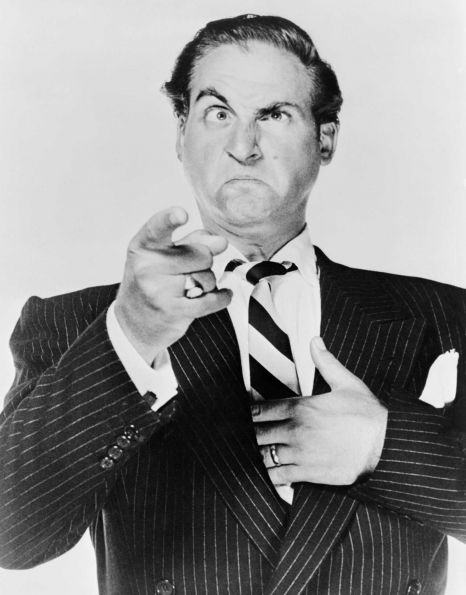
“I remember a satire we did on ‘High Noon.’ The townspeople were supposed to abandon me and return their deputy badges to me by pinning them on my chest. I was supposed to have a sponge inside my shirt. But I didn’t have time to change. So they kept coming, saying, ‘Sorry, Sheriff,’ and pinning on the badges. After it was over, I went backstage, and somebody said, ‘Hey, you did real good pain takes.’ I told him the pain was for real.”
—-Comedy great Sid Caesar,who died yesterday at the age of 91, recounting for the New York Times an example of a how he suffered for his art, which was, always, making us laugh.
Caesar’s anecdote is as perfect a description of professionalism as I have ever seen, or ever will see.
Thank you, Sid Caesar, for devoting your life, body and soul, to laughter.
Samuel Jackson’s reckless and unjustified attack on KTLA entertainment reporter Sam Rubin (which, incredibly, continues to be misrepresented by most of the news media, internet and social media) is an excellent example of how relatively trivial incidents can teach important ethics lessons. One of those lessons I did not discuss in the previous post about this episode involves the phenomenon of the gratuitous or needless apology.
To briefly recap: Rubin’s celebrity guest, Samuel L. Jackson, falsely and obnoxiously accused Rubin of confusing him with another black actor, Laurence Fishburne, thus asserting that Rubin 1) thought all blacks looked alike 2) was impliedly a bigot or racist as a result, 3) was unprepared for the interview, and 4) was unprofessional and should lose his job. Rubin apologized twice, first during Jackson’s unprovoked rant (for Rubin had not confused him with Fishburne, and it was Jackson who was confused and unprepared for the interview), and later, to everyone else, after headlines that his “racist mistake” had justly provoked Jackson were being repeated everywhere. Rubin said:
“We start right now with the beauty and the occasional pain of live television. First and foremost, I do know who Samuel L. Jackson is. I’ve interviewed him several times over the years, but never quite like the conversation we just had. I indicated to Samuel that I’d seen him during the Super Bowl, and he thought that I had confused him with the commercial Laurence Fishburne had done for a car company. Of course a “Captain America” ad had also run during the Super Bowl, but I immediately felt so dumb, I didn’t bring that up — and he gave me the shellacking that was well deserved. I pride myself on the fact — that unlike a lot of people who do this kind of work — more often than not, I really do know what I’m talking about. But I didn’t 30 minutes ago, and I’m really embarrassed about it, and I very much apologize to Samuel L. Jackson and anyone else who was offended for what was a very amateur mistake.”
This kind of apology, a coerced, false apology for conduct that warrants no apology, regret or forgiveness at all, does not appear on the Ethics Alarms Apology Scale, because while it looks and sounds like an apology, it is something else entirely. The Apology Scale ranks the intent, sincerity, honesty and effectiveness of apologies for actual wrongdoing or harm. The coerced and false apology is wrongdoing that causes harm, and is the product of wrongdoing itself. Continue reading →
Shirley Temple Black, perhaps best known to most of us as Little Miss Marker, Curly Top,the Littlest Rebel, Heidi, or, most of all, Shirley Temple, died overnight. I learned of her passing this morning in a Facebook update from child performer advocate Paul Petersen, like Shirley a distinguished and successful former child star who has dedicated his post-performing career to important causes. He wrote:
SHIRLEY TEMPLE passed in the night. She was 85…and no age at all. What a life. What a treasure. A woman of amazing courage and dignity.The world was enriched by her accomplishments. She will always be a part of us. Rest now, Shirley Temple. We love you.
There really isn’t too much more that needs to be said. Few human beings ever began having a positive impact on society so soon in life (she began making adults smile at the age of three, when she made her first film) and continued to do so for so long. From show business, a profession that so often leads to ethical rot, and a rarefied corner of it infamous for leaving its practitioners spoiled, narcissistic, addicted to fame and dysfunctional, Shirley Temple emerged as an adult who was industrious, courageous, intelligent, compassionate, and dedicated to public service. Often dismissed and mocked as a washed-up child star, she proved again and again that her detractors were not just wrong to pre-judge her, but spectacularly wrong. She excelled as a diplomat, serving as U.S. ambassador to Ghana and Czechoslovakia, using her Hollywood fame to open doors and hearts, and also as the U.S. delegate to the United Nations. Temple never played the celebrity: my favorite Shirley moment was when she returned, in her seventies, to join a large group of former Oscar winners (hers was a special award, at the age of six) on the stage of the Academy Awards. As they announced the names of the famous performers and the camera panned the group, it was Shirley who received the most loving response from the Hollywood crowd, which stood and cheered. Shirley looked genuinely surprised, beamed, showed those famous dimples, and handled it, as she always handled everything, with charm and poise.
A proto-feminist, Shirley Temple was one of the first celebrities to go public with a diagnosis of breast cancer, and raised national awareness by promoting a frank discussion of mastectomies. In her autobiography, she also had the courage to point out the predominance of sexual predators in the the Hollywood power structure and culture, recalling that MGM musical unit head Arthur Freed*, whose career is celebrated in “Singing in the Rain,” exposed himself to her in his office when she was barely 13. (She laughed at him; he threw her out of his office.)
Historians credit Shirley Temple with saving the movie studio RKO and raising America’s spirits during the Great Depression; she also was a Cold Warrior, a mother, the inspiration for a best-selling line of dolls as well as the alcohol-free cocktail that still bears her name, and one of a kind. It is fair to say we will never see her like again.
Late in life, she told an interviewer, “If I had it all to do over, I wouldn’t change a thing.” How many of us can say that sincerely?
Paul was right. What a life!
Take a curtain call, kid…
* The original version of the post incorrectly referred to Arthur Freed as Alan Freed, who was an influential disc jockey in the early days of rock and roll. I apologize to both of them.
Michael Sam, an All-American defensive lineman from Missouri and the Associated Press’ SEC Defensive Player of the Year, told ESPN Sunday that he is gay. “I am an openly, proud gay man.” Sam is projected to be a mid-round draft choice for the NFL draft in May. If he is drafted and makes the team, Sam would be the first openly gay active NFL player.
We shall see. Sam’s plan, he said, was to announce his sexual orientation after the draft, which might have been wiser and more practical, though not as ethical. He said that rumors were circulating, so he decided to come out now.
However he arrived at the decision, Sam’s candor is a courageous act, and I assume he will suffer for it. No NFL team has to draft him, and many teams that might have will not, presumably, simply to avoid the distraction of media scrutiny. If they draft him and cut him, will he claim that it was out of bigotry? Will he sue? I think most teams will decide that there are other similarly talented non-gay players available, and let some other team jump into these roiling social change and political waters. Continue reading →
“John McCain and Paul Ryan have corrected constituents who spout conspiracy theories about the President. Should this Republican have left this town hall comment unchallenged?”
The incident referenced is on view here:
That’s Oklahoma congressman Jim Bridenstine (R-OK) who listens as a woman says, “Obama is not president, as far as I’m concerned. He should be executed as an enemy combatant…I can’t tell you, or I can’t say because we are in a public place, this guy is a criminal,” and then answers by saying that “everybody knows the lawlessness of this president,” without addressing her more outrageous assertions. “The only way I see out of this is to overwhelmingly change the Senate, so that we can then impeach the SOB,” another woman says. “You know, you look so sweet…” says Bridenstine, deflecting. Continue reading →
Not a composer, not deaf, and maybe Irish, female, and 12-years old, for all we know.
There need be no debate about whether this was unethical, or why. It is obviously one of the great arts hoaxes of all time.
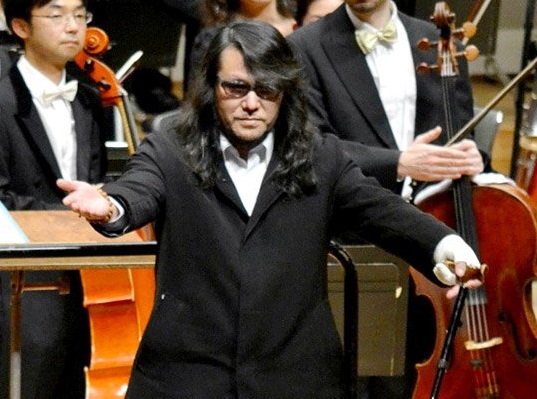
Mamoru Samuragochi, the composer sometimes known as “The Japanese Beethoven,” was exposed this week as being more like a Japanese Milli Vanilli. A double fraud, he didn’t compose the works that made him Japan’s most popular classical composer, and he isn’t even really deaf, which was a large element of his fame and notoriety. Samuragochi has perpetrated a long, elaborate, audacious hoax, hiring a musical ghostwriter to compose for him over nearly two decades. The Man Behind the Curtain revealed himself as Takashi Niigaki, a lecturer at a Tokyo music college, who admitted to writing more than twenty compositions for Samuragochi since 1996, receiving the equivalent of about $70,000. Samuragochi’s most famous works include Symphony No. 1 “Hiroshima,” the theme music for the popular video games “Resident Evil” and “Onimusha,” and especially the “Sonatina for Violin,” which is the program music for the Japanese Olympic figure skater Daisuke Takahashi.
What interests me most about this strange story is how it illustrates the power of cognitive dissonance in the arts. Continue reading →
“I think most women understand that they should not be held accountable for the behaviors of their husbands. And you know, frankly, it was a long time ago, and our country did very well under the leadership of Bill Clinton.”
—-Sen. Claire McCaskill (D-Mo), on MSNBC, doing a lousy job rebutting Sen. Rand Paul’s recent statements accusing Democrats of hypocrisy by pursuing their lucrative and politically successful “war on women” attacks on Republicans while continuing to embrace the Clintons, ignoring Bill Clinton’s treatment of his wife, Monica Lewinsky, and women.
Sen McCaskill pulls me back in, damn her.
Curse anyone who reminds me of anything related to Godfather III, but there was Claire, turning me into Michael: “Just when I think I’m out, they puuull me back in!” I know I write about Bill Clinton too much; I have promised multiple times to enshrine him in the Ethics Alarms Ethics Hall of Eternal Contempt, but haven’t had time to build the damn thing. His sly, shameless, smirking, dishonesty and manipulations drive me crazy, almost as crazy as the way so many otherwise rational ethical people, especially women (oh, that Bill’s a charmer, like so many sociopaths), keep giving him pass after pass to keep on doing it.
When Sen. Rand Paul, whom I generally do not admire but who has his moments, recently turned a “Meet the Press” question about the “war on women” around and attacked the Democratic hypocrisy for making such a claim while defending and cheering on the likes of Bill Clinton, I enjoyed the jiu-jitsu, as Paul was right….but I didn’t mention it! I resisted! I was even about to write a post today criticizing Senator Paul, who has apparently embarked on a long-term anti-Clinton jihad (fine with me!), for saying that Clinton’s settlement with Paula Jones in 1999, in which he paid $850,000 to settle her claims of sexual harassment, was an admission of guilt, which is an unfair, legally ignorant statement embarrassing for a Senator. I even wrote the headline: Ethics Dunce: Sen Rand Paul. Then Sen. McCaskill has to respond with her display of virtuoso unethical nonsense, and—I’m Michael Corleone.
Her quote really is one for the ages…dishonest, insulting, loaded with rationalizations: Continue reading →
Sneaking expensive entitlements into long-term national policy is craven, dishonest, and continues the dangerous trend of sloppy, election-driven legislating that has become virtually standard operating practice in recent years. Senate Republicans generated some hope for transparency and the future of honest debate on governing philosophy by using the threat of a filibuster to block yet another extension of the supposedly “short-term” extensions of unemployment benefits.
I’ve written about this recently, so I won’t belabor it, but there was nothing in Democratic rhetoric surrounding the extension to disprove my suspicion, which was full-blown three years ago, that this is nothing but a strategy for embedding a permanent government subsidy of unemployment without a national debate regarding the consequences of such a policy. A ‘temporary” benefit is permanent if elected representatives lack the integrity and courage to end it; for an example one need only look to the supposedly short-term “Bush tax cuts,” which a Democratic President and legislature, despite exorbitant rhetoric about how irresponsible they were (and irresponsible they were), extended, and they are in place still. There is not a single Democratic argument in favor of the supposedly temporary extension that would not apply to a policy of paying the unemployed forever. Here are some quotes from “The Hill” yesterday:
“We’re one Republican vote away from restoring benefits to 1.7 million Americans. There is one Republican vote standing in the way of a lifeline to these 1.7 million people.”-—Majority Leader Harry Reid (D-Nev.)
1.7 million, 1 million, 657,000…when would such benefits not qualify, in Reid’s words, as a “lifeline”? If the answer is never, and it is, why would anyone believe these are intended to be temporary benefits? Isn’t the money just as crucial to an unemployed worker whether he or she has 1.7 million companions in misery, or fewer? Continue reading →
It’s not often that I am called upon to rebut a web post that relies on one of my articles for its unethical conclusions, but that is the position that Ron Chimelis has placed me in with his recent essay, Why the Boston Red Sox should rename Yawkey Way.
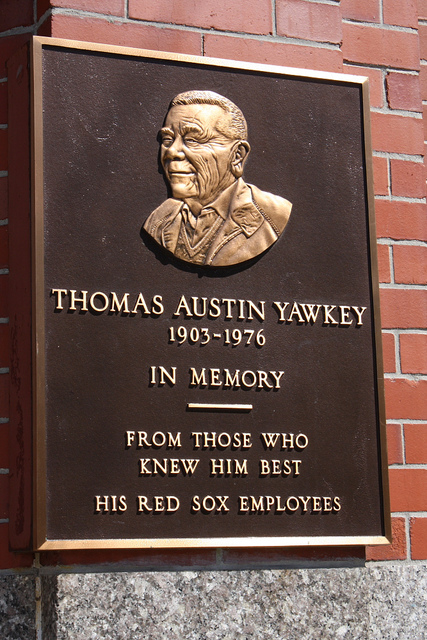
To catch you up quickly: Tom Yawkey was a lumber tycoon and baseball enthusiast who owned the Boston Red Sox from 1933 to 1976, making him the longest-tenured team owner in the sport’s history. Yawkey was almost certainly a racist; if he was not a racist, his team’s policies certainly were for many years. The Red Sox were the last major league team to integrate, and blacks did not have a significant place on the team’s roster until the late 1960s, two decades after Jackie Robinson broke the color line. From the beginning, Yawkey ran the Red Sox as a public utility, paying little attention to the bottom line as he tried to build a winner out of the franchise that had been a perennial loser since selling Babe Ruth to the Yankees in 1919. After his death, Yawkey’s wife Jean continued the family tradition, running the Red Sox, except for a few years, until her own death in 1992.
When Tom Yawkey died, the City of Boston re-named Jersey Street, which runs past the entry to Fenway Park where the Red Sox play, Yawkey Way in his honor.
In the unerring clarity of hindsight bias, Chimelis argues that Tom Yawkey is undeserving of any recognition by the city that he devoted much of his life to representing, enhancing, serving, inspiring and entertaining because racism is the ultimate crime, and anyone possessing that vile state of mind should be consigned to shame forever. It is a common point of view, and an unfair one. Continue reading →







Here is his Comment of the Day, to the post Zero Sum Ethics Encore: When An Unfair Firing Is Still The Most Ethical Course.