Comment of the Day
Comment Of The Day: “Morning Ethics Warm-Up, 1/27/2018: ‘If You Want It, Here’s How To Get It’ Edition”

Extradimensional Cephalopod was moved to write his wry Comment of the Day based on this partial post by Harold I. Ziegler ,which I quoted to illustrate the kind of reasoning that drives libertarians crazy…
Recently, videos have circulated on social media showing teens deliberately eating Tide Pods laundry detergent packs. All of this is part of what some call the “Tide Pod Challenge.” These pods contain highly concentrated laundry detergent under pressure and explode when bitten into, releasing their toxic contents and causing rapid ingestion and inhalation of dangerous chemicals. In my capacity as a toxic chemical researcher and consultant, I have investigated and seen several instances of the horrendous consequences that result from laundry pack ingestion: permanent burning of the mouth, throat, digestive tract, and lung tissue, and in some cases even death.Procter & Gamble (P&G), the manufacturer of Tide Pods, as well as other companies selling laundry detergent packs, have acted in the past to stem the misuse of their products. But these safety measures have failed.
It’s clear that laundry pods as they currently exist are too dangerous to be sold to the public. If P&G and other manufacturers can’t figure out a way to reduce the more than 10,000 injuries they cause each year, laundry packs need to be taken off the market.
I used to work for the trial lawyers association; I think product liability law is important, and that manufacturers need to consider consumer safety. The argument that anyone but parents are responsible when their toddlers eat Tide Pods, and worse, that anyone but the teens themselves are responsible for what happens when they put the detergent in their mouths knowing that it is detergent, however, is societally corrosive, as toxic as the pods themselves. Parents have the responsibility to keep poisons away from children. Teens have the responsibility to not take stupid dares they see on social media. If you can make Tide shelve its pods because teens are eating them, then you can ban knives with points because there’s a social media fad promoting knife-juggling. EC humorously expresses my feelings about the “if one stupid teen is saved” mindset.
Here is Extradimensional Cephalopod’s Comment of the Day on the Item #1 in the post, Morning Ethics Warm-Up, 1/27/2018: “If You Want It, Here’s How To Get It” Edition:
At first I was relating the argument for discontinuing detergent pods to the character of Wonko the Sane from the Hitchhiker’s Guide to the Galaxy. After seeing instructions printed on a toothpick container, he concluded that the world had gone mad, and put it in an asylum with himself as the warden (he turned his house inside out). After all, if you can discontinue laundry detergent because people old enough to know better are using it for a dangerous unintended purpose and parents can’t keep their cleaning agents in a safe place, then you can use that argument against literally any physical product, because someone can deliberately hurt themselves with it. Making it taste bad just adds to the challenge of self-harm.
However, after reading the article, I got an idea from the part where the author says that the companies have been dragging their feet as far as making their products less tasty-looking is concerned. Continue reading
Comment Of The Day “Morning Ethics Warm-Up: 1/27/2018: “If You Want It, Here’s How To Get It” Edition”
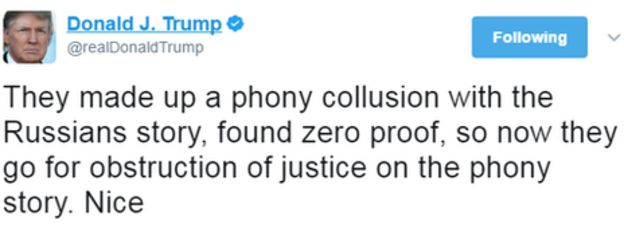
Chris Marschner, who has had several, scored another Comment of the Day today with his reflections on the strange nature of “obstruction of justice ” charges, when justice would in fact be for no charges to be brought at all.
He was focusing on #3 in today’s warm-up, which discussed yesterday’s “resistance” theory that allegations that the President wanted to fire the Special Prosecutor (but didn’t) prove that he was trying to obstruct justice when he fired James Comey, who so, so deserved it.
I see unmistakable signs that the “resistance” is losing its already tenuous grip on reality, and is increasingly yielding the raw hate and fury that long ago supplanted any rational criticism of Donald Trump. Consider has-been Leftist documentarian Michael Moore, who with fellow progressive performers Mark Ruffalo, Whoopi Goldberg, Rosie Perez and Cynthia Nixon, who have to do something between jobs, is pushing Monday’s Counter-State of the Union , which is only slightly more sensible than the “scream pointlessly at the sky” event. Remarkably, among Moore, Whoopie, Rosie, Cynthia and Mark there isn’t a single political science, history, economics, or government major. In fact, there isn’t a single college degree of any kind between them, or business, government or executive experience of any kind.
Michael Moore, speaking on behalf of MoveOn.org (Do the Time’s Up and #MeToo crowd recall that Move-On was spawned to protest Bill Clinton facing accountability for his cover-up of sexual misconduct? Nah.), sent out an email that read in part, before the fundraising pitch,
This situation is a nightmare. And the only reason that things aren’t FAR WORSE than they already are is that millions of us have come together to engage in our democracy, resist, and organize.
But our problems go far beyond one sociopath president. The mission that we are on and the work that we must do is to tear down the rigged system that produced Trump in the first place. We must imagine the America that we want to live in. We must create the post-Trump America.
And this is actually possible: The fierce, determined Resistance movement that began after Trump’s election could create an avalanche at the polls this November. Together, we can stop Trump and the GOP and begin the work of creating the country that we imagined.
The country the Moore imagined was called the USSR. But I digress.
Here is Chris Marschner’s Comment of the Day on the post, Morning Ethics Warm-Up: 1/27/2018: “If You Want It, Here’s How To Get It” Edition: Continue reading
Comment Of The Day: “Morning Ethics Warm-Up: 1/18/2018: Enemies Of The People

Today’s Comment of the Day teaches a couple of lessons:
1 Contrary to common belief, and Ethics Alarms Comment of the Day does not have to be long, though many are. Indeed, I was tempted to make Willem Reese’s one sentence comment to the Kangaroo People abortion ethics thought experiment a Comment of the Day. He asked, shaming us all,
“The deciding case would likely be Roo v.Wade, then?”
2. Late comments on older posts are still worth reading.
Here is Pennagain’s Comment of the Day on the post, Morning Ethics Warm-Up: 1/18/2018: Enemies Of The People:
Over the past couple of decades, approximately, I have become increasingly uneasy, depressed, anxious, angry, isolate and finally maddened by what has gone into the methodical and insanely deliberate betrayal of ideals and freedoms, the destruction of respected, useful institutions, the disregard for all the high, bright values in “my” society, my culture. But even when the detrimental changes began to affect me directly — my person, my quality of life, my safety and security (such as it was: I’ve never needed much) — I clung to the mantra this too shall pass. But, as my historian friend kept reminding me, the 500+ year old Roman Republic went belly up within the same amount of time, and never found its feet again. Still, I wasn’t scared out of my wits until I read the word “COUNTERSPEECH.”
Counter. Speech. Against speech. Not just anti-First Amendment, something to STOP PEOPLE FROM SPEAKING. Not just “free” speech; simply not using any words that mean anything. The language of technology, the language that becomes more abbreviated with all its faster-than-life(sic) changes, a spoken version of texting and twitting, a dumbing of vocabulary, a numbing of nuance. . A muffling of all meaningful voices. The left will pull the blanket over its head first, and willingly, and not even understand what is happening until it wakes up in the middle of the night with its headphones glued to its brains, silently screaming.
Much as I hate to bring up the name of der Furher because it has become such a cliche, he has the most appropriate description of what “Counterspeech” can become. It is akin to what Hitler first announced at the Wannsee Conference in 1942 as The Final Solution.
Comment Of The Day: “Ethics Quiz: ‘NCIS’ Ethics”
 [ Again I am awash in Comments of the Day. There’s no question about it: the comments here are getting better, and more commenters are participating. There are also more comments being made to posts than ever before. 2017, despite a 10% drop in traffic from 2016, set a record for comments. This blog was always designed to be an interactive online colloquy on ethics. More views, links and shares would be nice, but I’ll take more and better comments over volume any day. You all are doing a terrific job. I may have to make “Comment of the Day” a daily rather than an occasional feature. That would be progress.]
The latest Ethics Quiz was about this week’s “NCIS” episode in which the federal agency’s director got all misty eyed and proud to learn that his daughter had accepted the blame (and the charges) for her friend’s shoplifting because her friend was 18 (and a habitual shoplifter) and the offense would end her dream of college. Ethics Alarms readers were asked whether this was a responsible ethics message for Mark Harmon’s long-running procedural to send, especially to any children watching.
The quiz attracted uniformly excellent responses (my take is here).
Here is Greg’s Comment of the Day on the post, Ethics Quiz: “NCIS” Ethics:
I would say that the daughter acted foolishly and the father acted unethically.
The father has a duty to teach and protect his children, which he utterly failed to fulfill in this case. His daughter is showing disastrously poor judgment, placing her future seriously at risk, and he needed to set her straight. He should have lectured her on the enduring truth of the adage, “Lie down with dogs, rise up with fleas.” She should not be spending any time at all with an incorrigible thief. This other girl is big trouble. She has already gotten the daughter arrested once and if the daughter continues to hang out with her, the odds are high that she will do it again. The lesson that the daughter should have learned from this incident is that she needs to shun the company of this supposed friend. Instead, the incident has bound them together even more closely. Continue reading
Comment Of The Day (And Poll Results!): “Meet The Passionate Ethics Dunce Confronting Public Figures With Their Immigrant Histories…”

I decided that this one was too stupid for the poll…
I want to express my gratitude to veteran Ethics Alarms commenter and previous Commenter of the Year texagg04 for another of his epic contributions, this one following up on my poll asking readers to vote for the worst of 15 commonly used justifications for tolerating illegal immigrants. Rather than choose the worst—“stupidest,” in Tex’s parlance that I approve of in this matter—he ranked them from stupidest to least stupid, after commenting on each and explaining what each signifies.
The Most Stupid in his ranking is also the most sinister and the most important: “Opposing illegal immigration is racist/xenophobic.” The entire pro-illegal immigration movement has adopted the strategy of impugning opponents as racist or xenophobic to both stifle legitimate debate while demonizing the rule of law and immigration restrictions.
The poll that ended the January 22 Ethics Alarms post about Jennifer Mendelsohn , who thinks that if you had a legal immigrant in your lineage you are a hypocrite to advocate enforcing immigration laws attracted 239 votes, and Ethics Alarms record (multiple choices were allowed). The final results with percentages of votes cast:
“Opposing illegal immigration is racist/xenophobic.” 19.67%
“We stole their country, so it’s really theirs to use as they please.” 12.55%
“We’re a nation of immigrants.” 11.3%
“The words on the Statue of Liberty!” 7.95%
“They do jobs Americans won’t do.” 7.53%
“Think of the children!” 6.69%
“Illegal immigration is an act of love.” 5.44% (tie)
“They just want a better life.” 5.44% (tie)
“They aren’t hurting anybody.” 5.44% (tie)
“Our economy depends on them.” 5.02%
“They aren’t really criminals.” 4.18%
“We’re a compassionate people.” 3.77%
“You would do it too, if you were them.” 2.93%
“It’s a dumb law.” 2.09%
Here is texagg04′ s Comment of the Day on the poll included in Meet The Passionate Ethics Dunce Confronting Public Figures With Their Immigrant Histories As If It Proves Anything: Continue reading
Comment Of The Day: “Morning Ethics Warm-Up, 1/14/18: Comfort Women…”

Sam Halverson’s 6th comment to Ethics Alarms is a Comment of the Day, and a fascinating one. It comes in response to Item #2 in the 1/14/18 Warm-up, which involved the seemingly endless argument between South Korea and Japan over the Korean women forced be sex slaves by their Japanese captors during World War II. One of the pleasure of operating this blog is that its readers teach me so much. This is a prime example.
Here is the Comment of the Day by Sam Halverson on the post, Morning Ethics Warm-Up, 1/14/18: Comfort Women, Presidential Health Lies, Pit Bulls And No “Goodbye Columbus”…Yet
Let start this comment by saying; this is not what it looks like.
My dog (a mutt, maybe a little bull terrier, who knows?) is not in this fight between Japan and the Republic of Korea. To categorize it as a fight probably isn’t correct either as the facts have been settled and there has obviously been a huge evil committed by Japan against the people of Korea, one I am not writing this to convince anyone of anything but rather to inform people of something they may not of known before hand. Whataboutism this is not, anger, disgust and a bit of shame it is.
Everyone loves a hypocrite; watching someone fall always delight the side of us that craves spectacle and someone who betrays themselves only raises the precipice higher. Which is why I want to talk about the massive human trafficking problem that goes on in The Republic of Korea.
The Korean people are polite. They do not talk about scandalous things in public, not with strangers and definitely not with foreigners. They would rather ignore a problem in their polite society than admit it exists. Getting an average South Korean to self criticize the culture is like pulling teeth and just as likely to end in blood loss.
For example, it is a blatantly open secret that while prostitution is illegal (as well as pornography) in Korea, it is rampant. There are literal whorehouses that display their wares in the open on the street behind pink curtains and glass walls, police walk by without comment. These are known as “glass houses” and the implied metaphor for the country is apt.
While the Korean government is chastising the Japanese for refusing to apologize for atrocities committed over half a century ago, they are practicing the very same evils today.
Every year an unknown number of women are forced into prostitution and domestic servitude on a country that is rated as a TIER I nation on the U.S. Office to Monitor and Combat Trafficking in Persons, TIER I being reserved that nation’s that comply with international laws on human trafficking.
I wonder if South Korea is afforded leniency because of it’s strategic position in advancing US interests in the region, a reclassification would bring sanctions and weaken US Korean relations. I can personally tell you that that status is crap, unlike the US where human trafficking is hidden behind closed doors there it is as mentioned visible from the street.
How do I know? I was stationed at Camp Hovey, South Korea for a period of one year while serving in the army as an 11B. It’s a smaller camp connected to Camp Casey which is one of the largest and furthest north of the primary American installations. I was stationed there in 2010 and witnessed this with my own eyes. Comfort women still exist, but they are being sold willingly by the Korean public to friends not Invaders. Continue reading
Comment Of The Day: “I Worry About Cary Grant”

Today’s Comment of the Day was spawned by the post about the fading of cultural memories of important film artists. texaggo4 has his doubts about my concerns, and whether the phenomenon is worth worrying about, or even a problem at all.
I admit, this topic is an unusually intense and personal one for me. It was the reason why I devoted a large portion of my life and creative energy for twenty years to the quixotic challenge of creating and trying to maintain a professional theater company in the Washington, D.C. area devoted to producing American stage works of quality and historical importance that were in danger of falling out of the American stage repertoire entirely, if they were not already forgotten. We proved that many shows thought hopelessly dated or politically incorrect still worked (“The Boys in the Band,” “The Seven Year Itch,” “Native Son,” “The Cradle Will Rock”…), found genuine masterpieces that almost nobody knew existed (“Moby Dick Rehearsed,” “Machinal,’ “Marathon 33″…), and lost a fortune on artistic gambles that didn’t pan out, for a wide variety of reasons, including bad management, bad luck, or the unpredictability of show biz. Notable disasters that still give me nightmares include ” “Home of the Brave,'” Mr Roberts,” “A Flag is Born,” “Dear World, and “The Pirate.” We had a devoted and loyal following, and I think we proved our point, but basically didn’t make a ripple despite all that work. (Except perhaps in this case, and maybe that was enough…) Heck, our theater was in a school building, and we couldn’t get any teachers to bring their classes to our shows, even for free.
But then, most of my life has been devoted to futile pursuits. After all, I’m an ethicist…
Here is tex’s Comment of the Day on the post,I Worry About Cary Grant:
What exactly are we asking for here? Facial recognition of the actor and an ability to recollect every great movie ever produced? What’s the goal of Cultural Memory? It cannot be the rote memorization of EVERY SINGLE great artist, producer and creator of art & culture. 1, we’d never have time to get around to memorizing ALL of it, 2, we’d never have time to get around to viewing all of it, 3, we’d never have any time to get around producing new examples of it, 4, we’d never have any time to get around doing anything else that life calls us to do.
The great conversation, as it is called, which is the ongoing “dialogue” between artists of the present with their contemporaries as well as with their predecessors. Artists take the concepts that are explored in the past, the debates had between opposing concepts in the past, and rework them in the present, either shedding light on new angles or re-engaging the old arguments, or bolstering new arguments. This long process of cultural production has produced MILLIONS of individual works and, without a doubt, TENS of thousands of artists. Of those countless producers & performers, we can assume there are many many thousands of individual works that could be called “culturally iconic” or “unique” or “ground breaking” and thousands of artists.
Feeling less well read that I ought to, I compiled a list of what several thinkers considered to be the “Western Canon”: a list of essential books that captured the literary and written philosophy component of this “Great Conversation”, with the goal of plodding through them over my lifetime.
930 books. Just the books.
The authors, as I read their names, certainly had recognizable names and I could probably guess relatively accurately the eras they wrote in. Could I reasonably hold a discussion or even mention some prominent idea found in them? Maybe 10% of that list. With any level of deeper understanding? Less than that.
But what I could do, without those books, is hold a relatively well thought out conversation about the ideas that most of those books were also exploring. Why? Because that is what cultural memory does for us, without being able to hold an in depth idea about a particular work of art, we can still be able to hold in depth ideas about the particular notion that a work of art was exploring. Because cultural memory goes a great way towards preserving, through the Great Conversation, all those ideas and philosophies and beauties and art, without me having to memorize in rote detail the specifics of each work.
930 books, considered essential to grasp the great conversation of *just* Western Culture. How many paintings & painters? How many concertos and composers? How many sculptures? How many plays and playwrights and stage actors? How many buildings and architects? How many movies and directors and actors and screenwriters?
The interesting thing of course, is how the growth of culture has accelerated due to population, communication and technology. Whereas one generation in the 1000s may have produced a half dozen *iconic* culture producers, one generation in the 1500s produced several dozen *iconic* culture producers. One generation in the 1700s, maybe 100. A generation of the 1900s, easily several hundred.
Producers. Multiply that by 10 for iconic works. And I think I’m underestimating. Continue reading
Comment Of The Day: The Pastor’s Confession

There was a lively and contentious debate on Megachurch Pastor Andy Savage’s 20-year-old encounter with a 17-year-old girl. There were several extensive comments, and I may yet post one from the pro-Andy camp to balance this one, by johnburger2013.
Here is his Comment of the Day on The Pastor’s Confession
There are at least 3 creeps in this story:
A. Megachurch minister Andy Savage. This incident as revealed by Jules Woodson clearly demonstrates that Savage knew what he had done to Woodson was, at the very least wrong and immoral. He has a crisis of conscience and seeks absolution from the Lord God Almighty. Good for him. I suspect that God would have said, “Hey, jerk. Apologize to her, make it right, and never, ever use my name in vain. Go away.” He told her not to discuss it with anyone. Nice guy, that. Nothing in the story reveals that he tried to make amends to her; on the contrary, everything points to him trying to cover up what he did to her.
I would not even rate his statement as an apology, though. Note the buzz words:
1. “As a college student”: Hey! I was young and impetuous, and my hormones got the best of me.
2. “On staff at a church in Texas”: I was nobody important at the church, just a young buck hauling stuff for the church way over there in Texas.
3. “More than 20 years ago” : It was a long time ago. The winds of history have clouded my memory. Don’t judge my sexual assault of a 17 year old girl by today’s standards; things were different back then! Come on!
4. “I regretfully had a sexual incident”: I forgave myself, and you know what the Good Book says about sin, repentance and forgiveness. The Lord has forgiven me, so you should, too.
5. “With a female high school senior in the church.” She was a senior and not some under-aged school girl. Besides, she was like an adult.
6. “Until now, I did not know there was unfinished business with Jules”? Unfinished business? What does that mean? Unrequited love? A bad date you need to make right? Does the good pastor mean, “I thought we forgave and forgot; I guess not.”
7. “Jules, I am deeply sorry for my actions 20 years ago.” There he goes with the 20 years ago stuff again. Why don’t we just move on. Remember: he did not say this to her on the phone or in person but on a NATIONALLY televised prayer/worship service. He tried to pull a Jimmy Swaggart or a James and Tammy Baker. (Que: Sound of bombs dropping and whistling right before detonation.) So, let me get this straight. He assaults a 17 year old, tells her to keep it quiet, and then 20 years later, he further humiliates her on national television about some unfinished business. What a jerk. Continue reading
Comment Of The Day: “Lies, Dunces, Fools, Villains, Hypocrites And Big Liars In The Resistance’s Plan E, “The President Is Disabled!” [Part 3]”

Here’s another one.
Regular readers here know I’m a sucker for Presidential history, even when I’m not the one expounding on it. I’m also a sucker for posts that I would otherwise have to write myself., and I was outlining a very similar post to this when Steve-O-in-NJ kindly produced this Comment of the Day. For of there is one thing my life-time love affair with the Presidency and the men who have had the audacity to try, always with mixed success, to fulfill its crushing challenges, has taught me, it is that these were all weird men, each in their own unique ways. You have to be weird to seek this job, or survive it. The argument that Donald Trump’s undeniable weirdness is somehow deserving of less tolerance than any of the other Presidents is bigotry mixed with ignorance. Leadership is itself abnormal, and has infinite guises.
Welcome to Steve-O-in-NJ’s Comment of the Day on the post, Lies, Dunces, Fools, Villains, Hypocrites And Big Liars In The Resistance’s Plan E, “The President Is Disabled!” [Part 3]
Washington was an inch away from leading an army personally to put down the Whiskey Rebellion. Andrew Jackson had a notorious temper (all his life), fought duels (though not while in office), and said he was going to hang the first South Carolinian who defied Federal law to the first tree he could find if bloodshed resulted from that defiance. LBJ gave interviews while on the toilet, more than once. Jimmy Carter talked about having consulted with his young daughter regarding policy matters and claimed to have seen a UFO. Calvin Coolidge brushed off a reporter who had made a bet that she could get more than two words out o him by saying “you lose.” Grover Cleveland had half his jaw cut out due to cancer and told the press he had two bad teeth extracted. He also married a woman who was young enough to be his daughter. Lincoln of course battled what we’d probably now recognize as clinical depression.
The two biggest offenders for presidential disability were Woodrow Wilson, who was actually completely disabled by a stroke and hid it, in effect making the nation an oligarchy ruled by his wife and closest advisors, and JFK, who hid the fact that he had Addison’s disease (why that didn’t keep him out of the Navy I don’t know), probably PTSD, and crippling back pain that sometimes left him unable to stand without drugs. I also wonder if it would be out of line to diagnose Clinton with satyriasis, given his behavior.
My main point is that some of the arguably best presidents like Washington and Jackson, others who were at least popular like Cleveland and Clinton, and some that official history is reluctant to examine too closely like JFK (although that is starting to change) all had issues of risky or extreme actions, bizarre behavior, or concealing disability from the public, and no one now calls any of them unfit for office, nor was that charge ever leveled to my knowledge at any of them with any level of seriousness. As far as I know no Republican leader has ever leveled the charge of mental or other unfitness at any Democratic president with any seriousness, although Clinton’s sexcapades, Carter’s incompetence and errors, LBJ’s open crudeness and weirdness, and JFK’s litany of problems presented the opportunity several times. Continue reading
 Ethics Alarms
Conservative journalist David Greenstein made a provocative speech before a Tea Party group in which he posited a “civil war,” defined by him as when a political party rejects a lawful Presidential election and refuses to accept the legitimacy of any government it does not dominate. I admit that offering up such inflammatory analysis for comment is the pedagogical equivalent of tossing a hand grenade in a room, but there is method to my madness, beginning with my conviction, documented here since November 2016, that much of the Democratic Party is denying the legitimacy of the last Presidential election, and is actively working to find a way to remove President Trump without having to defeat him in the next one. I believe that this is among the most damaging and dangerous political developments, and ethics outrages, in U.S. history, and one that has been intentionally covered up by an unethical news media with the same agenda.
Greenstein’s speech placed the matter front and center, and I guessed, correctly, that it would get a lot of attention, though the speech has been largely ignored by progressive commentators, even as numerous Democrats, announced that they would boycott the State of the Union message, a traditional yearly symbol of a unified people. I also assumed that it would pose an interesting challenge for readers here, specifically the challenge of keeping bias out of their analysis, since, as we all know, bias makes you stupid.
Chris Marschner did an especially good job of this, and here is his excellent Comment of the Day on the post, Ethics Quote Of The Month, Terrifying Thoughts Division: Daniel Greenfield: