1. Traffic here is cratering in the run-up to the 4th, guaranteeing that for one of the few months in Ethics Alarms history, June 2017 will have seen significantly less traffic than its previous year’s equivalent. 2017 and 2016 are now in a dead heat.
I have some theories: by this point last year the campaign was heating up, and I was being sufficiently critical of both parties and candidates to make everyone happy. Ethics Alarms also started getting a lot of those paid Hillary shills commenting; I banned more commenters in 2016 by far than any other year. Also because of the campaign, there were an unusual number of posts shared by hundreds and even thousands of readers, as well as a record number of the anomalous posts that double or even triple the daily average. Those, I have found, are completely unpredictable. What I consider important or especially astute essays almost never attract readership; the runaway posts are usually about something relatively trivial.
On the other hand, the blog has many more followers in 2017, more consistently high-quality comments, and, as my life partner continues to remind me with dagger glances, revenue is holding steady…
Major League Baseball umpire John Tumpane, assigned to a Pittsburgh Pirate home series, was walking from his hotel to the ball park across the Roberto Clemente Bridge when he saw woman climb over the railing to the outside of the bridge. He decided to approach her, and in response to his queries, she told Tumpane she just wanted to get a better view of the Allegheny River below.
The look on her face and the tone of her voice told Tumpane otherwise, so he grabbed her and refused to obey her demands that she let her go…and jump. Another bystander saw what was going on and joined him, grabbing the woman’s free arm. A third grabbed her legs through the railing as Tumpane implored the gathering crowd to call 911. The three men held on until emergency responders arrived. Continue reading →
A secondary school teacher or administrator (or other role model for children) who allows pictures of himself or herself to be widely publicized, as on the web, showing the teacher naked or engaging in sexually provocative poses, cannot complain when he or she is dismissed by the school as a result.
Various discussions f the NTP can be found here. [The original post on the topic is on the old Ethics Scoreboard, which is down at the moment thanks to an incompetent web hosting operation. It will be back soon, or there will be blood….]
Now we have the borderline case of a kindergarten teacher—that’s primary school, not secondary school—who is a proud porn performer as a second occupation.
Nina Skye is a preschool teacher at a religious school in Los Angeles and decided to go public—with Fox News, of all places—with her secret double life moonlighting in the adult film industry.
“I love teaching. I love sex. If I can get away with doing both, then I will,” Nina says. “I know what I’m doing when it comes to teaching, I’m a really good teacher.” On the other hand, “It’s easy money. For my very first scene, I just did a regular boy on girl and I got paid $2,500 on the spot.”
Skye’s explanation about why she is revealing her passion at the risk of her teaching? “I guess some people are really tied by that moral code, ” she says. “There’s a really big stigma associated with it, and how our society views it, but that’s not how I am… I’m really open-minded. Super open-minded and not judgemental.” Continue reading →
1. Since I don’t want to have too many posts at once showing how untrustworthy CNN has become, let’s put this one in the short form: on Sunday, CNN’s alleged show about journalism ethics, “Reliable Sources,” hosted by “watchdog” (stifling a guffaw here) Brian Stelter, conveniently skipped the single biggest broadcast journalism scandal in years.
Thomas Frank, a reporter for “CNN Investigates, announced that “the Senate Intelligence Committee was investigating a Russian investment fund”, the Direct Investment Fund — “whose chief executive met with a member of President Donald Trump’s transition team four days before Trump’s inauguration.” The CNN “exclusive ” was based on a single unnamed source, and quickly attacked as fake news—which it appears to have been. CNN, of course, has pushed the Trump-Russia collusion hypothesis as if it were a missing Malaysian airplane. The network pulled the story, retracted it, and three reporters involved in the fiasco “resigned.”
If one were depending on Stelter to get a weekly briefing on how reliable and ethical news media sources were in the week past, one would have been thoroughly deceived. “Reliable Sources,” under the oversight of Stelter, itself isn’t reliable or ethical. It is a house mouthpiece, masquerading as an ethics show. This is res ipsa loquitur, an episode that speaks so loudly by itself that no further evidence is required. If the host of a broadcast ethics watchdog cannot and will not report on serious ethics breaches by his own employer, which is also one of the most visible and significant broadcast news outlets in the journalism, then the show isn’t really dedicated to journalism ethics. It is a biased tool of competition and propaganda, with conflicts of interest that it neither admits nor tries to avoid.
Stelter devoted most of his show to attacking President Trump for not according proper respect to the news media. The President has labelled CNN as “fake news.” This episode vividly demonstrated why.
2. Watching HLN’s Robin Meade this morning to avoid “Fox and Friends” (the CNN outgrowth also has thus far neglected to mention the network’s fake news episode,) the Cheerful Earful began, “The minimum wage might actually hurt workers????” while making a shocked face that would be appropriate if she was saying that the moon was made of cheese. Thus do those constantly marinated in progressive/ Bernie-style fantasies set themselves up for amazement by the obvious.
Yes, Robin, it has been well-known for about a century that raising the minimum wages causes unemployment for workers whose negligible skills just are not worth the new mandated wage, eliminates whole job categories (summer jobs for teens being the most harmful to society), and puts many small businesses out of business. But never mind! “Living wage” sounds so kind and good, and the rising minimum wage is always a tool to help unions argue for increases in their much more than minimum wages, which is why the Democratic Party keeps promoting the lie that raising the minimum wage ever higher makes sense.
Robin was shocked at a new study of the results of Seattle’s huge minimum wage increase, enacted in the heat of mindless progressive faith. Conducted by a group of economists at the University of Washington who were commissioned by the city, the study indicates that far from benefiting low-wage employees, the costs to low-wage workers in Seattle outweighed the benefits by a ratio of three to one. This is the study found that some employers have not been able to afford the mandated minimums, so they are cutting payrolls, delaying new hiring, reducing hours or firing workers. Gee, who could have predicted that? The news media is reporting this as if it is a surprise. It’s not. I oversaw a study at the U.S. Chamber of Commerce decades ago that indicted this would happen, because it has happened before. Frankly, it’s obvious; so obvious that I have long believed that Democratic Party advocates for the minimum wage are lying to their gullible supporters. Both Bernie Sanders and Hillary Clinton made raising the minimum wage a rallying cry, which is one of many reasons why I found it impossible to trust Bernie Sanders or Hillary Clinton.
In the meantime, having seen the writing on the wall, restaurants are increasingly moving to replace waiters, waitresses, and cashiers with automated systems, because they are cheaper…thanks to the minimum wage. If humans were cheaper, humans would keep those jobs, and restaurants would be more pleasant, unless you prefer dealing with computers than human beings. I don’t.
Lies have consequences. Or as Robin would say, “Lies have consequences???”Continue reading →
Ethically challenged left-wing website Salon somehow found an ethically challenged law professor, Cassandra Burke Robertson, to justify the leaks in the Trump Administration. Robertson, despite being a Distinguished Research Scholar and the Director of the Center for Professional Ethics at Case Western Reserve Law School, advocates unethical and sanctionable conduct in a jaw-dropping post, “When is a leak ethical?”
Here, professor, I’ll fix your misleading and dishonest article for you: It’s NEVER ethical to leak.
Never.
She begins by noting “I am a scholar of legal ethics who has studied ethical decision-making in the political sphere.” Wow, that’s amazing….since she apparently is hopelessly confused about both, or just pandering to Salon’s pro-“resistance” readers.
Robertson writes:
“Undoubtedly, leaking classified information violates the law. For some individuals, such as lawyers, leaking unclassified but still confidential information may also violate the rules of professional conduct.”
1. It is always unethical to break the law, unless one is engaging in civil disobedience and willing to accept the consequences of that legal breach. By definition, leakers do not do this, but act anonymously. Thus leakers of classified information, lawyers or not, are always unethical, as well as criminal.
1. I am puzzled that no respected journalism source—assuming arguendo that there is one—hasn’t taken on the New York Times’ alleged list of President Trump’s “lies,” which was in my Sunday Times and released on-line earlier. I will do it today, but it shouldn’t fall to me, or other similarly obscure analysts. Why, for example, hasn’t the Washington Post taken this golden opportunity to prove how biased, dishonest and incompetent its rival is? Because, you see, the list is disgraceful, and smoking gun evidence of the Times’ abdication of its duty to its readers, except its own perceived duty to give them around the clock Trump-bashing.
The other thing I’m puzzled about is why I continue to subscribe to the New York Times.
2. One possible reason: The Sunday Times is now a weekly collage of the various derangements, false narratives and obsessions of the Left, and worth reading just to witness how 1) bias makes you stupid and 2) how unmoored to reality one can be and still be judged worthy of op-ed space. Here, for example, is “Black Deaths, American Lies” (the print title), a screed by Ibram X. Kendi, a professor of history at American University in Washington, D.C. (Disclosure:I was also a professor at American University. But I was an honest and apolitical one.)
The first line is, “Why are police officers rarely charged for taking black lives, and when they are, why do juries rarely convict?” This is deceit: an honest scholar wouldn’t have written it, and an ethical editor wouldn’t have allowed it to get into print. The sentence implies that officers are less rarely charged and convicted when they take white lives, and this is not true. In the print version, the article is headed by a touching photo of a street memorial to Mike Brown, whom we now know got himself shot. The Black Lives Matter narrative that Brown was murdered is still carried on by racist activists, ignorant members of the public, cynical politicians and unethical figures like Kendi, who lend their authority to divisive falsehoods. Kendi then focuses on the Philandro Castile shooting, as if its facts support his thesis. They don’t. First, the officer was charged, though he shouldn’t have been. Second, we have now seen the video, which clearly shows that after telling the officer that he had a gun, Castile reached into his pocket and began pulling out his wallet as the obviously panicked officer shouted at him not to pull out his gun. Just as the video proves that the officer was unfit to be a cop, it shows that he was in fear of his life and why. He could not be convicted of murder on that evidence. Never mind: The professor writes, Continue reading →
Meanwhile, for Trinity College, the countdown has started.
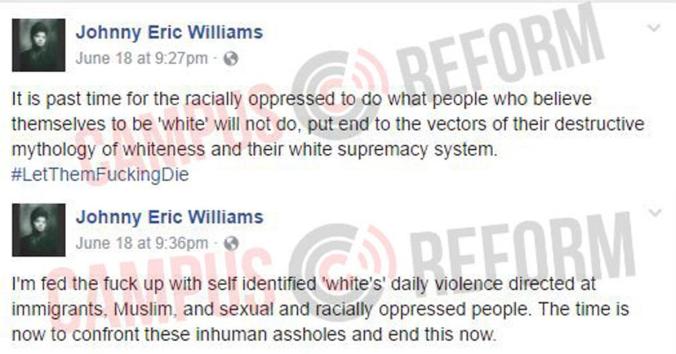
After Professor Johnny Eric Williams, associate professor of sociology at Trinity College in Hartford, approvingly posted a Medium article titled “Let Them Fucking Die” on Facebook, he went on to endorse the article’s thesis ( potential rescuers like those who helped Rep. Steve Scalise should let imperiled white people die as a form of combating white supremacy) in his own Facebook posts:
The Medium article concluded with this advice regarding one’s responsibilities as a citizen and a human being when a white person is in mortal peril… Continue reading →
1. I’m trying to get this up while I prepare for a new legal ethics seminar, teaming once again with the brilliant D.C. actor Paul Morella who has toured the country in the Clarence Darrow one-man-show he and I collaborated on more than a decade ago, using Darrow’s career and courtroom oratory to analyze modern legal ethics. Readers here have encountered a lot of those Darrow-related discussions already. For once, I’m grateful most lawyers don’t frequent this blog.
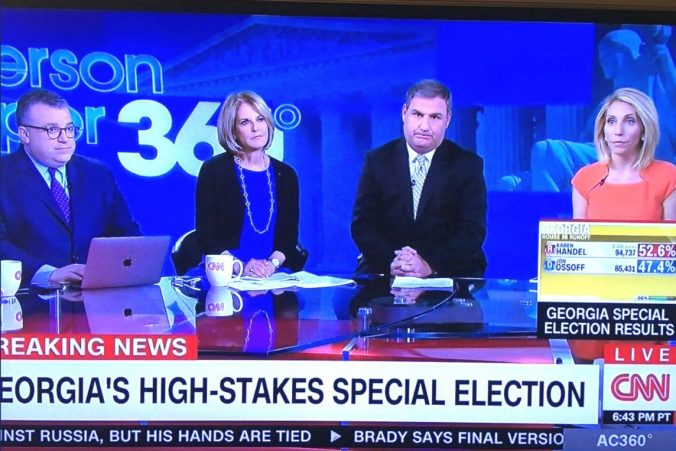
2. This now viral photo of the faces of CNN’s talking heads and analysts at the moment they realized that the Democrats had lost the Georgia Sixth District special House election that was hyped to be the beginning of a surge to the Left rejecting Donald Trump…
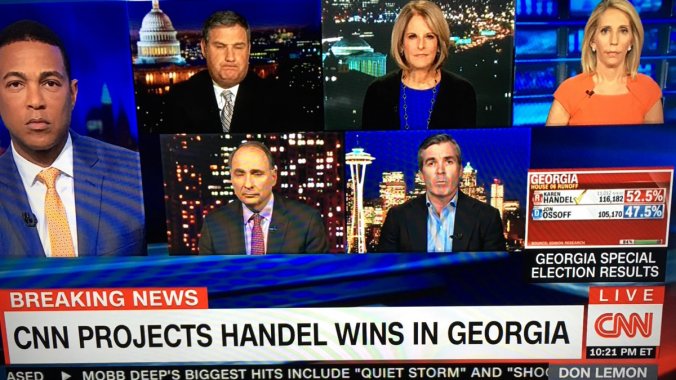
…and this one…
…are more than just gags. They are smoking gun evidence of the stunning lack of professionalism in journalism, and especially CNN. If there was any sensitivity or commitment to ethics on that set or in that production chain of command, every one of these arrogant hacks would have been told, “I want poker faces up there at all times. Objective and fair news reporting includes body language and facial expressions. Your attitudes warp your reporting. If anything about your demeanor betrays your personal preferences or political biases, you’re getting suspended. Got that? This isn’t a cheerleading squad.
3. This warrants its own post, but today will be a squeeze, so I’ll focus on the astounding chutzpah of that race’s loser here and now. Losing Georgia Six Democratic candidate Jon Ossoff was interviewed by NPR’s Rachel Martin, and this exchange resulted: Continue reading →
This is the second Comment of the Day within a week from Ethics Alarms prodigal son Curmie, a college prof, who makes the case that college education is being excessively maligned. You should probably re-read the post he’s responding , another Comment of the Day, to appreciate his argument.
This is a cogent analysis up to a point, but I must say I’m more than a little sick and tired of having people tell me what goes on in my classroom. I teach at a non-flagship state university. And the description of what happens in college classrooms simply does not match my experience of them.
(Side note to Ryan: I really do like a lot of what you’ve said here. I apologize if the succeeding sounds like a personal attack. It is not intended in that spirit. Just one too many sweeping generalizations about my profession, and the last straw happened to be yours.)
Ryan cites Thomas Aquinas. I prefer the great late-20th century philosophers known as Monty Python: “I’m not dead yet.”
I do expect students to know some objective facts: if you can’t tell me the basic tenets of neoclassical theory or who David Garrick was, you’re not going to fare well in my theatre history class. If Ryan wants to say that in this sense I insist on regurgitation, he has my permission to do so.
But to get an A on the research paper, you’d better be able to interpolate from incomplete data, and to articulate a point of view based on the facts as they are available to us. That means finding out what the facts are, but also finding context: okay, so it cost a penny to see a play at the Globe Theatre. But that’s a meaningless statistic if you don’t know what that Elizabethan spectator could have bought for a penny if he didn’t spend it on standing room in an outdoor theatre. Continue reading →
One thing I have noticed on those rare occasions when I truly listen to someone whose viewpoint is diametrically opposed to my own is that I discover there are indeed legitimate points being made and legitimate concerns that need to be heard. That doesn’t mean that I experience a paradigm shift. I will still believe that opposing viewpoint is incorrect, but at the same time I discover that my understanding of that opposing view was actually wrong.
There’s a great deal of satisfaction in being right, and I confess that at times I am more concerned with being right than with listening to someone whom I think is wrong. But there may be much more to the desire to be right than mere ego. Our brains are wired to find the simplest and easiest course. We learn actions that can then be performed by rote, without even thinking about them. That is why we find ourselves, upon walking into the kitchen, opening the refrigerator door and staring at food for five minutes before we recall we really entered the kitchen to find a flashlight. Our brains have developed a pattern that says: “enter kitchen, open fridge”. Having the right answer is a great thing, for our brain can discard all else and hold onto that right answer. It is easier. Simpler. Life now makes sense and we can proceed with cataloguing the more important details in life (the current Kardashian scandal or the names of all the Pokemon and their evolutions).
Being challenged in our right answers is uncomfortable. It can be especially distressing when someone presents us with a set of facts that, at least on the surface, contradict our right answers. We have two choices when confronted with such a challenge: we can either try to hone our own arguments, or we can retreat and try to insulate ourselves from further confrontation. We’ve seen quite a bit of the latter. We develop little adages about how it is impolite to discuss religion and politics — the two most important areas of life, and the two areas most likely to spark an argument. We surround ourselves with like-minded people, listen to the news that most appeals to our viewpoints, and never venture outside the echo-box. Certainly all these tactics are easier than constantly assimilating new arguments, researching new theories and developments, stringing together logical narratives, and perhaps even adjusting our own viewpoints when our conclusions lead us to recognize errors in our previous judgments.
I’ve read a little bit recently on St. Thomas Aquinas, and in reading I gained a peek into life in the universities of the thirteenth century. Students did not come to a university to attend lectures. They essentially apprenticed themselves to a master, who then did not teach so much as dialogue. They demanded that their students ask questions and find answers themselves. I read an account of how universities would host open debates, and the masters would throw their students into the ring to answer the challenges and objections people would raise. Continue reading →
“A few hysterically censorious kids screaming for a professor’s termination for crimethink do not threaten the foundations of free speech, but Yale lauding them does. Relatively few thugs disrupting a speech and even physically assaulting a professor don’t call into question the culture’s support for free speech, but Middlebury offering weak slaps on the wrist and shrugs for that violent behavior does. A violent mob in Berkeley does not undermine the legitimacy of free speech doctrine — a mob is a mob — but Berkeley’s timorousness or indifference in the face of violent censorship does. Students furious at a professor disagreeing with them don’t call into question the nation’s commitment to freedom, but state officials refusing to guarantee a professor’s safety do. In short: the regrettable behavior of officials who have failed to stand up to disruption of speech are the people most responsible for legitimizing further disruptions of speech, whoever commits them.”
——Lawyer/blogger/ free speech champion Ken White, writing about efforts on both the Left and the Right to interfere with or punish speech and opinions they don’t approve of.
Well and truly said, Ken.
Ken continues,
“But we can, and should, do better. Commitment to free speech as an American value — as an element of American exceptionalism — has always required tolerating evil and injustice and idiocy. We don’t refrain from disrupting speech because the speakers deserve it, or because we’ve been treated fairly by the speakers or their allies. We refrain from disruption — and ought to punish those who disrupt — because free speech is the necessary prerequisite of a society based on individual rights and freedoms. It’s the right that’s the gateway to all other rights. Shrugging and abandoning it as a value is an abandonment of our commitment to all rights.”
Why is this so hard to teach in colleges? Perhaps because the faculties and administrators prefer that their students never learn it.



 Ethics Alarms
This excellent comment requires no introduction, just reading.
Here is Ryan Harkins’ Comment Of The Day on the post, “Ethics Quote Of The Week: Ken White Of Popehat”: