That this episode could occur anywhere is ominous evidence of just how determined our progressive-infested institutions are determined to indoctrinate rising generations.
Gabby Stout, a junior at Ardrey Kell High School in Charlotte, North Carolina, and part of the Charlotte-Mecklenburg Schools district, received permission from the school to paint a message on the school’s “spirit rock.” This is a large boulder on school grounds traditionally used by students to paint various opinions and messages. They don’t have to be wise or uncontroversial either: one such message was “Black Lives Matter.”
Stout painted a Bible passage and her support for the recently assassinated Christian conservative leader of Turning Point USA, Charlie Kirk. For reasons never explained (but you can guess, can’t you?) the school quickly reversed itself. Within hours the school officials ordered her message to be painted over.
Heard outside the Collin County Courthouse today, after Karmelo Anthony was found guilty of murder (because he was) from the rabble-rousing Black Panthers: “We got to tell our kids the truth that this is a racist ass country. We gotta tell them the truth.”
Of course it isn’t the truth, but many unethical people, teachers, politicians, activists and organizations have made great strides toward creating the illusion that the U.S. is racist, and the efforts have accelerated over the past decade. One of the villains was Barack Obama, whom I am convinced will eventually be recognized for the divisive, destructive, corrupt and devious President he was. Another was Black Lives Matter, which is hardly a startling revelation. Of course we had the lazy, fearful, enablers of BLM, all of the companies, non-profits, local governments and pandering institutions that groveled at BLM’s metaphorical feet, with solemn “in these difficult times” ads and open letters, banners, and nauseating virtue-signaling.
Perhaps as despicable as the worst of them— Ta-Nehisi Coates, Al Sharpton, Charles M. Blow, the Democratic National Committee, which declared that the only reason Kamala Harris wasn’t elected President is because U.S. voters are racists—were the New York Times and its fake historian Nikole Hannah-Jones’ dishonest “1619 Project,” which contrived the lie that the main purpose of the American Revolution was to preserve slavery. Naturally the pathetic Pulitzer Prize people rewarded the Times and its reporter for their libel.
Even though that false framing was debunked forcefully and repeatedly by real historians, U.S. schools have been teaching the “1619 Project” anyway. Gordon Wood died this week. He was a Professor of History emeritus at Brown University and author of the acclaimed book “The Radicalism of the American Revolution,” as well as “Empire of Liberty: A History of the Early Republic, 1789–1815.” Wood was recognized as one of the most eminent authorities on this nation’s founding, and in 2019, in his courtly, understated way, gave a lively interview explaining just how full of garbage the Times’ anti-American propaganda was. Revealing that Hannah-Jones’ “racist America” trope was hooey was politically incorrect in 2019, so Wood had to go all the way to the World Socialist Web Site to have his analysis published. (The Times, if it weren’t such a biased disgrace, would have interviewed him.)
Here is the whole interview. It doesn’t matter who the interviewer was, but the “A” signifies Prof. Wood’s replies. The result is long but fascinating; I learned a lot, and perhaps you will too.
My father once told me that everyone should have a law degree to protect them from being cheated or scammed by other lawyers. He also said law school was the best way to be trained in rhetoric and logic as well as societal ethics, since the schools had abdicated those fields. As someone who seldom practiced law, Dad proved his claim that a law degree qualifies someone for lost of non legal jobs; for better or worse, people assume that lawyers are competent at management, negotiation, governing, and problem-solving. My experience has been the same as my father’s: I’ve been hired for lots of jobs requiring non-legal skills because I’m a lawyer.
This depressing episode, however, validated my father’s original endorsement of a law degree.
A couple of weeks ago, the News Mix channel on Direct TV suddenly disappeared. It was weird: first the message said I wasn’t subscribed, then it flipped to the message I get from the MLB channel when a Red Sox-Orioles game is blacked out, except instead of mentioning a baseball game, it said “News Mix” couldn’t be found, then said it was searching for another channel that had that “game.”
So I took a deep breath, knowing the horrors I would soon face, and called customer service. First the woman I finally reached after fighting with an AI bot gaslighted me and pretended that I was doing something wrong, because, she said, the channel was really there. Then she “checked” and said I wasn’t subscribed to the channel, which I knew was untrue: I have regularly checked it every morning to see how Fox News, CNN, MSNOW and BBC America were spinning the same stories, and what news each is deliberately ignoring or lying about. Channel 71 or 200 gave me access to those four stations and two weather channels. It’s part of my package. And it was gone. “Poof!”
After arguing with the agent, who had an indecipherable accent, she transferred me to a supervisor, who suspiciously sounded like the same person—could she have been pretending to be her own supervisor? But her clone was clearly smarter and spoke a bit clearer and slower. But this supervisor also tried to deny anything was wrong. After I argued with her for a while, she said, and I’m not kidding, “OK, I’m going to be honest with you: I received a complaint about NewsMix right before this call.”
OH! NOW you’re going to be honest and not pretend I’m making this up? Oh, thank you, thank you, thank you!
Ethics Alarms first mentioned the Karmelo Anthony case a year ago in the context of how completely screwed up woke Minnesota has become. Anthony, a teen who allegedly stabbed an unarmed white student to death at a school track meet, is the beneficiary of a GoFundMe effort that raised a large sum of money. Many conservative pundits wrote that this was a black backlash against a racist white woman who had attracted large donations to support her when a black man posted a video on social media that caught her in the act of calling him a “nigger.” I wrote in part,
“Anthony, who is black, is accused of stabbing 17-year-old Austin Metcalf, who was white, to death during a rain delay at their high school track meet. Anthony has not faced trial yet and claims that he in innocent by reason of self-defense. The online fundraising campaign on his behalf has raised over a half-million dollars. The clear difference between that and [the racist white woman’s] ill-gotten booty: Anthony hasn’t been found guilty of anything yet, and raising money for his defense is not, as some are claiming, the same as rewarding him for murdering a white kid. The accused teen’s family is the object of this fundraising campaign, and it is not inherently endorsing a black kid murdering a white kid to show sympathy for his family with a contribution.”
This ethics train wreck is still running. Anthony’s trial is finally getting started, and, naturally, the usual race-hustlers and victim-mongers are already claiming that the young man is another victim of racism by evil whites. Protesters were out in front of the courthouse chanting “Self-defense is not a crime!” They have no idea whether Karmelo has a legitimate self-defense case, but he’s black, so that’s all they need to know that he’s being framed by the racist justice system.
A straight “Unethical Quote of the Week” or “Incompetent Elected Official” EA honor still doesn’t do Rep. Judy Chu (D-CA) justice. She is special. Well, I hope she is.
Treasury Secretary Scott Bessent was crossing rhetorical sword points with Rep. Judy Chu (D-CA) during the House hearing over U.S. military action in Iran. When Rep. Chu accused the administration of not caring about Americans’ financial struggles—which is, after all, completely irrelevant to the decision to defang a hostile nation seeking nuclear weapons that has been at war with the U.S. since 1979— Bessent asked her who was President of the U.S. during World War I. After a pause, apparently to check all the blank files in her memory banks, Chu answered “I don’t know.”
The gimmick of walking through college campuses or other denizens of the young, woke and stupid and exposing the stunning ignorance on parade is an old one. Jay Leno developed it into an art form with his “Jay Walking” segment on the “Tonight” show. Jesse Waters has displayed versions of the bit on Fox News for quite a few Memorial Days now, asking young beach-goers about basic U.S. military history.
I know, I know. We have no idea how many people had to be interviewed to collect the staggeringly wrong answers. The dumbest participants are featured multiple times. Maybe these were the only embarrassing responses, though, frankly, I doubt that. I have mentioned before a lawyer I worked with who had been an associate at Skadden Arps, and was a graduate of Cornell. She had no clue when the Civil War was, guessing its dates to be “somewhere in the 1930s???” “Well, I was an economics major,” she explained.
These videos have the same perverse appeal as reality shows: they give audiences a chance to feel superior. It’s the same appeal that carnival freak shows had in past generations. Nevertheless, I believe that Watters’ Memorial Day debacles have value, because they provoke some clarity as well as foreboding.
First, the fact that there is a single adult American without a brain tumor, dementia or a closed head injury who doesn’t know who we fought in the Revolutionary War or who guesses that Albania was the world threat in World War II is a serious indictment of our culture, parenting, and the educational system from pre-school through college. One such idiot is too many. That more than one can be located on the same California beach on the same day portends of a decaying society being undernourished by atrophied minds. Democracy, more than any other form of government, depends on an engaged and informed populace. If people can reach adulthood that ignorant, we don’t have one, or at least we don’t have enough of one.
Second, it is arguably even more alarming that these dolts all laugh and giggle when their pet rock-level ignorance is exposed. They shouldn’t find it funny; they should be humiliated. They should dash into the surf to drown themselves. At very least they should tearfully apologize to, well, everyone.
These people vote. They are the audience that the Axis news media aim at, and the low information citizens that politicians like AOC, Kamala Harris, Tim Walz, Mamdani and James Talerico pander to. They, and people like them everywhere, are the reason the world doesn’t work.
I write comedy; I perform comedy, I have directed award winning comedies. I like satire, parody, slapstick and sophomoric humor. Will Rogers, Mark Twain, Oscar Wilde, W.S. Gilbert, Oscar Levant, Jerry Seinfeld, P.G. Wodehouse, Lewis Black and Chris Rock all amuse me, as will a good knock-knock joke. Those answers on the beach, however do not elicit a smile from me. They elicit despair.
The summary of the Pope Leo’s open letter to “all people of good will” is at Part I, along with a link to the whole 42,000 word opus. News reports on the document can be read here, hereand here.
1. The document appears to begin, as we would expect, from the basic socialist/Communist/progressive bias the Catholic Church has always displayed, which includes suspicion and contempt for capitalism. In the text, Pope Leo says that while “technology should not be considered, in itself, as a force antagonistic to humanity,” he added that “the pursuit of greater profits cannot justify choices that systematically sacrifice jobs.” The encyclical doesn’t resolve the obvious conflict that has always existed in that perspective: technology ideally improves the quality of life for humanity, saves resources and redistributes them elsewhere, and often reduces the costs of goods and services making them more affordable to all. One of my favorite inventors, Walter Hunt (inventor of the safety pin), invented the first practical sewing machine but didn’t patent or market it because he was certain that it would put seamstresses out of work. So Elias Howe patented the sewing machine instead. Were more jobs lost or created by the invention? I have no idea. This has been the inevitable sequence with new technology throughout human history: its ultimate impact is usually impossible to predict.
Ethics Lesson: Trying to develop rules and laws limiting the uses of emerging technology is stifling as well as futile, and foolish to boot.
2. A Pope using the Biblical fable of the Tower of Babel as his primary analogy to justify limiting the use of artificial intelligence is signature significance that makes me, for one, tend to roll my eyes at the entire document. That’s a story about the Old Testament God finding sinful the aspirations of mankind and sabotaging an effort by humans to cooperate in creating something ambitious and unprecedented. The encyclical demands acceptance of human limits, while science, capitalism and American individualism set no limits on human advancement. The Pope seems to be saying the equivalent of “If God had meant for us to fly, he would have given us wings.”
[This guest post’s origin was the most recent Open Forum. Personally, I don’t believe there is a rational, ethical, realistic “other side” to the issue. As I wrote in a longer response to Ryan that you can read here, “the issue of illegal immigration is quite simple. It’s against the law. It’s against the law because open borders to a country like the US is literally national suicide…The immigration laws we have, flawed or not, have to be enforced uniformly and strictly.”—JM]
My wife and I have been debating the illegal immigration issue on and off for a while now, and part of the reason we keep returning to ethics of the illegal immigration issue is the fact that so many in leadership in the Catholic Church have been very critical of Trump’s deportation efforts. As faithful Catholics, we believe we need to listen when our bishops speak. It doesn’t mean we mindlessly agree, but in cases where the bishops take a position we initially oppose, it is incumbent upon us to study and ponder the issue as thoroughly as we can before making any objections.
To that end, my wife and I are trying to be as open as we possibly can regarding the issue of how to manage people who are in our country and in our local communities illegally. I have told her that I think the best way to understand a viewpoint with which we disagree is to argue from that viewpoint and to steelman its arguments as best we can. Interestingly enough, my wife and I do highlight differing aspects of why we have problems with illegal immigration. I focus very heavily on the human trafficking issue. She focuses very heavily on the financial injustices the illegal immigration causes.
From the trafficking standpoint, I think that is it clear that a lot of illegal immigrants end up practically as slave labor, which has largely been overlooked because it seems like it keeps prices down in the supermarket. But far more devastating is the sex trafficking which never seems to get the attention it deserves, especially when so many of these “lost and displaced children” end up serving the debauched desires of affluent Americans who believe they can continue their predations because “Who would dare contact the authorities?”.
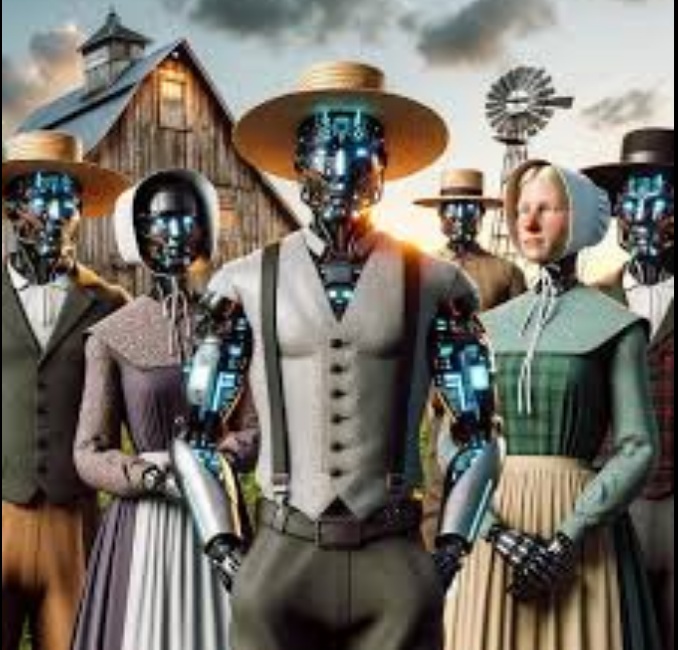
I always thought of the Amish as a devout religious sect with thee courage of their faith’s convictions, notably that technology is a tool of Satan, and the way to be closer to God is to eschew the modern developments that slowly but surely corrupt us all. That describes an ethical culture to me, if one that I personally find extreme and illogical. Google tells me that “The Amish are a traditionalist Christian group of Swiss-German Anabaptist heritage known for their pacifism, simple living, plain dress, and reluctance to adopt modern conveniences. Numbering roughly 411,000 across North America, they primarily reside in rural settlements in Pennsylvania, Ohio, and Indiana.” That’s nice. I’ve seen “Witness” several times, and assumed that Harrison Ford film more or less accurately portrayed Amish society.
I was also vaguely aware that there were variations withing the sect, based on, to some extent, relative isolation because of the general rejection of modern communication methods. Every local congregation operates under an unwritten set of rules called the Ordnung. These dictate daily life, acceptable technology, and community standards.
Today I realized that the Amish are not, in fact, a conservative religious sect that believes it can best maintain traditional values by rejecting technology. It is, in fact, a cult without integrity regarding technology. The Unabomber had more integrity.
According to New York Magazine (Stipulated:I am relying here on a source that I have found to be unreliable before, but unless the piece by Eric German is a flat-out lie as well as an attempt to defame the Amish, I believe it is trustworthy.), “The Amish Are Falling in Love With AI: Cars and TVs might be banned, but some sects are all-in on ChatGPT.”
“Holmes County, Ohio, has the highest concentration of Amish people of any county in the U.S. Visitors expecting to see traditional horses and buggies, bonnets and Abe Lincoln beards, won’t be disappointed. Still, they’ll find Amish entrepreneurs plugging into the digital economy and one clan of early adopters weaving generative AI into their knowledge work without much hesitation. Of course, none of this sounds like the tech-shy Amish life in the popular imagination. However, there’s no such thing as a single Amish approach to technology. There are some 2,600 Amish churches across the country, and each makes its own, separate decisions about what sorts of new hardware and software church members can use. The Wengerd’s church is Old Order Amish. Its married members dress plainly, don’t drive cars or own TVs, and don’t connect their homes to the electrical grid….Daniel is a minister in his church and has played a role in the congregation’s collective decisions to interdict smartphones and social media but to allow e-bikes, flip phones, solar-generated electricity, and religiously curated internet access. “I don’t want to paint a picture that we’re pushing for new technology and we don’t have respect for our traditions and our values,” he tells me. “We’re not just opening the door to anything.”
Sure they are. In fact, I can see no legitimate argument that a sect that embraces artificial intelligence can be taken seriously when it simultaneously rejects standard electricity, television and automobiles. Ethics is based on integrity, and requires holding to consistent standards subject to continuous testing and re-evaluation based on observed experience. Morality, in contrast, requires obeying clear rules of conduct that will be enforced by an authority, in the case of religion, God. The Amish appear to have neither a moral code nor ethical principles regarding technology. “We believe modern technology is a corrupting force in modern society and that it is not sanctioned by God, unless the technology is really cool and can save us time, like chatbots” is not a coherent code of conduct.
This is religion as Calvinball, the satirical “Calvin and Hobbes” game where the rules are made up as you go along. In Mark Harris’s novel “Bang the Drum Slowly,” a team’s baseball players fleece gullible fans by luring them into a gambling card game called “Tagwar.” It’s an acronym for “the amazing game without any rules.” It’s cheating.
Jonathan Haidt is a social psychologist and author of, among other works, “The Coddling of the American Mind.” he has been vocal on criticizing attacks on campus free speech for more than a decade, warning that the American education system is handicapping generations of students by allowing them to avoid ideas, opinions, and even facts that they find unpalatable. Last week he gave the guest commencement speech at NYU, but not before students, including the Executive Committee of the NYU Student Government Assembly, angrily protested his selection…because they found his ideas and opinions opposed to their “values.”
As Mr Rogers would say, “Can you say ‘irony’? Sure you can!” Below is the hilarious letter they sent to the school’s administration. Frankly, I don’t know how any student with the sense to come in out of a lightning storm could read this and not think, “Wait a minute…doesn’t this letter prove that this Haidt guy may be on to something?”
But no. Read this thing without your head exploding or dissolving into giggles. I’ll try to keep my comments brief at the end: