The Misleading Nature Of Media-Hyped Research

Aaron Carroll is an American pediatrician and professor of pediatrics at Indiana University School of Medicine, as well as the Vice Chair for Health Policy and Outcomes Research and the Director of the Center for Health Policy and Professionalism Research. He favored the New York Times with an unusually clear and unbiased explanation of why so much “consensus” research used to panic the public is dubious, and mirabile dictu, they published it. For some reason, however, it ended up inside the Times Business section, despite Times having a perfect forum for it, its weekly Science insert.

I’m going to apply Hanlon’s Razor and attribute this to lunk-headedness rather than sinister instincts, even though Carroll’s observations clarify much of what’s wrong with “climate science.” Professor Carroll’s specific complaint involves the myths, as he calls them, declaring that diet soda is deadly, but his points apply to other scientific research and public opinion manipulation as well. Among them:

The public’s fear of “chemicals”

“Everything is a chemical,” Carroll writes, “including dihydrogen monoxide (that’s another way of saying water). These are just words we use to describe ingredients. Some ingredients occur naturally, and some are coaxed into existence. That doesn’t inherently make one better than another.”

[As an aside, the same kind of intentional confusion occurs regarding the term “drugs.” I saw a TV ad last might for melatonin tablets that repeated over and over that the pills were “100% drug free.” Melatonin is a hormone, and hormones are drugs, defined as any substance “that causes a change in an organism’s physiology or psychology when consumed.” Ah, but chemicals and drugs are scary.] Continue reading

Catch-Up Ethics Warm-Up, 10/22/2019: Updates, Word Policing, And The World Series

Late start to the day…

…in part as a hangover from the lively Smithsonian Associates presentation on cross examination with my sister last night. The event was completely sold out, a first among my five Smithsonian programs, and it was an intense two hours, followed by lively questioning from some participants who stayed for nearly an hour to grill us.

1. Good ethics news follow-up: Marlon Anderson, the black security guard who was fired from Madison’s West High School last week for protesting being called “nigger” by  a student, thus triggering an unreasonable, brain-dead and indefensible “no-tolerance”  policy, is being reinstated.

Interim Superintendent Jane Belmore  rescinded the termination less than a week after Anderson was fired. The dismissal triggering intense criticism here and elsewhere, including a student walk-out.  One nice thing about incompetent bureaucracies is that their lazy, thoughtless, unethical actions seldom are accompanied by any real logic or conviction, so they will usually back down, following the path of least resistance.

Still, as Ethics Alarms has asked dozens of times, how can responsible parents trust educators whose judgment is so wretched?

I also want to note that most publications reporting on the story emulated the Wisconsin State Journal, which wrote, “A black security guard who was fired from Madison’s West High School last week for repeating a racial slur a student had hurled at him, in an attempt to correct the student, will get his job back.”

Gee, which racial slur? Isn’t the particular slur an essential part of this story? Was it “negro”? “Uncle Tom”? When is it ever competent journalism to withhold relevant information from readers? Is the theory that the mere word will upset some readers more than the tales of carnage the same publications include daily without censorship? Do we read stories that report, “Someone did something really terrible to 26 people in a church using a weapon of some kind”?

In this case, withholding the crucial word at issue supports the “logic” behind the no-tolerance policy that led to the whole fiasco.

2. In more news of progressive word-policing:  Massachusetts state Rep. Daniel HuntGuess what party he belongs to. Come on, guess!  Hey, you have a 50-50 chance of being right!—-has submitted a bill to the legislature that would criminalize use of the word “bitch.” There will be a hearing today on Beacon Hill. Of course the bill is unconstitutional, but why should we expect elected representatives to be able to figure that out?

Meanwhile, the Boston Herald, supposedly the city’s conservative paper (meaning it’s not as left-biased as the Boston Globe) didn’t dare publish the word, writing instead, “the B-word — the term for a female dog that is commonly used to slander women.”

Someone should  tell the Herald that calling a woman a “bitch,” no matter how unjustified, cannot possibly constitute slander. Continue reading

Sunday Ethics Warm-Up, 10/20/19: Ancient Icelanders And Others Behaving Badly

Good Morning!

1. Confession: I called a stranger an asshole on Facebook yesterday. I had patiently explained to a Facebook Borg-infected friend that no, the Justice Department report on Hillary’s email fiasco had not proven for all time that she hadn’t “done anything wrong,” quite the contrary. The report revealed that she was directly responsible for over 600 security breaches (after saying otherwise for more than a year). That means that she was reckless, incompetent, irresponsible and dishonest, and, since the applicable statute doesn’t require intent, could have been prosecuted. The report did find that there was no evidence that Clinton deliberately set out to endanger national security, which was never the issue.

Some clod following the thread wrote that you “could sure tell who follows Fox News talking points.” Well, I’m sick of that lazy deflection, and anyone who uses it, especially on me, is an asshole, and needs to be told.  maybe ist not too late to get treatment. It’s even more of an asshole thing to say than the reflex “But ….Trump!” retort.

2. Yes, this is unethical. Yes, it is newsworthy. No, it is receiving almost no national coverage outside of conservative news sources. Rep. Katie Hill, Vice Chair of the House Committee on Oversight and Reform, has been engaged in a three-way sexual relationship involving a  staffer and her husband. This would not matter to me, and should not matter to you, except that the woman involved is Hill’s subordinate. The workplace is not a dating bar or personal harem, not in the private sector, not in Congress. In addition, close personal relationships create conflicts of interest for the supervisor in any office. I would mention the inherent imbalance of power that makes it impossible for an employee to consent to a superior’s advances in such a situation, but of course Lee knows that, being an ardent #MeToo and Time’s Up! supporter.

The hypocrisy in the Democratic Party on this issue is wide, deep, and nauseating, except, I guess, to Democrats. Last week, discussing this issue with lawyers following my ethics seminar, a usually smart, fair, male attorney actually opined that Joe Biden’s serial non-consensual groping wasn’t really a problem because “he didn’t mean it to be sexual assault.” The lawyer really said this, though “I didn’t mean anything by it” has been the reflex excuse of every sexual harasser from Bill O’Reilly to Louis C.K.

3. Stipulated: President Trump’s harsh rhetoric in the aborted White House meeting with Democrats was one more stupid self-inflicted wound. Given the barrage of ad hominem attacks by the party that she leads, and the disrespect for the office that Pelosi herself has orchestrated (that mocking clap at the State of the Union speech alone was unforgivable), Trump was certainly provoked, but the President is not supposed to slide into the gutter just because his adversaries live there. It’s swell to be a “fighter”—Trump is probably correct that Mitt Romney would have been elected President in 2012 if he had a some Trump in him—but that doesn’t mean that gratuitous incivility and nastiness is a competent or responsible political strategy.

However, this image, part of a cartoon by Andy Marlette for the Pensacola News Journal earlier this year… Continue reading

Once Again, The Unwarranted Presumption Of Racism

“What’s that kid doing up there?”

If something undesirable happens to an African American, the culture is pushing the norm that the misfortune ought to be presumed to be the result of racism until decisively proven otherwise. Similarly, if a white individual is responsible for a black citizen’s plight, deserved or not, the white individual’s motivations are also presumed to be based on racial animus.

Both presumptions are nothing less than sanctified bias and prejudice, as much so as racism itself.

A case study from Washington, D.C.:

About a hundred seventh and eighth-grade students from Shelton Intermediate School in Shelton, Connecticut were visiting the nation’s Capital last week. The group was supervised by twelve chaperones, and the itinerary included the usual museums, monuments and landmarks, including the newest attraction, the Smithsonian’s  African American Museum.

While touring the museum, a male student leaned over a balcony and drooled or spit down on the visitors below. His saliva struck one of them, and the victim was black.  As a result of the incident, the entire group was ejected from the museum. Continue reading

The Return Of The Finger Gun


If finger guns are made illegal, only those with fingers will have guns. No, wait..if fingers that can be be made into guns are illegal, only criminals will have fingers. No, that can’t be right…

I cannot resist posting this right after the previous post.

The last time Ethics Alarms discussed punishing children for making finger guns was in 2013. A six-year-old boy in Maryland’s ultra-progressive Montgomery County was suspended from school for making a finger and thumb gun gesture.

This came at the height of post-Sandy Hook anti-gun hysteria, though that was no excuse. I concluded the post,

This is, in order of importance,

  1. Child abuse. This young boy is being treated like a wrongdoer because the adults around him are acting like babies. Will they suspend him for making really scary faces next? Biting his pizza slice into threatening shapes?
  2. Proof of incompetence on the part of the school administrators. Why incompetence? They are stupid, that’s why. Only certifiably stupid people would think it is fair, sensible or reasonable to punish a first-grader for making a gesture kids have been making on playgrounds for hundreds of years, without a single casualty.
  3. Why many people lose respect for anti-gun zealots early in life. They forfeit all respect by acting like ninnies.

The dismaying aspect of this is ridiculous episode is that it has happened before in other schools, and clearly the message wasn’t sent clearly enough to the previous offenders–that is, the fools who victimized innocent children for miming, drawing or otherwise suggesting guns—that this kind of conduct is a career-ender. It should be; it has to be. Such irrational fearfulness, bad judgment, panic, disregard for the sensibilities of the young, lack of proportion and brain dysfunction forfeits all right to trust, and such fools must not be allowed to have power over young bodies and minds.

Nevertheless, it has happened again. Continue reading

Monday Ethics Musings, 10/7/2019: Questions, Questions…

Thinking…

Wait, where are my clothes???

1. When will Mrs. Q make her debut as a regular contributor to Ethics Alarms? I’m working out the details. She’s ready, I’m behind, we’ll get it done. Very excited.

2. If everything is going to be done online, is it reasonable to expect those companies who force us to interact that way to be competent? Case Study: The Boston Globe just offered me a 6 month digital subscription for a buck. But an old password connected to my email address prevented me from entering the new one necessary to accept the deal. All links went to current subscription or subscribing at the regular price. It took 40 minutes of online chats with robots and a human being (who disconnected me one) to fix the problem, which was in how the Globe set up the offer acceptance page. I ended up using a password made up by “Sherry” because I couldn’t reset my password myself. This kind of thing happens all the time. I wouldn’t have a clue how to set up a website response system, but if that was my job, I would be obligated to do better than this.

3. What good are movie critics whose opinions and tastes aren’t shared by their readers? My view: not much. The job of a critic is to let readers know if readers would appreciate the movie or not. A critic who can’t or won’t do that, and most don’t, is useless. I was thinking about this when I encountered this article in The Guardian listing the films for which audience ratings and critical ratings diverged the most.

Much of the disparity today is caused by critics who allow their ideological biases to dominate their judgment: yes, bias makes them stupid. Another problem, harder to over-come, is that the judgment of people who see hundreds of movies a year and who are often steeped in the art of film-making often has no relevance to the movie average audience member at all. Yet another is the unavoidable fact that few critics are equally qualified to review all genres. Horror movies are especially frequent victims of this problem.

Incidentally, yesterday I watched a new horror movie, “A.M.I.” that exploited the inherent creepiness of online personal assistants like Siri and Alexa. It was pretty bad, but the final scene was so ridiculous (and predictable) that it almost justified the film. Almost. Continue reading

The Ruling In The Harvard Asian Discrimination Case: So What WAS “The Point”?

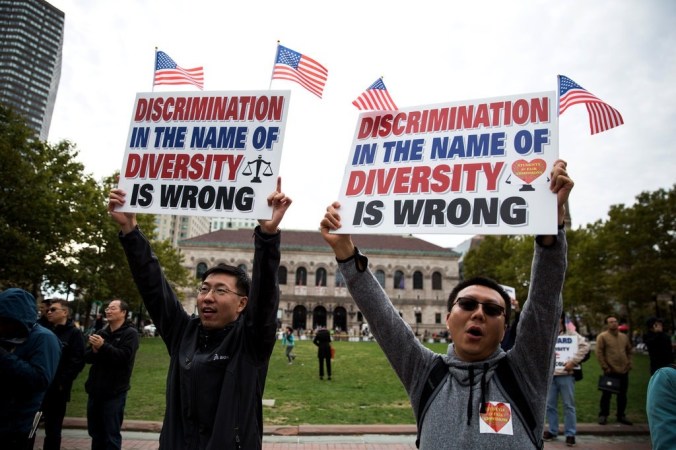
In response to U.S. District Judge Allison D. Burroughs’ ruling this week that Harvard University does not discriminate against Asian Americans in undergraduate admissions, two commentators issued reactions with almost themes: the ruling missed the point. In the New York Times, law professor Melissa Murray wrote that the opinion missed the point by being…

…focused on diversity as the sole grounds on which the use of race in admissions may be justified. As Judge Burroughs noted in her ruling, diversity-centered admissions policies can “enhance the education of students of all races and backgrounds, to prepare them to assume leadership roles in the increasingly pluralistic society into which they will graduate,” “broaden the perspectives of teachers” and “expand the reach of the curriculum and the range of scholarly interests.” Her words echo the standard refrains that have been deployed to defend affirmative action since Justice Lewis Powell’s opinion in University of California v. Bakke (1978). Justice Powell famously extolled the virtues of the “Harvard Plan,” which recognized that a “farm boy from Idaho can bring something to Harvard College that a Bostonian cannot offer.” The problem, of course, is that thinking about diversity in terms of what beneficiaries might contribute makes the benefits of affirmative action contingent and conditional — worthy only because its beneficiaries serve the broader needs of institutions and those who are assumed to belong.

To the contrary, Murray believes that Harvard’s race preferences out to be justified as permanent reparations, though she never uses those exact words.  (Hmmmm.…I wonder if she’s black? Let’s see…why yes, she is!):

Those who fought for affirmative action expected institutions to maintain policies that ensured continued representation of those who had long been excluded. But at least in the courts, these convictions have been largely jettisoned.

That’s because they are unethical, illegal and unconstitutional.

The momentary victory for Harvard, which was correctly accused of discriminating against Asian-Americans in admissions in order to further affirmative action goals, was the result of an ideological rather than a legal analysis. I give the judge credit for being open about his bias: how else could one interpret his reasoning? From the Washington Post:

While Harvard’s “admissions process may be imperfect,” Burroughs wrote, the judge concluded that statistical disparities among racial groups of applicants “are not the result of any racial animus or conscious prejudice.”

The law does not require “racial animus or conscious prejudice” to make  racial discrimination illegal. Discrimination on the basis of race is unfair, unjust, illegal and wrong. The judge doesn’t address that fact; he just explains why Harvard’s discrimination is the good kind, writing,  “The use of race benefits certain racial and ethnic groups that would otherwise be underrepresented at Harvard and is therefore neither an illegitimate use of race or reflective of racial prejudice.”

What does “under-represented” mean? This is a tell: Judge Burroughs is a disciple of the Left’s edict that  institutions, workplaces, benfits and distinctions are inherently suspect or harmful if they don’t closely match demographic divisions within the public in general. This essentially un-American myth requires the use of quotas while disguising their intent and function.

Affirmative action has always been an example of policy hypocrisy, engaging in present discrimination in order to combat the effects of past discrimination. It was justified, at best, as a temporary breach of core principles in pursuit of a theoretical remedy to a unique problem.

Another “the opinion missed the point” article had a more useful, if also flawed,  analysis than the law professor’s “We should keep discriminating against whites and Asians forever because of slavery and Jim Crow” argument. Richard Ford makes the case in “The Harvard Ruling Misses the Point” that the entire debate is taking place within an absurdity. Elite institutions like Harvard exist to bestow the credential of being  certified “elite,” a member of the deserving American upper class. “Democratizing” the anointment process by artificially using factors that have nothing to do with merit or achievement to bestow elitism is self-contradictory: once it becomes obvious that getting admitted to Harvard signifies nothing substantive, then Harvard’s ability to sanctify its graduates vanishes, or should.

It should. Harvard’s degree always was something of a fraud in this respect. Ford correctly observes,

The unstated assumption that folds affirmative action into a general critique of elite admissions is that acceptance should be based exclusively on individual merit (and that merit, in turn, should be measured by grades and test scores). Indeed, opponents of affirmative action often speak as if it is a departure from an otherwise even-handed and admirable meritocracy. But the Harvard case and the bribery scandal both expose—in high relief, if not for the first time—the extent to which non-racial (and hence legally unproblematic) admissions preferences dwarf those associated with race. Athletes, legacy applicants, and those otherwise likely to help universities secure large donations enjoy higher admission rates than members of underrepresented racial groups. Affirmative action is one of the more modest of many departures from numerical indicia of merit.

Continue reading

Comment Of The Day: “Contract Cheating: One More Reason College Is A Massive Scam On Our Society”

Michael R’s Comment of the Day on the post “Contract Cheating: One More Reason College Is A Massive Scam On Our Society,” to my mind, represents an overly optimistic view of the state of higher education policy as well as the mindset of the typical college student in 2019. It is, however, a view—I could say a romantic view–that has majority support in this country, despite growing evidence that indoctrination now co-exists with education as the de facto mission of most liberal education colleges. I answered Michael’s comment thusly…

I was the chairman of a non-profit educational advocacy organization, and attended many conferences and symposiums. The emphasis always was on college as a way to get better jobs. Always. At one session, a Clinton rep from the Dept of Education went on and on about how a college degree was essential to being employed and getting a good job, and why this justified affirmative action, grade inflation, and making sure we eliminated all impediments to graduation.

I stood up and asked why I had heard nothing about the value of education for its own sake…that it made better citizens and better, more productive, happier human beings. My comments were ridiculed. Literally, no one in the room would concede that education itself was the mission of going to college. And college does not educate. Indoctrinates, baby-sits, credentials, but there isn’t a strong current that leads to education. Students are incentivized to seek easy courses that guarantee the highest grades, and, in turn, better job prospects. Most college graduates, for example, cannot write coherently.

I absolutely stand by my statement, and until and unless we realize that this is the true framing of higher education in rhetoric and policy up and down the bureaucracy, the scam will continue.

Well, as I have a tendency to do, that was a bit over-stated. I also should have pointed out that one certainly can get educated in college, but one can also get educated outside of it, and a lot more cheaply. I’d also point to the recent push to pay college athletes, because, apparently, the quid of an education isn’t deemed as sufficient justification for the quo of their sports heroics.

Here is Michael R’s Comment of the Day on the post “Contract Cheating: One More Reason College Is A Massive Scam On Our Society”

“The idea is to get jobs, not to be educated.”

I’m sorry, this is just elitist academic garbage. Why is it that if you want a college education to become employable, it means you don’t want to be ‘educated’? I would say it is because the elites in this country don’t need any type of knowledge for THEIR jobs, so they equate being educated to possession of trivia and anything they have defined as elite culture. I went to college because I wanted to have a better life than I could have without a college education. That is true for a majority of college students nationwide. I wanted knowledge because I had neither money nor connections. I was going to have to make my way in the world based on my own merit.

This post is deceptive because it does not point out the dichotomy of college experiences. There are some students who go to college to become employable. Other people go to college to get plausible paper credentials and network. The latter have always been more likely to buy their papers and pay others to take their tests for them. Take someone like Chelsea Clinton. She didn’t have to learn one thing at Stanford. She had million dollar jobs lined up just because of who she was. However, she needed some kind of plausible degree to allow those companies to plausibly say she was qualified. In reality, they could have hired her at 18 and she could have done just as good a job for them, since her pedigree and connections were all they wanted. However, it would have been blatantly obvious what was going on and apologists couldn’t say “No, she really is qualified because of her B.A. in…”. Just look at the apologists go with Hunter Biden right now. Continue reading

The Most Important Question Raised By Another Fake Hate Crime Story: How Much Lousy, Irresponsible, Divisive, Biased Journalism Will The Public Tolerate And The News Media Refuse To Fix?

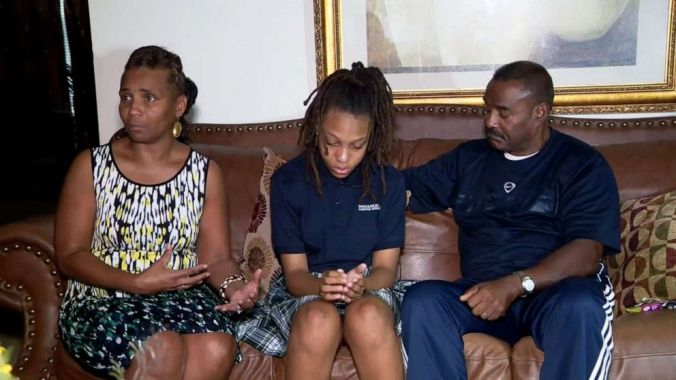
All over the major newspapers and news media last week was the ugly tale of another “hate crime.” 12-year-old Amari Allen, a black sixth-grader at a Christian, Northern Virginia private school, said that three white boys held her down and  cut off some of her dreadlocks.

The New York Times  and other news sources decided this was national news, just like a white Catholic school boy not having the right expression on his face when he was being harassed by a Native American activist.  More proof of racism in America! “They put me on the ground,” the girl recounted in an emotional phone interview”One of them put my hands behind my back. One put his hands over my mouth. One cut my hair. They were saying that my hair was ugly, that it was nappy.”  Why was this alleged episode of childhood bullying worthy of national attention? It was because Mike Pence’s wife Karen teaches at the school, the Immanuel Christian School in Springfield, about 15 minutes from my home.

This was cognitive dissonance manipulation. Pence’s wife teaches at a school where a black girl was racially harassed, thus the school is racially biased, thus Karen Pence is facilitating racism, thus her husband consorts with a racist, and it all leads back to that racist, President Trump. ( Big Lie #4)

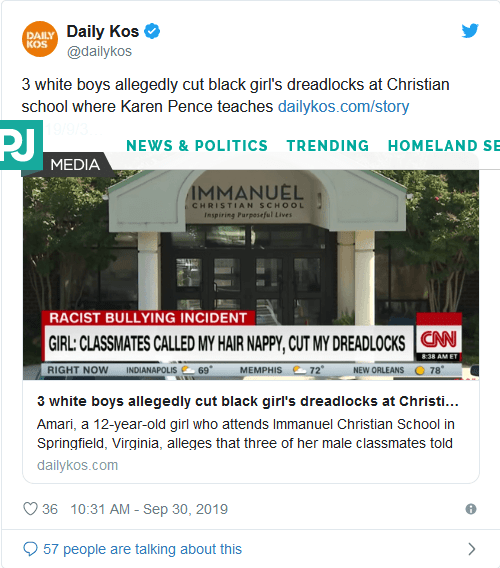
With the same motivation,  the left wing websites enthusiastically promoted the story. Here’s the always shameless Daily Kos:

See the white supremacy hate crimes that Trump, Pence, and Republicans foster? The local NAACP immediately got into the act, talking about lawsuits.

Except that it didn’t happen. The Washington Post reported today that the girl has recanted, and her grandparents, who are raising her, have apologized.  Continue reading

Contract Cheating: One More Reason College Is A Massive Scam On Our Society

A disturbing article from several perspectives appeared last week in the Times. Titled Cheating, Inc.: How Writing Papers for American College Students Has Become a Lucrative Profession Overseas,”  it contained one ethically troubling paragraph and factoid after another, such as…

  • “Finally, a friend offered to help her break into “academic writing,” a lucrative industry in Kenya that involves doing school assignments online for college students in the United States, Britain and Australia. Ms. Mbugua felt conflicted.”

    “This is cheating,” she said. “But do you have a choice? We have to make money. We have to make a living.”

  • “Cheating in college is nothing new, but the internet now makes it possible on a global, industrial scale. Sleek websites — with names like Ace-MyHomework and EssayShark — have sprung up that allow people in developing countries to bid on and complete American homework assignments.

    “Although such businesses have existed for more than a decade, experts say demand has grown in recent years as the sites have become more sophisticated, with customer service hotlines and money-back guarantees. The result? Millions of essays ordered annually in a vast, worldwide industry that provides enough income for some writers to make it a full-time job.”

  • “A Facebook group for academic writers in Kenya has over 50,000 members…

“…It is not clear how widely sites for paid-to-order essays, known as “contract cheating” in higher education circles, are used. A 2005 study of students in North America found that 7 percent of undergraduates admitted to turning in papers written by someone else, while 3 percent admitted to obtaining essays from essay mills. Cath Ellis, a leading researcher on the topic, said millions of essays are ordered online every year worldwide.”

Yes, I’d say that the statistics cited in the article make the 7% and 3% findings risible.  What do you think are the real numbers? 15%? 20%? If that large a segment of graduating college students have cheated to get by, why is a diploma trusted as a credential? Would you want to be operated on by a doctor with a 20% chance that he or she cheated to graduate from medical school? Continue reading