I detest memes, but like all other rules, there are exceptions. Sometimes, only a meme will do.
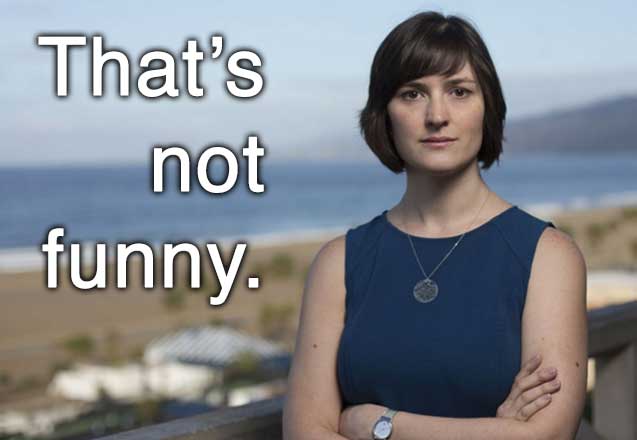
Of the many warpings and distortions of a healthy culture we have seen emanating from the ideologically extreme, one of the more insidious is the antagonism towards humor. This episode speaks for itself.
Fisayo Eniolorunda, the club’s event organizer, wrote in an email, “Attached is a short behavioural agreement form that we will ask for you to sign on the day to avoid problems.”
Problems like actually being funny, apparently.
The “behavioral agreement” states,
“This comedy night… aims to provide a safe space for everyone to share and listen to Comedy. This contract has been written to ensure an environment where joy, love, and acceptance are reciprocated by all. By signing this contract, you are agreeing to our no tolerance policy with regards to racism, sexism, classism, ageism, ableism, homophobia, biphobia, transphobia, xenophobia, Islamophobia or anti-religion or anti-atheism. All topics must be presented in a way that is respectful and kind. It does not mean that these topics can not be discussed. But, it must be done in a respectful and non-abusive way.”
Respectful of whom and not abusive in what way? Oh, never mind. The agreement is a joke itself. What does “love and acceptance” have to do with humor? Does Fisayo Eniolorunda know what “Comedy” is? Of course comedy doesn’t have to be cruel or mean, but then an audience that would lay out such rigid standards can’t be trusted to judge what cruel, mean, respectful, non-abusive, safe—lordy, especially “safe”–or funny is. These are subjective standards being judged by people who are so besotted with ideological mania, virtue-signaling addiction and political correctness that they can’t be trusted. Continue reading →
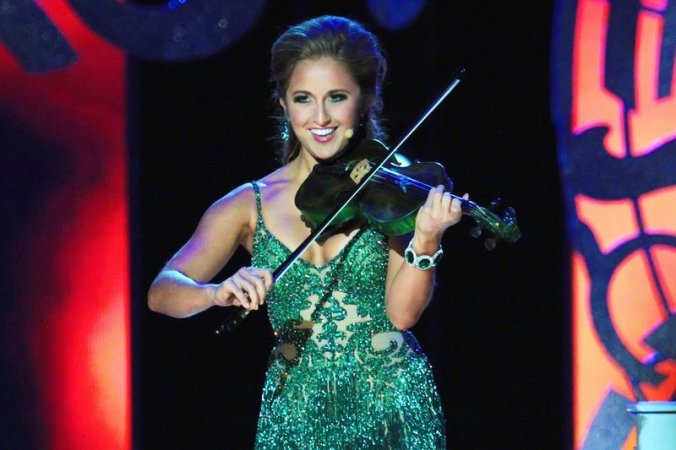
Yeah, I know…”She can play on my violin any time she likes…”
Tucker Carlson’s toy, conservative website “The Daily Caller,” headlined the story I mentioned in today’s warm-up about a teacher who sent naked photos of herself to a teen-aged former student, this way:
“Former Miss Kentucky Arrested For Assaulting 15-Year-Old Teen’s Eyes With Her Naked Body.”
I’ve called Carlson’s site on this kind of idiocy before. It’s the brainless, macho, “yeah, I sure wish a teacher had mistreated me like that when I was a kid” jerkism that seeds the next generation of Harvey Weinsteins and Matt Lauers, as well as perpetuating the still flourishing double standard that sees a male teacher who has sex with female high school student as a rapist, but a male student who is seduced by his female teacher as lucky dog.
This is one of many reasons I don’t watch Carlson’s popular show on Fox. I really don’t care what assholes with those kinds of warped values have to say about anything. Teachers cannot use their position to prey on students, and it doesn’t matter how attractive the teacher is or how appreciative her victim is. The fact that so many conservatives gravitate to Carlson’s frat boy attitudes is one reason to be wary of conservatives.
1. Starting with the important stuff: Baseball’s badly-named Today’s Game Era Committee announced that long-time right-fielder/designated hitter Harold Bainesand towering closer Lee Smith had been voted into the Major League Baseball Hall of Fame. Smith, who retired as the all-time saves leader and is now third behind two Hall of Famers, was a defensible pick, but not Baines. The Committee’s job is to look back on players who were rejected in the regular Hall of Fame voting process and see if some of them fell through the cracks who were Hall caliber. There are only 16 members of the committee, and an ex-player needs 12 votes to enter Cooperstown. The sixteen members included at least four with strong ties to Baines, and they presumably argued eight more members into letting him squeak by. Bias made them stupid. Those four, which included Baines’ former manager and the owner of the Chicago White Sox, which retired his number, should have had to recuse themselves because of conflicts of interest.
Baines led the league in an offensive category, once, when he had the best slugging percentage in the American League. He never finished high in the Most Valuable Player voting. Most of the players who compare most closely to him are not in the Hall. The big thing Baines had going for his candidacy as a very good but not great player was that everybody liked him. He’s sort of the opposite of Curt Schilling, who is clearly Hall-worthy but whom most sportswriters hate—too religious, too conservative, too mouthy.
Now the argument for admitting other good but not great players will be, “But he was better than Harold Baines!” This is how conflicts of interest undermine the integrity of institutions.
2. When Naked Teachers have no excuses. The Naked Teacher Principle holds that when a teacher allows a nude photo of herself or himself to circulate on the web where it can be seen by students, that teacher cannot complain when and if it leads to their dismissal. A teacher really can’t complain if she sends the photo to a student intentionally, which is what Ramsey Bearse, 28, a former Miss Kentucky now teaching at Andrew Jackson Middle School in Cross Lanes, West Virginia, did with a 15-year-old former student , according to the sheriff’s office. She faces four felony counts of distributing or displaying obscene matter to a minor.
3. Pondering whether to include an open Ethics Alarms forum as a regular feature. Many of the blogs I frequent for story ideas do this late at night. Ethics Alarms has done it once when I was forced to be away from a keyboard for most of the day, and I was impressed with the results. Those forums on the other blogs often devolve into silliness, bad jokes, memes and worse, and I would insist that an “open forum” on Ethics Alarms be restricted to raising and discussing ethics and ethical topics. Continue reading →
I usually hesitate to call for anyone to be fired, though there have been exceptions. In this case, however, the call is mandatory on ethical grounds. It is unethical for a school dedicated to the arts to hand oversight to an gross incompetent who doesn’t comprehend the arts she is supposedly responsible for teaching; it is unethical for someone to take on this responsibility who is wildly unqualified for the job; and it is unethical for that individual to act in a way that undermines the mission of the school she heads.
I have just fairly described Lisa Mars, currently the principal at the Fiorello LaGuardia High School, the high school “of music, arts the performing arts” made famous in the movie and TV show, “Fame.”
On opening night of a school production of “The Sound of Music,” she ordered all Nazi-themed props and set pieces struck. They are offensive, you see. Never mind that the show is set during Germany’s take-over of Austria as the Third Reich was expanding. Never mind that Nazi Germany and its officers are major elements in the plot, or that the plot is based on the real-life escape of the singing Von Trapp family from the Nazis. Never mind that theater is a representational art form. Stage deaths are not real killings, stage rape isn’t really rape, stage racism isn’t really racism, and stage representations of Nazi symbols do not promote fascism. Most grade-school actors can grasp this basic principle, but not the head of a school for the performing arts.
“This is a very liberal school, we’re all against Nazis,” one sophomore said. “But to take out the symbol is to try to erase history.” Yes, that too. “Obviously the symbols are offensive,” he added. “But in context, they are supposed to be.”
1. The Hader Gotcha strikes again. Let me be clear: this is unconscionable, despicable, and indefensible. (Aside: Do you like that trio? In “Perry Mason,” the lawyers always objected that a question was “incompetent, irrelevant, and immaterial,” because it sounded nifty. I’ve never heard that objection made in a real trial, or read it in a transcript.) To remind you all, during the baseball season, beginning with young All-Star pitcher Josh Hader, multiple baseball players were embarrassed when someone with ill intent searched their old Twitter feeds to search for tweets that could be deemed racially offensive, hostile to gays, or disrespectful of women. I dubbed this miserable practice as “The Hader Gotcha.“All of the players had to grovel apologies to their team mates and the public, as “woke” sportswriters condemned them and lobbied for MLB to punish them for impulsive social media comments made before they could vote, before they were celebrities, and when their followers consisted of fourteen or so pimply-faced jerks. The same basic principle was employed to smear Brett Kavanaugh, the unfair and factually false preemption that conduct and attitudes displayed by minors indicate what their character is in adulthood.
Well, I guess it’s nice to know that not only whites, baseball players and conservatives are victims of this crap. Mere hours after winning the Heisman Trophy as the nation’s outstanding college football player, Oklahoma Sooners quarterback Kyler Murray had to apologize today for anti-gay tweets he made in 2011-12 , when he was 14 and 15 years old.
In case you are keeping score, because I am, the culprits here are an irresponsible, vicious news media, totalitarian-leaning leftists who want to police thoughts and intimidate the public into ideological conformity, and social media lynch mobs.
2. Sure, Donald Trump is the fear-monger. The increasingly hysterical and hyped warnings and soothsaying by various climate change-promoting bodies are either causing over-sensitive, scientifically ignorant and gullible members of the public to descend into despair, or members of the news media are deliberately trying to cause fear and panic—at least based on the broadcast lament of MSNBC’s Katie Tur. The anchor told her audience that life was meaningless without a mass effort to combat the horrors of the warming planet. Discussing a New Yorker article on the topic, she said,
“I read that New Yorker article today and I thought gosh, how pointless is my life, and how pointless are the decisions that I make on a day-to-day basis when we are not focused on climate change every day, when it’s not leading every one of our newscasts?”
Unconscionable, despicable, and indefensible? No, just irresponsible, unprofessional, and stupid. And they wonder why so many people can’t take these hysterics seriously…
3. And the winner is…Plan K? Former federal prosecutor Andrew McCarthy thinks that the sentencing statement on Michael Cohen means that the President is very likely to be indicted on a charge of violating federal campaign finance laws by the U.S. Attorney for the Southern District of New York, who has openly been pursuing a “get Trump” campaign. The theory would be election law violations in the pay-offs to Stormy Daniels, even though paying off a kiss-and -tell threat is usually legal, and even though election law violations are typically handled with fines, not indictments. McCarthy writes,
When it was discovered that Barack Obama’s 2008 presidential campaign was guilty of violations involving nearly $2 million – an amount that dwarfs the $280,000 in Cohen’s case – the Obama Justice Department decided not to prosecute. Instead, the matter was quietly disposed of by a $375,000 fine by the Federal Election Commission.
Yes, but Obama’s Justice Department’s mission was to run interference for the President, and there was not an ongoing effort to find some way to undo a presidential election. Continue reading →
1. How can this be? Based on the same documents, the President crowed that Mueller had nothin,’ and the mainstream Trump-hating media crowed that the walls were closing in. It’s a confirmation bias orgy! Charges aren’t evidence, and attempted contacts with a foreign power isn’t “collusion,” and we’ve already talked about the theory that paying off a floozy not to kiss and tell, which is 100% legal at all other times, is a stretch to call and election law violation when the rake is running for President. No such case has ever been brought; it’s dubious whether one would prevail; even if it did, this is a fining offense at most. [ For the record, this is the “resistance’s” Impeachment Plan K, in my view, one of the lamest.]
Both sides are jumping the gun. In the media’s case, it’s more fake new, future news and hype.
2. Stare decisis vs. the prohibition on double jeopardy. In Gamble v. US, just argued before the Supreme Court, the question is whether the federal government can try a citizen for the same crime a state court acquitted him of committing. I’ve always hated the rule that it can (the cops in the Rodney King case were jailed that way), because it seems clear to me that the Constitutional prohibition on double jeopardy (that’s the Fifth Amendment) was intended to prevent such trials. Still, previous Supreme Court decisions have upheld the convictions. In the current case, it appears from oral argument that a majority of the current justices agree with me, but are hesitant to so rule because of the doctrine of stare decisis, which means respecting long-standing SCOTUS precedent.
A ruling to apply double jeopardy would be a ruling against stare decisis, meaning that Roe v. Wade might have less protection than many—including me–have thought. Stay tunes, and watch Justice Kavanaugh’s vote particularly.
3. Is wanting to/needing to/ actually taking steps to changing one’s sex a mental disorder? There have been a lot of articles about this lately, especially in light of evidence that peer groups, the news media, LGBT advocacy and parents are making many young children want to change their sex before they even know what sex or gender is. The question is itself deceptive, because it pretends that “mental disorder” is anything but a label that can be used or removed with a change of attitude or political agendas. Vox writes,
Major medical organizations, like the American Medical Association and American Psychiatric Association, say being transgender is not a mental disorder. The APA explained this in explicit terms when it stopped using the term “gender identity disorder” in favor of “gender dysphoria”: “Part of removing stigma is about choosing the right words. Replacing ‘disorder’ with ‘dysphoria’ in the diagnostic label is not only more appropriate and consistent with familiar clinical sexology terminology, it also removes the connotation that the patient is ‘disordered.’”
Well, “removing a stigma” is hardly a valid criteria for deciding whether something is a malady or not. What being transgender “is” can’t be changed by what we call it. Recently narcissism was removed from the mental disorder list—that doesn’t change the fact that narcissists see the world and themselves in a way that most people do not, and that this perspective causes them and the people around them a lot of trouble during their lives. The process worked in reverse with alcoholism, where being officially labelled a disease removed a stigma.
I once directed the comedy/drama “Nuts,” which opines that “insanity” is just a view of reality not shared by the majority. It was on this basis that the Soviet Union sent dissidents to mental hospitals. I don’t care what various associations or professionals call these minority positions: we know that they are using bias and political agendas to devise the label. This is one area where a phrase I despise, “It is what it is,” may be appropriate. Continue reading →
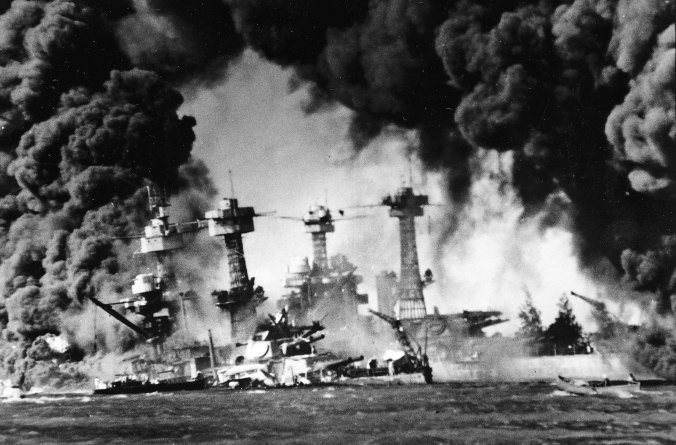
…And a good morning to remember a very bad morning in Hawaii 77 years ago today.
1. Oscar’s latest fiasco. The Academy Awards, which like all awards shows has descended into nasty political advocacy, undermining its mission and alienating its audience, decided to pick famously non-partisan black comedian Kevin Hart, who is also a successful movie actor, to host. His gig lasted just a few day. People looking to discredit him went digging into his social media posts, and some tweets from eight years ago–you know, before Barack Obama and Hillary Clinton had flipped on gay marriage?—were judged as “homophobic.” In a post on Instagram at about 11 p.m. last night, Hart said he got a call from the Academy of Motion Picture Arts and Sciences and was asked to apologize for his prior tweets, or step down as host. He chose to withdraw, and tweeted this:
“I have made the choice to step down from hosting this year’s Oscar’s….this is because I do not want to be a distraction on a night that should be celebrated by so many amazing talented artists. I sincerely apologize to the LGBTQ community for my insensitive words from my past. ‘m sorry that I hurt people.. I am evolving and want to continue to do so. My goal is to bring people together not tear us apart. Much love & appreciation to the Academy. I hope we can meet again.”
The conservative media is calling Hart another example of political correctness run amuck. That’s ignorant and wrong. To be successful, an MC has to be liked and trusted by his audience, which is, for the Oscars, the people inside the theater above all. A huge percentage, even a half or more, of the Oscar audience is gay. No one can host the Oscars while it is known that he once said, even eight years ago, that he was terrified that his son might grow up to be gay. It doesn’t matter that he may have “evolved.” Hollywood is a substantially gay community, and the host of its biggest party of the year should neither be nor be suspected of being homophobic,
Why the Academy’s vetters and Hart himself couldn’t figure this out is a different issue: gross incompetence. Continue reading →
I definitively laid out how lazy, biased and deceptive Snopes is, here and elsewhere. Yet Google and Facebook still rely on the fact-checking site. This is signature significance: it can only mean that these businesses want biased standards to rule the day. The Daily Caller just called out a typical example of Snopes’ unethical work. As with its spinning for Hillary Clinton that I flagged in 2016, this is egregious and irrefutable.
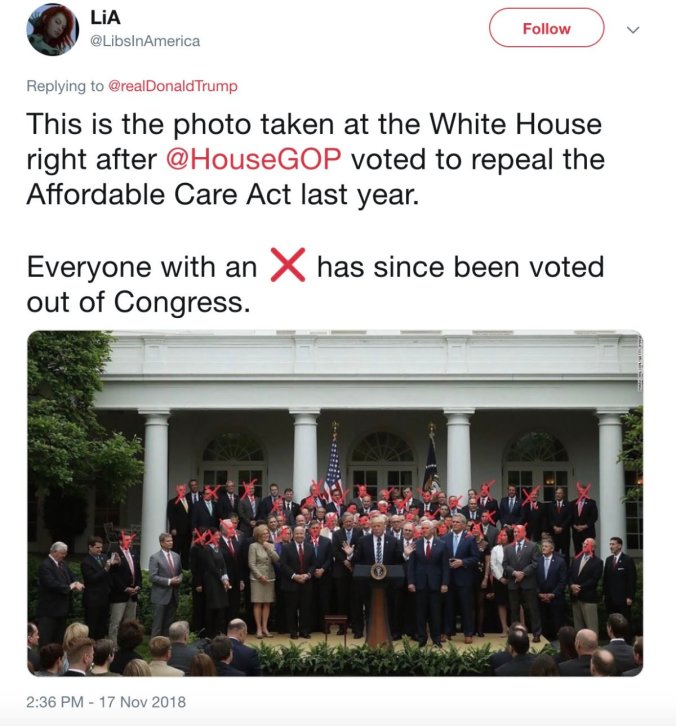
Here is a meme that has been circulating on the web:
It’s a lie, fake news, wrong, however you want to describe it. It’s just not true. The X’s are through some people who weren’t members of Congress. X’s also cover the faces of Jodey Arrington, Ron Estes, Liz Cheney, Michael Burgess, Patrick McHenry, Jason Smith, Bradley Byrne, Markwayne Mullin, Paul Mitchell, Glenn Grothman, Doug Lamborn, and Tim Walberg, all of whom were re-elected. There were other errors as well. Politico reporter Jake Sherman observed that the meme “is actually more incorrect than correct.”
In other words, a typical internet meme.
Nevertheless, Snopes fact-checker Bethania Palma ruled it accurate. To do so, she used Snopes favorite trick, falsely characterizing what the claim was. Palma rated it “true” that “The Congressional seats of almost three dozen Republicans who voted to repeal Obamacare were lost to Democrats in 2018” when the meme clearly said that everyone in the picture who was Xed voted for repeal and was voted out of office. Her claim is pure deceit. “In the meme, red ‘X’ marks were drawn through the faces of 33 lawmakers who purportedly were rejected by voters in the 6 November 2018 midterm elections,” Palma wrote. Wrong. They weren’t all “lawmakers,” and they weren’t all defeated. Continue reading →
I wrestled with posting this; mocking the People For The Ethical Treatment of Animals is too easy, and it’s getting easier. On the other hand, it’s too easy, and easy can be fun. Plus there is a lesson worth emphasizing; even if your organization is fanatic, full of wackos, and without any sense of proportion or common sense, it it accepts contributions, you have an ethical obligation a) not to be flagrantly incompetent, and b) not to make donor feel like they need to wear bags over their heads, or wish they had just chucked their money into a swamp.
And I am always looking for opportunities to honor my favorite line from “Animal House.”
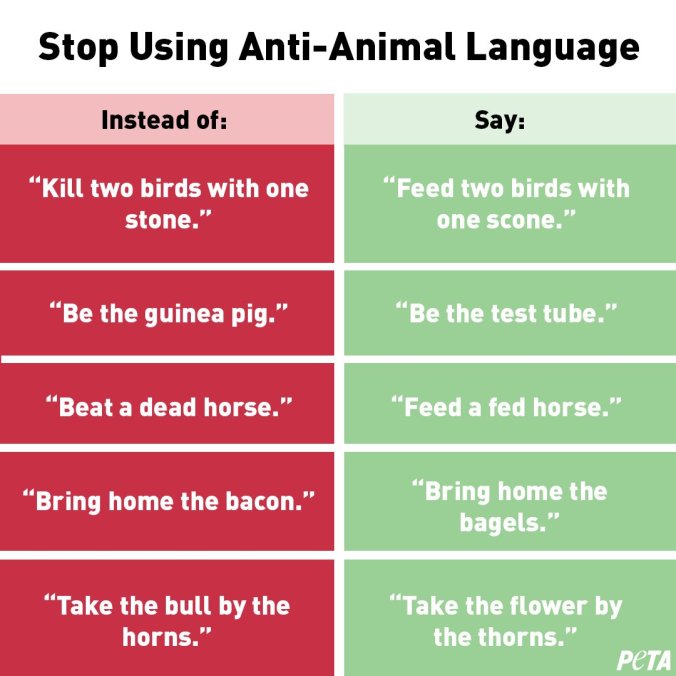
Here is PETA’s latest auto-fiasco: It tweeted out…
“Words matter, and as our understanding of social justice evolves, our language evolves along with it. Here’s how to remove speciesism from your daily conversations…”
Yes, the theory is that using animal imagery, references and metaphors is somehow unethical. There’s no explaining this logically; it makes no sense. Acknowledging the actual characteristics of animals in discourse or referring to them in metaphors advances the critical task of human communication, and does no conceivable harm to the animals involved whatsoever. Nor does it pollute human respect for goats to say, “That got my goat.” Anyway, here is PETA’s best effort—they got all their most creative, clever minds together—at retooling some common phrases for vegan sensibilities, I presume, because it would be irresponsible for a group that seeks to persuade to put forth a product created by its worst and dimmest rather than it’s best and brightest:
Yeah, I’m sure these will catch on.Was it “Visit mommy or daddy’s office day” and PETA let the kids handle the job? Continue reading →
Here I was, about to point out the arrogance and anti-religious bigotry of Democratic chair Tim Perez, who just suggested that the only reason anyone opposes abortion must be that they are ignorant and foolishly pay attention to religion, and here is something that supports his view that at least some of those preaching from pulpits on Sunday may not be all that bright, since they have the grasp of reality of a six-year-old.
The dimwit who approved this abomination, Pastor Stephen Josoma, told radio station WBZ, “We try to take a picture of the world as it is and put it together with a Christmas message.” That message this year questions about peace on Earth. He says Jesus represents migrant children being held at the southern border separated from their parents. The wise men represent the caravan of migrants behind the border wall. “Jesus was about taking care of one another. This is not the way to take care of one another,” said Josoma.
How do you even begin to unpack all the ignorance, false logic, bad analogies, historical fatuousness and political nonsense in this statement along with the offensive creche scene it attempts to justify? I’m not up to it. It would probably begin with “There are material differences between 6 B.C. in Gallilee and the 21at Century United States of America. You idiot” and expand out from there. For now, all I will say is that turning Christmas into a divisive, ugly, partisan debate while exploiting the symbols of Christmas into simplistic social justice warrior propaganda is a betrayal of the season, the event, the spirit behind the event, and the cultural purpose it endures to serve.



 Ethics Alarms