The Wall Street Journal Steals From A Blogging Lawyer…Luckily For Them, A Nice One

A lawyer asks: Will Google Cars put me out of business? The Wall Street Journal  asks: Why shouldn't we make money off your answer?

A lawyer asks: Will Google Cars put me out of business? The Wall Street Journal asks: Why shouldn’t we make money off your answer?

I always do a double-take when I see that someone has “re-blogged” a piece from Ethics Alarms. Unless there is something in my WordPress agreement that allows other bloggers to lift my work and publish it as their content without my permission—oh, who knows, there probably is—this is a copyright violation, but worse than that, it’s wrong. Apparently they think that if they give attribution, that makes everything fine. Why would they think that? I’m writing for my blog, not anyone else’s. If a blogger wants to reprint all, most or some of my commentary in order to critique it, that’s fine ( WindyPundit is doing this right now). But lifting all or most of my work to fill space on your website, without my permission? Not fair, and not ethical.

This just happened to personal injury lawyer and estimable blogger Eric Turkewitz, but the culprit wasn’t a blogger, it was the Wall Street Journal. It took his post about Google Cars and just slapped it into the print and online editions of the paper. “Lawyer Eric Turkewitz writes that self-driving cars will hurt the business of many personal-injury attorneys,” said the sub-head under “Notable and Quotable.” Hmmm. Usually a writer gets paid to write features for a newspaper. I guess just lifting copy without permission is “Fair Use.”

No, First Amendment expert Marc Randazza points out in his typically irreverent way, it isn’t:

In this case, the Wall Street Journal used 44% of Turkewitz’ post, with no additional commentary, criticism, or discussion.  The WSJ could have called Turkewitz a moron for his views, and quoted the whole thing (theoretically).  Or, the WSJ could have given approval, more discussion, or turned the article into piece of art, with spray painted Che Guevaras and stencils of Paris Hilton, as a commentary on Turkewitz, tomato soup, and golf, or whatever.  But, they didn’t do any of that.  

So lets look at the §107 [Fair Use]factors

(1) the purpose and character of the use, including whether such use is of a commercial nature or is for nonprofit educational purposes;
(2) the nature of the copyrighted work;
(3) the amount and substantiality of the portion used in relation to the copyrighted work as a whole; and
(4) the effect of the use upon the potential market for or value of the copyrighted work.

The purpose and character of the use is certainly commercial and for profit. The WSJ sold its newspaper with Turkewitz’ work in it, and even put it behind its paywall online. Same exact use, except WSJ took what Turkewitz distributes for free, gathered it, and sold it.

The nature of the copyrighted work was Turkewitz’ original opinions and thoughts.

The amount and substantiality of the portion used? 44%. Pretty substantial. Remember, this is not dispositive, but if you used almost half of an original work, you better have a good reason.

The effect of the use on the potential market for the value of the copyrighted work? That’s sorta iffy. It isn’t as if Turkewitz sells his work. But, that is not a requirement. Turkewitz’ blog currency is readership. If you do some quick online searches for some of the content, sometimes the WSJ version comes up above Turkewtiz’ version. Not cool. Ultimately, the WSJ blew it here because they didn’t add anything to the original — they just lifted it and reposted it….

So the verdict? The Wall Street Journal is definitely guilty of copyright infringement for lifting a bloggers’ work without any justification.

It’s worse than that, however. Continue reading
Ethics Quote Of The Day (Christmas Confusion File): Jonathan Turley

“Best wishes to everyone celebrating Christmas.”

—- Law Professor and blogger Jonathan Turley, wishing at least some of his readers a merry Christmas.

Get ready to duck, Fred!

Get ready to duck, Fred!

Prof. Turley is a lawyer, of course, and trained to express himself with precision. Thus I have to ask: what the heck is he trying to say here?

Is he wishing good tidings only those who, like his family, are celebrating Christmas, and rotten times to the rest? Is he editing the humanist message of Christmas to “Peace on Earth, and good will to those who are putting up Christmas trees and giving gifts, other wise you’re on your own”?

Or, as I fear greatly, given the fact that he is part of the U.S. education establishment and thus prone to have a spine of cream cheese, just observing the trendy political correctness that infects our times, and bowing to those who contrive to take offense when anyone smiles at them and offers a greeting that only says, at minimum, “We’re all in this together, so let’s try to be as good to each other as we can, OK?” Continue reading

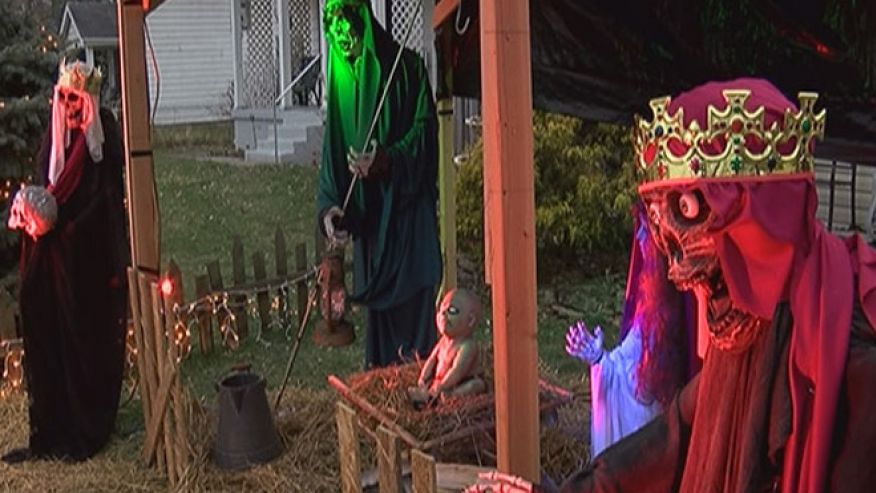
I’m Dreaming Of A Zombie Christmas

Zombie Nativity

I didn’t say it was a pleasant dream.

Hmmm, how should I describe this? I would say that a law is being used to violate the First Amendment rights of an unethical jerk who is intent on abusing them.

Or, in the alternative, Jasen Dixon may just be an idiot.

Sycamore Township, which is just outside Cincinnati, has responded to complaints by neighbors by applying various ordinances against Dixon’s unusual Nativity scene that he constructed in his front yard. It features life-size figures portraying Joseph and Mary as the walking dead, and a zombie baby Jesus, who has pale skin and pure white eyes. Here, here’s a close-up of Zombie Baby Jesus:

Zombie-nativity-scene

Awwwww!

Dixon suspects that the township laws, which prohibit structures in the front or the side yard of a residence that occupy more than 35 percent of its total area, and require that the primary structure must be 3 feet from the street and 6 feet from the dwelling, are really being selectively enforced against him because his holiday display offends some people….well, almost everyone. I suspect this as well.

Poor Jason says he doesn’t mean any harm: he’s just doing the best he can to celebrate the birth of baby Jesus. “I wanted a Nativity and I worked with what I had,”  says Dixon, who manages a nearby haunted house called “The 13 Rooms of Doom.” He says his First Amendment rights are being infringed.

“I’ve lived here for 15 years and I’ve never had a violation of any kind,” Dixon said. “It’s a holiday decoration. I know if it was a real pretty Nativity scene they wouldn’t be saying anything.”

I’ll agree with that too. Continue reading

Just In Time For Christmas, Here Are All The Bad Arguments And Rationalizations Against Tipping So You Can Feel Self-Righteous About Being A Scrooge

See? The rest of the world knows how to deal with you sexist, racist, aristocratic poverty perpetuating, self-esteem destroying bastards!

See? The rest of the world knows how to deal with you sexist, racist, aristocratic poverty perpetuating, self-esteem destroying bastards!

Vox has published an entertaining screed against tipping, massing all the contradictory, facile rationalizations and faulty arguments against demonstrating one’s gratitude when someone serves you well. This is Vox, remember—Ezra Klein’s uber-progressive website with an agenda. Think about what the alternative to tipping is, and where the critics of tipping are going with these claims. Hint 1: It has nothing to do with democracy or individualism. Hint 2: The piece argues that tipping is classist, racist, sexist, “lookist”…the works.

The full illogical, ethically confused character of this junk has to be read to be fully appreciated, but here is a quick overview:

1. Hoary old quotes. There are these, for example:

English author Lynne Truss on visiting New York: “In this great financial capital … tips are not niceties: give a ‘thank you’ that isn’t green and foldable and you are actively starving someone’s children.” No, Lynne, you’re being cheap, that’s all.

The Village Voice’s Foster Kamer: “It reinforces an economically and socially dangerous status quo, while buttressing a functional aristocracy.”   Ah. You see, if lower paid service professions are treated like robots and underpaid, they will rise up and overturn this monstrosity called capitalism.

 Michael Lewis: “I feel we are creeping slowly toward a kind of baksheesh economy in which everyone expects to be showered with coins simply for doing what they’ve already been paid to do.” Who is being “showered with coins?”

2. “Tipping lets employers off the hook.” Translation: It gets in the way of the progressive “living wage” campaign. Mandatory salary levels drive businesses out of business and reduce jobs. Want to see all restaurants go to the iPad, self-ordering, system running rampant at airport restaurants—and no, I don’t tip a runner who just carried my food to the table—by all means, force restaurants to pay “a living wage.”

3.  “Tipping is undemocratic.” This is the George Orwell, “Peace is War” argument. The government should stop me from giving my money to whoever I want in the name of democracy. Continue reading

Encore: “Ethics Call To Arms: Fight the ‘Fuck You!’ Culture”


kid fu

[This happens sometimes with 5000 posts in the bank: some topic causes me to find one that I can’t even remember writing, and I realize that I still agree with it, and if I forgot about, everyone else probably did too. The previous post led me to link to this one, and I decided that the list of steps I recommended to try to halt the culture’s slide into permanent vulgarity and incivility was worth re-posting, especially since five years ago the blog got less than a fifth of the traffic it does today. Thus I am re-posting this one, slightly edited to remove a few rhetorical excesses and outdated references, from November 18, 2010.]

“Every action done in company ought to be with some sign of respect to those that are present.”

This was the very first edict in the list of civility rules memorized by George Washington as a child, rules that shaped his character and significantly influenced not only his life and career but the fate of America. Like most of Washington’s 11o rules, the first has universal and timeless validity, pointing all of us and our culture toward a society based on mutual respect, caring, empathy, and fairness.

Recently, however, there has been a powerful cultural movement away from George’s rules and the culture of civility that they represent. Rudeness has always been with us, of course, and public decorum has been in steady decline since the Beatniks of the Fifties, to the point where it is unremarkable to see church-goers in flip-flops and airplane passengers in tank-tops. Something else is going on, however. Like the colored dots of paint in a George Seurat painting, isolated incidents and clues have begun to converge into a picture, and it is not one of a pleasant day in the park. I believe we are seeing a dangerous shift away from civility as a cultural value, which means that we are seeing a cultural rejection of ethics. Continue reading

“It’s Unethical To Be A Weenie,” Part I: The Lipreading NFL Fans

Preface: The Rise of the Weenies

Tom Brady, mid-

Tom Brady, mid-“Fuck!”

Everywhere we look, it seems, we see the United States culture being threatened by weenies and the rise of Weenyism. In a nation founded on the principles of self-reliance and individual liberty, built and shaped by stunningly brave men and women who hacked civilization out of an uncertain and perilous wilderness, there is a growing mass of citizens—the cancer imagery is intentional—who are committed to giving the government near total control over every conceivable danger, threat, peril, offense, inconvenience or annoyance, real or imagined, as the role of individual Americans devolves into pointing and saying, “There! Fix that! I don’t like that! Arrest them. Fine him.” Increasingly, the primary motivation for public policy is fear, planted by activists and politicians to panic, terrify and mobilize the weenie base, who are ever eager to trade individual freedom for protection against, well, almost everything.

I know I am hyper-sensitive to the weenification problem right now, having spent three weeks reviewing the history of the American West and its portrayal by Hollywood in preparation for my Smithsonian Associates program last week on how the Hollywood Western shaped American culture. Around the same time that the Sixties exploded, the culture’s unified acceptance of traditional American values began to collapse, just as the primacy of the Western as an entertainment genre declined. Now weenyism is in its ascendency. There are those who claim that the name of a distant football team causes psychological trauma to Native Americans who don’t follow football. Blogger Andrew Sullivan (a candidate for Head Weenie) asserts that the United States should have the “courage” to do nothing about ISIS and allow it to run amuck (the ultimate goal of the Weenies: an Orwellian “Weenies Are Heroes” motto). Feminists insist that women are so vulnerable to male sexual predations on campus that due process, fairness, common sense and much of the respect as equals their predecessors fought for must be surrendered, in a new system that begins with the presumption that all men are potential rapists and all women simpering, helpless victims, even when they say “yes.” College students and other are demanding that books, stories, essays and blog posts contain “trigger warnings” to alert weenies that words and topics in the text might give them the vapours. Needless to say—I hope—this not a healthy development for the United States, or  our culture.

The resistance to Weenyism ought not to be a partisan issue. The obligation to help the weak, disadvantaged and powerless become stronger, overcome their handicaps and acquire power is part of the American tradition too. Somewhere, however, this obligation was distorted by the realization that in a system where the government is looking for victims to justify its existence, Weakness Is Power (Orwell again). Weenies—fearful, risk-averse, passive-aggressive citizens who shrink from conflict, confrontation and the messy process of democracy— have realized that they can mobilize power to satisfy their narrow biases and interests, often at the expense of their fellow citizens’ right to liberty and the pursuit of happiness. Now the culture is tilting away from the uniquely American model that encouraged individuals to fight their own battles and succeed or fail on the merits of their causes and their own determination and skill, to one that rewards the perpetually offended, victimized, and passively unsuccessful.

It is unethical to be a weenie, and equally unethical to allow Weenieism to overcome what has been an American cultural strength.

Part I: The Lipreading NFL Fans

Several TV viewers who watched the NFL’s  New England Patriots-Green Bay Packers made official complaints to the Federal Communications Commission because they could see Patriots quarterback Tom Brady saying “fuck” repeatedly on the sidelines in frustration over his own play.  They couldn’t hear it, mind you: they were just able to read his lips. This was so horrible that they felt that the Federal government needed to investigate and take remedial action.

One complaint was from an Indianapolis parent who wrote that their “6 year old children know how to read lips.” Another was from a Pennsylvania grandparent who complained to the FCC,  “My 8 year old grandson was watching the game with me and even commented that he should not have said that.”

The Horror. Law professor Jonathan Turley opined on his blog,  “I do not believe that this was a good thing for a NFL QB to be doing.” Well, sure: he should be picking his nose of grabbing his crotch, either, but this isn’t scripted, and its a football game.  The whistle has to be blown for Federal retribution for mouthed obscenities to nobody in particular, as these sensitive parents and grandparents happily allow their delicate charges to cheer men in the process of maiming themselves and risking that their children will be changing their fathers’ diapers in the disturbingly near future?

The really frightening thing is that our regulatory morass encourages such attempts at censorship. Continue reading

Ethics Alarms Mail Bag: The Cologne Allergy

Perfume allergyEvery now and then readers think I’m Ann Landers. Today I got a “Dear Ethics Alarms: What’s right?” e-mail from a friend, and I thought I’d answer it on the blog because it raises a classic ethics conundrum.

The inquirer belongs to a social group that meets weekly. It is a weekly joy, I am told; the writer has been attending for years. Everyone convenes, on the given day, right after work. Attendance varies, and membership is informal, though individuals have been told, on rare occasions, to come no more.

Of late an infrequent attendee, but a member of long standing, has begun to attend meetings with some regularity. My friend says this is not the happiest of developments, because the two do not get along. It is a breach of long-standing, I am told and is not going to be healed. “She is an asshole,” is how the letter delicately puts it.

Last week, shortly before the end of the 90 minute gathering, the recent interloper stood up and declared that she had developed a serious allergy to colognes, perfumes, aftershave, and all chemical scents. Looking right at my friend, she declared that this allergy made exposure to any sort of commercial scent unbearable, and she asked that in the future no members should wear perfume of any kind.

“I have worn a favorite brand of cologne every day for over thirty years,” the from my acquaintance letter says. “I always get complimented on it; the scent is subtle and nobody would notice it unless they were right next to me. The asshole and I have been separated by the length of the room since she started coming. Personally, I think she made the demand just to make me miserable. She knows, from our previous relationship [NOTE: I think it was more than just a friendship], that I wear the cologne.”

The question: Is she ethically obligated to stop wearing cologne on the day of the meeting (she goes right from work) to accommodate this member’s special problem?

Add to this the broader ethics question that comes up often: Does a group member with special sensitivity have the ethical upper hand allowing such a member to demand that all other members avoid conduct that only bothers that member? Continue reading

On Peter Pan, Pippi Longstocking, And Ethics Of Applying Political Correctness To Art And Literature

Cultural events earlier this month brought to light, on two continents, the problem of maintaining the integrity of art and literature under the onslaught of political correctness.

In Sweden, a controversy has erupted over the re-broadcast of a 1969 television adaptation of the Pippi Longstocking books, the children’s classics authored by Astrid Lindgren. The Swedish national TV station, SVT, announced that it is revising a scene from the 1969 television series about Pippi  which she says her father is “king of the Negroes,”a direct quote from one of the stories. Believe it or not, this has set off a contentious national debate.

The family has approved the station’s  desire to change the TV version, but is keeping the term in future editions of the books. In 2006, the family added a preface explaining that today, the word is considered “offensive,” but that when the books first appeared, “Negro was a common expression for people with black skin who lived in other parts of the world than ours.” That’s a sensible solution. Period and context is important in art and literature: the urge by some to constantly purge the world of any reference, word or attitude in past creations that seem out of place now leads to a form of cultural self-lobotomy. Erik Helmerson, a columnist at Dagens Nyheter, an influential Stockholm newspaper, called the changes a form of censorship. “I’m very sensitive to the fact that people are offended by the N word,” he said in an interview. “I’d never use it myself.” He even called revising the TV series  “a huge interference into freedom of speech.”  “Where do we draw the line? What do we cut and what do we keep? Who should decide? Who needs to be offended before we cut a word?” Continue reading

Ethics Dunce: George Stevens, Jr.

Abuse of power, abuse of position, disrespect, unfairness and old-fashioned pettiness—these are just some of the ethics fouls the Kennedy Center’s George Stevens, Jr. committed during the 37th Kennedy Center Honors program last night in Washington, D.C.

“Take this job and shove it” is a pleasing anthem of the abused and disaffected in the workforce, but acting on the sentiment is usually a bad idea, and in some cases, like this one, a terrible idea. The Kennedy Center Honors program was Stevens’ baby from its inception nearly two decades ago, a gala honoring the greats of American culture with a star-studded stage show attended by the glitterati of Washington and Hollywood. Through his skill and showmanship—it runs in his family: he is the son of the great Hollywood director George Stevens, who directed “Shane,” among other classics–he had made the annual event an institution. The awards were considered the official confirmation of icon status, and the program was one of the few culture-related presentations remaining that was deemed worthy of a yearly network telecast. Apparently, Stevens felt that he made the Honors what they were, so he had the right to warp it to his own selfish ends.

Kennedy Center Chairman David Rubenstein thanked the audience for its support, and then, in a gesture unchanged from past years, thanked producers George Stevens Jr. This time, however, instead of waving from the audience as in past years, Stevens came on stage and announced that Rubenstein was forcing him out as producer after 37 years. “We accept that this will be our last Honors,” Stevens said. “This is our good night.” It was hardly a spontaneous show of pique, for he had programmed his comments into the teleprompter.

The sour note interrupted the flow of the evening, and cast a pall over the tributes to honorees Lily Tomlin and Sting, which had not yet begun. (The celebrations of the careers of Tom Hanks, ballerina Patricia McBride and soul singer Al Green had been completed.)

Stevens had been engaged in contentious talks with Kennedy Center management, which wanted to move the Honors show in a new direction and sought a fresh creative vision. In a messy split redolent of Jerry Lewis’s divorce from the Annual MS Labor Day Telethon, an aging creator of a cherished tradition was being retired against his will, and felt betrayed.

Jerry Lewis, however, did not crash the telethon to announce his departure.

This kind of petulant and vindictive exit may feel good in the doing, but is always destructive. The victims included the honorees, the audience, and Steven’s own good will and reputation, as well the event itself.  Can this be justified by the momentary satisfaction of telling his foes at the Kennedy Center off, and holding them up for brief, unwanted criticism? Of course not. All this act accomplishes is to make it clear why the leadership of the Kennedy Center concluded that it was time for Stevens to go. This was not the act of a professional nor the act of a gentlemen. It is the act of an egotist, or perhaps that of someone who has stayed too long and through age or complacency forgotten that maxim of both the theater and life, that you always want to leave your audience wanting more.

The Wall Street Journal’s Uncultured Culture Critic

Joanne Kaufman was here...

Joanne Kaufman was here…

In a jaw-dropping essay for her employer, The Wall Street Journal, alleged culture critic Joanne Kaufman proudly and candidly disabuses readers of any misconceptions they might have had regarding her qualifications for her job. She is not merely unqualified, but willfully, shamelessly, spectacularly unqualified. In a smug screed in which she admits to habitually walking out on Broadway shows at intermission, Kaufman reveals herself as lazy, arrogant, disrespectful of artists, and most crippling of all, to be afflicted by the attention span of the average Twitter addict.

“Don’t ask me what happened during the second acts of “Matilda,” “Kinky Boots,” “Pippin” and, reaching back a few seasons, “Boeing-Boeing” and “Billy Elliott, ”  Kaufman boasts.  “Really, I have no idea. But I am nothing if not cosmopolitan in my tastes, or distastes—French farces, English musicals set in gritty industrial cities, and American entertainments involving Charlemagne ’s Frankish kin.”

You can read her entire piece here; if the Journal doesn’t fire her, it is run by fools. “I’m of the “brevity is the soul of wit” school and of the belief that only a few bites are required to determine that you just don’t like a particular dish,” she happily admits. “My ideal night in the theater runs 90 minutes without an intermission (it is best not to put temptation in my path), which means that Shakespeare and I don’t tend to see a lot of each other.” This is the culture writer, remember. Yet she is admitting to membership in the lazy, sound-bite, bumper-sticker, multi-processing, distracted, ADD-addled public that has caused writers, playwrights, producers, book publishers, film-makers and song-writers to dumb down, redact, trivialize and simplify entertainment in an accelerating death cycle: plots don’t make sense, explosions start early, subtlety is forbidden, and no issue, thought or topic that can’t be fully explored in the time it takes to do a load of laundry is going can find its way on stage or screen. The Journal’s culture writer doesn’t have the time or interest to sit through King Lear, Hamlet, The Ice Man Cometh, or Death of a Salesman,  or to view all of “Seven Samurai,” “A Man for All Seasons” or “Gettysburg”—hey, a movie about one of those short Civil War battles for Joanne, please: she’s got a 15 minute segment of “Robot Chicken” to catch. Continue reading