What would Ted Williams have done? We know the answer to THAT question…
The Boston Red Sox won the World Series last night, making me happy. Something else happened too.
Some background is in order. The great Ted Williams used to give Boston baseball fans the biggest hat tip in baseball as they cheered him after a home run. This was when he was first known as “the Kid’ and indeed was one, as his Hall of Fame trajectory was obvious from the moment he stepped on a major league field in 1939 at the tender age of 19. Gradually but rapidly, a vicious local press and some ugly incidents in response to a few jackasses in the stands caused the Kid to sour on the admission-paying mortals who booed him when he struck out, and he decided to ignore their cheers, refusing to extend the traditional courtesy of a hat tip to the fans as he rounded the bases after a home run—which, since he was Ted Williams, happened frequently. Williams spent his whole career in the city of Boston playing before those fans who offended him in his twenties, but right up to and after his final home run, which he hit, famously, in his last at bat, the Red Sox fans got no hat tip from Ted. He rounded the bases the final time as they cheered themselves hoarse, and never looked up or acknowledged their praise. Screw ’em.
That was Red Sox pitcher John Lackey’s attitude toward the current generation of Fenway fans, for similar reasons. He had been signed to a rich, long-term contract in 2010 to be a Red Sox mound ace, but arrived in Boston with his arm deteriorating and his abilities diminished. 2010 was a disappointing season for Lackey and 2011 was worse, as he pitched in pain for a team that was short of hurlers. The 2011 Red Sox became infamous for their late-season collapse and underachieving starting pitchers, and no one on that team was jeered on the field or savaged in the call-in sports shows like John Lackey. He missed the entire next Red Sox season recovering from arm surgery after the 2011 collapse, and thus missed the 2012 debacle that was even worse. In 2013, however, Lackey returned with a renewed right arm, a fit body and a fierce determination to finally live up to the big contract. He did, too. He pitched well all season, and became a key factor in the Boston charge to the World Series, as they rose from last place in their division in 2012 to first.
In 2013, Lackey received nothing but cheers from the surprised and grateful Boston fans. Nevertheless, he adamantly maintained the Kid’s attitude—“Screw ’em”—all season long. As he walked into to the Red Sox dugout after being relieved in another fine pitching performance and the Boston fans saluted him, Lackey refused to reciprocate with the traditional hat tip, all season long and through the play-offs. The fans were fickle hypocrites, and their loyalty conditional. They booed him when he was valiantly pitching hurt and embarrassed in 2011, and he wasn’t going to forget it. They were going to get snubbed like they deserved, and that was the way it was going to be.
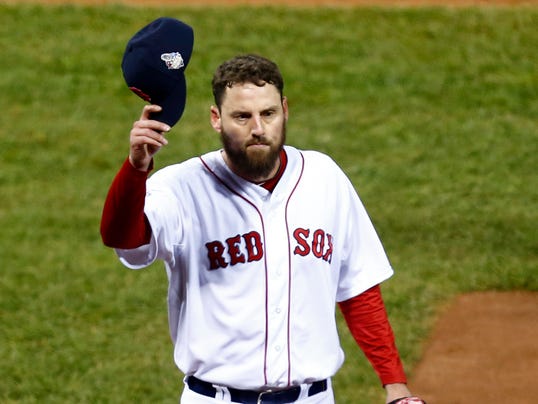
Last night the Boston Red Sox won their third World Series in the last ten years. It was the first time the home team fans had been able to witness the deciding game since 1918 (as the Fox announcers informed the presumably senile audience over and over and over again), and John Lackey was the pitching star for the home town team. The night was a love fest for Boston baseball fans, as they cheered every move of their frequently star-crossed and quirky team, and no Red Sox player was cheered more loudly than John Lackey, as he walked off the field for the final time in 2013 in the 7th inning, with his team safely ahead by five runs. They stood and applauded and chanted his name, as he moved deliberately to the Boston dugout, head down, grim, just like Ted on that gray day in 1960 when he hit homer number 521.
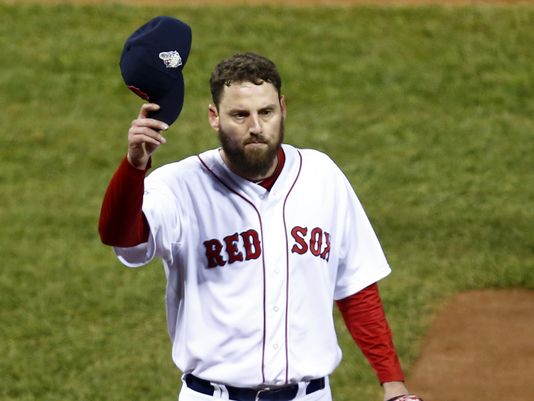
Then he tipped his cap.
It was a small thing, the smallest really, only a gesture and for most players, most of the time, an automatic one…except that it symbolized the ethical virtues of grace, forgiveness, gratitude, humility and fairness. This memorable, wonderful night for the Boston Red Sox and the grand old city it represents—my home town– was no time to let bitterness and resentment prevail. Unlike Ted Williams (who wouldn’t make his peace with Boston fans until years later, when he returned as an opposition manager), John Lackey found the strength and decency to let it go.
It was, as I said, a small thing. But it took character, and it was the right thing to do.
______________________________
Graphic: USA Today